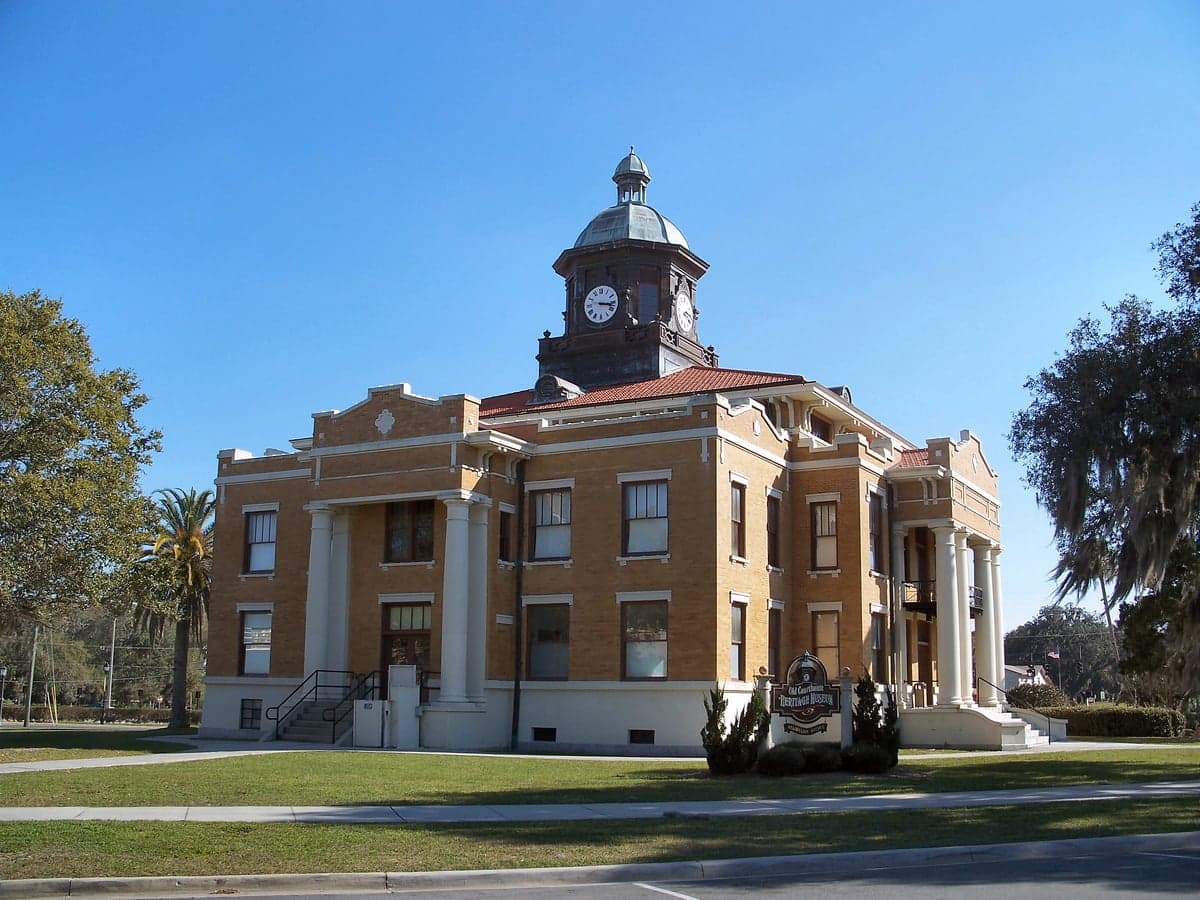
Photo: Wikipedia
Demographics of Citrus County
Affluence Level in Citrus County
A middle-class area roughly in line with national averages across income, home values, education, and employment.
People of Citrus County
Citrus County, Florida, is home to 158,693 residents who form one of the state's oldest and least diverse populations by origin. The county is overwhelmingly White (85.7%) and native-born (98.5% U.S.-born), with a median age well above the state average, giving it a character defined by long-term retirees, multi-generational Florida families, and a sparse but growing Hispanic minority (6.5%). Its distinctive identity markers include a heavy concentration of veterans, a strong rural and small-town ethos centered on communities like Crystal River and Inverness, and a population that has grown primarily through domestic in-migration rather than international immigration.
Settlement & growth (pre-1960)
Before American settlement, the area now known as Citrus County was inhabited by the Timucua people, who lived in small villages along the Crystal River and Homosassa River for thousands of years. The Crystal River Archaeological State Park preserves one of Florida's oldest continuously occupied Native sites, with burial mounds and ceremonial complexes dating back to 500 BCE. Spanish explorers, including Hernando de Soto's expedition in 1539, passed through the region, but no permanent European settlement occurred during the Spanish or British colonial periods. The area remained sparsely populated by Seminole bands and scattered frontier settlers until after the Second Seminole War (1835–1842) forcibly removed most Native inhabitants.
American settlement began in earnest in the 1840s and 1850s, when pioneers from Georgia, South Carolina, and Alabama—predominantly of Scots-Irish and English descent—moved into the interior of what was then Hernando County. These early settlers established small farming and cattle-ranching communities, with the first permanent settlement at Homosassa (founded 1840s) and later at Inverness (platted 1888). The primary industries were subsistence agriculture, timber, and cattle grazing on the open range. Citrus County was formally created in 1887 from portions of Hernando and Sumter counties, named for the citrus groves that early settlers planted along the rivers.
The arrival of the Florida Central and Peninsular Railroad in the 1880s transformed the county's settlement pattern. The railroad reached Inverness in 1888, making it the county seat and a shipping hub for citrus, lumber, and naval stores. Small towns sprang up along the rail line: Floral City, Lecanto, and Beverly Hills (the latter platted in the 1950s as a retirement subdivision). The railroad also brought a wave of African American laborers, mostly from the Deep South, who worked in the citrus groves, turpentine camps, and railroad maintenance. By 1900, Black residents made up roughly 15% of the county's population, concentrated in small communities like Pineola and the "south side" of Inverness.
The 1920s and 1930s saw a modest influx of Dust Bowl migrants from Oklahoma, Arkansas, and Texas—"Okies" and "Arkies"—who came for agricultural work in the citrus and vegetable fields. These families settled in rural pockets around Hernando and Holder, often living in labor camps or tenant shacks. The Great Depression hit the county hard, and population growth stalled until after World War II. The post-war boom brought the first significant wave of retirees from the Midwest and Northeast, drawn by the warm climate, low cost of living, and the newly constructed U.S. Highway 19 and 98 corridors. Crystal River, previously a small fishing village, began to develop as a retirement destination in the 1950s, with subdivisions like Kings Bay and Ozello attracting northerners seeking waterfront property.
Modern era (post-1965)
The 1965 Hart-Cellar Act had minimal direct impact on Citrus County, as the area never became a destination for post-1965 immigrant groups. The foreign-born population today is just 1.5%, among the lowest in Florida. Instead, the county's modern demographic story is one of domestic migration: retirees from the Rust Belt and Northeast, plus a smaller stream of younger families from other parts of Florida seeking cheaper land and a slower pace.
The most transformative event was the construction of the Withlacoochee State Trail and the expansion of the Suncoast Parkway (State Road 589) in the 2000s, which made the county more accessible to Tampa commuters and second-home buyers. Beverly Hills and Lecanto saw the fastest growth, with new subdivisions marketed to retirees from Ohio, Michigan, and New York. The Hispanic population grew from under 2% in 1990 to 6.5% today, driven primarily by Mexican and Central American workers in construction, landscaping, and agriculture, with small clusters in Homosassa Springs and Citrus Springs. The Black population, however, declined from its historical peak, falling to just 2.1% as younger Black residents left for urban job markets in Tampa and Orlando. East/Southeast Asian communities (1.2%) and Indian-subcontinent residents (0.2%) remain tiny, concentrated in professional roles in healthcare and education in Crystal River and Inverness.
The county's educational attainment remains low—only 20.4% of adults hold a bachelor's degree or higher—reflecting its blue-collar and retiree character. The economy is dominated by healthcare (with Citrus Memorial Hospital and several assisted-living facilities), retail, and construction, with a small but stable tourism sector centered on manatee-watching in Crystal River and fishing in Homosassa.
The future
Citrus County is projected to become slightly more diverse over the next 10–20 years, but the change will be gradual and driven by domestic migration rather than international immigration. The Hispanic share is expected to rise to 10–12% by 2040, as younger Hispanic families move in for affordable housing and construction jobs, particularly in Lecanto and Citrus Springs. The White share will likely decline to around 80%, but the county will remain one of Florida's least diverse. The Black population is unlikely to recover to historical levels, as the county lacks the urban job base to attract Black professionals or younger families. New residential development is concentrating along the Suncoast Parkway corridor, especially around Beverly Hills and Lecanto, where master-planned retirement communities and 55+ subdivisions are expanding. The cultural identity is evolving from a purely retiree haven to a more mixed-age community, as remote workers and Tampa commuters seek cheaper housing, but the county's political and social character remains solidly conservative and rural.
For someone moving in now, Citrus County offers a low-cost, low-stress environment with strong community ties and abundant natural amenities, but it comes with limited diversity, a thin job market for professionals, and a population that skews older and less educated than the state average. The county is becoming more connected to the Tampa Bay metro area, but it is unlikely to urbanize or diversify rapidly, making it best suited for those who value quiet, space, and a slower pace over cultural variety or career opportunity.

* Values derived from national, state, county, city and local statistics and may differ in a specific area. Last updated: 2026-09-29T09:19:26.000Z
Narrative content on this page is AI-generated and may contain mistakes. Verify any details that matter before acting on them.
ReloMaps may earn a commission from affiliate links at no extra cost to you.

