
Photo by Alex Reynolds on Unsplash
Demographics of Five Forks, SC
Affluence Level in Five Forks, SC
An upper-middle-class area. Household wealth, education levels, and homeownership run ahead of national benchmarks.
People of Five Forks, SC
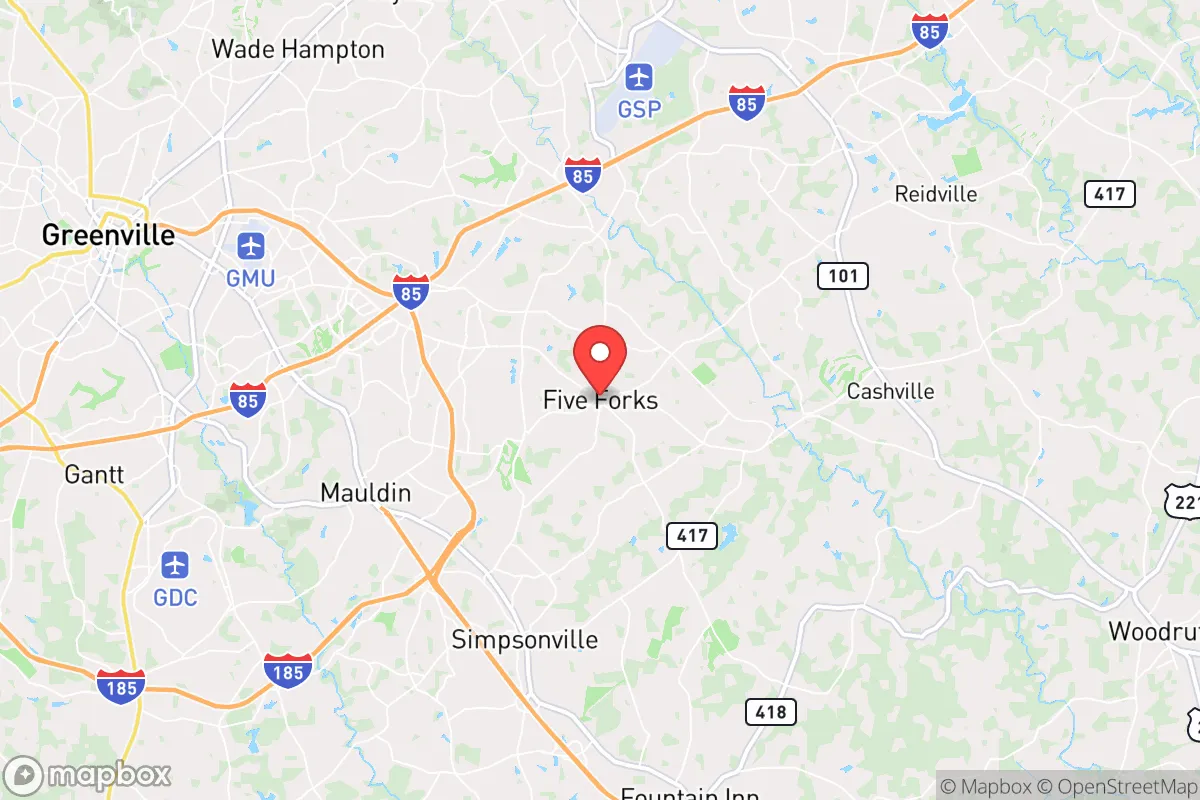
Today, Five Forks, South Carolina, is a rapidly growing, affluent Greenville suburb of roughly 19,093 residents, characterized by a highly educated population (64.7% college-educated) and a predominantly White (73.3%) demographic base. The city’s identity is shaped by its role as a family-oriented bedroom community, with a notably low foreign-born population (3.7%) and a population that is significantly more White and less diverse than Greenville County as a whole. Its residents are largely professionals and executives drawn by top-rated schools and new master-planned subdivisions, giving Five Forks a polished, homogeneous feel that sets it apart from the more urban and diverse core of Greenville.
How the city was settled and grew
Five Forks was not a historic town but a rural crossroads that began to transform in the late 20th century. The area’s original population consisted of small-scale farmers and mill workers, drawn by the region’s textile industry and the post-Civil War expansion of the railroad through the Greenville-Spartanburg corridor. The first significant wave of settlement came in the 1800s with Scots-Irish and English families who established small homesteads along the roads that converged at the “five forks” intersection. These early residents built the foundations of what would later become neighborhoods like Old Spartanburg Road and the Five Forks Historic District, where a few antebellum homes and churches still stand. For most of the 20th century, the area remained sparsely populated, with the population hovering under 1,000 as late as 1970, as the local economy remained tied to agriculture and the nearby textile mills in Simpsonville and Mauldin.
Modern era (post-1965)
The modern transformation of Five Forks began in earnest after 1990, driven by the expansion of Greenville’s corporate economy and the construction of Interstate 85. The Hart-Cellar Act of 1965 had little direct impact here; instead, the primary demographic driver was domestic in-migration of White professionals from the Northeast and Midwest, attracted by lower taxes, good schools, and the booming automotive and manufacturing sectors in the Upstate. This wave settled overwhelmingly in new master-planned subdivisions, most notably Falcon Ridge, Ashford Chase, and Chanticleer, which were built from the late 1990s onward on former farmland. The population exploded from roughly 2,500 in 1990 to over 19,000 today. The Asian (East/Southeast Asian) population stands at 2.9%, and the Indian subcontinent population at 3.3%, reflecting a modest but notable presence of professionals in the tech and engineering sectors, concentrated in newer developments like Hampton Ridge and Summer Trace. The Black population (8.4%) and Hispanic population (6.9%) are present but remain below county averages, with most Black and Hispanic residents living in older, more affordable pockets near the Simpsonville border, such as the Five Forks Station area. The city’s racial and ethnic makeup has remained relatively stable over the past decade, with White population share declining only slightly as new subdivisions have attracted a broader mix of buyers.
The future
The population of Five Forks is projected to continue growing, driven by ongoing residential development and the expansion of Greenville’s economy. The city is likely to become slightly more diverse, but the pace of change will be slow. The foreign-born population (3.7%) is expected to rise modestly as more professionals from the Indian subcontinent and East/Southeast Asia are recruited by local employers like Michelin, BMW, and Prisma Health, but Five Forks will remain a predominantly White, native-born suburb. The city is not tribalizing into distinct ethnic enclaves; rather, new residents of all backgrounds are integrating into the same master-planned subdivisions, though the high cost of housing (median home values above $500,000) will limit in-migration from lower-income groups. The next 10-20 years will likely see Five Forks become an even more established, affluent suburb, with a population that is slightly more diverse but still overwhelmingly White and college-educated.
For someone moving in now, Five Forks offers a stable, family-oriented environment with excellent schools and low crime, but it is not a place of rapid demographic change or cultural diversity. It is becoming a classic Sun Belt success story: a homogeneous, high-amenity suburb that attracts those seeking a predictable, safe, and prosperous community. The city’s future is one of steady, managed growth, not transformation.

* Values derived from national, state, county, city and local statistics and may differ in a specific area. Last updated: 2026-04-23T04:01:08.000Z
Narrative content on this page is AI-generated and may contain mistakes. Verify any details that matter before acting on them.
ReloMaps may earn a commission from affiliate links at no extra cost to you.

