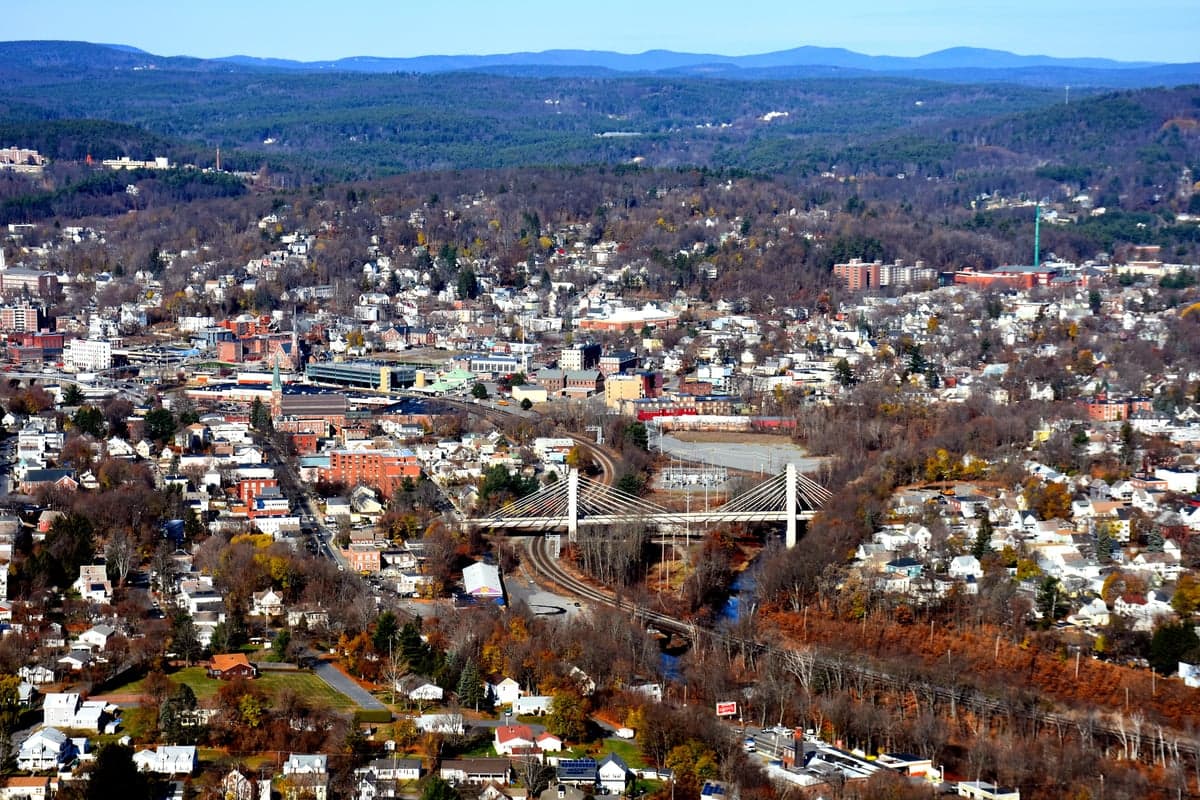
Photo: Wikipedia
Personal Sovereignty in Fitchburg, MA
Moderate friction. Expect trade-offs in some aspect of personal liberty and independence.
What does Personal Sovereignty tell us?
Personal Sovereignty measures your capacity for self-reliance and independence with minimal government friction. Higher scores mean fewer barriers between you and the way you want to live... but it assumes you have the space you need and good neighbors.
What does this tell us?
Personal Sovereignty measures your capacity for self-reliance and independence with minimal government friction. Higher scores mean fewer barriers between you and the way you want to live... but it assumes you have the space you need and good neighbors.
State Policy
Energy independence: Importer (5% of energy produced in-state)
Personal Liberty
Homesteading

Personal Liberty Analysis
Fitchburg, Massachusetts presents a mixed picture for those prioritizing personal sovereignty, with the city’s gritty, working-class character offering some practical advantages while the state’s heavy regulatory hand imposes significant constraints. For a conservative-leaning individual or family focused on self-reliance and minimizing government overreach, Fitchburg’s lower cost of land and relative distance from Boston’s political orbit provide breathing room, but the Commonwealth’s aggressive tax structure, restrictive gun laws, and expansive public health mandates create a ceiling on true autonomy. The city’s aging infrastructure and struggling economy mean fewer intrusive development pressures, but the trade-off is a constant battle against state-level policies that erode personal freedoms. Overall, Fitchburg offers a foothold for those willing to navigate a hostile legal environment, but it is not a sanctuary for liberty-minded residents seeking minimal government interference.
Tax burden and regulatory posture in Fitchburg compared to other Massachusetts cities
Massachusetts imposes one of the highest combined state and local tax burdens in the nation, and Fitchburg residents feel this acutely. The state’s flat income tax rate of 5.0% (with a surtax on incomes over $1 million passed in 2022) is paired with a sales tax of 6.25% and property taxes that, while lower than Boston’s, still average around $3,500 annually on a median home value of roughly $280,000. Fitchburg’s property tax rate is about $16.50 per $1,000 of assessed value, which is moderate by state standards but high nationally. The regulatory environment is equally burdensome: Massachusetts has some of the strictest environmental and building codes in the country, including Title 5 septic regulations that can cost tens of thousands to upgrade, and a state building code that mandates energy-efficiency standards far beyond federal requirements. For a prepper or homesteader, this means any construction—whether a new home, a workshop, or a greenhouse—requires navigating a thicket of permits, inspections, and fees. The state’s MassSave program mandates energy audits and insulation upgrades for many home sales, adding costs and bureaucratic hurdles. Fitchburg’s city government, while less aggressive than Boston’s, still enforces zoning codes that limit accessory dwelling units and require minimum lot sizes of 10,000 to 20,000 square feet in most residential zones, constraining the ability to build self-sufficient compounds.
Self-defense rights and gun law specifics in Fitchburg and Massachusetts
For those prioritizing the right to keep and bear arms, Massachusetts is one of the most restrictive states in the country, and Fitchburg offers no local relief. The state requires a License to Carry (LTC) for both open and concealed carry, which is issued by local police chiefs with significant discretion. In Fitchburg, the police department has historically been moderate in issuing LTCs, but applicants must still complete a state-approved firearms safety course, pass a background check, and provide references. The process can take 6-12 months, and the chief can deny an application for “suitability” reasons—a vague standard that has been used to deny licenses to individuals with minor infractions or even political activism. Massachusetts bans “assault weapons” by name and feature, including AR-15s and many semi-automatic rifles, and magazines are limited to 10 rounds. The state also has a strict “safe storage” law requiring firearms to be locked in a container or with a trigger lock when not in use, which can be a liability for those who want quick access for home defense. Ammunition purchases require a separate permit, and online sales are effectively banned. For a survivalist, this means building a meaningful arsenal is legally impossible, and any defensive plan must account for the risk of prosecution for using a firearm in self-defense, even in a home invasion. Fitchburg’s crime rate, which is above the state average, makes this restriction particularly galling for residents who want to protect their families.
Self-reliance and homesteading viability in Fitchburg’s zoning and land-use landscape
Fitchburg offers some of the most affordable land in eastern Massachusetts, with vacant lots available for under $50,000 and larger parcels (1-5 acres) in the $100,000-$200,000 range. This makes it one of the few places within commuting distance of Boston where a family can realistically pursue a homesteading lifestyle. However, zoning is a major obstacle. Most residential zones require minimum lot sizes of 10,000 square feet, and keeping livestock like chickens or goats is restricted to lots of at least 1 acre, with a limit of 6 hens and no roosters. Pigs and cattle are prohibited in most residential areas. The city’s zoning board must approve any “agricultural use” on parcels under 5 acres, and the process is subject to neighbor input and public hearings. Off-grid living is effectively illegal: Massachusetts requires connection to the municipal water and sewer system where available, and solar panels must be grid-tied unless you obtain a special exemption. Rainwater collection is allowed but limited to 250 gallons per property, and composting toilets are not permitted in homes with sewer access. For a prepper seeking true self-reliance, these restrictions mean that Fitchburg is more of a “suburban homestead” than a rural off-grid haven. The city’s industrial past has left some areas with soil contamination from old mills, so soil testing is essential before planting food gardens. On the positive side, the city’s community garden program offers plots for $25 per year, and the local farmers’ market operates from June to October, providing some food security options.
Personal liberties in Fitchburg: parental rights, medical autonomy, and property protections
Massachusetts has some of the most expansive state-level mandates in the country when it comes to personal liberties, and Fitchburg residents are subject to them all. On parental rights, the state’s comprehensive sex education law (Chapter 71, Section 32A) requires schools to teach LGBTQ-inclusive curriculum, and parents cannot opt their children out of specific lessons—only the entire health program. The state also mandates that schools allow students to use their chosen name and pronouns without parental notification, a policy that has sparked legal battles. For medical autonomy, Massachusetts imposed one of the nation’s strictest COVID-19 vaccine mandates, including for school attendance, and the state’s public health emergency powers allow the governor to issue binding orders without legislative approval. The state also has a “right to shelter” law that guarantees housing for homeless families, which has strained local resources and led to increased property taxes. On property rights, Massachusetts has strong eminent domain powers, and Fitchburg has used them to acquire land for redevelopment projects, including the recent Fitchburg State University expansion. The state’s rent control ban was repealed in 2024, allowing cities to impose rent stabilization, though Fitchburg has not yet done so. For speech, Massachusetts has some of the nation’s strictest campaign finance laws and a “hate speech” statute that has been used to prosecute online comments. The state’s gun-free school zones extend to public parks and libraries, limiting where armed citizens can carry. Overall, Fitchburg offers little refuge from state-level overreach, and residents must be prepared to fight for their rights in court or at the ballot box.
In the broader context of personal sovereignty, Fitchburg ranks as a middle-ground option within Massachusetts but a poor one nationally. Compared to states like New Hampshire or Texas, where gun laws are permissive, taxes are lower, and zoning is more flexible, Fitchburg’s regulatory burden is heavy. However, within the Bay State, its lower land costs and less aggressive local enforcement make it a more viable option than Boston or Cambridge for those seeking to carve out a self-reliant lifestyle. The city’s blue-collar resilience and community networks offer some buffer against state mandates, but anyone moving here should be prepared for constant vigilance against government overreach. For a survivalist or prepper, Fitchburg is a compromise—a place to build a base of operations while fighting for broader freedoms, but not a final destination for those seeking true autonomy.

* Values derived from national, state, county, city and local statistics and may differ in a specific area. Last updated: 2026-05-01T11:11:37.000Z
Narrative content on this page is AI-generated and may contain mistakes. Verify any details that matter before acting on them.
ReloMaps may earn a commission from affiliate links at no extra cost to you.

