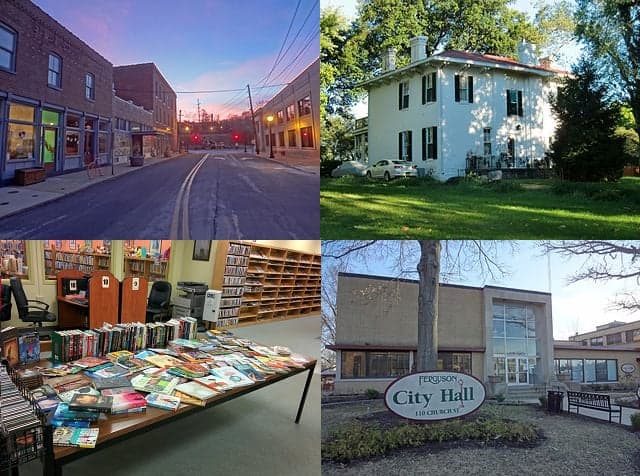
Photo: Wikipedia
Demographics of Ferguson, MO
Affluence Level in Ferguson, MO
A low-income area with significant economic hardship. Household wealth and educational attainment are well below national averages.
People of Ferguson, MO
The people of Ferguson, Missouri, today number roughly 18,350, making it a densely settled inner-ring suburb of St. Louis with a distinctive character shaped by rapid demographic change. The city is overwhelmingly Black (69.7%) with a White population of 25.4%, a tiny Hispanic share of 1.5%, and a foreign-born population of just 0.2% — one of the lowest in the metro area. College-educated adults make up 21.7% of residents, reflecting a working-to-middle-class profile that is notably less affluent than nearby suburbs like Clayton or Kirkwood. Ferguson’s identity is defined by its role as a historic railroad and manufacturing hub that underwent a dramatic racial transition in the late 20th century, leaving a population that is now heavily African American, native-born, and rooted in the region’s industrial past.
How the city was settled and grew
Ferguson was founded in 1855 as a stop on the Missouri Pacific Railroad, named after William B. Ferguson, a railroad official who donated land for a depot. The city’s early growth was driven by German and Irish immigrants who arrived in the 1860s–1880s to work on the railroad and in nearby clay mines and brickworks. These groups settled in what is now the Old Ferguson neighborhood, centered around the historic downtown along Florissant Road, and in the Ferguson Station area near the original depot. By the early 1900s, the population remained small — under 1,000 — but expanded steadily as streetcar lines connected the suburb to St. Louis. A second wave of European immigrants, including Italians and Eastern Europeans, arrived between 1900 and 1930, settling in the North Ferguson district near the railroad yards and along Elizabeth Avenue. The city incorporated in 1894 and grew to about 11,000 by 1950, remaining overwhelmingly White (over 99%) through the mid-20th century, with a small Black population concentrated in the South Road area near the city’s southern edge.
Modern era (post-1965)
The post-1965 era brought the most dramatic shift in Ferguson’s population history. Following the Hart-Cellar Act and the Fair Housing Act of 1968, Black families began moving north from the city of St. Louis into inner-ring suburbs like Ferguson, seeking better housing and schools. This movement accelerated in the 1970s and 1980s as White families departed for farther-out suburbs in St. Charles and Jefferson counties — a pattern of white flight common across north St. Louis County. By 1990, Ferguson’s Black population had risen to roughly 25%, and by 2000 it reached 52%, making it a majority-Black suburb for the first time. The Canfield Green apartment complex, built in the 1970s off West Florissant Avenue, became a key landing point for Black families moving in from the city, as did the Forestwood subdivision near I-270. The Hispanic population remained negligible throughout this period (under 2%), and the Asian and Indian populations were essentially zero — a pattern that persists today. The 2014 unrest following Michael Brown’s death accelerated a second wave of White departure, with the White share dropping from 29% in 2010 to 25.4% in 2024. Today, the Black population is concentrated across most of the city, with the highest densities in the West Florissant Avenue corridor and the Canfield Green area, while the remaining White population is clustered in the Old Ferguson historic district and along the city’s western edge near the border with Florissant.
The future
Ferguson’s population is likely to continue its trajectory toward greater racial homogeneity, with the Black share potentially reaching 75–80% by 2035 if current trends hold. The foreign-born population is virtually nonexistent (0.2%), and there is no evidence of significant immigrant inflows from any region — Hispanic, Asian, or Indian communities remain negligible and are unlikely to grow substantially given the city’s limited economic pull and housing stock. The city is not tribalizing into distinct ethnic enclaves but rather homogenizing as a predominantly Black, native-born suburb. The remaining White population is aging and concentrated in a few historic pockets, and younger White families are not moving in at replacement rates. For a conservative-leaning individual or family considering relocation, Ferguson offers a stable, majority-Black community with deep local roots but limited ethnic diversity and a shrinking tax base. The city’s future depends on whether it can attract new residents — of any background — to reverse population decline (down from 21,000 in 2010) and stabilize its schools and municipal finances.
In sum, Ferguson is becoming a more uniformly Black, native-born suburb with little immigration and a declining White population — a place whose demographic story is one of rapid racial transition followed by stagnation. For someone moving in now, the city offers affordable housing and proximity to St. Louis, but the population trends suggest a community that is consolidating rather than diversifying, with limited demographic dynamism on the horizon.

* Values derived from national, state, county, city and local statistics and may differ in a specific area. Last updated: 2026-04-21T10:43:02.000Z
Narrative content on this page is AI-generated and may contain mistakes. Verify any details that matter before acting on them.
ReloMaps may earn a commission from affiliate links at no extra cost to you.

