Photo: Wikipedia
Demographics of Fayetteville, NC
Affluence Level in Fayetteville, NC
A below-average socioeconomic profile. Incomes, home values, and educational attainment trail the U.S., with higher poverty and unemployment.
People of Fayetteville, NC
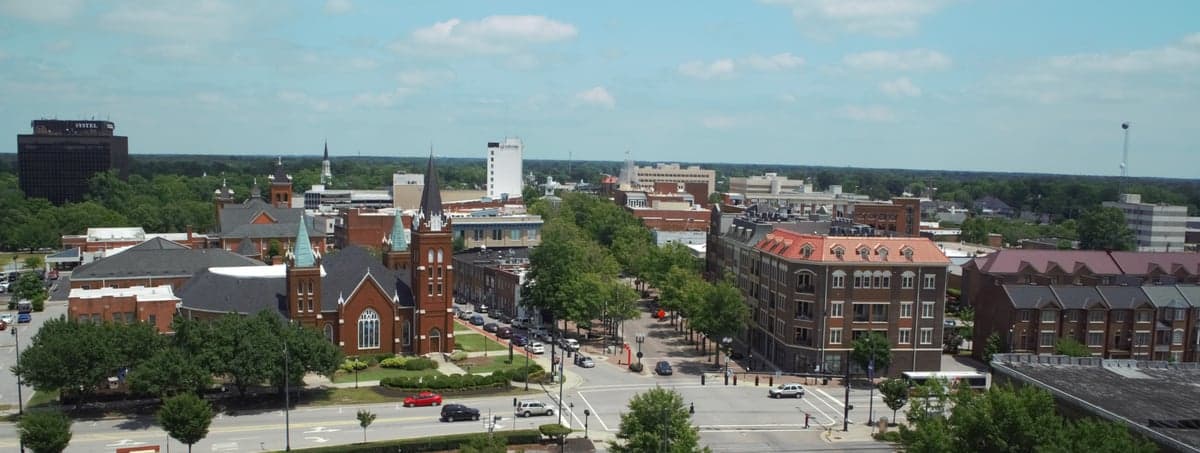
The people of Fayetteville, North Carolina, today number 209,692, forming a city defined by its deep military ties, a majority-Black population (41.0%), and a growing Hispanic community (13.0%). The city is notably less diverse in foreign-born residents than the national average, with only 3.4% born abroad, and its college-educated share sits at 28.6%. Fayetteville’s identity is overwhelmingly shaped by Fort Liberty (formerly Fort Bragg), making it a transient, patriotic, and economically military-dependent city where civilian and service member populations blend in distinct neighborhoods.
How the city was settled and grew
Fayetteville was founded in 1762 as a trading post on the Cape Fear River, named after the Marquis de Lafayette. Its early population was a mix of Scottish Highlanders, English, and German settlers drawn by fertile land and the river’s access to the port of Wilmington. By the early 19th century, the city became a center for cotton and naval stores, with enslaved African Americans forming a significant portion of the labor force. After the Civil War, freedmen established communities like Haymount, a historic Black neighborhood that remains a cultural anchor today, and Murchison Road, which became a corridor for Black-owned businesses and churches. The city’s first major demographic shift came in 1918 with the establishment of Camp Bragg (later Fort Bragg), which drew thousands of soldiers and civilian workers from across the country. By mid-century, Fayetteville’s population was roughly half white and half Black, with a small but established Jewish community centered around the Downtown area.
Modern era (post-1965)
The post-1965 era brought two major demographic forces: the expansion of Fort Bragg during the Cold War and the suburbanization of white families. The 1965 Hart-Cellar Act had minimal direct impact on Fayetteville’s foreign-born population (still only 3.4% today), but the base’s growth attracted a steady stream of domestic migrants, particularly from the South and Midwest. White families increasingly moved to newer subdivisions in West Fayetteville and Jack Britt areas, while Black families remained concentrated in Haymount, Murchison Road, and the College Lakes neighborhood. The 1990s and 2000s saw a notable influx of Hispanic residents, mostly from Mexico and Central America, drawn by construction and service jobs tied to the base. They settled primarily in Spring Lake (a town adjacent to Fayetteville) and the Ramsey Street corridor. The Asian population, at 2.4%, is largely East and Southeast Asian (Filipino, Vietnamese, Korean), reflecting military marriages and base-related employment, with clusters near the Fort Liberty gates. The Indian subcontinent population is a separate, smaller group at 0.6%, concentrated in professional and medical fields near Cape Fear Valley Medical Center.
The future
Fayetteville’s population is trending toward greater racial and ethnic diversity, but the city remains highly segregated by neighborhood and income. The white share has declined from over 50% in 1990 to 34.8% today, while the Hispanic share has grown steadily. The Black population, at 41.0%, is stable but aging, with younger Black families moving to suburbs like Hope Mills and Raeford. The foreign-born share is unlikely to rise dramatically given the city’s lack of a large immigrant-service infrastructure or gateway-city status. Instead, future growth will likely come from domestic migration tied to Fort Liberty’s mission and from natural increase among Hispanic families. The city is not homogenizing; rather, it is tribalizing into distinct enclaves: military families near the base, Black families in historic neighborhoods and southern suburbs, white families in the west, and Hispanic families along the Ramsey Street corridor. For a newcomer, Fayetteville offers a patriotic, family-oriented environment with a strong military culture, but the city’s economic and social life is heavily dependent on federal defense spending.
Fayetteville is becoming a more diverse but more spatially divided city, where military affiliation often matters more than race in daily life. For someone moving in now, the key decision is which neighborhood aligns with their lifestyle—whether near the base for convenience, in the historic Black communities for cultural roots, or in the western suburbs for newer schools and amenities. The city’s future is tied to Fort Liberty’s stability, and its population will remain transient, patriotic, and grounded in service.

* Values derived from national, state, county, city and local statistics and may differ in a specific area. Last updated: 2026-04-21T19:18:20.000Z
Narrative content on this page is AI-generated and may contain mistakes. Verify any details that matter before acting on them.
ReloMaps may earn a commission from affiliate links at no extra cost to you.

