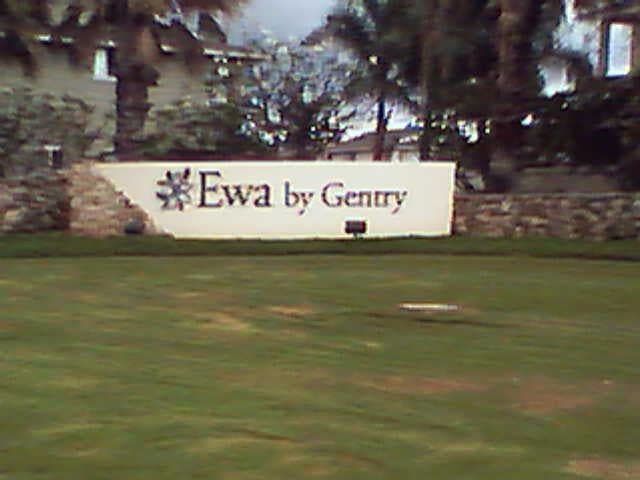
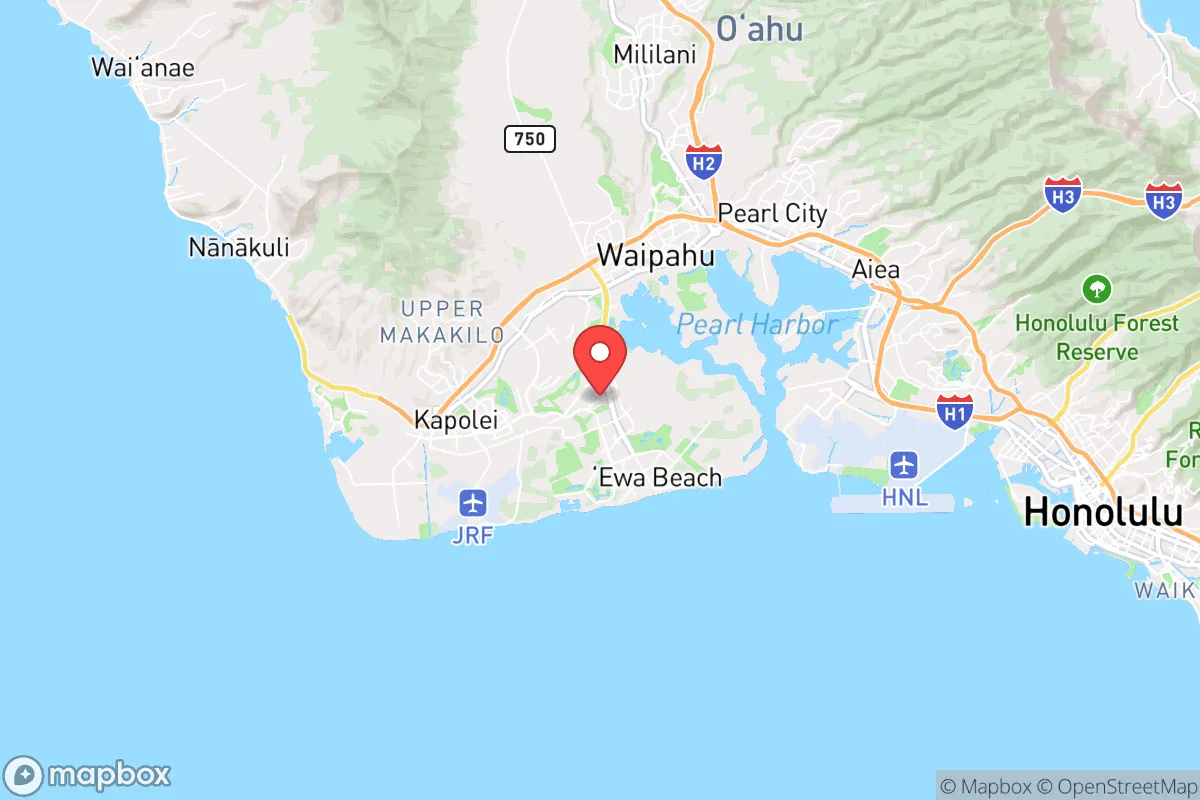
Photo: Wikipedia
Demographics of Ewa Gentry, HI
Affluence Level in Ewa Gentry, HI
An upper-middle-class area. Household wealth, education levels, and homeownership run ahead of national benchmarks.
People of Ewa Gentry, HI
Today, Ewa Gentry is a predominantly Asian and Pacific Islander community of 26,738 residents, with East and Southeast Asian groups (45.3%) forming the largest single demographic bloc, followed by Hispanic residents (14.4%) and a small White population (9.8%). The city is a master-planned suburban enclave on Oahu's leeward coast, characterized by its relatively young median age, high share of military-affiliated families, and a distinctly family-oriented, middle-class identity. Only 5.2% of residents are foreign-born, reflecting a population that is largely multi-generational American, with deep roots in Hawaii's plantation and military history.
How the city was settled and grew
Ewa Gentry did not exist as a settlement until the late 20th century. The area now comprising the city was historically part of the vast Ewa Plain, a region of sugarcane and pineapple plantations that drew waves of immigrant laborers from the 1870s through the 1920s. The original plantation camps—such as Ewa Villages and Varona Village—housed Japanese, Filipino, Chinese, and Portuguese workers who cleared and worked the fields. These camps were ethnically segregated by design, with distinct neighborhoods for each group: Filipino Camp and Japanese Camp were literal place names. The descendants of these plantation laborers form the core of today's Asian and mixed-race population in Ewa Gentry, though the physical camps themselves were largely demolished or redeveloped by the 1990s. The city's name itself—"Gentry"—comes from the Gentry family, a major landholding clan that transitioned the area from agriculture to residential development beginning in the 1980s.
Modern era (post-1965)
The modern Ewa Gentry population is a product of two post-1965 forces: the end of plantation agriculture and the expansion of military housing. After the 1965 Hart-Cellar Act reshaped U.S. immigration, Hawaii saw a new wave of Filipino and Korean immigration, but Ewa Gentry itself was not built until the 1990s and 2000s. The city's growth exploded after 2000, driven by the construction of Hoakalei and Ocean Pointe—two master-planned subdivisions that attracted military families from nearby Joint Base Pearl Harbor-Hickam and civilian professionals priced out of Honolulu. The Asian plurality (45.3%) reflects a mix of long-established Japanese and Chinese families from the plantation era, plus newer Filipino and Korean arrivals. The Hispanic share (14.4%) is notably higher than in most Oahu suburbs, driven by a growing Puerto Rican and Central American presence tied to military service and construction work. The Black population (3.3%) is also disproportionately military-affiliated, concentrated in rental neighborhoods near the base. White residents (9.8%) are largely military retirees and professionals, clustered in the newer, higher-priced sections of Ewa Gentry's gated communities like those off Kapolei Parkway.
The future
Ewa Gentry's population is trending toward greater ethnic diversity but also economic stratification. The Asian plurality is projected to remain stable, as Filipino and Japanese families continue to move in from older Honolulu neighborhoods, while the White share is slowly declining as housing prices push out non-military retirees. The Hispanic and Black shares are likely to grow modestly, driven by military transfers and service-sector employment in nearby Kapolei. The city is not tribalizing into distinct ethnic enclaves—most neighborhoods are mixed—but economic divides are sharpening: Ocean Pointe and Hoakalei are increasingly affluent and Asian-majority, while older sections near Ewa Gentry's central park are more diverse and middle-income. The foreign-born share (5.2%) is low and likely to remain so, as most growth comes from domestic migration within Hawaii and the U.S. mainland. The next decade will see continued infill development and a gradual aging of the population, though the military presence keeps the median age young.
For a conservative-leaning individual or family considering relocation, Ewa Gentry offers a stable, family-oriented suburb with strong Asian cultural influences, low crime, and excellent schools—but at a high cost of living and with limited rental options. The population is becoming more economically stratified but remains ethnically integrated, with no single group dominating. The city's future is one of slow, managed growth, shaped more by military and professional in-migration than by immigration or natural increase.

* Values derived from national, state, county, city and local statistics and may differ in a specific area. Last updated: 2026-04-24T13:43:31.000Z
Narrative content on this page is AI-generated and may contain mistakes. Verify any details that matter before acting on them.
ReloMaps may earn a commission from affiliate links at no extra cost to you.

