Photo: Wikipedia
Demographics of Espanola, NM
Affluence Level in Espanola, NM
A below-average socioeconomic profile. Incomes, home values, and educational attainment trail the U.S., with higher poverty and unemployment.
People of Espanola, NM
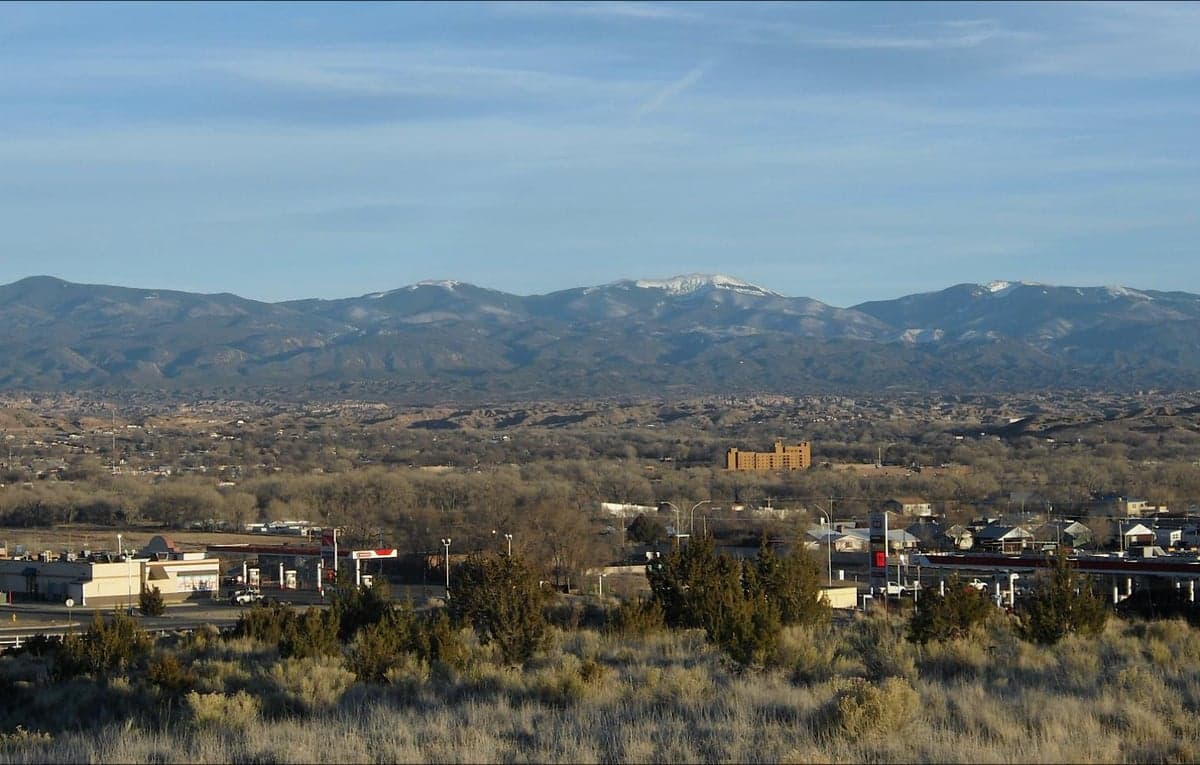
Espanola, New Mexico, is a small city of 10,472 residents with a deeply rooted, predominantly Hispanic identity—81.7% of the population identifies as Hispanic, while non-Hispanic whites make up just 10.9%. The city is characterized by a dense, family-oriented feel, with a median age around 35 and a college attainment rate of 18.4%, reflecting a working-class community with strong ties to the surrounding Rio Arriba County. Its people are defined by centuries of Spanish and Mexican heritage, a legacy of land grant settlements, and a modern population that is relatively stable but aging, with a foreign-born share of 10.9% that is almost entirely from Latin America.
How the city was settled and grew
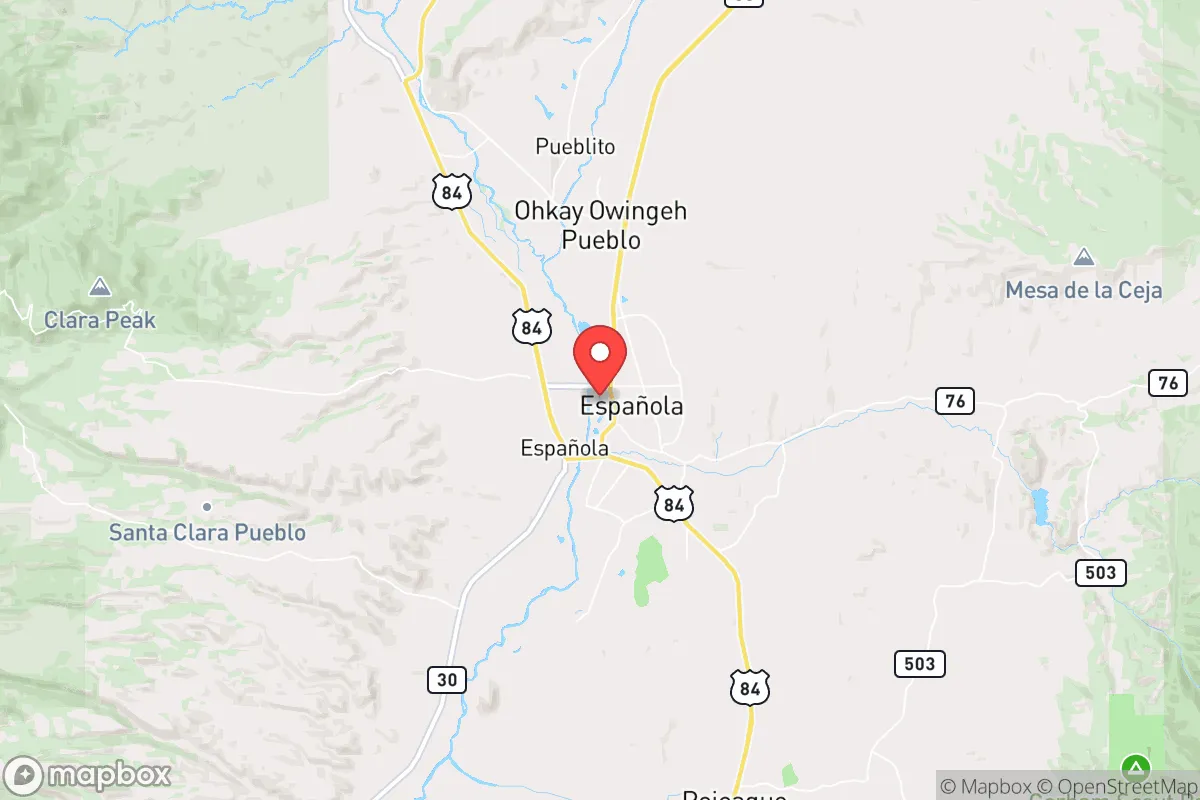
Espanola’s human history begins not with a single founding event but as a slow accretion of Spanish colonial settlements along the Rio Grande and its tributaries. The area was part of the 1743 San Juan de los Caballeros land grant, one of the oldest Spanish land grants in New Mexico, which drew families from Mexico and Spain seeking agricultural land and religious community. The original settlers were Spanish colonists, often of mixed Indigenous and European ancestry (mestizo), who established small farming villages like Santa Clara Pueblo (a Tewa-speaking pueblo that predates Spanish arrival) and the historic district of San Juan Pueblo (now Ohkay Owingeh), just north of modern Espanola. These communities were built around acequia irrigation systems and Catholic missions, with the Plaza de Española emerging as a trading hub in the late 19th century when the Denver and Rio Grande Railroad arrived in 1880. The railroad brought a wave of Anglo-American merchants, railroad workers, and a small number of Chinese laborers, but the Hispanic population remained overwhelmingly dominant. By the early 20th century, the neighborhoods of Fairview and El Llano developed as residential areas for Hispanic families working in agriculture, small-scale mining, and the railroad, while the Chimayó district (technically a separate census-designated place but closely tied to Espanola) became known for its weaving and religious pilgrimage traditions.
Modern era (post-1965)
After the 1965 Immigration and Nationality Act, Espanola saw little of the large-scale immigration from Asia or Africa that reshaped other U.S. cities. Instead, the city experienced continued in-migration from rural Hispanic communities in northern New Mexico and southern Colorado, as well as a steady but modest flow of immigrants from Mexico—the foreign-born share of 10.9% is almost entirely Mexican-born. The Los Alamos National Laboratory, about 25 miles southeast, became a major employer starting in the 1940s, drawing some Anglo scientists and engineers to the region, but most settled in Los Alamos or White Rock rather than Espanola. Within the city, the Southside neighborhood (south of the Rio Grande) saw new subdivisions built in the 1970s and 1980s, attracting younger Hispanic families and some Anglo retirees. The Northside area, closer to the historic plaza, retained its older Hispanic character, with multigenerational homes and a slower pace of change. The Black population remains tiny at 1.5%, and East/Southeast Asian communities (1.0%) are mostly professionals connected to Los Alamos or the Santa Fe area. The Indian subcontinent population is effectively zero. The city’s racial and ethnic composition has remained remarkably stable: Hispanic share has hovered around 80-85% since the 1990s, with whites declining slightly as older Anglo residents move to larger cities or pass away.
The future
Espanola’s population is heading toward slow decline or stagnation, with a projected loss of about 2-3% per decade as younger residents leave for jobs in Albuquerque, Santa Fe, or Denver. The Hispanic population is homogenizing—there is little new immigration from Mexico, and the foreign-born share is likely to plateau or drop as older immigrants age and their U.S.-born children identify as Hispanic but not immigrant. The city is not tribalizing into distinct ethnic enclaves; rather, it is consolidating as a predominantly Hispanic, working-class community with a small Anglo minority concentrated in newer subdivisions like El Valle (a small development near the river) and a handful of gated communities. The East/Southeast Asian and Black populations are too small to form distinct neighborhoods and are scattered across the city. The biggest demographic shift may be an aging population: the median age is rising as young adults leave, and the city could see a growing share of retirees, both Hispanic and Anglo, drawn by low housing costs and proximity to Santa Fe’s healthcare facilities.
For someone moving in now, Espanola is becoming a quieter, older, and more culturally homogeneous place—a city where Hispanic heritage is not just a demographic fact but the defining social fabric. New residents, especially those from outside the region, will find a community that is welcoming but insular, with strong family networks and a slower pace of life. The city offers affordability and a deep sense of place, but limited economic opportunity and a population that is not growing or diversifying significantly. It is a good fit for those seeking a low-cost, culturally rooted environment, but less so for those looking for rapid change or a melting-pot dynamic.

* Values derived from national, state, county, city and local statistics and may differ in a specific area. Last updated: 2026-05-01T07:07:48.000Z
Narrative content on this page is AI-generated and may contain mistakes. Verify any details that matter before acting on them.
ReloMaps may earn a commission from affiliate links at no extra cost to you.

