Photo: Wikipedia
Demographics of Elgin, TX
Affluence Level in Elgin, TX
A middle-class area roughly in line with national averages across income, home values, education, and employment.
People of Elgin, TX
The people of Elgin, Texas today form a majority-minority community of roughly 11,000 residents, defined by a Hispanic plurality (44.1%), a significant Black population (19.2%), and a White population of 31.5%. With only 8.1% foreign-born and a college attainment rate of 22.5%, Elgin is a working-class, native-born city where family ties and local industry—not immigration—drive the demographic character. Its identity is distinctly Texan, shaped by railroad-era settlement, agricultural labor, and recent suburban spillover from the Austin metro.
How the city was settled and grew
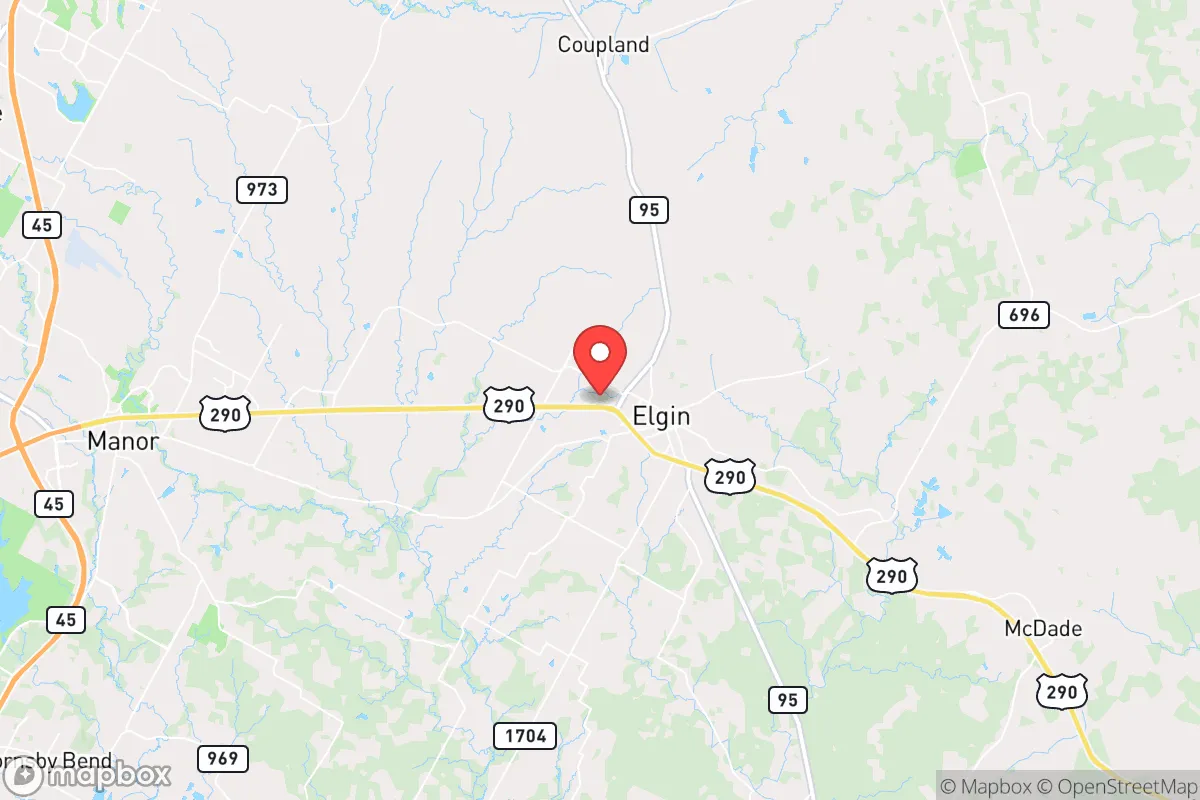
Elgin was founded in 1872 as a railroad stop on the Houston and Texas Central Railway, drawing its first wave of settlers from the American South and Midwest. The city’s original core, Historic Downtown Elgin, was built by Anglo merchants and railroad workers who established the brick storefronts and cotton warehouses that still line Central Avenue. By the 1880s, the arrival of the International-Great Northern Railroad spurred a second wave: German and Czech farmers who settled the surrounding rural areas and built the North Main Street corridor, where their descendants still operate family farms. The third major wave came during the early 20th century, when Black families moved from East Texas cotton plantations to work in Elgin’s brick yards and cotton gins. They established the Booker T. Washington neighborhood (south of U.S. 290), a historically Black enclave that remains the heart of the city’s African American community, anchored by the Booker T. Washington School and the St. James Baptist Church. Mexican and Mexican American laborers arrived in the 1910s and 1920s, drawn by railroad maintenance and agricultural work, settling in the Southside district along Depot Street, where Spanish-language businesses and Catholic parish life took root. By 1950, Elgin’s population was roughly 60% White, 25% Black, and 15% Hispanic, with a rigidly segregated housing pattern that persisted through the Jim Crow era.
Modern era (post-1965)
The post-1965 period brought two major shifts. First, the Immigration and Nationality Act of 1965 had a muted effect on Elgin: the foreign-born share today is only 8.1%, and the city’s Hispanic growth came primarily from native-born Mexican Americans moving from rural Texas counties, not from new immigration. Second, the expansion of the Austin metropolitan area after 1990 began pushing commuters east along U.S. 290. This domestic in-migration—mostly White and Hispanic families seeking cheaper housing—filled new subdivisions like the Elgin Estates (north of downtown) and the Villages of Elgin (off Highway 95). These neighborhoods are predominantly White and Hispanic, with homeownership rates above 70%. Meanwhile, the historic Black population has held steady but not grown: the Booker T. Washington neighborhood remains the core, but younger Black families have begun moving to newer subdivisions like the Cedar Creek area (southeast of town), where larger lots and newer homes are available. The Asian population (East/Southeast Asian) is negligible at 0.2%, and the Indian-subcontinent population is 0.0%, reflecting Elgin’s lack of tech-sector or professional-service jobs that attract those groups to other Austin suburbs.
The future
Elgin’s population is heading toward greater Hispanic plurality and slow overall growth. The Hispanic share (44.1%) is rising through higher birth rates and continued domestic migration from the Rio Grande Valley and San Antonio, while the White share (31.5%) is declining as older Anglo residents age out and younger White families choose closer-in suburbs like Kyle or Buda. The Black population (19.2%) is stable but not growing, with outmigration to larger cities partially offset by new arrivals from Houston’s Third Ward. The city is not tribalizing into distinct enclaves—newer subdivisions are more integrated than the historic neighborhoods—but the Booker T. Washington and Southside districts remain culturally distinct. Over the next 10–20 years, Elgin will likely become a 50%+ Hispanic city, with a smaller but stable Black community and a shrinking White minority. The foreign-born share may rise modestly as Central American families settle in the Southside district, but it will remain well below the Texas average.
For someone moving in now, Elgin is a working-class, family-oriented city where ethnic identity is tied to neighborhood history rather than recent immigration. The Booker T. Washington neighborhood offers a deep-rooted Black community, the Southside district provides a strong Mexican American cultural base, and the newer subdivisions offer affordable, integrated suburban living. The city is becoming more Hispanic and more native-born, with little of the cosmopolitan diversity seen in Austin proper. It is a place where local schools, churches, and the annual Hogeye Festival bind residents across ethnic lines—but where the historic segregation patterns still echo in where people live and worship.

* Values derived from national, state, county, city and local statistics and may differ in a specific area. Last updated: 2026-04-24T06:20:01.000Z
Narrative content on this page is AI-generated and may contain mistakes. Verify any details that matter before acting on them.
ReloMaps may earn a commission from affiliate links at no extra cost to you.

