Photo: Wikipedia
Demographics of Duluth, MN
Affluence Level in Duluth, MN
A middle-class area roughly in line with national averages across income, home values, education, and employment.
People of Duluth, MN
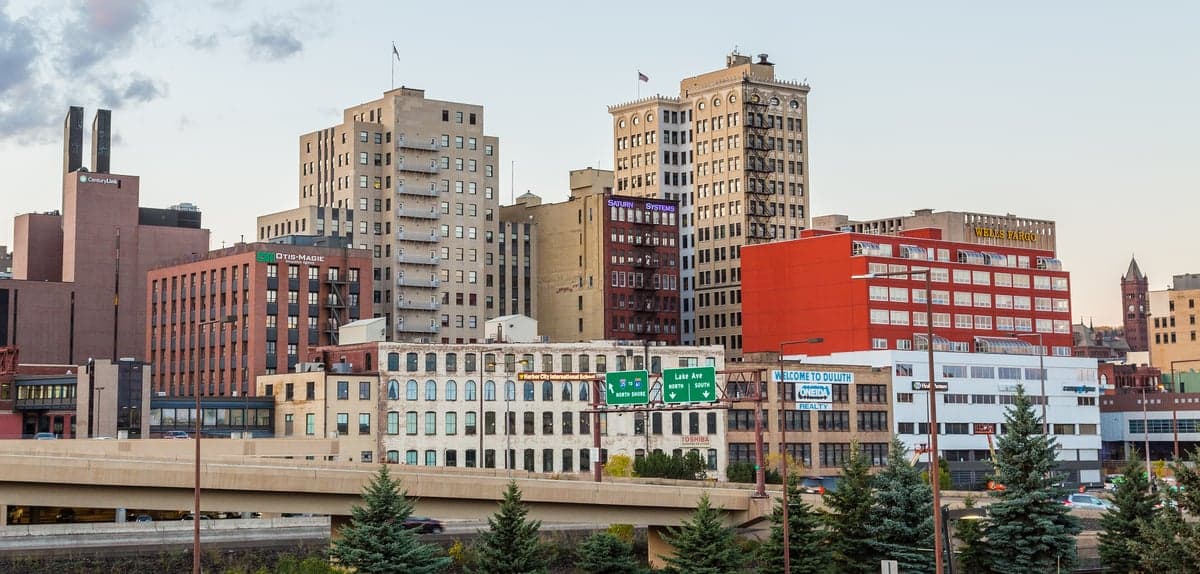
The people of Duluth, Minnesota, today number 86,863, forming a predominantly white (87.1%) and older-than-average population with a distinctively low foreign-born share of just 1.4%. The city’s character is shaped by its Lake Superior shoreline, a working-class Scandinavian and Eastern European heritage, and a recent influx of college-educated residents drawn to outdoor recreation and remote work—42.3% now hold a bachelor’s degree or higher. This is a place where the past is visible in brick-and-mortar neighborhoods like Lakeside and Lincoln Park, but where the future hinges on retaining young families and diversifying an economy long tied to shipping and mining.
How the city was settled and grew
Duluth’s population history begins with the Ojibwe people, who ceded the land in the 1854 Treaty of La Pointe, opening it to Euro-American settlement. The city was formally founded in 1857 as a speculative port for iron ore and timber, but the first major wave of settlers arrived after the railroad reached the harbor in 1870. Scandinavian immigrants—Norwegians, Swedes, and Finns—dominated this early period, settling in West Duluth and Morgan Park, where they worked in the ore docks and sawmills. Eastern European groups, including Poles and Slovenians, followed in the 1890s, clustering in Lincoln Park and Central Hillside, building the Catholic parishes and ethnic halls that still anchor those neighborhoods. By 1910, Duluth’s population had surged past 78,000, making it one of the fastest-growing cities in the Midwest. The post-World War II era saw a second wave of domestic migration, as returning veterans and their families moved into new subdivisions in Lakeside and Woodland, areas that remain predominantly white and middle-class today.
Modern era (post-1965)
The 1965 Immigration and Nationality Act had little immediate effect on Duluth’s demographics, as the city’s cold climate and industrial decline offered few draws for new international arrivals. The foreign-born share peaked at just 2.1% in 1980 and has since fallen to 1.4%, far below the national average. Instead, the post-1965 story is one of domestic out-migration and suburbanization. Between 1960 and 1990, Duluth lost roughly 15% of its population as manufacturing jobs disappeared and younger residents moved to the Twin Cities or Sun Belt. The city’s Black population, which had grown during the World War II era as workers came for shipbuilding jobs, remained small and concentrated in Central Hillside and East Hillside, where it still forms the largest non-white enclave. Hispanic residents, now 2.5% of the population, began arriving in the 1990s, primarily from Mexico and Central America, settling in Lincoln Park and West Duluth near service-sector jobs. East and Southeast Asian communities (1.2%) are a mix of Hmong families who arrived in the 1980s and smaller numbers of Vietnamese and Korean residents, with no single dominant neighborhood. Indian-subcontinent residents (0.5%) are a recent, highly educated cohort, many employed in healthcare or at the University of Minnesota Duluth, and are dispersed rather than clustered.
The future
Duluth’s population is slowly stabilizing after decades of decline, but the trend is toward homogenization rather than diversification. The white share has remained above 87% for decades, and the foreign-born share is not growing. The city’s Hispanic and Black populations are increasing at a modest pace—each up about 0.3 percentage points since 2010—but they remain small and are not forming large ethnic enclaves. The most notable demographic shift is the rise of college-educated residents, who are drawn by the quality of life and relatively affordable housing, but who often leave for better job markets after a few years. The city’s overall population is projected to remain flat or decline slightly through 2035, as the birth rate is low and in-migration from other parts of Minnesota and Wisconsin barely offsets deaths. The neighborhoods most likely to see change are Lincoln Park, which is gentrifying with new breweries and coffee shops, and Central Hillside, where a small but growing number of Somali and East African families are settling, though still in very low numbers.
For someone moving to Duluth today, the city offers a stable, predominantly white, and increasingly educated population with a strong sense of place. The low foreign-born share and modest diversity mean that newcomers will find a community where the cultural rhythms are still shaped by Scandinavian and Eastern European roots, not by rapid demographic change. The trade-off is a population that is aging and slow to grow, which may limit economic dynamism but also preserves the quiet, neighborly character that draws people here in the first place.

* Values derived from national, state, county, city and local statistics and may differ in a specific area. Last updated: 2026-04-24T13:56:08.000Z
Narrative content on this page is AI-generated and may contain mistakes. Verify any details that matter before acting on them.
ReloMaps may earn a commission from affiliate links at no extra cost to you.

