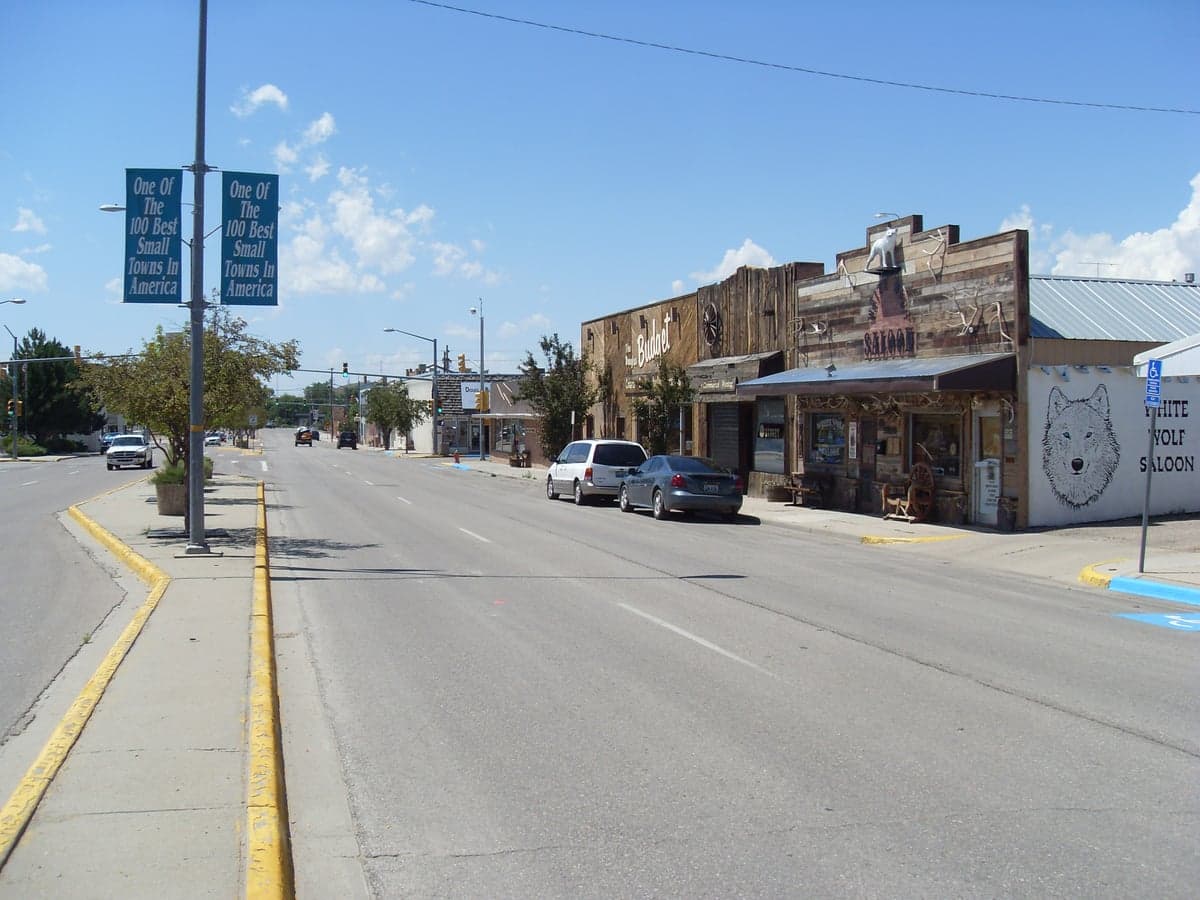
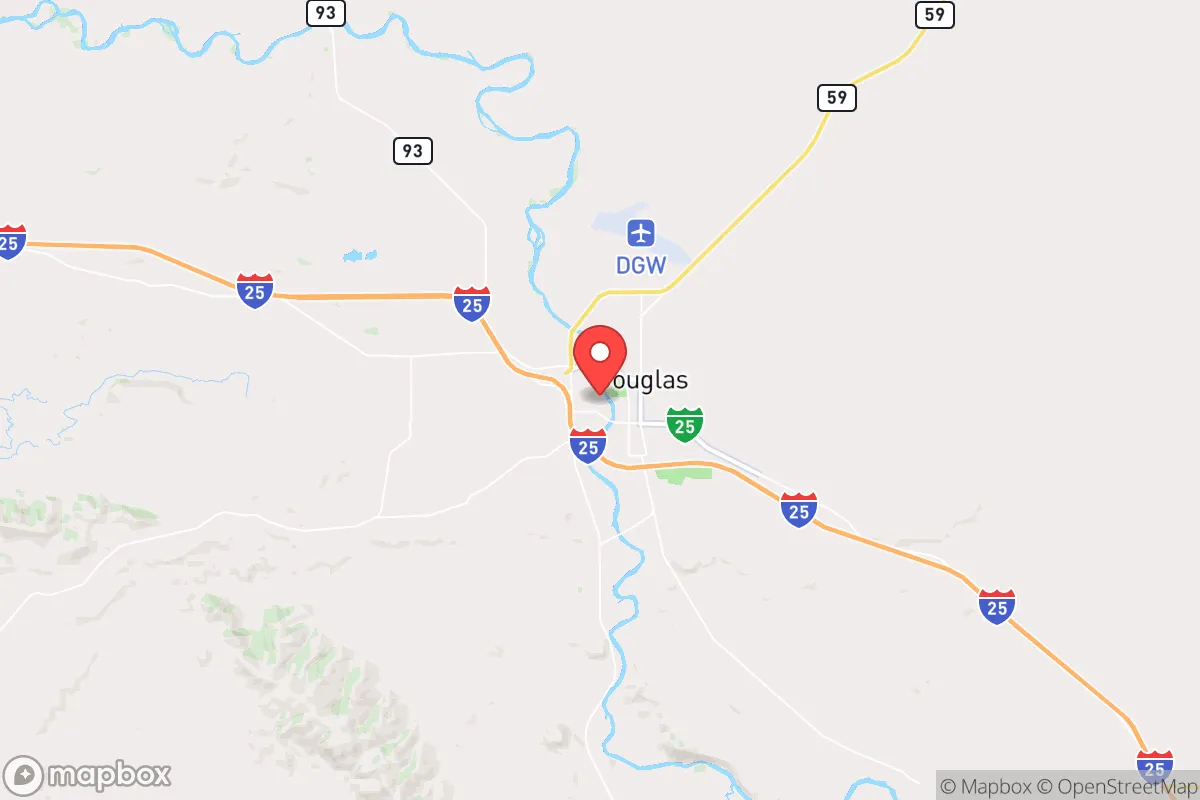
Photo: Wikipedia
Demographics of Douglas, WY
Affluence Level in Douglas, WY
A middle-class area roughly in line with national averages across income, home values, education, and employment.
People of Douglas, WY
The people of Douglas, Wyoming, today number roughly 6,400, forming a predominantly white (85.4%) and politically conservative community with a notable Hispanic minority (12.4%). The city’s identity is rooted in its railroad and ranching heritage, with a population density of about 1,100 people per square mile, giving it a small-town, spread-out feel. Distinctive markers include a strong sense of local history tied to the Oregon Trail and a demographic profile that is significantly less diverse than the national average, with a foreign-born population of just 1.3% and a college-educated share of 22.2%.
How the city was settled and grew
Douglas was founded in 1886 as a railroad town on the Fremont, Elkhorn & Missouri Valley Railroad line, named after Senator Stephen A. Douglas. The original population was drawn by the promise of work on the railroad and the surrounding cattle ranching industry, which boomed as the line opened the region to eastern markets. The first wave of settlers were predominantly Anglo-American homesteaders and railroad workers, many of whom built homes in the Original Townsite—the grid of streets around the depot that remains the historic core. A second wave arrived in the early 1900s with the expansion of the Wyoming State Fairgrounds and the establishment of the Douglas Air Force Base (later closed in 1946), bringing a mix of military families and service workers. These groups settled in the North Douglas neighborhood, near the base, and in the South Douglas area, where ranching families established larger lots. By the mid-20th century, the population had stabilized around 3,000, with little ethnic diversity beyond a small number of Mexican-American laborers who worked on the railroads and in the sugar beet fields, concentrated in the West Douglas district along the rail corridor.
Modern era (post-1965)
After the 1965 Immigration Act, Douglas saw minimal demographic change, as the city’s remote location and lack of major industry limited new arrivals. The Hispanic population grew modestly from the 1970s onward, driven by domestic migration from the Southwest and Mexico, with families settling in the West Douglas area and the newer Mountain View subdivision, where affordable housing attracted working-class families. The white population remained stable, with out-migration of younger adults to larger cities offset by in-migration of retirees and energy-sector workers during the 2000s oil and gas boom. The Black population (0.5%) and East/Southeast Asian population (0.0%) have remained negligible, reflecting the city’s lack of economic pull for these groups. The Indian subcontinent population is also 0.0%, and there is no measurable Arab community. Suburbanization has been limited, with most growth occurring in the East Douglas area near the interstate, where new single-family homes have attracted families seeking lower costs compared to Casper or Cheyenne. The college-educated share (22.2%) is below the state average, as the local economy relies heavily on manual labor and trades.
The future
Douglas’s population is projected to remain stable or grow slowly, with the Hispanic share likely increasing to 15-18% by 2040, driven by higher birth rates and continued domestic migration for agricultural and energy jobs. The white population will likely decline slightly in share but remain the overwhelming majority. The city is not tribalizing into distinct ethnic enclaves; rather, Hispanic families are dispersing across West Douglas and Mountain View, while white residents dominate the Original Townsite and East Douglas. The immigrant community is small and plateauing, with little new foreign-born influx expected due to the lack of refugee resettlement or tech-sector jobs. The next 10-20 years will likely see a gradual homogenization of the population around a working-class, conservative identity, with little change in racial or ethnic diversity.
For someone moving in now, Douglas offers a stable, predominantly white community with a growing Hispanic minority, a strong ranching and railroad heritage, and a conservative social fabric. The city is not becoming more diverse in a broad sense, but the Hispanic presence is deepening, particularly in the west side neighborhoods. New residents should expect a tight-knit, low-crime environment where local politics and culture reflect the values of the surrounding rural region.

* Values derived from national, state, county, city and local statistics and may differ in a specific area. Last updated: 2026-04-21T11:35:01.000Z
Narrative content on this page is AI-generated and may contain mistakes. Verify any details that matter before acting on them.
ReloMaps may earn a commission from affiliate links at no extra cost to you.

