Photo: Wikipedia
Demographics of Doral, FL
Affluence Level in Doral, FL
A middle-class area roughly in line with national averages across income, home values, education, and employment.
People of Doral, FL
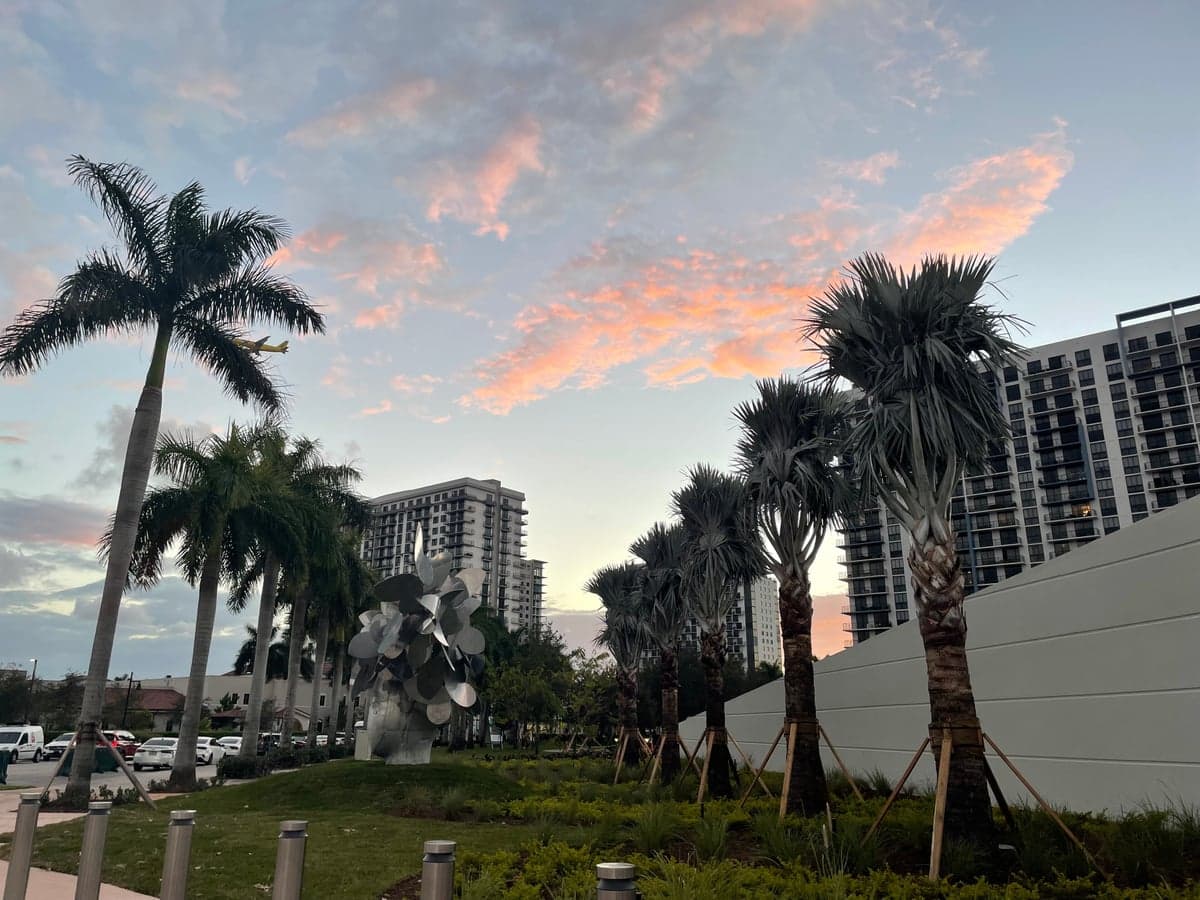
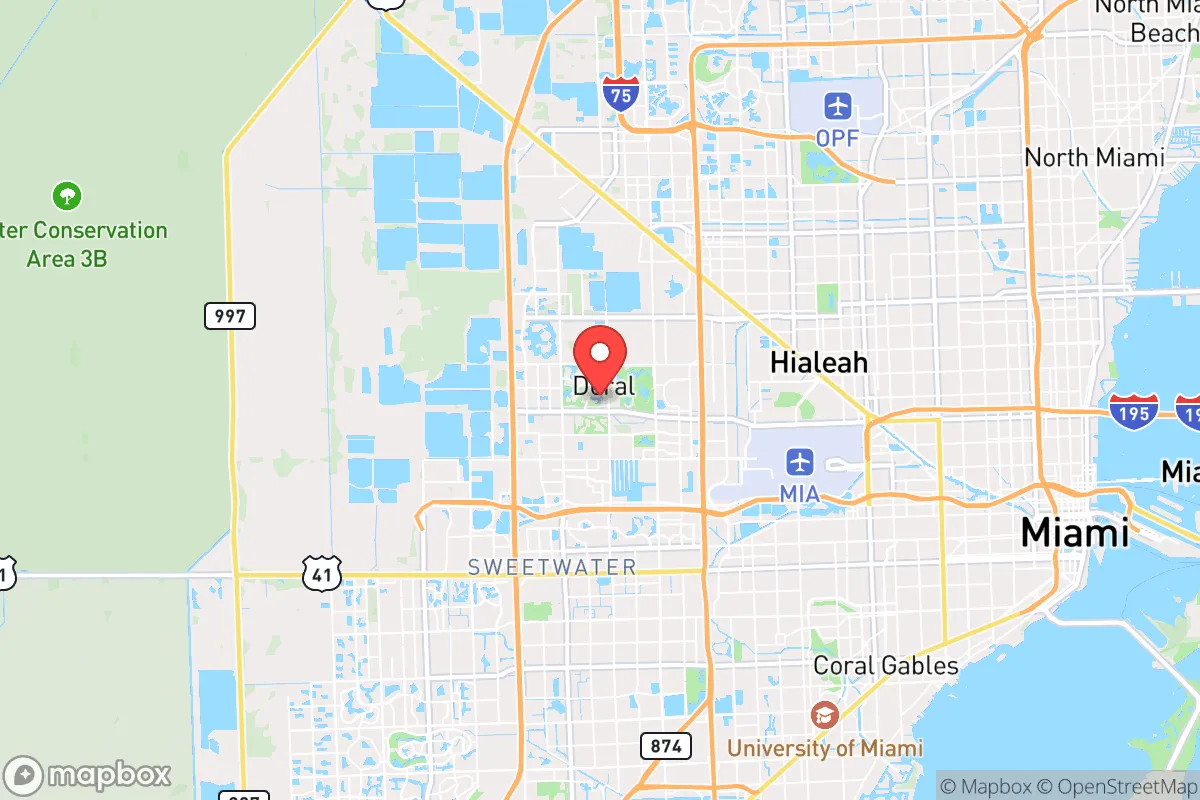
Today, Doral is a majority-Hispanic city of 76,490 residents, where 85.3% of the population identifies as Hispanic or Latino and 57.3% hold a college degree. The city’s character is defined by its blend of affluent Venezuelan and Colombian professionals, Cuban-American families, and a growing contingent of East/Southeast Asian and Indian-subcontinent immigrants. With a foreign-born share of 41.4%, Doral is one of the most internationally diverse suburbs in Miami-Dade County, yet it remains overwhelmingly Hispanic — a demographic reality that shapes its politics, schools, and daily life.
How the city was settled and grew
Doral did not exist as a municipality until 2003. Its land was originally part of the Everglades wetlands, drained in the early 20th century for agriculture. The area’s first permanent residents were farmworkers — mostly Cuban and Mexican laborers — who lived in scattered camps near the tomato and pepper fields. The turning point came in 1962, when real estate developers Doris and Alfred Kaskel purchased 2,400 acres of farmland and built the Doral Country Club (now the Trump National Doral). The Kaskels named the development by combining “Doris” and “Alfred” into “Doral.” Early residents were overwhelmingly white, upper-middle-class retirees and golf enthusiasts from the Northeast and Midwest, drawn by the resort lifestyle. These original homeowners settled in the Doral Estates neighborhood, a gated community of single-family homes around the golf course that remains one of the city’s wealthiest enclaves.
Modern era (post-1965)
The 1965 Hart-Cellar Act and the 1980 Mariel boatlift transformed Doral’s population. Cuban exiles, many of them professionals and small-business owners, began buying homes in the Doral Isles and Doral Park subdivisions during the 1980s and 1990s. These neighborhoods offered newer, larger homes than older Miami suburbs like Hialeah or Little Havana, and they attracted upwardly mobile Cuban families seeking good schools and low crime. By 2000, the city’s Hispanic share had already surpassed 70%, with Cubans forming the largest single group. The 2000s brought a second major wave: Venezuelan and Colombian professionals fleeing economic collapse and political instability. They concentrated in the Downtown Doral district — a master-planned, mixed-use development of high-rise condos and townhomes built after 2010. Today, Venezuelans are the fastest-growing nationality in Doral, and the city is sometimes called “Doralzuela” for its heavy Venezuelan influence. Smaller but visible communities of East/Southeast Asian immigrants (1.2% of the population) and Indian-subcontinent residents (1.0%) have settled in the Doral Commons area near the Palmetto Expressway, drawn by the city’s proximity to Miami International Airport and the logistics jobs at the nearby Airport West industrial corridor.
The future
Doral’s population is projected to continue growing, driven by foreign-born professionals from Latin America and, increasingly, from Asia. The city’s white non-Hispanic share has fallen from roughly 15% in 2000 to 9.9% today, and that decline is expected to continue as older white residents age out and their homes are bought by Hispanic families. The Hispanic population is not monolithic: Cubans, Venezuelans, and Colombians each maintain distinct social and commercial networks, and neighborhoods are beginning to tribalize along national lines. Doral Estates remains heavily Cuban and older; Downtown Doral skews younger and Venezuelan; the Doral Glades area, built in the 2010s, attracts a mix of Colombian and Central American families. The East/Southeast Asian and Indian communities are small but growing, and they are likely to remain concentrated in the apartment complexes near the airport rather than dispersing into single-family neighborhoods. The city’s high college attainment rate (57.3%) and its role as a hub for trade, logistics, and finance suggest that future in-migration will continue to be professional and middle-class, not low-wage. Doral is becoming more Hispanic, more educated, and more economically stratified by national origin — a trend that will likely intensify over the next decade.
For a conservative-leaning individual or family considering a move, Doral offers a stable, family-oriented environment with strong schools, low crime, and a population that is overwhelmingly Hispanic and foreign-born. The city is not homogenizing into a single Hispanic identity; instead, it is developing distinct enclaves defined by national origin, generation, and income. New arrivals should expect to find a community where Spanish is the dominant language in daily life, where civic culture is shaped by Cuban and Venezuelan traditions, and where the political leanings are reliably Republican — Miami-Dade’s only majority-Republican city. Doral is becoming a dense, vertical, professional-class Hispanic suburb, and its trajectory points toward continued growth and increasing ethnic segmentation.

* Values derived from national, state, county, city and local statistics and may differ in a specific area. Last updated: 2026-04-30T05:16:42.000Z
Narrative content on this page is AI-generated and may contain mistakes. Verify any details that matter before acting on them.
ReloMaps may earn a commission from affiliate links at no extra cost to you.

