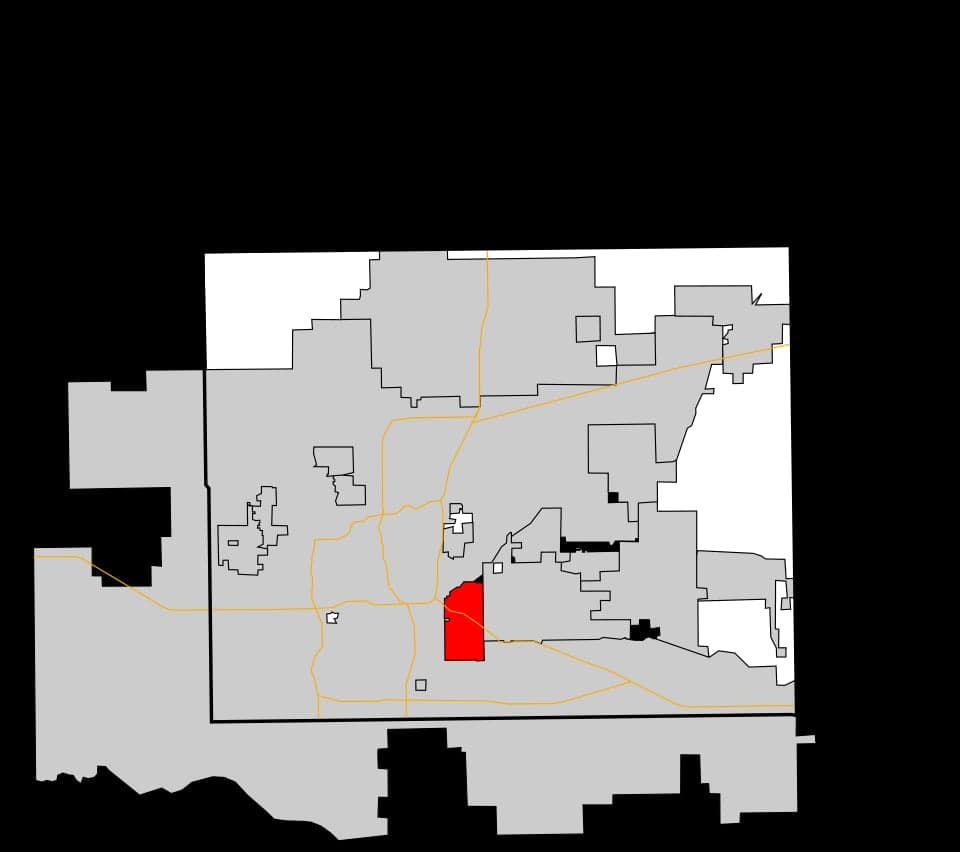
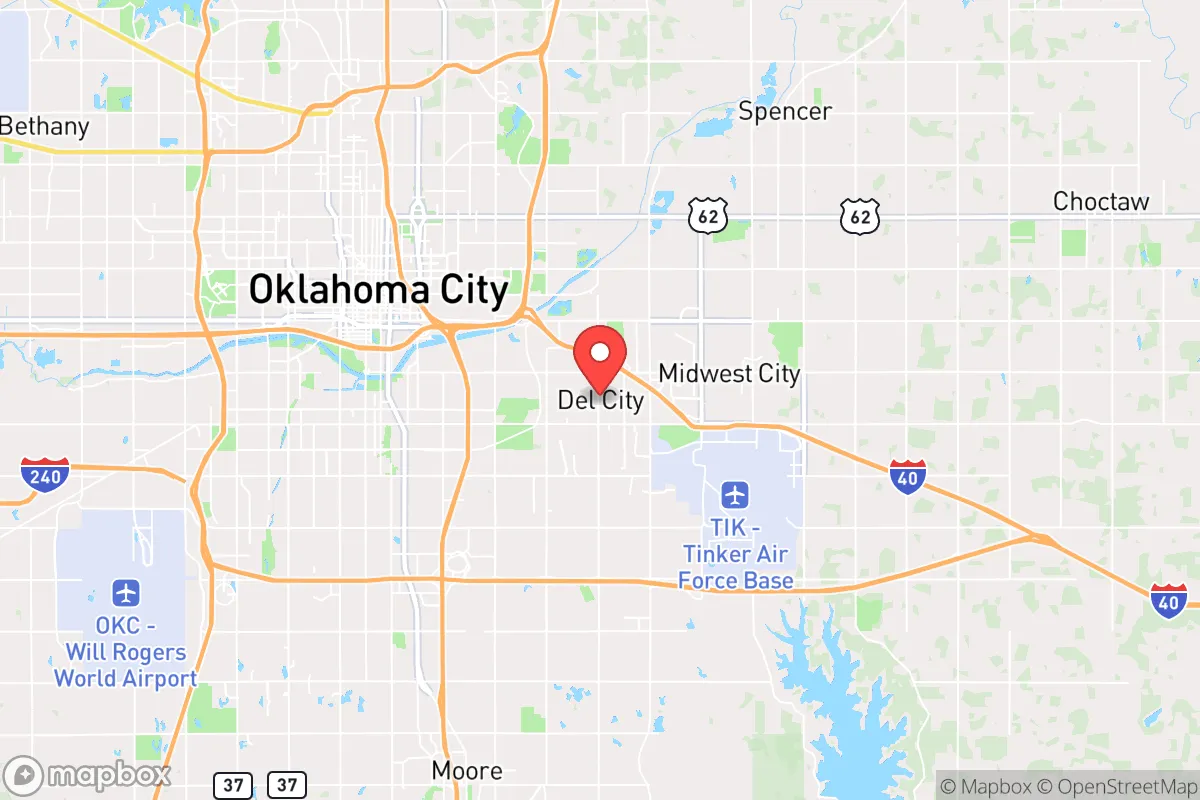
Photo: Wikipedia
Strategic Assessment of Del City, OK
Multiple tactical vulnerabilities. Population density, target proximity, or disaster risk are likely compounding. A retreat property and exit planning is required.
What does the Strategic Assessment tell us?
Our Strategic Assessment grades tactical survivability of an area. Major population centers, military targets, fallout zones, natural disasters, and border exposure all drive risk — lower exposure means a more defensible position in a crisis.
This is heavily inspired by Joel Skousen's Strategic Relocation book. Highly recommended you checkout the book ($)What does this tell us?
Our Strategic Assessment grades tactical survivability of an area. Major population centers, military targets, fallout zones, natural disasters, and border exposure all drive risk — lower exposure means a more defensible position in a crisis.
This is heavily inspired by Joel Skousen's Strategic Relocation book. Highly recommended you checkout the book ($)Strategic Pillars

Key Distances
Regional Safe Places
Below is our recommended "safe zones" in Oklahoma and the surrounding area based on our strategic heuristics. For most people, it's unrealistic to live in a “safe zone” full-time due to work, family or other personal reasons. They tend to be more rural. However, many of these areas are perfect for second homes and retreat properties that double as a vacation home or even a short-term rental.
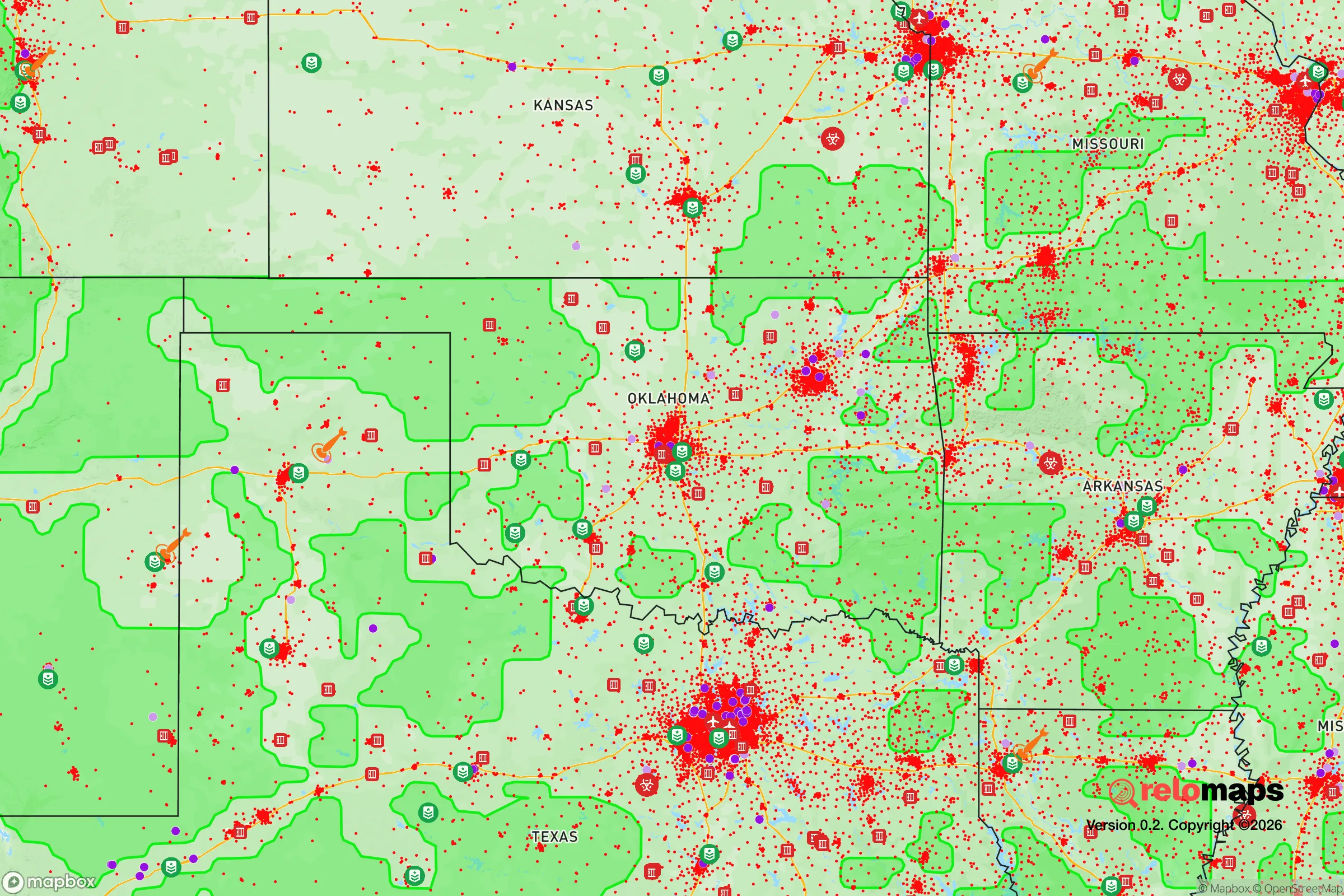
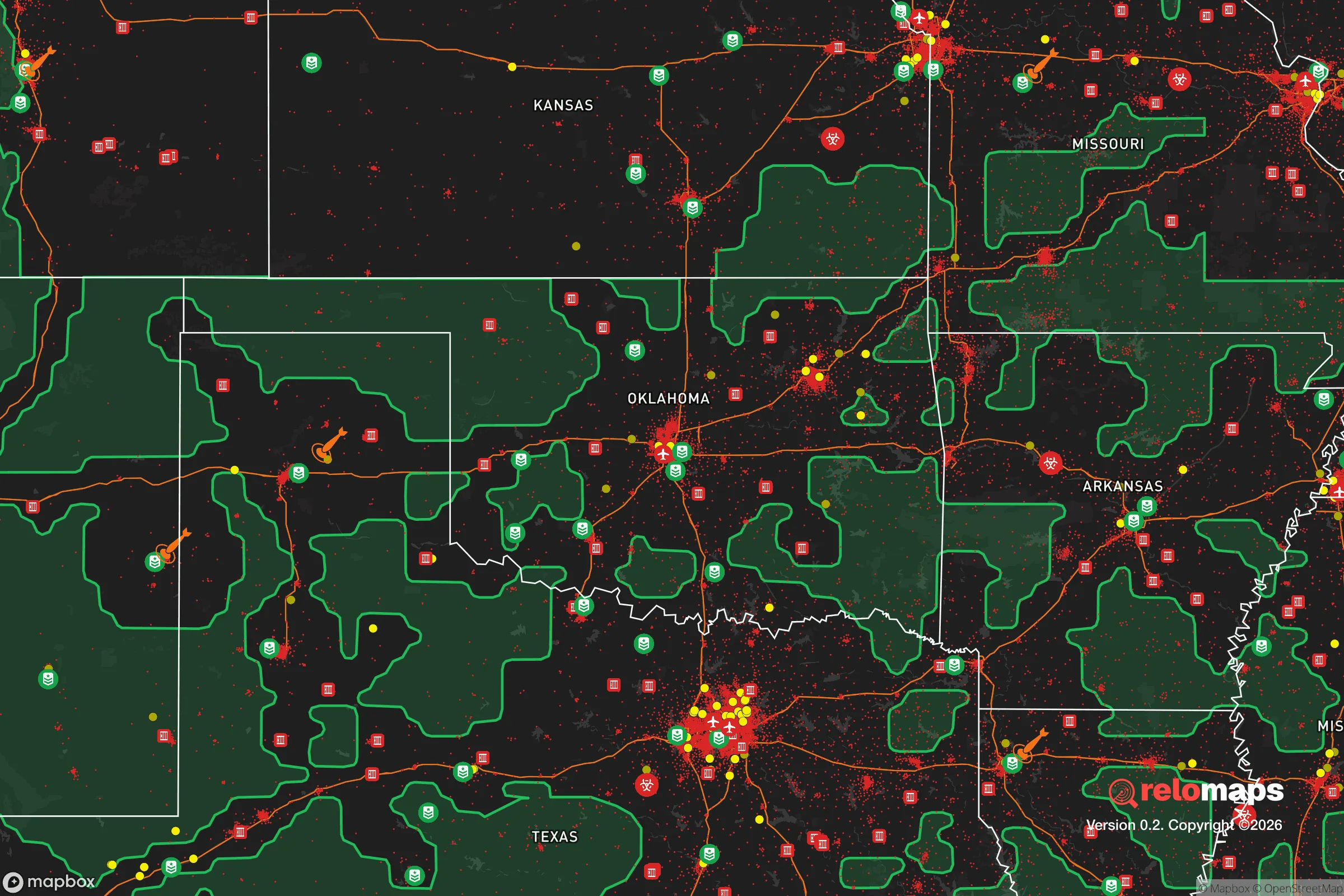


Important Note: For informational purposes only. This does not mean nothing bad ever happens in the green zones. Please use common sense. This is based on public data and modeled with AI. We tried to take a conservative approach but mistakes happen. We update this regularly as new information becomes available.
Solar Generator Recommendations
Backup power matters more here than in safer locations. We've picked three solar generators across budgets and capacity tiers — start with the budget unit if you only need a few essentials, or step up if you want to run a fridge and HVAC for days at a time.

Jackery Portable Power Station Explorer 300
Budget OptionPower on the Go: Weighing only 11 lbs, it's convenient to set up and store with book-sized foldable solar panels

BLUETTI Portable Power Station AC180
Designed for both indoor and outdoor scenarios, AC180 is highly capable as it has a robost capacity and continuous output power.

EF ECOFLOW DELTA Pro Ultra Power Station
Upgraded PickEcoFlow DELTA Pro Ultra is a whole-home energy system designed to grow with your family. Integrated with the Smart Home Panel 2, it scales to meet your evolving energy needs — keeping your home powered, intelligent, and secure through every stage of life.
We earn a commission, at no additional cost to you.
Strategic Assessment Analysis
Del City, Oklahoma, sits in a precarious but potentially workable position for the prepper or survivalist looking at the central United States. Its core advantage is its location within the Oklahoma City metroplex, which provides immediate access to supply chains and medical infrastructure, but that same proximity is its greatest liability in a crisis scenario. For a relocator weighing resilience against convenience, Del City offers a mixed bag: it is close enough to benefit from urban resources in a blue-sky scenario, yet dangerously close to high-value targets and population-density risks when the grid goes down or civil unrest erupts. The key is understanding that this is not a retreat property—it is a staging ground, and your survival plan must account for the fact that you are living inside the blast radius of a major American city.
Geographic position and natural advantages for long-term survival
Del City’s geography is defined by the flat, open terrain of central Oklahoma, which offers both pros and cons for a prepper. On the plus side, the area sits on the Canadian River watershed, providing decent groundwater access for those who drill a private well—something many suburban lots in the city do not have, but which is feasible on larger parcels just outside the city limits. The climate is continental, with hot summers and cold winters, but the growing season is long enough (roughly 210 days) to support a serious garden if you have the land. The lack of major natural barriers—no mountains, no dense forests—means you can see threats coming from a distance, but it also means you have little cover from aerial observation or weather events. Tornadoes are a real and recurring hazard; Del City lies in the heart of Tornado Alley, and the May 2013 Moore tornado (an EF5) passed within a few miles. For a survivalist, this means your shelter must be below grade—a reinforced storm shelter or basement is non-negotiable. The flat terrain also makes the area vulnerable to flash flooding after heavy rains, particularly near the Canadian River and its tributaries. Overall, the natural advantages here are modest: decent water potential, workable soil, and a climate that supports subsistence agriculture, but you are trading those for extreme weather risk and a lack of defensible terrain.
Risks, exposures, and proximity to fallout-relevant landmarks
This is where Del City becomes a hard sell for the serious prepper. The city is less than 10 miles from Tinker Air Force Base, a major strategic asset for the U.S. military. In a conflict involving strategic strikes—whether nuclear, EMP, or conventional—Tinker is a top-tier target. A ground burst at Tinker would render Del City uninhabitable for decades due to fallout, and even an air burst would likely destroy the local power grid and communications infrastructure. Additionally, Del City is within 15 miles of the Oklahoma City National Memorial (the site of the 1995 bombing) and the federal building cluster downtown, which remains a symbolic target for domestic or foreign actors. The proximity to I-40 and I-35, two major interstate corridors, means that in a mass evacuation scenario, Del City’s streets would gridlock within hours. The city’s population density (roughly 3,500 people per square mile) is high enough that civil unrest—riots, looting, or resource competition—would escalate quickly if supply chains falter. For a relocator, the risk profile here is clear: you are living next to a primary military target, a symbolic federal target, and a major transportation hub. If you are serious about fallout avoidance and societal collapse, this is not a safe distance.
Practical resilience for a relocator: food, water, energy, and defensibility
If you still choose Del City as a base, your resilience plan must be aggressive and redundant. Municipal water comes from the Oklahoma City water system, which draws from Lake Hefner and Lake Overholser—both vulnerable to contamination or sabotage. You need a backup: a private well (if your lot allows it), rainwater catchment (the area gets about 36 inches of rain per year, enough for a 1,000-gallon tank system), or stored water (at least 1 gallon per person per day for 90 days). Food storage is easier here than in many places: the Oklahoma City metro has multiple Costco, Sam’s Club, and WinCo locations, plus local farms and farmers’ markets within a 30-minute drive. But in a collapse, those shelves empty in days. You need a minimum of six months of shelf-stable food per person, plus the ability to garden and preserve. Energy resilience is a challenge: the grid is aging and prone to outages during ice storms and heat waves. Solar panels with battery storage are viable (the area gets about 260 sunny days per year), but you must harden them against hail and wind. A backup generator running on propane or natural gas is a practical stopgap. Defensibility is the weak point. Del City is a typical suburban grid of cul-de-sacs and arterial roads—easy to enter, hard to secure. Your best bet is a corner lot with a solid fence, reinforced doors, and a clear line of sight to approaches. But realistically, this is not a compound; it is a house in a neighborhood. If you are serious about long-term survival, you should treat Del City as a temporary base for resupply and information, not a final retreat. The real defensible ground lies 60–90 minutes south or west, in the Arbuckle Mountains or the Wichita Mountains, where terrain and distance from targets improve your odds.
The overall strategic picture for Del City is one of calculated risk. It offers the logistical advantages of a major metro—hospitals, hardware stores, fuel, and community—but those come with the highest possible exposure to the very events a prepper is trying to survive. If your plan is to ride out a short-term crisis (a week or two of unrest, a natural disaster) and then relocate, Del City can work as a forward operating base. But if you are planning for a long-term grid-down scenario, a pandemic, or a strategic strike, you are too close to Tinker Air Force Base and the interstate system to be safe. The conservative-minded relocator should view Del City as a stepping stone: buy here for the job market and the schools, but have a bug-out location already secured in a lower-risk area. The land is cheap, the people are generally self-reliant, and the local gun culture is strong—but none of that matters if the fallout cloud is drifting your way. Make your decision with eyes open: Del City is a place to live, not a place to survive.

* Values derived from national, state, county, city and local statistics and may differ in a specific area. Last updated: 2026-04-19T21:10:07.000Z
Narrative content on this page is AI-generated and may contain mistakes. Verify any details that matter before acting on them.
ReloMaps may earn a commission from affiliate links at no extra cost to you.

