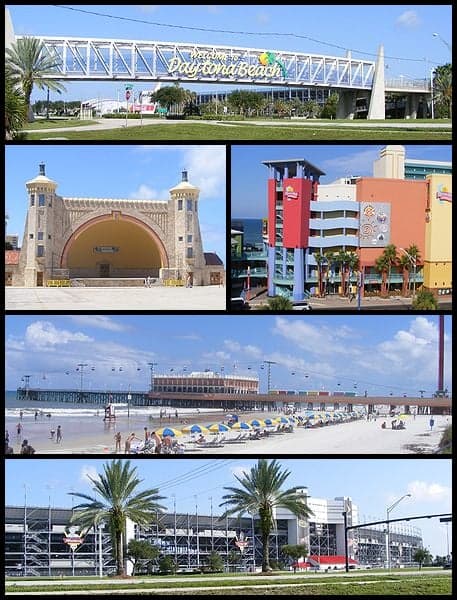
Photo: Wikipedia
Demographics of Daytona Beach, FL
Affluence Level in Daytona Beach, FL
A middle-class area roughly in line with national averages across income, home values, education, and employment.
People of Daytona Beach, FL
Daytona Beach’s 75,924 residents form a racially diverse, working-to-middle-class city with a notably low foreign-born share of 4.5% and a college attainment rate of 25.7%. The population is 51.0% White, 31.1% Black, 10.0% Hispanic, 2.3% East/Southeast Asian, and 0.5% Indian subcontinent. The city’s identity is shaped by a historic beach-tourism economy, a large seasonal “snowbird” presence, and a stark east-west racial divide that persists in neighborhood patterns today.
How the city was settled and grew
Daytona Beach was incorporated in 1876, but its population boom began after 1900, driven by the automobile and beach racing. The original settlers were White Northerners and Midwesterners drawn by the hard-packed sand beach and the promise of a winter resort economy. The Midtown district, originally a Black settlement called “Waycross,” became the heart of the city’s African American community during the Jim Crow era, anchored by Bethune-Cookman University (founded 1904). White tourism and residential growth concentrated along the beachfront in Daytona Beach Shores and the Seabreeze district, while the mainland west of the Halifax River remained largely rural until the 1920s land boom. The 1930s through 1950s saw a second wave: White retirees from the Northeast and Midwest buying winter homes in Ormond Beach (north) and the Peninsula Drive corridor, while Black workers from the rural South continued to settle in Midtown and the Derbyshire area. By 1960, the city was roughly 70% White and 28% Black, with negligible Hispanic or Asian populations.
Modern era (post-1965)
The 1965 Hart-Cellar Act had little direct effect on Daytona Beach’s foreign-born population, which remains low. Instead, the post-1965 story is one of domestic migration and suburbanization. White flight from the city core accelerated after school desegregation in the 1970s, pushing White families north into Port Orange and west into Deltona, while the city’s mainland neighborhoods—particularly Midtown and Derbyshire—became increasingly Black and lower-income. The Hispanic share grew slowly from the 1980s onward, driven by Puerto Rican and Mexican migrants working in tourism, construction, and agriculture; they settled mainly in the Holly Hill area (just north of city limits) and the Beville Road corridor. East/Southeast Asian communities (2.3%) are a small but visible presence, concentrated in the University area near Embry-Riddle Aeronautical University and in the Seabreeze district, where Vietnamese and Filipino families operate restaurants and nail salons. The Indian subcontinent population (0.5%) is tiny and largely tied to medical professionals at Halifax Health Medical Center. The city’s Black population peaked at around 36% in 2010 and has since declined slightly to 31.1%, as some middle-class Black families have moved to suburbs like Port Orange and Palm Coast.
The future
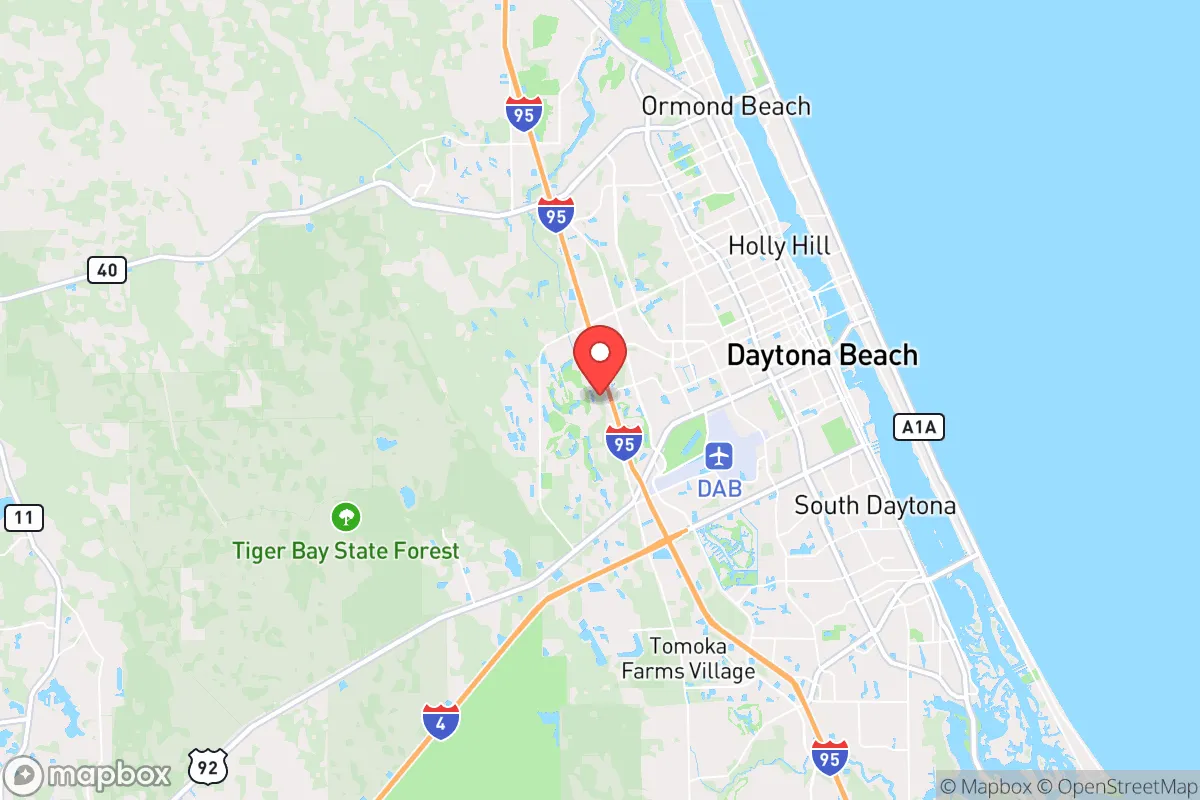
Daytona Beach’s population is slowly diversifying, but the foreign-born share (4.5%) is well below the national average of 13.7%, and immigration is unlikely to drive major change. The Hispanic share is growing steadily—projected to reach 14-16% by 2035—driven by natural increase and continued migration from Puerto Rico and Central America, with new arrivals settling in the Beville Road and Holly Hill corridors. The White share is declining gradually as the older snowbird population ages out and younger White families continue to choose suburbs. The Black share appears stable, though the city is seeing a modest return of Black professionals to the Midtown area, spurred by redevelopment around the university and the new Daytona Beach International Airport business park. The city is not homogenizing; instead, it is tribalizing into distinct enclaves: the beachside remains predominantly White and older, the mainland west of I-95 is increasingly Hispanic, and the historic Black neighborhoods are seeing a mix of gentrification and stagnation. For a new resident, Daytona Beach offers a racially diverse but economically stratified city where neighborhood choice strongly determines daily experience.
Daytona Beach is becoming a more Hispanic and slightly more Asian city, but its low immigration rate and aging White snowbird base mean the pace of change is slow. The city remains a place where racial and economic lines are drawn by the Halifax River and I-95, and where the beachside and mainland feel like different towns. For a conservative-leaning mover, the city offers a low-tax Florida environment with a clear trade-off: affordable mainland housing in diverse neighborhoods versus pricier, Whiter beachside enclaves.

* Values derived from national, state, county, city and local statistics and may differ in a specific area. Last updated: 2026-04-24T12:29:37.000Z
Narrative content on this page is AI-generated and may contain mistakes. Verify any details that matter before acting on them.
ReloMaps may earn a commission from affiliate links at no extra cost to you.

