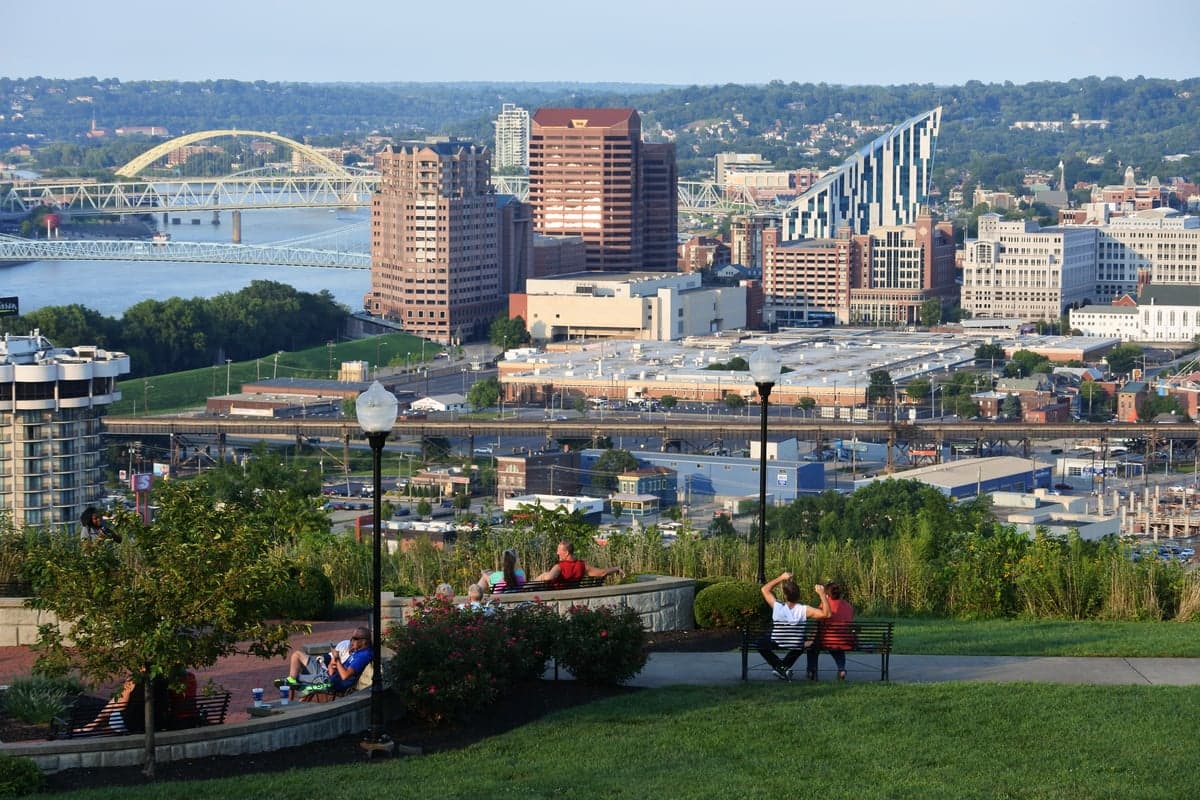
Photo: Wikipedia
Strategic Assessment of Covington, KY
Multiple tactical vulnerabilities. Population density, target proximity, or disaster risk are likely compounding. A retreat property and exit planning is required.
What does the Strategic Assessment tell us?
Our Strategic Assessment grades tactical survivability of an area. Major population centers, military targets, fallout zones, natural disasters, and border exposure all drive risk — lower exposure means a more defensible position in a crisis.
This is heavily inspired by Joel Skousen's Strategic Relocation book. Highly recommended you checkout the book ($)What does this tell us?
Our Strategic Assessment grades tactical survivability of an area. Major population centers, military targets, fallout zones, natural disasters, and border exposure all drive risk — lower exposure means a more defensible position in a crisis.
This is heavily inspired by Joel Skousen's Strategic Relocation book. Highly recommended you checkout the book ($)Strategic Pillars

Key Distances
Regional Safe Places
Below is our recommended "safe zones" in Kentucky and the surrounding area based on our strategic heuristics. For most people, it's unrealistic to live in a “safe zone” full-time due to work, family or other personal reasons. They tend to be more rural. However, many of these areas are perfect for second homes and retreat properties that double as a vacation home or even a short-term rental.
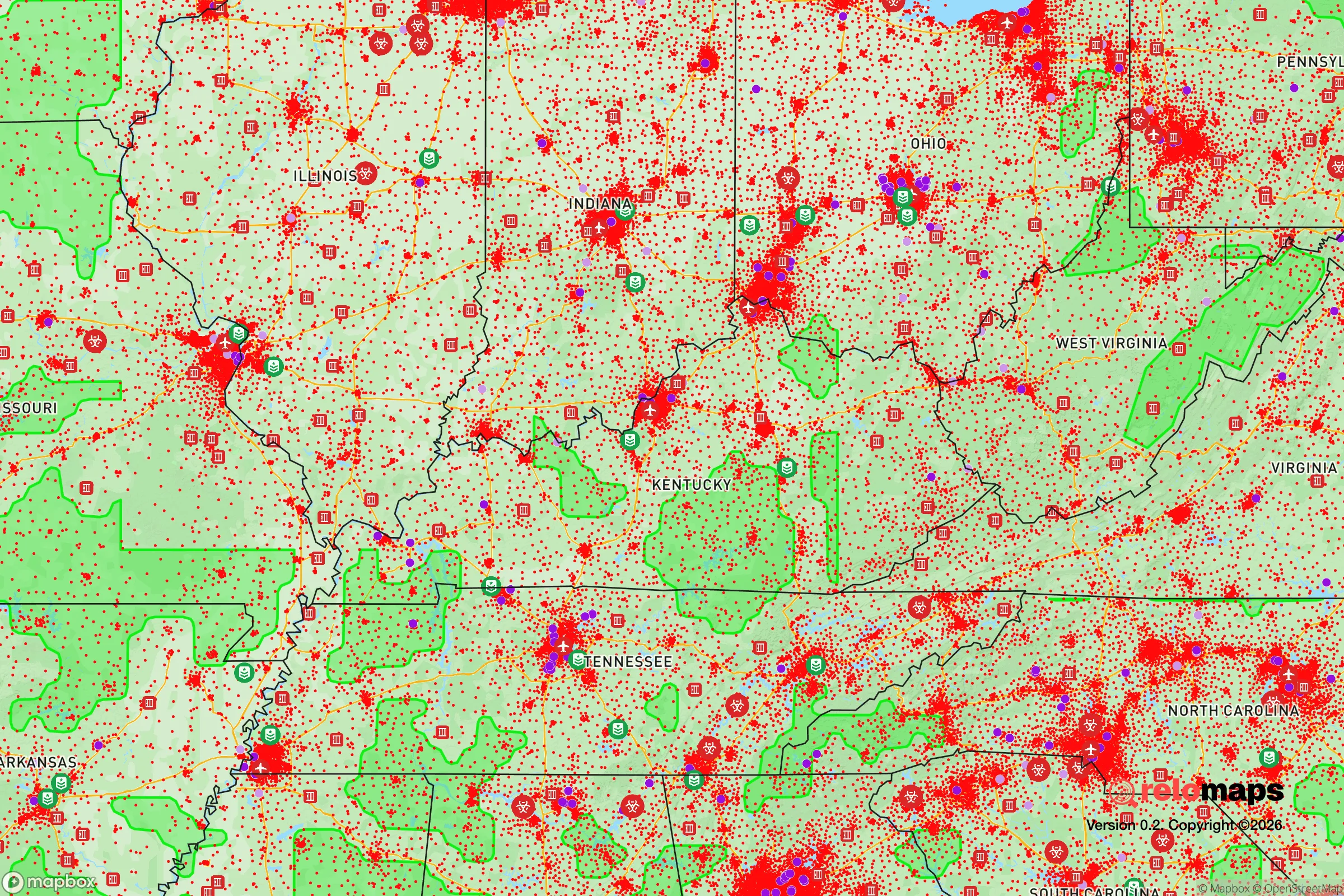
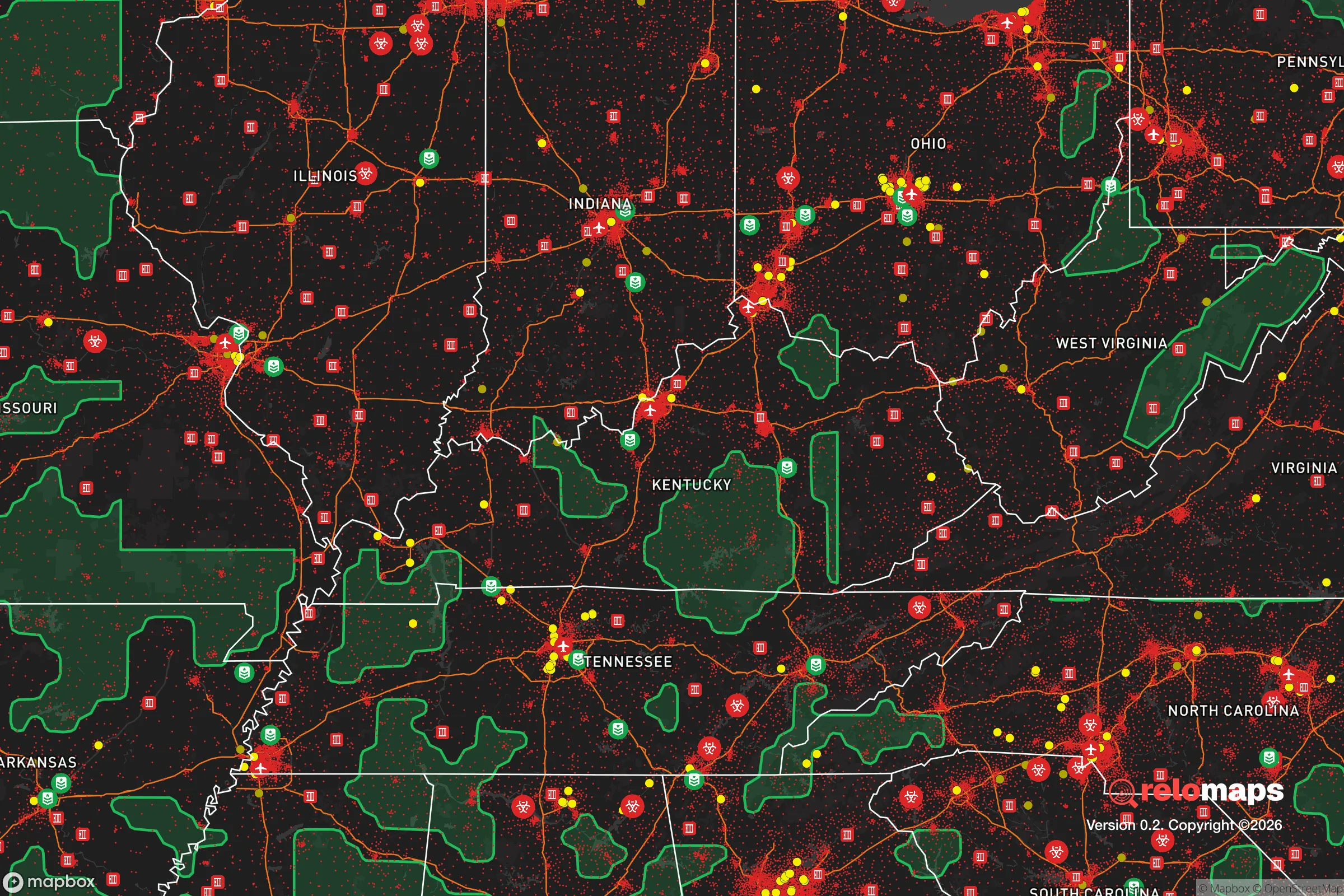


Important Note: For informational purposes only. This does not mean nothing bad ever happens in the green zones. Please use common sense. This is based on public data and modeled with AI. We tried to take a conservative approach but mistakes happen. We update this regularly as new information becomes available.
Solar Generator Recommendations
Backup power matters more here than in safer locations. We've picked three solar generators across budgets and capacity tiers — start with the budget unit if you only need a few essentials, or step up if you want to run a fridge and HVAC for days at a time.

Jackery Portable Power Station Explorer 300
Budget OptionPower on the Go: Weighing only 11 lbs, it's convenient to set up and store with book-sized foldable solar panels

BLUETTI Portable Power Station AC180
Designed for both indoor and outdoor scenarios, AC180 is highly capable as it has a robost capacity and continuous output power.

EF ECOFLOW DELTA Pro Ultra Power Station
Upgraded PickEcoFlow DELTA Pro Ultra is a whole-home energy system designed to grow with your family. Integrated with the Smart Home Panel 2, it scales to meet your evolving energy needs — keeping your home powered, intelligent, and secure through every stage of life.
We earn a commission, at no additional cost to you.
Strategic Assessment Analysis
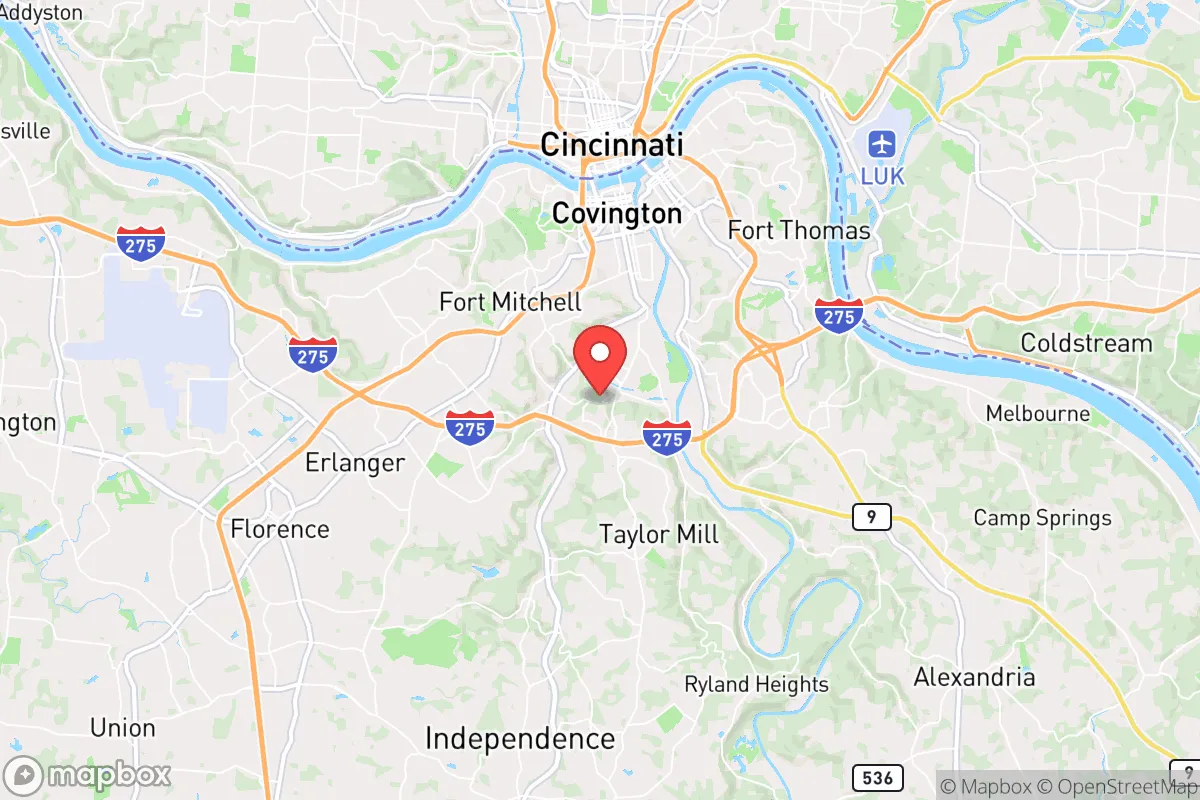
Covington, Kentucky, sits directly across the Ohio River from Cincinnati, a position that offers both strategic depth and significant exposure. For a relocator with a prepper or survivalist mindset, this city presents a complex calculus: it is close enough to a major metropolitan area to provide access to resources and infrastructure, yet far enough to offer a degree of separation from the worst of urban collapse. The city’s resilience is tied to its geography—a river city on a state border, with a mix of older, dense neighborhoods and more suburban, defensible pockets to the south and west. The key question is whether the advantages of this location outweigh the risks inherent in being within the blast radius of a major economic and transportation hub.
Geographic position and natural advantages for long-term survival
Covington’s primary natural advantage is the Ohio River, a massive, reliable freshwater source that also serves as a natural barrier and a potential transportation corridor. The city sits on the south bank, meaning any threat from the north—whether civil unrest in Cincinnati or a broader regional crisis—must cross one of several bridges, which can be monitored, controlled, or even blocked. The surrounding topography is rolling hills, not flat plains, which provides some natural defensibility and limits line-of-sight for any potential threats. The region is in the Ohio River Valley, which has a moderate climate with four distinct seasons, ample rainfall (averaging around 40 inches per year), and fertile soil for subsistence gardening. The underlying geology is primarily limestone and shale, which means groundwater is generally accessible via wells, though the urban core is heavily built over. For a relocator, the key takeaway is that Covington is not a floodplain city in the catastrophic sense—most of the residential areas sit on bluffs above the river, avoiding the worst of the 100-year flood zones. The city’s position also places it within a few hours’ drive of the Appalachian foothills, offering a potential bug-out location if the urban environment becomes untenable.
Risks, exposures, and proximity to fallout-relevant landmarks
The most glaring risk for Covington is its proximity to Cincinnati, a major city with a population of over 300,000 in the city proper and over 2 million in the metro area. In a scenario of civil unrest, mass casualty events, or a breakdown of social order, Covington would be directly in the path of any outflow from Cincinnati. The bridges across the Ohio—the Brent Spence Bridge (I-71/75), the Clay Wade Bailey Bridge, and the Roebling Suspension Bridge—are chokepoints that could become death traps if thousands of people attempt to flee south simultaneously. Furthermore, Covington is within the immediate fallout zone of several high-value targets. Cincinnati/Northern Kentucky International Airport (CVG) is just 10 miles southwest, a likely target in any conflict. The city also sits near the Fernald Feed Materials Production Center (a former uranium processing site, now a Superfund site) about 20 miles northwest, and the Portsmouth Gaseous Diffusion Plant (a former uranium enrichment facility) about 90 miles east. While these are not active nuclear weapons sites, they represent potential contamination risks in a major event. The Brent Spence Bridge itself is a critical infrastructure chokepoint for interstate commerce; its destruction or blockage would cripple regional logistics. For a prepper, the takeaway is that Covington is not a remote sanctuary—it is a suburban buffer zone that could become a pressure cooker during a crisis.
Practical resilience for a relocator: food, water, energy, and defensibility
For a single individual or family looking to establish a resilient household in Covington, the practicalities are mixed. Water is the strongest asset: the Ohio River is a massive, year-round source, but it requires heavy filtration and treatment due to industrial runoff and agricultural pollution upstream. A good Berkey or similar gravity-fed filter, plus a supply of purification tablets, is non-negotiable. The city’s municipal water comes from the Ohio River via the Cincinnati Water Works, which is a single-point-of-failure risk. Food security is moderate: the region has a strong agricultural base in the surrounding counties (Boone, Kenton, Campbell), with farmers’ markets and local farms within a 20-minute drive. However, Covington itself is a dense urban core with limited yard space for gardening. The neighborhoods of Devou Park, Latonia, and Park Hills offer more lot space for raised beds or small livestock (chickens are legal in Covington with a permit). Energy is a vulnerability: the grid is old and prone to outages during storms (ice storms are a recurring threat). Natural gas is common for heating, but a backup generator or solar setup with battery storage is essential for any serious prepper. The region is not particularly windy, so small-scale wind is less viable than solar. Defensibility is neighborhood-dependent: the historic Licking Riverside district has narrow, winding streets that can be easily blocked, while the suburban fringes offer more standoff distance. The city’s topography—hills and valleys—provides natural observation points. The biggest defensive weakness is the sheer number of entry points: Covington is not an island, and its borders are porous. A relocator should prioritize a home on a dead-end street or a cul-de-sac on higher ground, away from major thoroughfares like Madison Avenue or Pike Street.
The overall strategic picture for Covington is one of calculated risk. It is not a remote redoubt, nor is it a doomed urban core. For a conservative-leaning relocator who values community, access to resources, and a degree of separation from the chaos of a major city, Covington offers a viable middle ground—provided the risks are understood and mitigated. The city’s history as a German immigrant working-class town gives it a certain grit and self-reliance that aligns with prepper values. The presence of a strong Catholic and Protestant church network, along with a growing number of local firearm owners (Kentucky is a constitutional carry state), suggests a community that could organize under stress. However, the proximity to Cincinnati means that any large-scale event—whether a pandemic, civil unrest, or a natural disaster—will spill over the river. The smart play is to treat Covington as a forward operating base, not a final redoubt. Have a bug-out plan for the Appalachian foothills, maintain a low profile, and build relationships with neighbors who share your mindset. In a world of increasing uncertainty, Covington is a place where you can prepare without being isolated, but only if you are honest about the threats that come with being so close to the action.

* Values derived from national, state, county, city and local statistics and may differ in a specific area. Last updated: 2026-04-21T10:25:27.000Z
Narrative content on this page is AI-generated and may contain mistakes. Verify any details that matter before acting on them.
ReloMaps may earn a commission from affiliate links at no extra cost to you.

