Demographics of Corsicana, TX
Affluence Level in Corsicana, TX
A below-average socioeconomic profile. Incomes, home values, and educational attainment trail the U.S., with higher poverty and unemployment.
People of Corsicana, TX
The people of Corsicana, Texas, today number roughly 25,344, forming a community defined by its deep-rooted working-class character and a distinctive demographic blend. The city is a majority-minority population where non-Hispanic whites make up 39.0% of residents, closely followed by a Hispanic or Latino population of 36.0%, with a significant Black community at 14.6%. This demographic profile, combined with a foreign-born share of 11.3% and a college attainment rate of 16.5%, paints a picture of a historically industrial and agricultural hub that is now navigating a transition toward greater diversity and a more service-oriented economy.
How the city was settled and grew
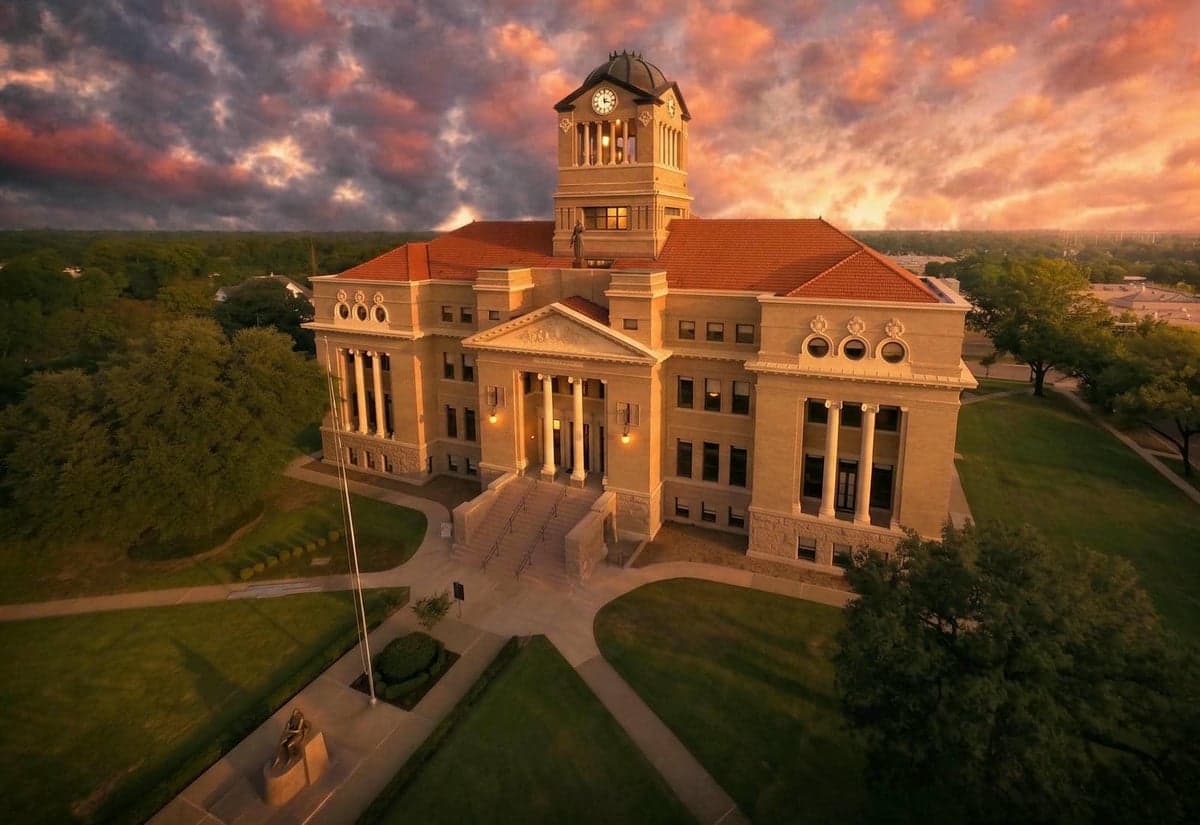
Corsicana’s human history begins with its founding in 1848 as a trading post on the Texas prairie, named after the father of a local settler. The first major population wave arrived in the 1870s with the completion of the Houston and Texas Central Railway, which transformed the town into a cotton and livestock shipping center. This era drew Anglo-American farmers and merchants, who established the original residential core around the downtown square in what is now the Downtown Historic District. A second, transformative wave began in 1894 with the discovery of the Corsicana Oil Field, the first major oil strike west of the Mississippi. This boom attracted a flood of white and Black laborers, as well as early European immigrants (primarily German and Czech), who settled in working-class neighborhoods like West Side and East Side, the latter becoming a historically Black community centered around the Lincoln High School area. By the 1920s, the city’s population had swelled to over 11,000, with the oil industry and its supporting businesses—including the still-operating Collin Street Bakery—cementing a blue-collar identity.
Modern era (post-1965)
The post-1965 period brought significant demographic shifts, driven by the Immigration and Nationality Act and the decline of domestic oil production. The Hispanic population, which was negligible before 1970, began growing steadily as Mexican-American families moved into the area for agricultural and construction work, settling primarily in the North Corsicana and West Side neighborhoods. The Black population, which had been a stable 20-25% share through the mid-20th century, declined slightly to 14.6% as some families left for larger urban job markets. The white population, once a dominant majority, fell from over 70% in 1970 to 39.0% today, reflecting both out-migration to suburban areas like Lake Corsicana and the growth of other groups. The East/Southeast Asian community, at 1.4%, is a small but visible presence, with Vietnamese and Filipino families concentrated in the Southwest Corsicana area near the Walmart corridor. The Indian-subcontinent population remains tiny at 0.2%, with no distinct enclave. The foreign-born share of 11.3% is almost entirely Hispanic, with a small number of Asian immigrants. Suburbanization within the city limits has been limited, as Corsicana lacks the sprawling master-planned communities common in the Dallas-Fort Worth metroplex, but newer subdivisions like Oak Valley have attracted some white and Hispanic middle-class families seeking newer housing stock.
The future
The population trajectory suggests Corsicana is slowly homogenizing in terms of class while tribalizing along ethnic lines. The Hispanic share is projected to continue rising, likely surpassing the white share within the next decade, driven by higher birth rates and continued immigration. The white population is aging and declining, while the Black share is stable. The East/Southeast Asian and Indian communities are expected to remain small, as the city lacks the high-skilled job base to attract significant numbers. The college attainment rate of 16.5%—well below the national average—indicates that Corsicana is not becoming a knowledge-economy hub, and the population is likely to remain predominantly working-class. The city is not experiencing rapid gentrification or major new immigrant enclaves; instead, the main trend is the gradual expansion of Hispanic neighborhoods like North Corsicana and West Side, while older white and Black areas like the Downtown Historic District and East Side see slower growth or slight decline. The next 10-20 years will likely see Corsicana become a majority-Hispanic city with a stable Black minority and a shrinking white population, mirroring trends in many smaller Texas industrial towns.
For someone moving in now, Corsicana is becoming a more diverse, younger, and more Hispanic community, but one that remains economically modest and family-oriented. The city’s identity is shifting from its Anglo-oil-past to a working-class, multicultural present, with strong roots in faith, local manufacturing, and a slower pace of life. New residents should expect a place where community ties are strong, but where economic opportunities are limited to sectors like healthcare, education, and light manufacturing, and where the demographic change is a lived reality rather than a future projection.

* Values derived from national, state, county, city and local statistics and may differ in a specific area. Last updated: 2026-05-14T18:15:56.000Z
Narrative content on this page is AI-generated and may contain mistakes. Verify any details that matter before acting on them.
ReloMaps may earn a commission from affiliate links at no extra cost to you.

