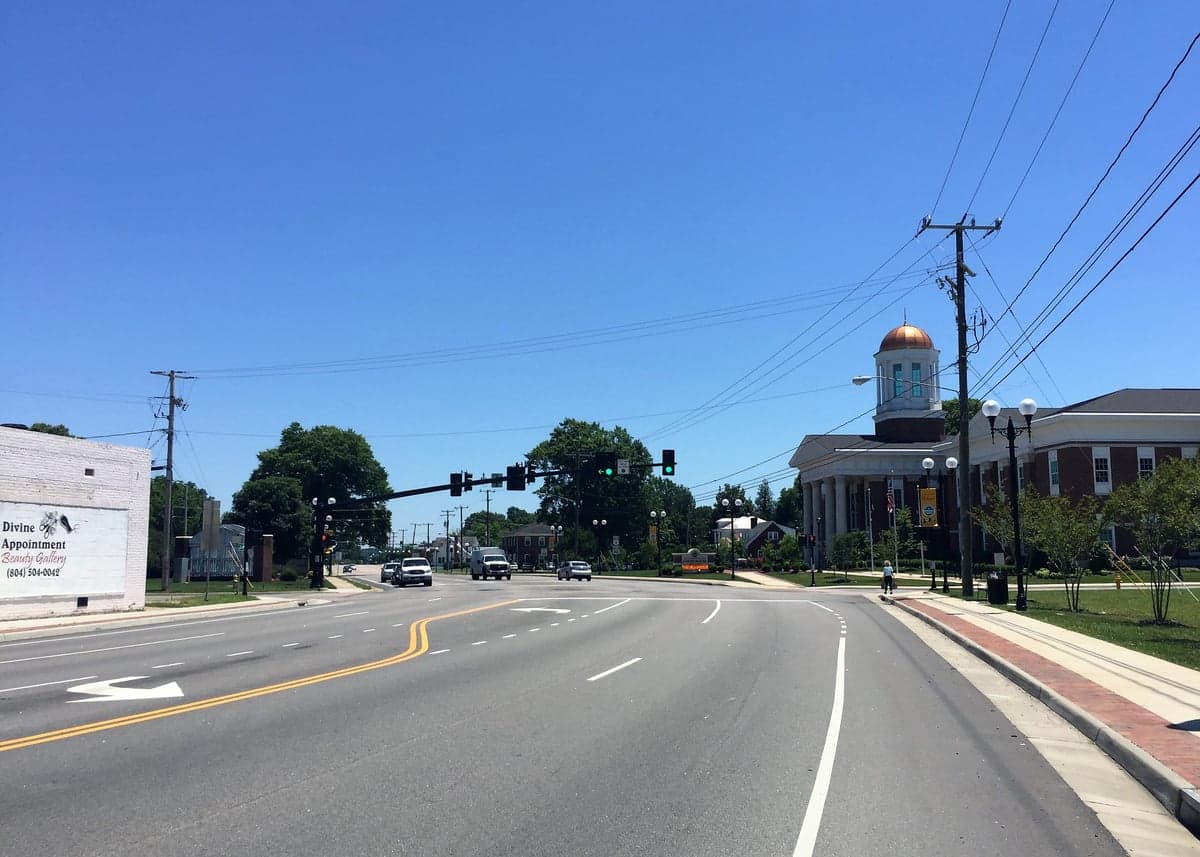
Photo: Wikipedia
Political ClimatePolitical Climate in Colonial Heights, VA
District shown is the primary district for this city’s centroid. Cities may span multiple districts.
Inherited from parent state — no local data available.
Local Political AnalysisPolitical Analysis of Colonial Heights, VA
Colonial Heights, Virginia, has long been a reliably conservative stronghold, but the Cook PVI of D+17 tells a different story than the one longtime residents remember. This rating, which measures how the area votes compared to the national average, actually reflects a shift toward the Democratic Party in recent years—a trend that has many of us here watching closely. While the city itself still leans right in local elections, the broader political climate is becoming more contested, and that’s a real change from the days when you could count on a straight Republican ticket without a second thought.
How it compares
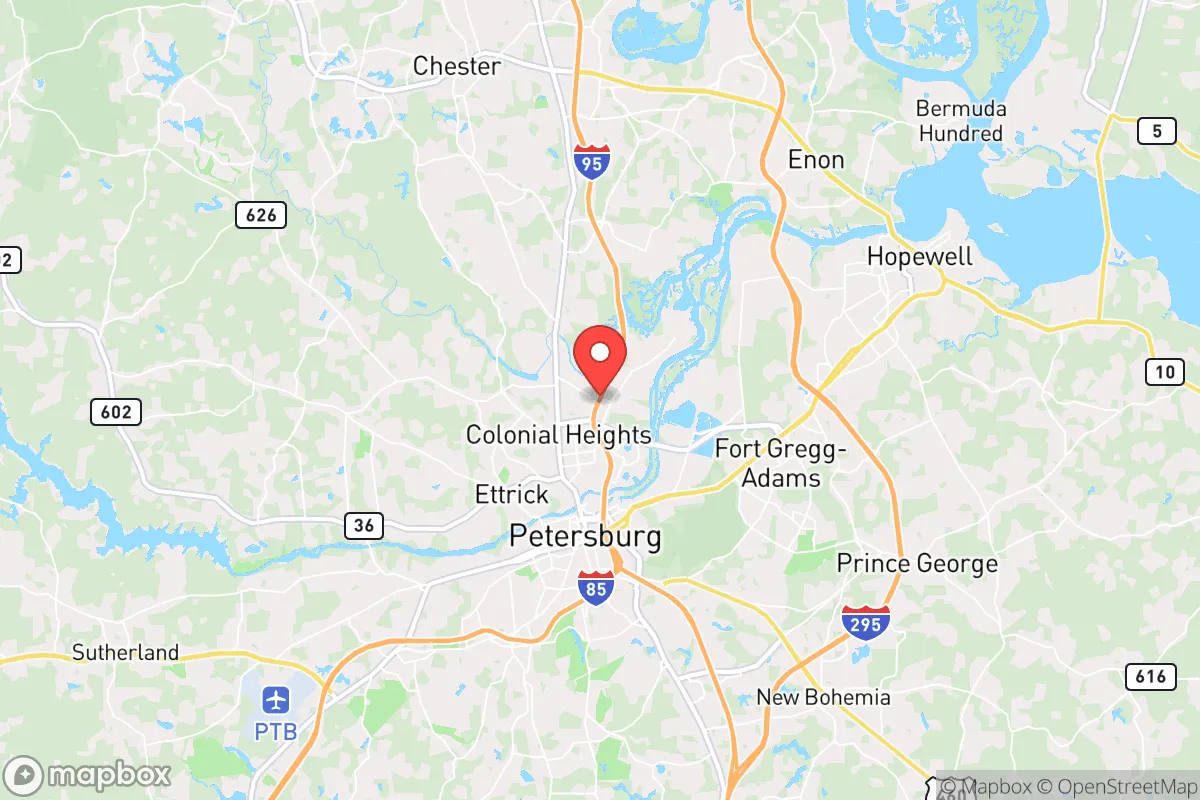
To understand Colonial Heights today, you have to look at the neighbors. Just across the Appomattox River, Petersburg is a deeply Democratic city with a Cook PVI of D+27, and Richmond to the north is even more progressive. But head south or west into Chesterfield County or Dinwiddie, and you’ll find areas that still vote solidly Republican—places where the local government keeps taxes low and stays out of your business. Colonial Heights used to be right in that camp, but the D+17 rating suggests it’s now more purple than red. The city council and school board still lean conservative, but the influence from nearby urban centers is creeping in, especially as new residents move here for the lower cost of living while bringing big-city voting habits with them.
What this means for residents
For those of us who’ve lived here a while, the biggest concern is how this shift affects daily life. A more progressive tilt often means more government involvement in things that used to be left to families and local communities—like zoning decisions, school curriculum, and even how small businesses operate. We’ve already seen debates over mask mandates and vaccine requirements that felt heavy-handed, and there’s a growing push for higher property taxes to fund programs that don’t always align with traditional values. The good news is that Colonial Heights still has a strong sense of local control, and the city’s small size means your voice can still be heard at town hall meetings. But if the trend continues, you might see more regulations on everything from rental properties to lawn care—stuff that used to be common sense, not government business.
On the cultural side, Colonial Heights has always been a place where people wave to each other on the street and the Fourth of July parade is a big deal. That hasn’t changed yet, but the political tension is starting to show. You’ll hear folks grumbling about “Richmond ideas” creeping in, and there’s a real worry that the next few election cycles could bring policies that feel like overreach—like stricter gun laws or mandates that affect how you run your own household. For now, the city remains a good spot for anyone who values personal freedom and a slower pace of life, but keep an eye on the school board races and city council elections. Those are where the real battles are happening, and they’ll tell you whether Colonial Heights stays true to its roots or drifts toward the kind of progressive governance that’s taken over so many other places in Virginia.

State Political ClimatePolitical Climate in Virginia
State Political AnalysisPolitical Environment in the State
Virginia has shifted from a reliably purple swing state to a solidly blue one over the past 15 years, driven largely by explosive growth in the Washington, D.C. suburbs. The state hasn’t voted for a Republican presidential candidate since 2004, and Democrats now control the governorship, both chambers of the General Assembly, and both U.S. Senate seats. For a conservative considering relocation, the key takeaway is that while the state’s overall lean is now left-of-center, the political geography is deeply split — and the policy environment reflects that tension.
Urban vs. rural divide
The political map of Virginia is a textbook case of the urban-rural chasm. The entire Democratic majority is generated by three metro regions: Northern Virginia (Arlington, Alexandria, Fairfax County), the Richmond metro (Henrico County, the city of Richmond itself), and the Hampton Roads area (Norfolk, Virginia Beach). These three regions account for roughly 70% of the state’s population and vote 60-70% Democratic in statewide races. Meanwhile, the rest of the state — from the Shenandoah Valley through Southside Virginia to the southwestern coalfields — votes 60-70% Republican. The most dramatic flip has been in Loudoun County, which went from a +20 Republican margin in 2004 to a +25 Democratic margin by 2020, driven by tech-worker transplants from D.C. Conversely, Roanoke and Lynchburg remain reliably red anchors in the western part of the state, while Virginia Beach has become a true swing city, voting narrowly for Biden in 2020 but electing a Republican mayor in 2024.
Policy environment
Virginia’s policy environment is a mixed bag that reflects its split personality. On taxes, the state is relatively competitive: a flat 5.75% income tax and a 4.3% sales tax (with local add-ons) keep it middle-of-the-pack nationally. Property taxes are locally set and generally moderate, though they’ve been rising fast in Northern Virginia. The regulatory posture is business-friendly in the right-leaning parts of the state — Chesterfield County and Hanover County actively court development with low permitting friction — but the state-level bureaucracy in Richmond has become more aggressive under Democratic control. Education policy is a flashpoint: the state eliminated its charter school cap in 2021, but actual charter growth has been slow due to local resistance. Parental rights took a hit in 2020 when the General Assembly passed a law requiring schools to adopt policies aligned with the Virginia Department of Education’s model policies on transgender students, which many conservatives saw as undermining parental authority. Election laws have tightened in the other direction: Virginia now has no-excuse absentee voting, same-day registration, and automatic voter registration, all of which conservatives argue reduce election integrity. The state also legalized recreational marijuana in 2021, though retail sales have been delayed until 2025 at the earliest.
Trajectory & freedom
On the freedom front, Virginia has been moving in a concerning direction for conservatives over the past five years. The most visible flashpoint was the 2020 passage of the Virginia Values Act, which added sexual orientation and gender identity to the state’s anti-discrimination laws — a move that many religious conservatives saw as a threat to their ability to operate businesses and ministries according to their beliefs. Gun rights have been under sustained assault: in 2020, Democrats passed a package of bills including universal background checks, a one-handgun-per-month limit, and a “red flag” law that allows courts to temporarily seize firearms from individuals deemed a threat. The state also banned the sale of assault weapons in 2020, though that law was later struck down by a federal court. On the positive side for conservatives, Virginia remains a right-to-work state, and the 2021 election of Governor Glenn Youngkin showed that a Republican can still win statewide by running on parental rights and education reform. Youngkin’s administration has rolled back some COVID-era mandates and pushed for more school choice, but the Democratic legislature has blocked most of his agenda. Property rights are generally strong outside of Northern Virginia, where zoning battles are intense.
Civil unrest & political movements
Virginia has been a stage for some of the most visible political confrontations in the country. The 2017 Unite the Right rally in Charlottesville remains a national symbol of far-right extremism, and the city’s subsequent removal of Confederate statues sparked a wave of similar actions across the state. On the left, the 2020 protests in Richmond over the Robert E. Lee statue turned into a months-long occupation of the surrounding park, with activists demanding police defunding and the removal of all Confederate monuments. The state has also seen a surge in organized conservative activism, particularly around school board meetings in Loudoun County and Fairfax County, where parents mobilized against critical race theory and transgender policies. Immigration politics are less heated than in border states, but Northern Virginia has several sanctuary jurisdictions that limit cooperation with ICE, which frustrates conservatives. Election integrity remains a live issue: the 2020 election saw no major irregularities, but the 2021 gubernatorial race was decided by just 2 points, and many conservatives remain skeptical of the state’s expanded mail-in voting system.
Projection
Looking ahead five to ten years, the trajectory is clear: Virginia will continue to trend blue as the D.C. suburbs expand further west and south. The fastest-growing counties in the state are Loudoun, Prince William, and Stafford — all of which are becoming more Democratic with each election cycle. The rural areas are losing population and political clout. However, there are countercurrents: the 2024 election saw Republicans flip two state Senate seats in the Hampton Roads area, suggesting that the Democratic margin is not insurmountable. The key variable is whether conservatives can hold onto the exurban and rural vote while making inroads with the growing Hispanic population in Northern Virginia. If current trends hold, Virginia will be a solidly blue state by 2030, with a Republican presence only in the western and southern rural counties. A conservative moving to Virginia today should expect to live under Democratic governance at the state level for the foreseeable future, with the possibility of occasional Republican victories in gubernatorial years.
For a conservative considering a move to Virginia, the bottom line is this: you can find a community that matches your values in the western and southern parts of the state, but you will be living under a state government that is increasingly hostile to those values. If you’re looking for a place where your vote will matter in state-level races, Virginia is not that place anymore. If you’re willing to fight for your local school board and county commission while accepting that Richmond will be run by the other side, then places like Roanoke, Lynchburg, or Chesterfield County can still offer a good quality of life. Just don’t expect the state to get more conservative anytime soon.
* Values derived from national, state, county, city and local statistics and may differ in a specific area. Last updated: 2026-05-01T18:41:27.000Z
Narrative content on this page is AI-generated and may contain mistakes. Verify any details that matter before acting on them.
ReloMaps may earn a commission from affiliate links at no extra cost to you.

