Photo: Wikipedia
Demographics of Chapel Hill, NC
Affluence Level in Chapel Hill, NC
An upper-middle-class area. Household wealth, education levels, and homeownership run ahead of national benchmarks.
People of Chapel Hill, NC
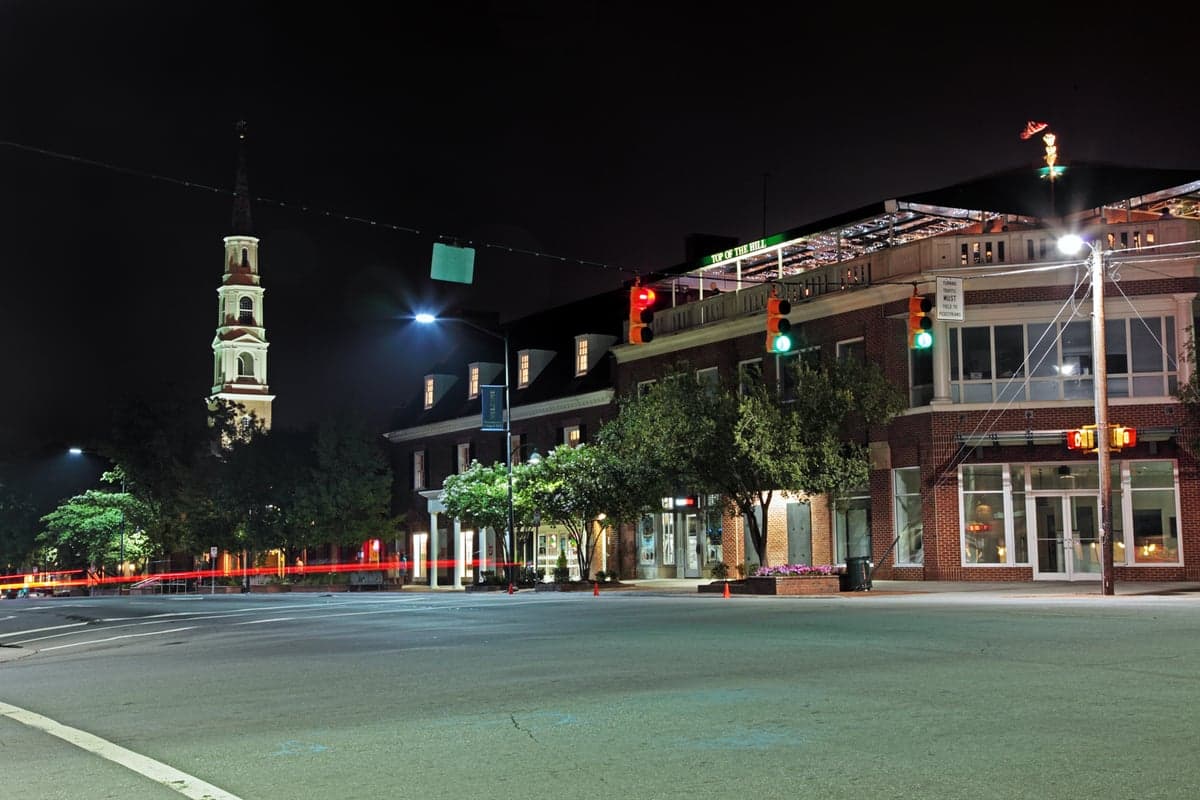
The people of Chapel Hill today form a dense, highly educated community of 59,889 residents, shaped overwhelmingly by the University of North Carolina at Chapel Hill. The city is 63.8% white, with a notable 10.8% Black population, 9.7% East and Southeast Asian, 7.4% Hispanic, and 3.5% Indian (subcontinent). With 77.2% of adults holding a college degree, Chapel Hill is one of the most credentialed small cities in the South, and its 8.2% foreign-born share reflects a steady but moderate international draw rather than a major immigrant gateway.
How the city was settled and grew
Chapel Hill was founded in 1793 specifically to host the University of North Carolina, the nation's first public university. The original population was a mix of plantation-owning families from the North Carolina Piedmont who sent sons to the university, enslaved African Americans who built and maintained the campus, and a small class of merchants and tradesmen serving the college. The historic Northside neighborhood, just north of Franklin Street, was settled by free and enslaved Black families before the Civil War and remains a historically Black community today. The Franklin Street corridor, the city's commercial spine, grew around student boarding houses and taverns. Through the early 20th century, Chapel Hill remained a small college town—its 1900 population was just 1,099—with growth driven by faculty and staff housing in Glen Lennox (built in the 1950s as a planned rental community for university employees) and Colonial Heights, a post-war subdivision for white professionals. The city's Black population, largely confined to Northside and the Pine Knolls area off Homestead Road, worked as domestic laborers and university service staff, a pattern that persisted through the 1960s.
Modern era (post-1965)
The 1965 Hart-Cellar Act and the Civil Rights movement reshaped Chapel Hill's demographics. The university began actively recruiting Black students and faculty, and the 1970s saw the first significant wave of East and Southeast Asian residents—primarily Chinese and Korean graduate students and professors—settling in Southern Village and the Eastwood Lake area. The 1980s and 1990s brought a surge of Indian (subcontinent) professionals, drawn by UNC's medical school and research institutes, who concentrated in Meadowmont and newer subdivisions near the Friday Center. Hispanic growth began later, accelerating after 2000, with many families settling in the Estes Hills and Northwood neighborhoods, often working in construction, landscaping, and the service industry. White in-migration remained dominant, fueled by the university's expansion and the city's reputation as a liberal enclave in a conservative state. The Black share of the population has declined from roughly 18% in 1980 to 10.8% today, as rising housing costs pushed many Black families to nearby Durham and Mebane. The foreign-born share has grown from 4.5% in 1990 to 8.2% in 2024, but this growth is plateauing as the city's high cost of living limits new arrivals.
The future
Chapel Hill's population is trending older, whiter, and more affluent. The university's continued dominance means the city will remain a magnet for highly educated professionals, but the 77.2% college-educated rate leaves little room for further credential-driven growth. The East and Southeast Asian and Indian communities are stable and well-integrated, with second-generation families moving into established neighborhoods like Southern Village and Meadowmont rather than forming new ethnic enclaves. The Hispanic population, while growing slowly, remains the most economically diverse group, concentrated in lower-cost areas like Estes Hills and the Rogers Road corridor. The Black population is likely to continue its gradual decline unless affordable housing initiatives—such as the town's 2023 "Inclusive Zoning" policy—succeed in retaining families. The city is not tribalizing into distinct enclaves; rather, it is homogenizing into a university-oriented professional class, with income and education level becoming stronger dividers than race or ethnicity. The next decade will likely see slow population growth (1-2% annually), an aging white cohort, and a modest increase in Hispanic and Asian shares as the university recruits internationally.
For someone moving in now, Chapel Hill is becoming a stable, high-cost, high-amenity college town where the population is defined more by educational attainment and university affiliation than by ethnic or immigrant identity. The city's demographic future is one of slow, managed growth, with the university as the primary engine of change. New residents should expect a community that is highly educated, politically liberal, and increasingly expensive, where the historic Black and working-class populations are shrinking, and where international diversity is concentrated among professional-class families rather than refugee or labor-migrant communities.

* Values derived from national, state, county, city and local statistics and may differ in a specific area. Last updated: 2026-04-29T23:22:12.000Z
Narrative content on this page is AI-generated and may contain mistakes. Verify any details that matter before acting on them.
ReloMaps may earn a commission from affiliate links at no extra cost to you.

