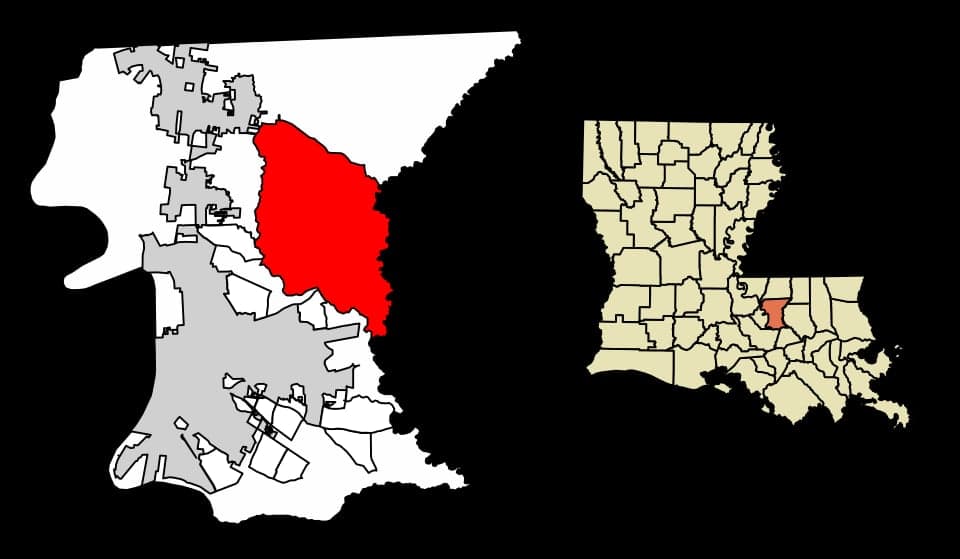
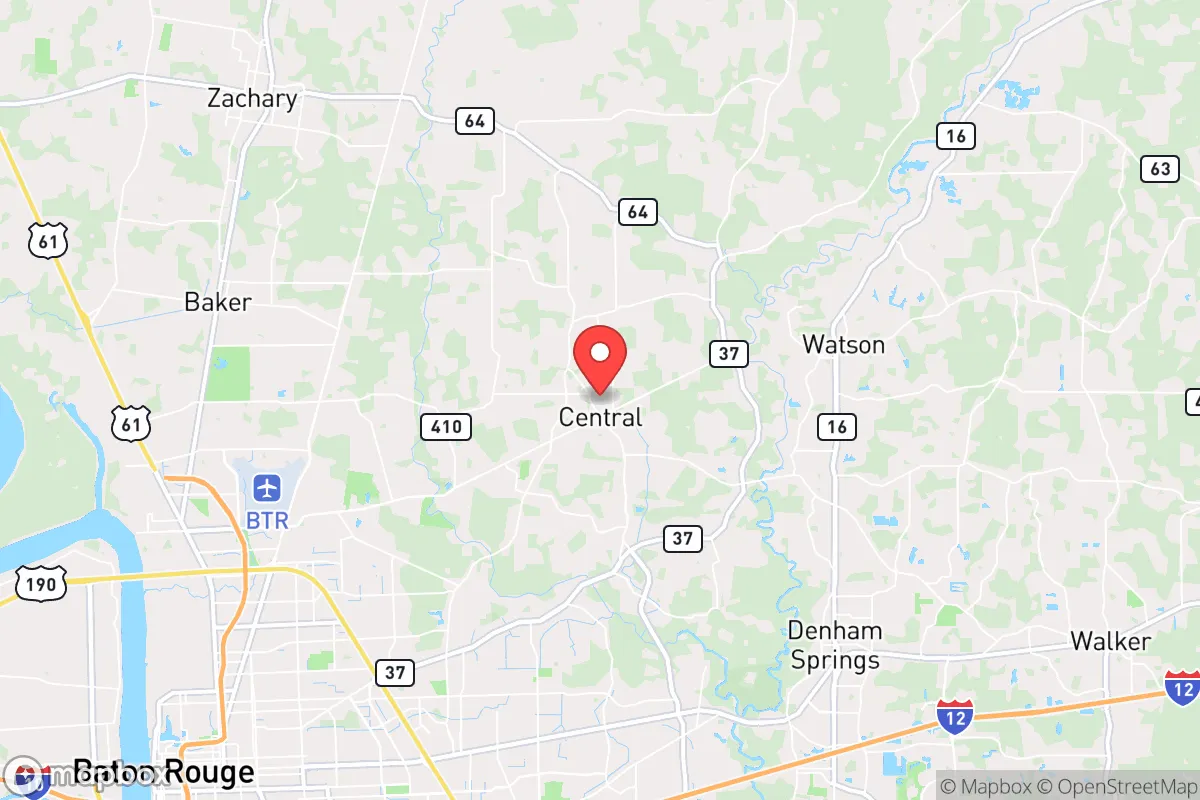
Photo: Wikipedia
Demographics of Central, LA
Affluence Level in Central, LA
An upper-middle-class area. Household wealth, education levels, and homeownership run ahead of national benchmarks.
People of Central, LA
Central, Louisiana, is a predominantly white, family-oriented suburb of Baton Rouge with a population of 29,603 that prides itself on small-town values, low crime, and strong public schools. The city’s identity is shaped by its relatively recent incorporation (2005) and its residents’ deliberate choice to separate from the more urbanized East Baton Rouge Parish. With a foreign-born population of just 1.0% and a Black population of 11.6%, Central remains one of the most racially homogeneous and culturally conservative communities in the Baton Rouge metro area.
How the city was settled and grew
Central was never a plantation-era settlement or a river port. Its original population consisted of small-scale farmers and timber workers who moved into the piney woods north of Baton Rouge in the late 19th and early 20th centuries. The area was originally part of East Baton Rouge Parish and was known simply as the “Central community” because of its geographic position between the Comite and Amite rivers. The first wave of permanent residents were white Anglo-Saxon Protestants of English and Scots-Irish descent who built homesteads along what are now Greenwell Springs Road and Hooper Road. These families were drawn by cheap, timber-rich land and the promise of self-sufficiency. By the 1940s, a small cluster of homes and churches had formed around the intersection of Sullivan Road and Joor Road, an area still referred to by longtime residents as “Old Central.” The population remained sparse—fewer than 2,000 people—until the post-World War II era, when Baton Rouge’s petrochemical boom began pushing middle-class white families northward in search of larger lots and quieter streets.
Modern era (post-1965)
The 1965 Hart-Cellar Act had little direct effect on Central, as the area attracted almost no international immigration. Instead, the major demographic shift came from domestic white flight out of Baton Rouge proper. Between 1970 and 2000, the population of the Central area grew from roughly 5,000 to over 20,000, driven almost entirely by white families leaving the increasingly diverse and crime-ridden neighborhoods of Baton Rouge. This wave settled in newly developed subdivisions such as White Oak Estates, Deerfield, and Shadowbrook, which offered large homes on acreage and access to the highly rated Central Community School System. The incorporation movement of the early 2000s was explicitly framed as a way to preserve local control over schools, zoning, and law enforcement. Today, the city’s 78.3% white population is concentrated in these newer subdivisions, while the 11.6% Black population is largely clustered in older, unincorporated pockets near Greenwell Springs and along Blackwater Road. The Hispanic share (4.8%) is small but growing, primarily among families working in construction and landscaping who have settled in rental properties near Central Thrifty Way and the commercial corridor along Hooper Road. East/Southeast Asian residents (0.4%) and Indian-subcontinent residents (0.0%) are virtually absent, reflecting the city’s lack of the professional-class job base that attracts those groups to other Baton Rouge suburbs.
The future
Central’s population is projected to grow slowly to around 32,000 by 2035, driven by continued out-migration from Baton Rouge and the completion of new subdivisions like The Settlement at Blackwater. The city is likely to remain overwhelmingly white and native-born, as its housing stock (mostly single-family homes on half-acre lots) and lack of rental density do not attract immigrant families. The Hispanic share may rise to 7-8% over the next decade as service-sector workers seek affordable housing, but the Black population share is expected to remain stable or decline slightly as older Black residents in the Greenwell Springs area sell to white buyers. There is no evidence of tribalization into distinct ethnic enclaves; instead, the city is homogenizing into a uniformly middle-to-upper-middle-class white suburb. The small Indian and East/Southeast Asian populations will likely remain negligible, as Central offers no ethnic grocery stores, places of worship, or community organizations for those groups.
For a conservative-leaning individual or family moving in now, Central represents a stable, low-diversity community where property values are rising, schools are strong, and the pace of change is slow. The city is becoming more affluent and more politically homogeneous, not more diverse. New arrivals should expect a place where neighborly familiarity and local civic engagement are the norm, and where the demographic profile of 2026 will look very similar to that of 2046.

* Values derived from national, state, county, city and local statistics and may differ in a specific area. Last updated: 2026-05-01T10:43:39.000Z
Narrative content on this page is AI-generated and may contain mistakes. Verify any details that matter before acting on them.
ReloMaps may earn a commission from affiliate links at no extra cost to you.

