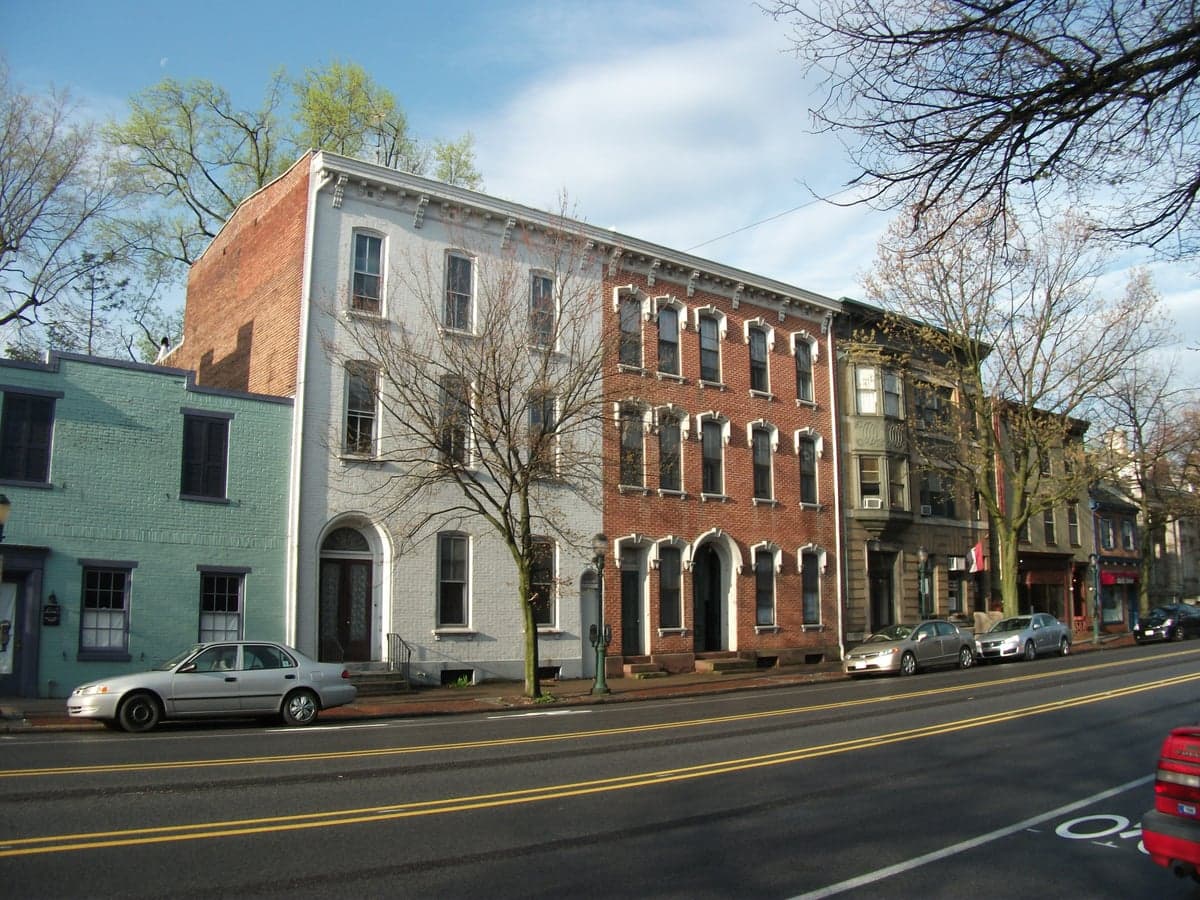
Photo: Wikipedia
Personal Sovereignty in Carlisle, PA
Strong independent fundamentals that actively favor personal liberty and low regulation.
What does Personal Sovereignty tell us?
Personal Sovereignty measures your capacity for self-reliance and independence with minimal government friction. Higher scores mean fewer barriers between you and the way you want to live... but it assumes you have the space you need and good neighbors.
What does this tell us?
Personal Sovereignty measures your capacity for self-reliance and independence with minimal government friction. Higher scores mean fewer barriers between you and the way you want to live... but it assumes you have the space you need and good neighbors.
State Policy
Energy independence: Net exporter (150% of energy produced in-state)
Personal Liberty
Homesteading

Personal Liberty Analysis
Carlisle, Pennsylvania offers a mixed bag for those prioritizing personal sovereignty, with the state’s overall regulatory climate creating both opportunities and constraints for individuals seeking maximum autonomy. While Pennsylvania is not a libertarian stronghold, Carlisle’s position in the more rural and culturally conservative Cumberland County provides a buffer against some of the more intrusive policies seen in Philadelphia or Pittsburgh. The town’s character is shaped by a blend of small-town self-reliance and the inevitable reach of state-level governance, meaning a strategic relocation here requires understanding where you can operate freely and where you’ll face friction.
Tax burden and regulatory posture in Cumberland County
Pennsylvania’s tax structure is a double-edged sword for the sovereignty-minded. The state imposes a flat 3.07% personal income tax, which is moderate compared to neighboring states like New York or New Jersey, but there is no tax on retirement income—a significant win for those looking to reduce dependency on the state. Property taxes in Carlisle and Cumberland County are a heavier lift, with effective rates typically landing between 1.5% and 2.0% of assessed home value, driven largely by school district levies. This is a real cost of ownership that eats into self-reliance budgets. On the regulatory front, Pennsylvania is not a “right to work” state, meaning union influence can affect local business climates, but Carlisle itself is not a union stronghold. The state’s business tax climate ranks in the middle of the pack nationally, so starting a small homesteading or trade business here is feasible but comes with more paperwork than in states like Texas or Florida. The county’s zoning is generally permissive in unincorporated areas, but Carlisle’s borough limits impose stricter codes on property use, which can be a hurdle for those wanting to run a home-based enterprise or keep livestock.
Self-defense and gun law specifics in Pennsylvania
Pennsylvania is a “shall issue” state for concealed carry permits, meaning Carlisle residents can obtain a license to carry a firearm without subjective approval from local authorities, provided they pass a background check. This is a solid foundation for self-defense rights. The state preempts local gun ordinances, so Carlisle cannot enact its own bans or restrictions that exceed state law—a critical protection against patchwork regulations. However, Pennsylvania does have some notable limits: open carry is legal without a permit except in Philadelphia, but you must have a permit to carry a concealed firearm in a vehicle. The state also requires a background check for private handgun sales at gun shows, though long gun private sales between individuals are not regulated. Castle Doctrine and Stand Your Ground laws are on the books, giving strong legal backing for using deadly force in self-defense within your home or vehicle. For the prepper, the biggest downside is that Pennsylvania does not recognize all out-of-state permits, so if you move here, you’ll need to apply for a Pennsylvania License to Carry Firearms (LTCF) within 45 days of establishing residency. The process is straightforward in Cumberland County, but it’s an extra step that adds a layer of government interaction.
Self-reliance and homesteading viability in Carlisle
For those looking to reduce dependence on supply chains and utilities, Carlisle’s surrounding area offers genuine potential, but with caveats. Within the borough itself, lot sizes are typically small (under a quarter-acre), and zoning restricts keeping chickens, goats, or other livestock to a limited number of birds, with no large animals allowed. The real opportunity lies in the townships surrounding Carlisle—North Middleton, South Middleton, and West Pennsboro—where you can find parcels of 1 to 5 acres at prices ranging from $15,000 to $40,000 per acre as of 2025. These areas allow for gardens, small orchards, and limited livestock without excessive permitting. Off-grid feasibility is moderate: Pennsylvania has no state law prohibiting rainwater collection, but well drilling requires a permit and testing, and solar panel installation is allowed but must comply with local building codes. The biggest sovereignty win here is that Cumberland County does not have a county-wide building code for agricultural structures, meaning you can erect a barn or workshop without a permit if it’s used for farming. However, connecting to the grid is still the norm, and going fully off-grid with septic and solar will require navigating township-level approvals that can be time-consuming.
Personal liberties in Carlisle: parental rights, medical autonomy, and speech
Pennsylvania’s track record on parental rights is mixed. The state does not have a broad “parental bill of rights” like Florida or Texas, but local school boards in Cumberland County have generally resisted extreme curriculum mandates. Carlisle Area School District has faced debates over library materials and health curricula, but parents have been able to influence policy through school board elections—a key lever for maintaining local control. Medical autonomy is a weaker point: Pennsylvania has not passed any broad medical freedom legislation, and vaccine mandates for school attendance remain in place, though exemptions for religious and philosophical reasons are available. This is a significant consideration for families who want to opt out of standard medical protocols. On speech and property rights, Pennsylvania is relatively strong. There are no state-level hate speech laws that criminalize political expression, and property rights are protected by the state constitution’s “takings” clause, though eminent domain has been used for economic development projects in the past. The biggest threat to personal sovereignty here is the state’s emergency powers: during the pandemic, the governor imposed broad restrictions that were later challenged in court, but the precedent shows that executive overreach is a real risk in Pennsylvania.
Overall, Carlisle offers a workable but not exceptional environment for personal sovereignty compared to other regions. It sits in a sweet spot for those who want the legal protections of a “shall issue” gun state and the affordability of rural homesteading, but who are willing to accept a moderate tax burden and some state-level interference in medical and educational choices. For the survivalist or prepper, the key is to locate outside the borough limits, engage with local township politics to preserve zoning freedoms, and stay vigilant about state-level legislation that could erode the autonomy you’ve secured. Compared to a state like New Hampshire or Idaho, Carlisle falls short on pure liberty metrics, but it beats the vast majority of the Northeast and Mid-Atlantic for those who value self-reliance and are strategic about where they plant their roots.

* Values derived from national, state, county, city and local statistics and may differ in a specific area. Last updated: 2026-05-01T00:36:49.000Z
Narrative content on this page is AI-generated and may contain mistakes. Verify any details that matter before acting on them.
ReloMaps may earn a commission from affiliate links at no extra cost to you.

