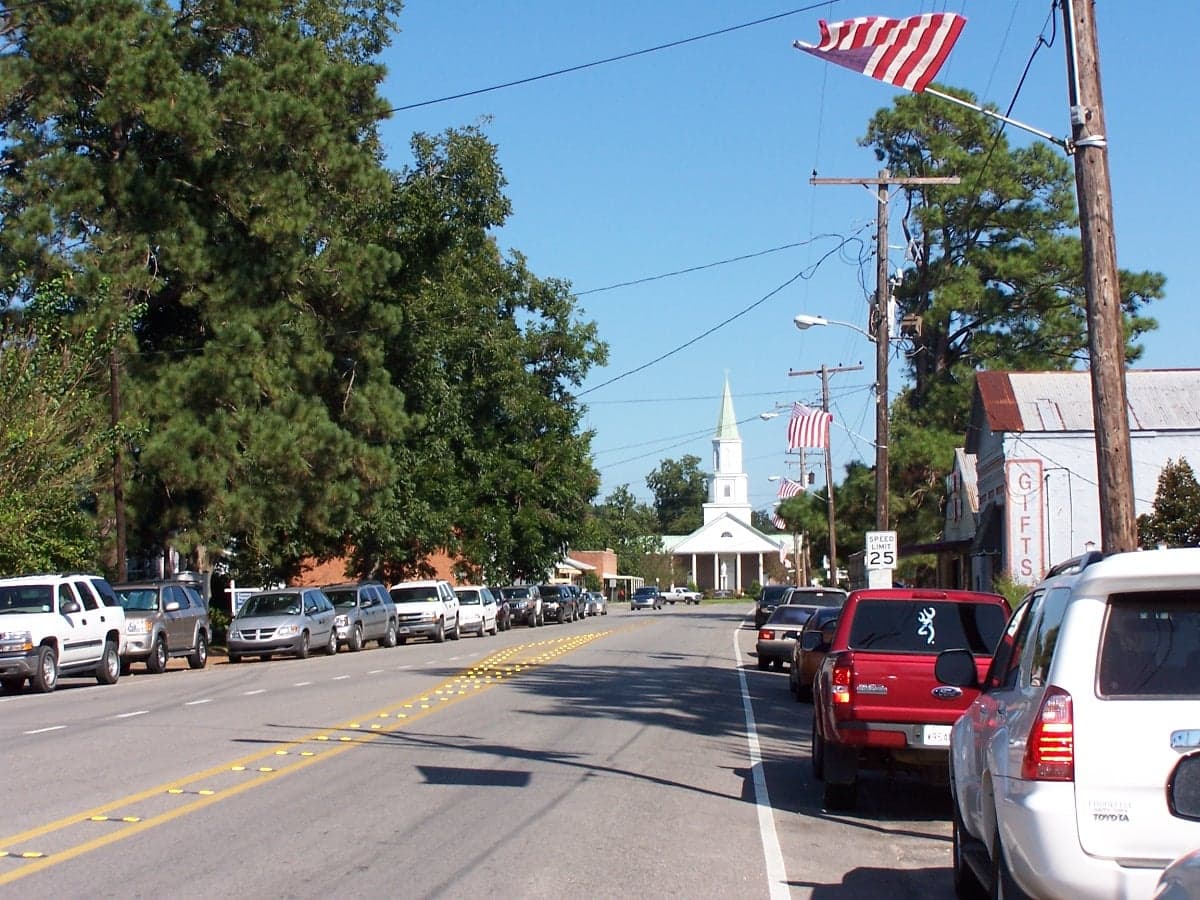
Photo: Wikipedia
Demographics of Carencro, LA
Affluence Level in Carencro, LA
A middle-class area roughly in line with national averages across income, home values, education, and employment.
People of Carencro, LA
The people of Carencro, Louisiana, today form a community of roughly 10,882 residents, defined by a Black majority (49.7%) and a substantial White minority (39.8%), with small but distinct East/Southeast Asian (1.2%) and Indian-subcontinent (1.2%) populations. The city is notably less diverse than the broader Lafayette metro area, with a foreign-born share of just 1.5% and a low college attainment rate of 15.9%. Carencro’s identity is rooted in its rural Cajun and Creole heritage, yet its modern character is increasingly shaped by the economic pull of nearby Lafayette and the preservation of tight-knit, historically segregated neighborhoods.
How the city was settled and grew
Carencro’s settlement began in the late 18th century as French-speaking Acadians (Cajuns) and Creoles of mixed African, French, and Spanish ancestry moved into the fertile prairie and bayou lands west of the Atchafalaya Basin. The original land grants, issued under Spanish and later American rule, created a patchwork of small farms centered on cattle, rice, and sugarcane. The arrival of the railroad in the 1880s spurred a modest commercial core around what is now the Old Town Carencro district, where Cajun merchants and Creole tradesmen built the first churches, general stores, and a cotton gin. By the early 20th century, the community had developed distinct enclaves: North Carencro became a predominantly Black Creole neighborhood, anchored by the historic St. Peter’s Catholic Church (founded 1902), while South Carencro remained largely White Cajun, centered on the St. John Berchmans Cathedral. The oil boom of the 1930s–1950s brought a small influx of Anglo workers from Texas and Oklahoma, but Carencro remained a rural service town, its population hovering around 2,000 until the 1960s.
Modern era (post-1965)
The post-1965 period, driven by the Hart-Cellar Act and the expansion of Lafayette’s petrochemical and healthcare industries, reshaped Carencro’s demographics. The city’s Black population grew steadily as families moved from rural farm labor into suburban-style housing in Bois Mallet and Ridge Road neighborhoods, drawn by proximity to Lafayette’s jobs and the relative affordability of land. White flight from Lafayette’s urban core also accelerated in the 1970s and 1980s, with new subdivisions like Acadian Hills and Bayou Shadows attracting middle-class White families seeking larger lots and lower taxes. The East/Southeast Asian community, primarily Vietnamese and Filipino, arrived in small numbers after 1975, settling mostly in the Ambassador Caffery corridor near the Lafayette line, where a handful of Asian-owned nail salons and restaurants opened. The Indian-subcontinent population, largely professionals in healthcare and IT, is even smaller and more dispersed, with no distinct ethnic enclave. By 2000, Carencro had become a bedroom suburb of Lafayette, its population tripling to over 7,000, but the racial divide between North Carencro (over 80% Black) and South Carencro (over 70% White) remained stark.
The future
Carencro’s population is likely to continue slow growth, driven by Lafayette’s suburban spillover, but the city faces demographic stagnation rather than transformation. The foreign-born share (1.5%) is far below the national average, and the small East/Southeast Asian and Indian communities show no signs of rapid expansion—they are plateauing as second-generation professionals move to larger metros like Houston or Baton Rouge. The Black and White populations are both aging, with younger families increasingly choosing newer subdivisions in Youngsville or Broussard. The city is not homogenizing; rather, it is tribalizing into its historic enclaves, with North Carencro and Bois Mallet remaining predominantly Black, and South Carencro and Acadian Hills staying overwhelmingly White. The low college attainment rate (15.9%) and limited local job base mean that Carencro will likely remain a working-class suburb, its identity tied to its Cajun and Creole roots rather than to new immigration.
For a conservative-leaning individual or family considering a move, Carencro offers a stable, low-crime, family-oriented environment with strong church communities and a slower pace of life. The city is not becoming a melting pot—it is a place where distinct racial and cultural enclaves coexist without significant mixing. New residents should expect to choose a neighborhood that aligns with their background and values, as the city’s social fabric remains largely defined by its historical divisions.

* Values derived from national, state, county, city and local statistics and may differ in a specific area. Last updated: 2026-10-10T16:27:00.000Z
Narrative content on this page is AI-generated and may contain mistakes. Verify any details that matter before acting on them.
ReloMaps may earn a commission from affiliate links at no extra cost to you.

