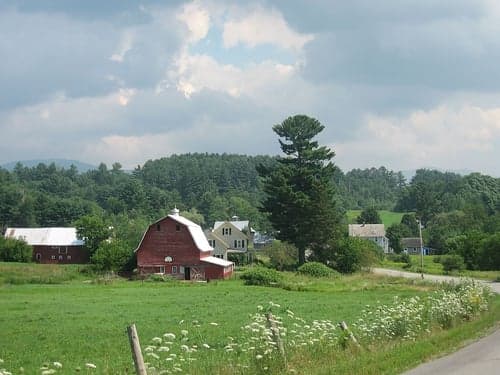
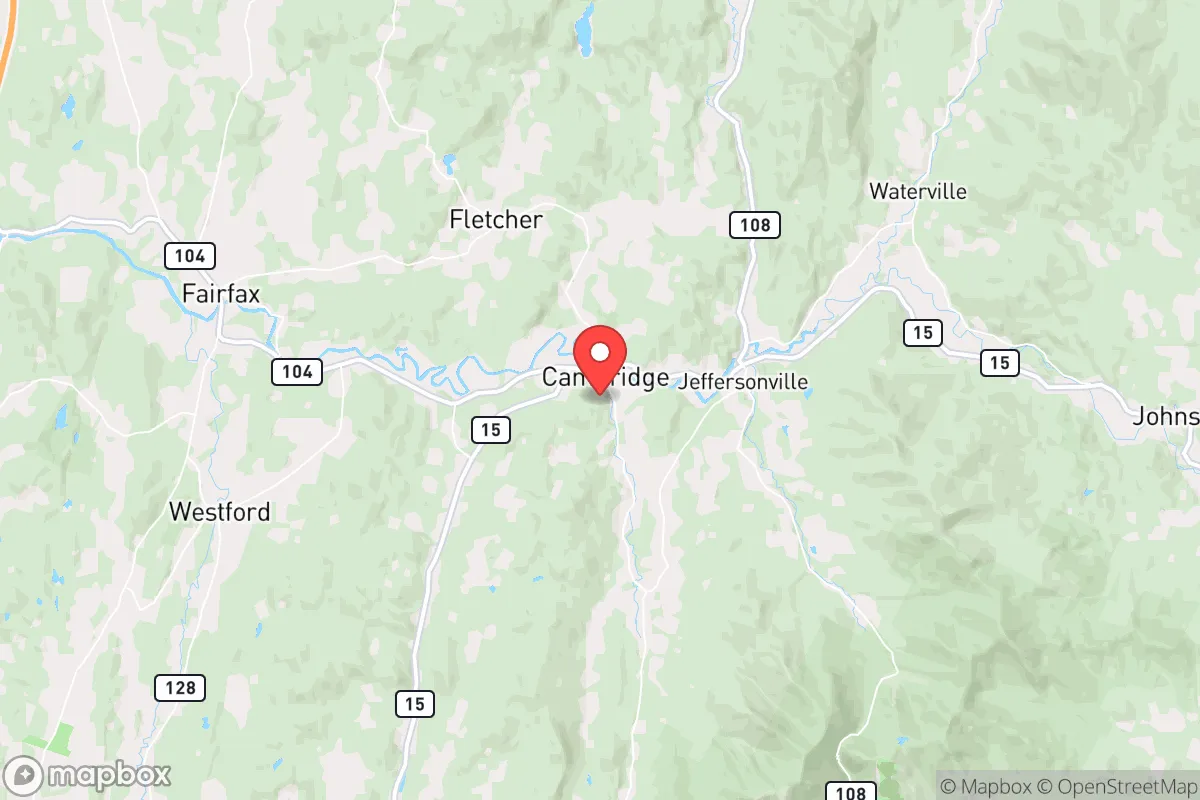
Photo: Wikipedia
Personal Sovereignty in Cambridge, VT
Moderate friction. Expect trade-offs in some aspect of personal liberty and independence.
What does Personal Sovereignty tell us?
Personal Sovereignty measures your capacity for self-reliance and independence with minimal government friction. Higher scores mean fewer barriers between you and the way you want to live... but it assumes you have the space you need and good neighbors.
What does this tell us?
Personal Sovereignty measures your capacity for self-reliance and independence with minimal government friction. Higher scores mean fewer barriers between you and the way you want to live... but it assumes you have the space you need and good neighbors.
State Policy
Energy independence: Importer (15% of energy produced in-state)
Personal Liberty
Homesteading

Personal Liberty Analysis
Cambridge, Vermont, offers a mixed bag for those prioritizing personal sovereignty, with the town's rural character and low population density providing a foundation for autonomy, but the state of Vermont's increasingly progressive governance imposing significant constraints. Nestled in Lamoille County, Cambridge's roughly 3,900 residents enjoy a degree of physical separation from federal overreach, yet must contend with state-level policies that can feel intrusive to those with a survivalist or prepper mindset. For the conservative-leaning individual or family seeking to minimize government entanglement, the key question is whether Cambridge's local advantages can outweigh the burdens of living under Montpelier's authority.
Tax burden and regulatory posture in Vermont's progressive landscape
Vermont's tax climate is a major consideration for anyone valuing financial sovereignty. The state imposes a progressive income tax with rates reaching 8.75% on high earners, and property taxes are among the highest in the nation, averaging roughly 1.8% of assessed home value. In Cambridge, this translates to a significant annual outlay on a modest home, funding a state government that has expanded its reach into everything from energy mandates to land use. The regulatory environment is dense, with Act 250—Vermont's landmark development control law—subjecting even minor construction projects to state-level review, a clear infringement on property rights. For a prepper looking to build a secure homestead or workshop, expect permitting delays and compliance costs that can stifle self-reliance. Sales tax is a relatively low 6%, but the state's aggressive pursuit of tax revenue through other means, including a new payroll tax for paid family leave, signals a government that sees personal income as a communal resource. Vermont's tax burden ranks as the 5th highest in the nation, a reality that directly reduces the capital available for independent living and emergency preparedness.
Self-defense and gun law specifics in a restrictive state
For those who view the Second Amendment as a cornerstone of personal sovereignty, Vermont presents a stark contradiction. On one hand, the state has a strong tradition of gun ownership and does not require a permit to carry a concealed firearm—a positive for immediate self-defense. However, the landscape has shifted dramatically in recent years. In 2023, Vermont enacted a ban on "assault weapons" and large-capacity magazines, along with raising the purchase age for all firearms to 21. Magazines holding more than 10 rounds for long guns and 15 for handguns are now illegal to possess, a direct blow to preppers who rely on standard-capacity magazines for defensive or hunting purposes. Red flag laws are also in effect, allowing authorities to seize firearms based on unproven allegations, a clear due process violation. While Cambridge's rural setting means fewer encounters with law enforcement, the state's willingness to restrict firearm ownership is a major red flag. For the survivalist, the ability to defend one's home and family is non-negotiable, and Vermont's recent trajectory suggests further erosion of these rights is likely.
Self-reliance and homesteading viability in Cambridge's rural setting
Cambridge's rural character offers genuine opportunities for self-reliance, but with caveats. The town is zoned primarily for agricultural and residential use, with minimum lot sizes typically around 2 acres in rural areas, though some parcels are larger. This allows for substantial gardening, small-scale livestock, and even a modest orchard. The local soil is generally fertile, and the growing season, while short (roughly 120 days), is sufficient for cold-hardy crops. Off-grid living is technically feasible, but Vermont's building codes and Act 250 can complicate efforts to install solar panels, rainwater catchment systems, or composting toilets without state approval. Many off-grid properties in the area still rely on grid-tied power as a backup, due to the difficulty of getting permits for fully independent systems. The cost of land in Cambridge is moderate by Vermont standards, with raw acreage ranging from $5,000 to $15,000 per acre, but property taxes on even a small homestead can run $3,000-$5,000 annually. For the prepper, the land itself is viable, but the regulatory overhead is a constant drag on true independence.
Personal liberties in an era of expanding state control
Parental rights in Vermont are under increasing pressure, with the state mandating LGBTQ+ inclusive curriculum in public schools and allowing minors to consent to certain medical procedures without parental notification. For conservative parents, this represents a direct challenge to their authority to raise children according to their values. Medical autonomy is similarly constrained; Vermont has some of the most permissive vaccine mandates in the country, with school attendance requiring a full slate of immunizations and only narrow exemptions. The state's response to the COVID-19 pandemic, including prolonged emergency orders and business closures, demonstrated a willingness to override individual choice in the name of public health. Free speech protections are nominally strong, but the state's social climate can be hostile to conservative viewpoints, particularly in public forums and local governance. Property rights are further eroded by Vermont's land use laws, which can restrict what you do on your own land, from cutting trees to building a fence. The cumulative effect is a state that views personal liberty as subordinate to collective goals, a philosophy fundamentally at odds with the survivalist ethos.
In the broader context of personal sovereignty, Cambridge offers a trade-off: the physical space and rural infrastructure to pursue self-reliance, but within a state government that actively works to limit that pursuit. Compared to states like New Hampshire or Idaho, Vermont's tax burden, gun restrictions, and regulatory overreach are significant liabilities. For the conservative prepper, Cambridge might be a viable option if you can navigate the state's bureaucracy and accept the erosion of certain freedoms, but it is far from a sanctuary. Those prioritizing maximum autonomy would be better served looking to states with lower taxes, stronger gun rights, and fewer mandates, where the government's role in your life is minimal and your ability to prepare for an uncertain future is unencumbered. Cambridge is a compromise, not a stronghold, and that distinction matters when the stakes are your family's survival.

* Values derived from national, state, county, city and local statistics and may differ in a specific area. Last updated: 2026-04-30T13:05:00.000Z
Narrative content on this page is AI-generated and may contain mistakes. Verify any details that matter before acting on them.
ReloMaps may earn a commission from affiliate links at no extra cost to you.

