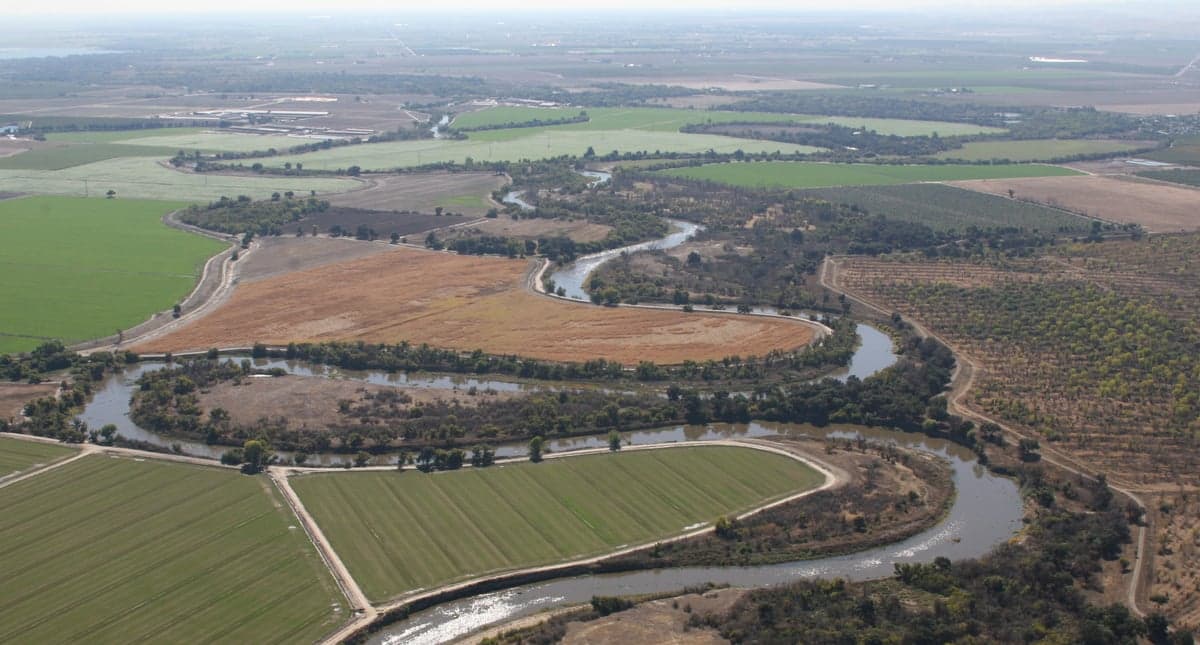
Photo: Wikipedia
Political ClimatePolitical Climate in Stanislaus County
Showing district-level results — no local-only data available.
Local Political AnalysisPolitical Analysis of Stanislaus County
Stanislaus County is one of those rare places in California where conservative values still have a fighting chance, but it’s a fight that’s getting tougher every year. The Cook PVI sits at R+1, which means the county leans just barely Republican, but that’s a far cry from the deep blue D+12 of the state as a whole. In the 2024 presidential election, the county went for Trump by about 3 points, but the margins are shrinking as the state’s progressive machine pushes its agenda into every corner. If you’ve been here long enough, you remember when this was a solid red stronghold—now it’s a battleground where your vote actually matters, but the pressure to conform to Sacramento’s way of thinking is relentless.
How it compares
Compared to California’s D+12 lockstep, Stanislaus County is a political island of sanity. The contrast is stark: while the state legislature in Sacramento churns out one-size-fits-all mandates on housing, energy, and education, local communities here push back. For example, Modesto, the county seat, is a classic swing area—its central precincts lean blue thanks to union and government workers, but the outer neighborhoods and suburbs vote red. Turlock is a mixed bag, with a growing Hispanic population that’s more conservative on family and faith issues than the state’s progressive narrative suggests. Ceres and Patterson are reliably red, while Riverbank and Oakdale are where you’ll find the strongest resistance to the coastal elite’s overreach. The swing precincts are in Salida and parts of Modesto’s west side—these are the neighborhoods that decide local elections, and they’re increasingly wary of the state’s encroachment on local control over land use, water rights, and school curriculum.
What this means for residents
For those of us living here, the political climate means constant vigilance. You can’t take your freedoms for granted. The state’s push for higher taxes, stricter environmental regulations that kill ag jobs, and mandates on everything from gas stoves to gender ideology in schools is a direct threat to the way we’ve always lived. Local school boards in places like Hughson and Waterford have become battlegrounds where parents fight to keep woke indoctrination out of classrooms. The county’s R+1 lean gives us a small buffer, but it’s eroding as more people move in from the Bay Area, bringing their big-government habits with them. If you value your right to raise your kids without state interference, to run a small business without endless red tape, or to own a firearm without a permission slip, Stanislaus County is still a decent place to be—but you have to stay engaged, vote in every local election, and push back against the progressive tide.
Culturally, Stanislaus County is a world apart from coastal California. Here, the Fourth of July parade in Modesto still feels like a small-town celebration, not a political statement. The local fairs and rodeos in Turlock and Oakdale are where community bonds are forged, not identity politics. But the state’s policies are creeping in—higher gas taxes hit our commuters hard, and the high-speed rail boondoggle threatens to carve up farmland. The real distinction is that we still believe in personal responsibility over government handouts, and we’re not afraid to say it. If you’re looking for a place where you can live free from the madness of San Francisco or Los Angeles, this is it—but don’t expect it to stay that way without a fight. The next few years will tell whether Stanislaus County holds the line or gets swallowed by the state’s progressive machine.

State Political ClimatePolitical Climate in California
State Political AnalysisPolitical Environment in the State
California is a deep blue state with a Cook PVI of D+12, meaning it leans more than a dozen points more Democratic than the national average. Over the past 20 years, the state has shifted steadily leftward, driven by massive population growth in coastal metros and a shrinking rural base. While the GOP held the governor’s office as recently as 2003 (Arnold Schwarzenegger), the legislature has been under supermajority Democratic control since 2012, and no Republican has won a statewide election since 2006. For a conservative considering relocation, the state’s political trajectory is a cautionary tale of one-party rule, expanding government, and eroding personal freedoms.
Urban vs. rural divide
The political map of California is a tale of two worlds. The coastal metros—Los Angeles, San Francisco, San Diego, and the Bay Area—generate the state’s Democratic supermajority. Los Angeles County alone casts more votes than 40 other states, and its progressive tilt (Biden won it by 40 points in 2020) drowns out the rest of the state. The Central Valley, by contrast, is a mix of blue and red: Fresno and Bakersfield lean Republican, while Stockton and Modesto are swing-ish but trending left. The real conservative strongholds are the inland rural counties: Shasta (Redding), Tehama, and Siskiyou in the far north, and Orange County’s inland suburbs like Yorba Linda and Huntington Beach. Orange County itself flipped from red to blue in 2018, but its northern and eastern edges remain GOP-friendly. The Inland Empire—Riverside and San Bernardino counties—is a battleground, with fast-growing exurbs like Temecula and Murrieta leaning conservative, while the cities themselves trend blue. The bottom line: if you’re a conservative, you’ll find your people in the Central Valley farm towns, the Sierra foothills, or the outer ring of SoCal suburbs—but you’ll be fighting an uphill battle in statewide elections.
Policy environment
California’s policy environment is a textbook case of progressive governance. The state has the highest income tax rate in the nation (13.3% for top earners), a statewide sales tax of 7.25% (with local add-ons pushing it past 10% in many cities), and some of the highest gas taxes in the country (currently 68 cents per gallon). Property taxes are capped by Prop 13, but recent ballot measures (Prop 15 in 2020, which failed) show the legislature is itching to raise them. On education, California spends over $20,000 per student but ranks near the bottom in test scores—a classic case of high spending, low results. The state’s healthcare system is heavily regulated, with a state-run exchange (Covered California) and a push toward single-payer that has stalled but not died. Election laws are among the most liberal: universal mail-in voting (made permanent in 2021), same-day registration, and no voter ID requirement. For a conservative, the policy environment feels like a slow-motion squeeze: higher taxes, weaker parental control over schools, and a voting system that many view as vulnerable to fraud.
Trajectory & freedom
On the freedom front, California is moving in the wrong direction. The state has enacted some of the strictest gun laws in the nation, including an assault weapons ban (1989, expanded in 2016), universal background checks, and a 10-day waiting period. In 2023, the legislature passed a law (SB 2) banning concealed carry in most public places, effectively gutting the Second Amendment in the state. Parental rights have taken a hit: California was one of the first states to ban “outing” students to their parents (AB 1955, 2024), meaning schools can hide a child’s gender identity from mom and dad. On speech, the state’s AB 5 (2019) reclassified independent contractors as employees, crushing gig workers and freelancers—a direct attack on economic freedom. Medical autonomy is also under siege: California mandated COVID-19 vaccines for schoolchildren (later paused) and has a history of strict lockdowns. Property rights are weak, with rent control (AB 1482, 2019) and a hostile regulatory environment for new housing. The trend is clear: more laws, more mandates, less personal choice.
Civil unrest & political movements
California has been a flashpoint for political unrest. The 2020 George Floyd protests in Los Angeles and San Francisco turned into widespread looting and property destruction, with little accountability. The state’s sanctuary policies (SB 54, 2017) limit cooperation with federal immigration enforcement, making it a magnet for illegal immigration and creating tension in border-adjacent communities like San Diego and Calexico. The secession movement—Calexit—has fizzled but still has a vocal fringe. On the right, the “Recall Gavin Newsom” movement in 2021 gathered 1.7 million signatures but failed to oust the governor, though it showed the GOP’s organizational muscle. Election integrity remains a hot-button issue: the 2020 and 2022 elections saw widespread use of ballot drop boxes and mail-in voting, with no ID requirement, leading to ongoing distrust among conservatives. In places like Huntington Beach, the city council passed a voter ID law (2024) in defiance of the state, sparking a legal battle. A new resident will notice the political tension in everyday life—from bumper stickers to local city council meetings.
Projection
Over the next 5-10 years, California will likely get bluer, not redder. Demographic trends are working against conservatives: the state’s population is aging, with a growing share of Latino and Asian voters who lean Democratic (though not uniformly—Cuban-Americans in the Central Valley are more conservative). The exodus of conservatives to Texas, Idaho, and Tennessee is accelerating, leaving a more uniformly progressive electorate. The legislature will continue to pass new taxes, gun restrictions, and social policies, with little opposition. However, there are cracks: the housing crisis is pushing young families to the Inland Empire and Central Valley, which could shift those areas rightward. The 2024 election saw Orange County’s GOP registration tick up slightly, and the “school choice” movement is gaining traction in suburbs like Temecula. But for a conservative moving in now, expect to live in a state where your vote for president or Senate is essentially meaningless, and where local politics is your only real lever of influence.
For a new resident, the bottom line is this: California offers incredible natural beauty, economic opportunity, and cultural diversity, but it comes at the cost of high taxes, heavy regulation, and a political system that is hostile to conservative values. If you’re moving here, focus on local elections—city council, school board, county supervisor—where your vote still matters. Choose a county like Riverside, San Diego (north of the city), or Placer (Auburn, Roseville) where the political climate is more balanced. And be prepared for a state that will continue to push policies you disagree with, from gun control to parental rights. It’s not an easy place to be a conservative, but with the right strategy, you can carve out a life that works for you.
* Values derived from national, state, county, city and local statistics and may differ in a specific area. Last updated: 2026-05-30T05:04:31.000Z
Narrative content on this page is AI-generated and may contain mistakes. Verify any details that matter before acting on them.
ReloMaps may earn a commission from affiliate links at no extra cost to you.

