Photo: Wikipedia
Demographics of Burlington, NC
Affluence Level in Burlington, NC
A below-average socioeconomic profile. Incomes, home values, and educational attainment trail the U.S., with higher poverty and unemployment.
People of Burlington, NC
Burlington, North Carolina, is a mid-sized manufacturing and distribution hub of roughly 58,600 residents, defined by a tri-ethnic balance of white (44.7%), Black (29.8%), and Hispanic (18.5%) populations, with a modest foreign-born share of 7.9%. The city’s character is distinctly working-class and family-oriented, shaped by a history of textile and railroad employment that drew successive waves of rural white, Black, and later Latino workers. Unlike many Southern cities, Burlington lacks a single dominant ethnic majority, creating a patchwork of neighborhoods where each group’s arrival story remains visible in the housing stock and local institutions.
How the city was settled and grew
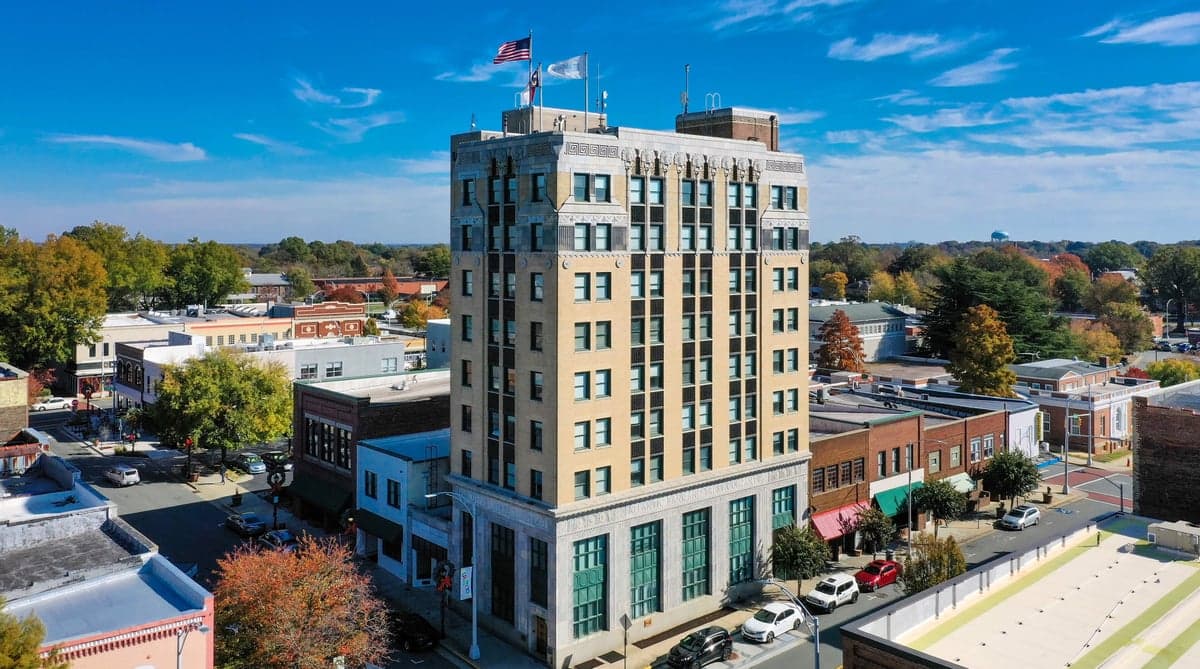
Burlington was founded in 1857 as a railroad depot town, originally called “Company Shops” for the North Carolina Railroad’s maintenance facilities. The first permanent residents were white mechanics, engineers, and managers who built modest frame houses near the tracks in what is now Downtown Burlington and the Company Shops Historic District. By the 1880s, the arrival of cotton textile mills—most notably the Holt family’s mills—triggered a second wave: rural white families from the Piedmont who moved into mill villages like Glencoe (now part of the city’s northern edge) and Alamance, where company-owned housing and company stores created tight-knit, insular communities. A third wave followed in the early 1900s, as Black families from Alamance County’s farms and from eastern North Carolina migrated to Burlington for mill labor, settling in segregated enclaves such as West End and the area around Pine Street. By 1950, Burlington was roughly 70% white and 30% Black, with virtually no other groups, and the economy remained anchored to textiles and hosiery.
Modern era (post-1965)
The 1965 Hart-Cellar Act had little immediate effect on Burlington; the city’s foreign-born share remained below 2% through the 1980s. The major demographic shift began in the 1990s, when the declining textile industry was replaced by logistics and food-processing plants (such as LabCorp’s headquarters and several poultry processors), drawing a new wave of Hispanic immigrants—primarily from Mexico and Central America—into neighborhoods like East Burlington and the Huffman Mill Road corridor. By 2020, the Hispanic share had risen to 18.5%, making Burlington one of the most Latino cities in the Piedmont Triad. During the same period, domestic in-migration brought a small but growing East/Southeast Asian population (1.7%) and an Indian-subcontinent population (1.0%), concentrated in newer subdivisions near University Drive and the I-40/85 interchange. The Black share has held steady at roughly 30%, while the white share has declined from 70% in 1970 to 44.7% today, driven both by Hispanic growth and by white out-migration to suburban Alamance County towns like Mebane and Graham. Burlington’s college-educated share (28.7%) remains below the national average, reflecting the city’s enduring blue-collar base.
The future
Burlington’s population is trending toward a tri-ethnic equilibrium rather than homogenization. Hispanic growth is plateauing—the foreign-born share has held at 7.9% for several years—while second-generation Latino families are assimilating into the broader working class, often moving from East Burlington into mixed neighborhoods like South Burlington. The Black and white shares are both declining slowly, as younger, college-bound residents leave for Raleigh or Greensboro, while new arrivals are disproportionately Hispanic or Asian. The city is not tribalizing into rigid enclaves; instead, older mill-village neighborhoods are becoming more mixed, while newer subdivisions near the interstate are attracting a multi-ethnic middle class. Over the next 10–20 years, Burlington will likely remain a majority-minority city with a stable Hispanic plurality, a shrinking white share, and slow growth in Asian and Indian populations. The key risk is economic stagnation: without a major new employer or a rise in college attainment, the city could see continued out-migration of its most educated residents.
For someone moving in now, Burlington offers a genuinely integrated, family-oriented community where no single group dominates and where housing remains affordable relative to the Triangle. The city’s identity is still rooted in its mill-town past, but the population is becoming more diverse, more suburban, and less insular with each passing decade.

* Values derived from national, state, county, city and local statistics and may differ in a specific area. Last updated: 2026-09-21T19:02:19.000Z
Narrative content on this page is AI-generated and may contain mistakes. Verify any details that matter before acting on them.
ReloMaps may earn a commission from affiliate links at no extra cost to you.

