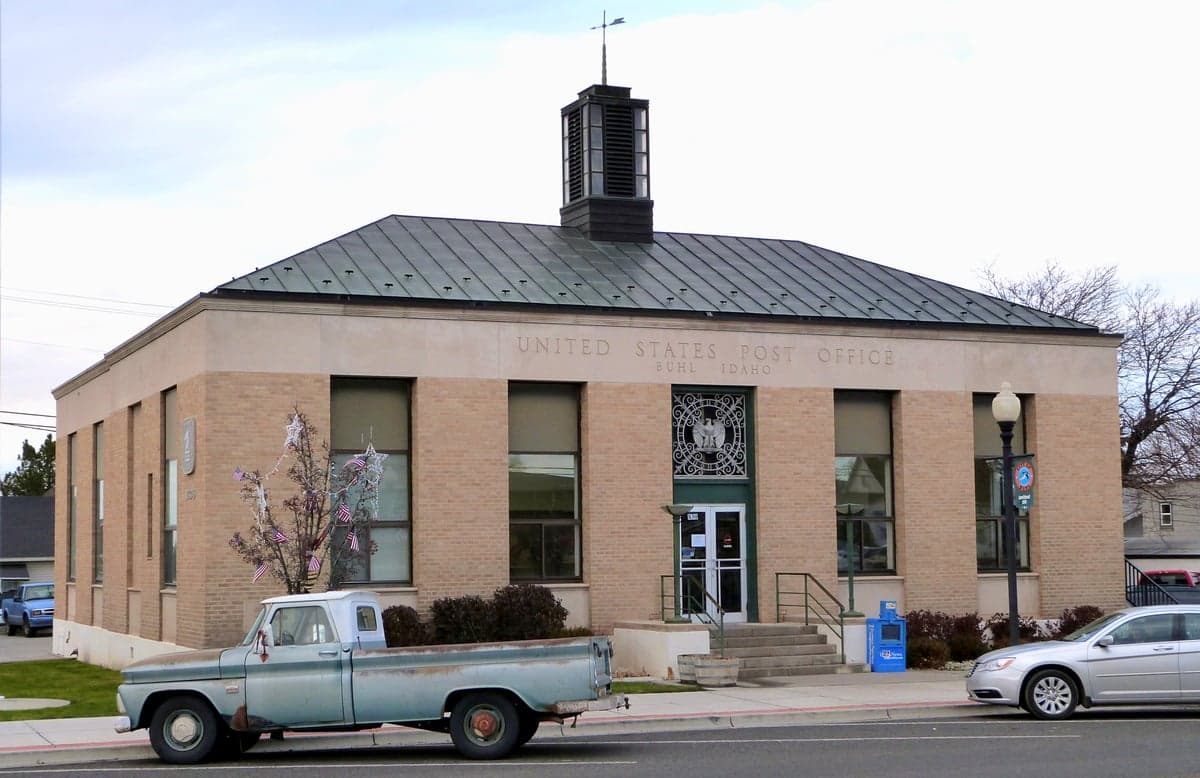
Photo: Wikipedia
Demographics of Buhl, ID
Affluence Level in Buhl, ID
A below-average socioeconomic profile. Incomes, home values, and educational attainment trail the U.S., with higher poverty and unemployment.
People of Buhl, ID
The people of Buhl, Idaho today number 4,624, forming a tight-knit community where two-thirds of residents identify as White (66.6%) and nearly one-third as Hispanic (31.0%), with a foreign-born population of 9.6%. This is a working-class city—only 14.1% of adults hold a college degree—rooted in agriculture and food processing, giving it a practical, family-oriented character. Buhl is notably less diverse than the national average in Asian and Black populations (both near 0%), and its demographic story is one of steady Hispanic growth alongside a stable White majority, creating a distinct cultural blend in the Magic Valley.
How the city was settled and grew
Buhl was founded in 1906 as a railroad town on the Oregon Short Line, drawing its first settlers from Midwestern farming families and Mormon converts from Utah and the East. The city’s growth was driven by the Milner Dam (1905) and the Twin Falls Canal Company, which opened the arid Snake River Plain to irrigated agriculture. The original Anglo-Protestant and Latter-day Saint homesteaders clustered in the Original Townsite around Broadway Avenue, building the first schools and churches. A second wave arrived during the 1910s–1930s: Basque sheepherders from the Pyrenees, who settled in the North Side near the railroad tracks, and Japanese farm laborers who worked the sugar beet fields but were largely displaced after World War II internment. By 1950, Buhl’s population was nearly 100% White, with a small Basque enclave remaining in the West End near the old stockyards.
Modern era (post-1965)
The 1965 Immigration and Nationality Act opened the door for a new wave of Mexican and Central American laborers, who arrived to work in the Amalgamated Sugar Company factory (now part of Snake River Sugar) and the surrounding potato and dairy operations. These families initially settled in the South Side along 3rd Avenue South, an area that became the city’s primary Hispanic neighborhood. By the 1990s, the Hispanic share of Buhl’s population had risen to roughly 15%, and by 2020 it reached 31.0%. This growth was almost entirely domestic in-migration from other agricultural regions in the West (California’s Central Valley, Texas’s Rio Grande Valley) rather than direct immigration, though the 9.6% foreign-born figure indicates a continuing connection to Mexico. The East Side around Buhl High School and the Clear Lakes Country Club area remain predominantly White and more established, while the South Side has become a vibrant, majority-Hispanic corridor with tiendas, taquerias, and Spanish-language church services. There has been no significant Asian or Black in-migration; the East/Southeast Asian and Indian subcontinent populations remain at 0.0%.
The future
Buhl’s population is trending toward a White-Hispanic binary, with the Hispanic share likely to reach 35–40% by 2035 based on current birth rates and continued agricultural labor demand. The city is not tribalizing into hostile enclaves—the South Side and Original Townsite are increasingly integrated, with bilingual signage and mixed-race families common—but distinct cultural zones persist. The White population is aging and slowly declining in absolute numbers, while the Hispanic population is younger (median age roughly 28 vs. 42 for Whites) and driving school enrollment growth. The foreign-born share is plateauing, suggesting that second- and third-generation Hispanic families are assimilating into the broader community while retaining cultural ties. No new immigrant groups (Arab, Indian, East/Southeast Asian) are emerging, so the demographic future is one of gradual homogenization into a White-Hispanic majority with a shared agricultural identity.
For someone moving to Buhl now, this is a place where the population is becoming more Hispanic and younger, but where the overall character remains that of a stable, working-class agricultural town. The South Side offers the most affordable housing and the strongest sense of community for new Hispanic families, while the East Side and Clear Lakes areas appeal to those seeking established neighborhoods with larger lots. The city’s demographic trajectory suggests continued growth in diversity within a narrow band—Hispanic and White—without the broader multiculturalism seen in larger Idaho cities like Boise. This makes Buhl a predictable, family-oriented choice for those comfortable with a bicultural, agrarian lifestyle.

* Values derived from national, state, county, city and local statistics and may differ in a specific area. Last updated: 2026-05-03T04:42:43.000Z
Narrative content on this page is AI-generated and may contain mistakes. Verify any details that matter before acting on them.
ReloMaps may earn a commission from affiliate links at no extra cost to you.

