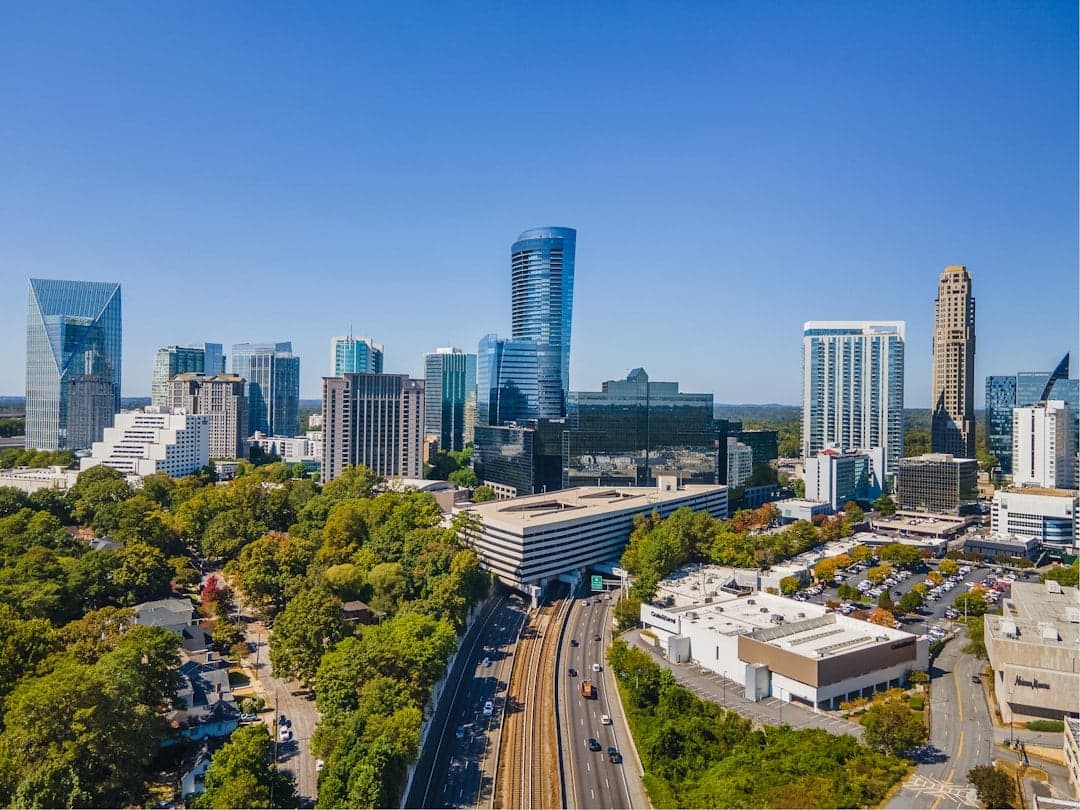
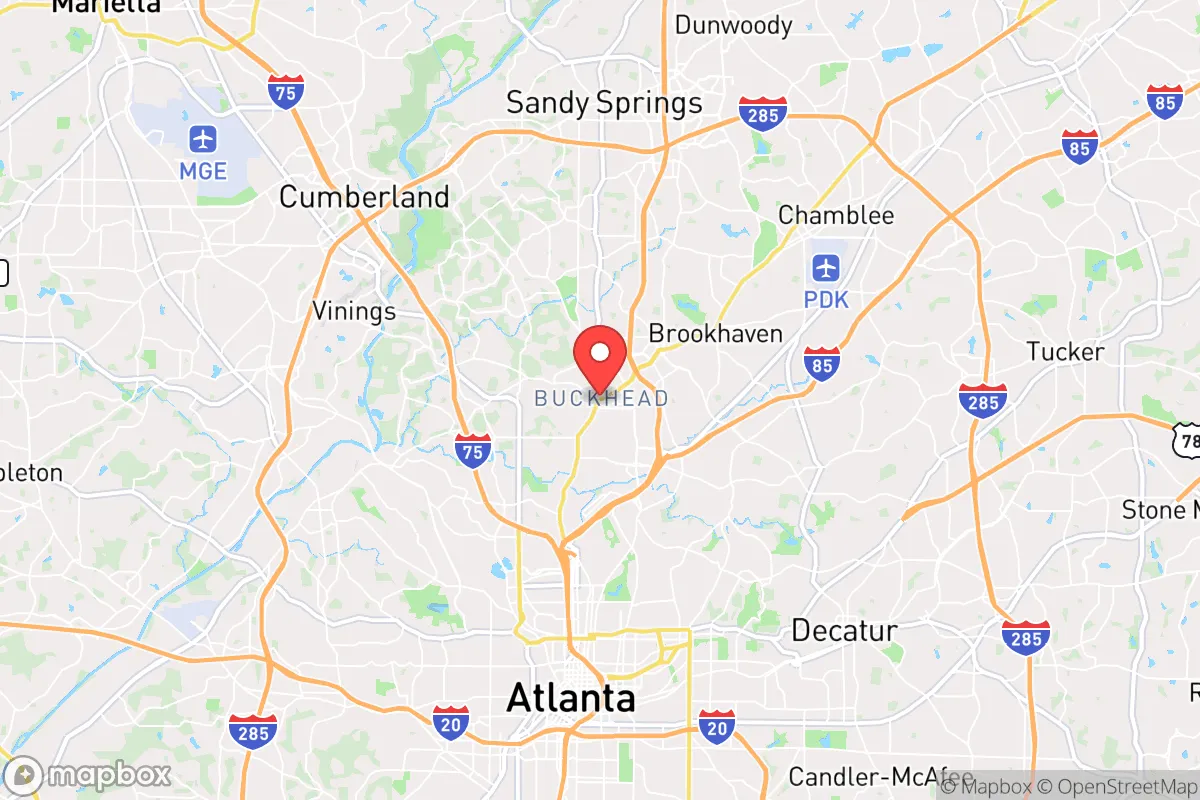
Photo: Kaleb East via Unsplash
Demographics of Buckhead, GA
Historical data isn't available for Buckhead, GA. Trends shown are for Fulton County, Georgia.
Affluence Level in Buckhead, GA
An upper-middle-class area. Household wealth, education levels, and homeownership run ahead of national benchmarks.
People of Buckhead, GA
Buckhead, Georgia, is a small, predominantly white, highly educated city of 4,640 residents where nearly 60% of adults hold a college degree. The city’s population is notably homogeneous compared to surrounding metro Atlanta, with a foreign-born share of just 1.7% and a demographic profile that skews heavily toward native-born, professional-class families. Its character is defined by quiet, established subdivisions, low population density, and a strong sense of local identity that sets it apart from the more diverse and rapidly changing areas of Gwinnett and DeKalb counties.
How the city was settled and grew
Buckhead was originally settled in the early 19th century as a farming community, part of the land ceded by the Creek Nation in the 1821 Treaty of Indian Springs. The area’s first permanent residents were Anglo-American yeoman farmers from the Carolinas and Virginia, drawn by cheap land and the fertile clay soils of the Piedmont. The community remained a sparsely populated crossroads through the Civil War and Reconstruction, with no significant railroad or industrial development to spur growth. The city was formally incorporated in 1975, but its modern population base began forming in the 1950s and 1960s as white, middle-class families moved out of Atlanta proper into what was then rural Morgan County. The earliest subdivisions, such as Lake Rutledge Estates and Buckhead Heights, were built on former farmland and attracted families seeking larger lots, lower taxes, and racial homogeneity during the era of white flight from Atlanta’s urban core. A second wave of growth came in the 1980s and 1990s, when executives and professionals employed by Atlanta’s expanding corporate sector—particularly at nearby Emory University and Rockdale Medical Center—built custom homes in neighborhoods like Heritage Hills and Buckhead Forest. These subdivisions remain the city’s demographic anchors today, with most original families still in residence or having passed homes to adult children.
Modern era (post-1965)
Buckhead’s modern demographic story is one of stability rather than transformation. The post-1965 Hart-Cellar Act, which dramatically increased immigration to the United States, had almost no effect on this city: the foreign-born population remains below 2%, and the city has not experienced the waves of Hispanic, Asian, or Indian immigration that reshaped nearby communities like Conyers or Snellville. Instead, Buckhead’s population has remained overwhelmingly white (76.0%) and native-born, with the largest minority group being Black residents at 8.7%, followed by Indian-subcontinent residents at 5.7% and Hispanic residents at 3.0%. The Indian-subcontinent population, while small in absolute numbers, is the city’s fastest-growing demographic segment, concentrated in newer construction in the Buckhead Manor subdivision and along Old Mill Road. These families are typically professionals in technology, medicine, or academia, drawn by the same factors that attracted earlier waves: good schools, low crime, and large lots. East/Southeast Asian residents (0.8%) are a negligible presence, and Arab residents are statistically absent. The city’s Black population, which has remained steady at roughly 8-9% since the 1990s, is largely composed of families who moved from Atlanta’s Southside during the same suburbanization wave that brought white residents, settling primarily in the Lakeview Estates area. No single ethnic enclave has formed; instead, Buckhead’s minority populations are dispersed across the city’s subdivisions, reflecting a pattern of assimilation rather than clustering.
The future
Buckhead’s population trajectory points toward slow, incremental diversification rather than rapid change. The city’s housing stock—dominated by single-family homes on one-acre lots with a median price above $400,000—limits in-migration to upper-middle-class buyers, which naturally filters for college-educated professionals regardless of ethnicity. The Indian-subcontinent share is likely to continue growing, as tech and medical professionals from the broader Atlanta area seek the same school quality and space that attracted earlier waves, but the absolute numbers will remain small. The Hispanic and East/Southeast Asian populations are expected to remain flat, as these groups tend to settle in denser, more affordable parts of Gwinnett and DeKalb counties. The white share will likely decline slowly—from 76% to perhaps 70-72% by 2040—as older residents age out and are replaced by a slightly more diverse cohort of buyers. The city shows no signs of tribalizing into ethnic enclaves; rather, it is homogenizing around class, with income and education level becoming the primary demographic markers. For a conservative-leaning family moving in now, Buckhead offers a stable, low-diversity environment where property values are supported by Atlanta’s broader growth but the pace of change is measured in decades, not years.
Buckhead is becoming a classic “donut hole” suburb—a small, affluent, predominantly white enclave surrounded by a more diverse and dynamic metro region. For someone moving in today, the city offers continuity: the same kind of quiet, family-oriented, low-tax community that drew its first residents sixty years ago, with just enough demographic evolution to avoid stagnation. The bottom line is that Buckhead is not a place of rapid change or cultural mixing; it is a place where stability is the primary selling point, and where newcomers are expected to fit into an existing, well-defined social and economic order.

* Values derived from national, state, county, city and local statistics and may differ in a specific area. Last updated: 2026-04-23T05:23:59.000Z
Narrative content on this page is AI-generated and may contain mistakes. Verify any details that matter before acting on them.
ReloMaps may earn a commission from affiliate links at no extra cost to you.

