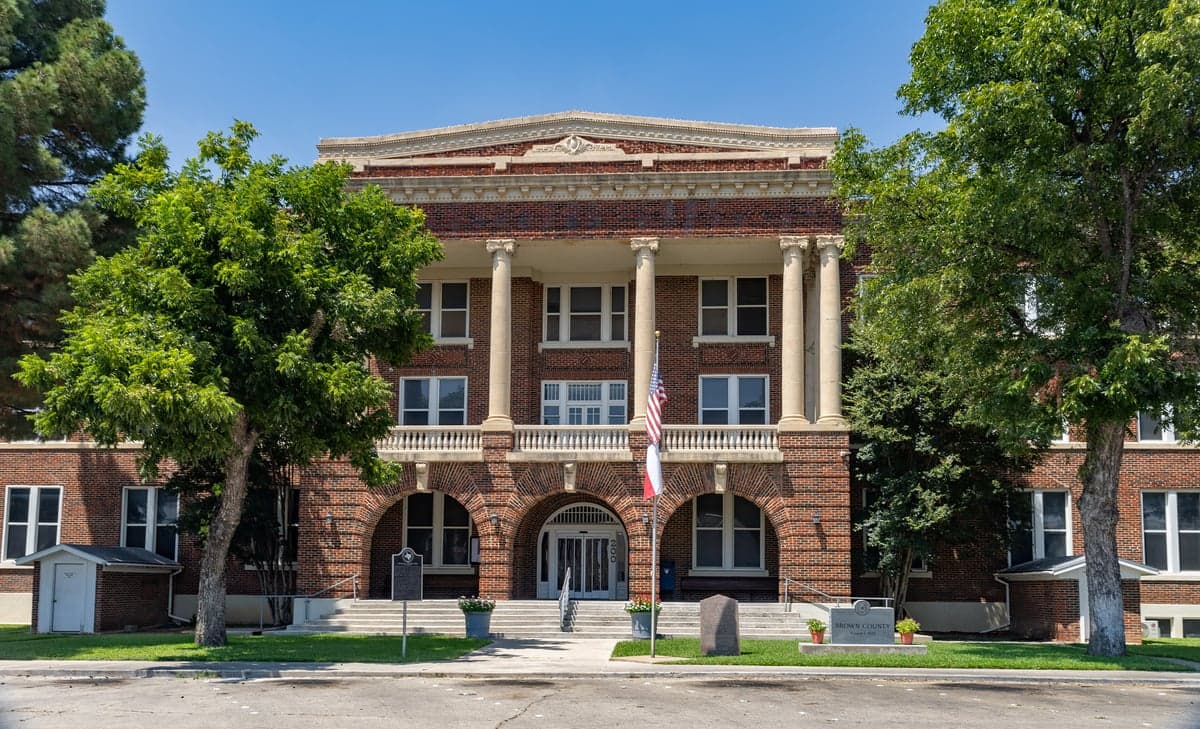
Photo: Wikipedia
Personal Sovereignty in Brownwood, TX
Strong independent fundamentals that actively favor personal liberty and low regulation.
What does Personal Sovereignty tell us?
Personal Sovereignty measures your capacity for self-reliance and independence with minimal government friction. Higher scores mean fewer barriers between you and the way you want to live... but it assumes you have the space you need and good neighbors.
What does this tell us?
Personal Sovereignty measures your capacity for self-reliance and independence with minimal government friction. Higher scores mean fewer barriers between you and the way you want to live... but it assumes you have the space you need and good neighbors.
State Policy
Energy independence: Net exporter (220% of energy produced in-state)
Personal Liberty
Homesteading

Personal Liberty Analysis
Brownwood, Texas, offers a notably high degree of personal sovereignty, largely insulated from the most aggressive forms of government overreach found in coastal states or even larger Texas cities. The local culture, rooted in West Texas self-reliance, combined with a county-level governance structure that generally favors minimal interference, creates an environment where an individual’s ability to live by their own rules is the default, not the exception. For those looking to step back from the encroaching regulatory state, Brownwood represents a strategic position where state-level protections—like the Texas Constitution’s strong property rights and firearm preemption laws—are actively reinforced by a community that values independence over compliance.
Tax burden and regulatory posture: How much government takes and demands
The financial aspect of sovereignty in Brownwood is favorable, particularly when compared to high-tax jurisdictions. Texas has no state income tax, which immediately preserves a larger portion of personal earnings. The primary local burden is property tax, and Brown County’s combined rate (city, county, school district) typically falls in the range of 2.2% to 2.5% of assessed value, which is moderate for Texas but significantly lower than states like New York, California, or Illinois. More importantly, the regulatory posture at the city and county level is one of restraint. Brownwood does not impose the kind of business license fees, occupational taxes, or permitting delays that plague entrepreneurs in more regulated metros. Zoning is present but not draconian; the city’s code is largely focused on basic safety and land use separation, not aesthetic control or lifestyle mandates. For a survivalist or prepper, this means fewer bureaucratic hurdles to establishing a home-based business, storing supplies, or modifying property for self-sufficiency. The local government’s appetite for new regulations is low, and public sentiment strongly opposes any expansion of municipal authority over private property or daily conduct.
Self-defense and gun law specifics: Carrying, storage, and legal protections
Brownwood sits in a state with some of the strongest self-defense laws in the nation, and local enforcement culture aligns with that. Texas is a permitless carry state, meaning any law-abiding adult 21 or older can carry a handgun openly or concealed without a license. For those under 21 or who prefer a license for reciprocity, the Texas License to Carry (LTC) is straightforward to obtain. The Castle Doctrine and Stand Your Ground laws are fully in effect, with no duty to retreat in any place where a person has a legal right to be. This is not a theoretical protection; Brown County juries and prosecutors are known to respect the right to defend life and property. There are no local ordinances that restrict magazine capacity, firearm types, or ammunition sales. The sheriff’s office is generally pro-Second Amendment, and the county has not adopted any of the “red flag” or extreme risk protection order mechanisms that some Texas cities have attempted. For those storing firearms or ammunition in quantity, there are no state or local storage mandates beyond basic safety common sense. The legal environment here is designed to empower the individual, not the state, when it comes to armed self-defense.
Self-reliance and homesteading viability: Lot sizes, zoning, and off-grid feasibility
For those seeking to reduce dependence on centralized systems, Brownwood’s land and zoning landscape is highly accommodating. Within the city limits, standard residential lots range from 7,000 to 10,000 square feet, and many older neighborhoods have larger parcels that allow for substantial gardens, small livestock (chickens, rabbits), and workshops. The city does not prohibit rainwater collection, and while it requires connection to municipal water and sewer for new construction, existing homes on larger lots often have wells and septic systems that predate annexation. The real opportunity lies just outside city limits in unincorporated Brown County. Here, zoning is minimal to nonexistent. Lot sizes for rural parcels commonly start at 1 to 5 acres, with many 10- to 20-acre tracts available within a 15-minute drive of downtown. Off-grid living is entirely feasible: solar panels, wind turbines, rainwater catchment, and composting toilets are legal and common. The county does not enforce building codes on rural residential structures, meaning you can build a cabin, workshop, or storage facility without permits or inspections, provided it meets basic health and safety standards for occupancy. This is a jurisdiction where a person can genuinely disappear into their own land and live by their own schedule, with minimal government awareness or interference.
Personal liberties: Parental rights, medical autonomy, speech, and property
Brownwood’s social and legal climate strongly favors individual and parental authority over state authority. Parental rights are respected at the school district level; the Brownwood Independent School District has not adopted controversial curriculum mandates or gender ideology policies that override parental consent. Medical autonomy is bolstered by Texas’s broad exemptions for religious and conscientious objections to vaccines and medical treatments, and local healthcare providers generally respect patient choice. During the COVID-19 era, Brownwood saw minimal enforcement of mandates, and the county judge did not impose lockdowns or business closures. Free speech is robustly protected, with no local hate speech ordinances or permit requirements for public assembly. Property rights are the bedrock of local governance: eminent domain is rarely used for private development, and the county assessor’s office is transparent and accessible. There is no local equivalent of “rent control” or forced inclusionary zoning. For a prepper or survivalist, this means you can stockpile supplies, host training groups on your property, and express dissenting political views without fear of government retaliation. The community’s ethos is live-and-let-live, with a strong presumption that the state should stay out of personal decisions regarding health, education, and livelihood.
Compared to the regulatory saturation of the Pacific Northwest, the Northeast, or even the Texas Triangle cities, Brownwood stands out as a pocket of genuine personal sovereignty. The tax burden is manageable, the gun laws are permissive, the land is available for self-sufficient living, and the cultural and legal systems prioritize individual liberty over collective compliance. For a single person or family looking to opt out of the expanding administrative state, Brownwood offers a rare combination of legal protections, low regulatory friction, and a community that expects you to handle your own business. It is not a utopia—no place is—but it is a place where a determined individual can live largely on their own terms, with the government as a distant neighbor rather than a constant overseer.

* Values derived from national, state, county, city and local statistics and may differ in a specific area. Last updated: 2026-04-15T06:21:19.000Z
Narrative content on this page is AI-generated and may contain mistakes. Verify any details that matter before acting on them.
ReloMaps may earn a commission from affiliate links at no extra cost to you.

