Photo: Wikipedia
Demographics of Brookhaven, MS
Affluence Level in Brookhaven, MS
A below-average socioeconomic profile. Incomes, home values, and educational attainment trail the U.S., with higher poverty and unemployment.
People of Brookhaven, MS
Brookhaven, Mississippi, is a small city of 11,656 residents where Black residents form the majority at 53.9%, with White residents comprising 42.7% and a very small foreign-born population of just 1.1%. The city’s identity is rooted in a deep, biracial Southern history, shaped by railroad expansion and agricultural commerce, with a notably low college attainment rate of 21.4% reflecting its working-class character. Today, Brookhaven is a predominantly native-born community, with negligible Hispanic (1.9%) and East/Southeast Asian (0.1%) populations, and a tiny Indian-subcontinent community at 0.8%. The city remains a stable, majority-Black and White Southern town, with little recent immigration reshaping its demographic core.
How the city was settled and grew
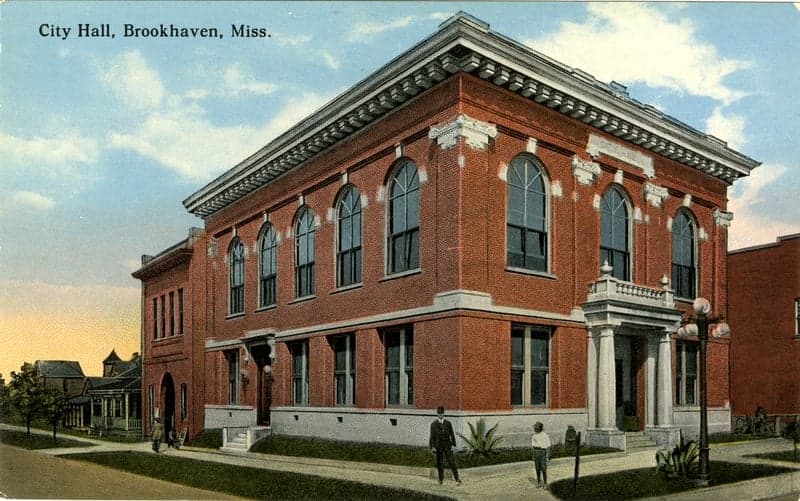
Brookhaven’s population history begins with its founding in 1818 as a trading post, but its real growth came after the New Orleans, Jackson and Great Northern Railroad arrived in the 1850s. The railroad made Brookhaven a regional shipping hub for cotton and timber, drawing White settlers from the surrounding rural areas and enslaved Black laborers who built the infrastructure. After the Civil War, freed Black families established the Northside neighborhood, a historically Black district centered around Martin Luther King Jr. Drive, where many descendants of those early laborers still live. The Southside area, near the railroad tracks, became the commercial and White residential core, with homes built by merchants and railroad executives. By 1900, the population was roughly 60% White and 40% Black, a ratio that held through the early 20th century as the city grew slowly, never exceeding 5,000 residents until after World War II.
Modern era (post-1965)
The post-1965 era brought significant demographic change, driven by the Second Great Migration of Black Americans from the rural South to urban centers, but Brookhaven experienced the reverse: Black families who had left for Northern cities began returning in the 1970s and 1980s, settling back into Northside and expanding into the Eastside neighborhood near Brookhaven High School. White flight to the suburbs was limited, as the city itself was small, but new subdivisions like Westbrook Estates (developed in the 1980s) attracted White families seeking newer homes, creating a subtle racial geography. The foreign-born population remained negligible, with no significant immigration waves; the tiny Indian-subcontinent community (0.8%) is concentrated in a few professional households near the hospital on Highway 51, while the East/Southeast Asian population (0.1%) is virtually nonexistent. By 2020, the city had shifted from a White-majority to a Black-majority population, a trend that accelerated after 2000 as older White residents aged out and younger Black families moved in.
The future
Brookhaven’s population is likely to continue its gradual homogenization into a Black-majority city with a stable White minority, as the foreign-born share remains below 2% and no major immigration corridors are developing. The Northside and Eastside neighborhoods will likely see continued Black population growth, while Westbrook Estates and the Southside will retain their White-majority character but with aging demographics. The low college attainment rate (21.4%) suggests limited in-migration of highly educated professionals, and the city’s economy—anchored by manufacturing (e.g., Georgia-Pacific) and healthcare—does not attract the tech or academic migrants that diversify other Southern towns. Over the next 10–20 years, Brookhaven will likely remain a biracial, native-born community, with no significant growth in Hispanic, Asian, or Indian populations, and a slow overall population decline as younger residents move to larger cities like Jackson or Hattiesburg.
For someone moving to Brookhaven now, the city offers a stable, deeply rooted community where racial lines are clearly drawn but daily life is cooperative, with shared institutions like churches and schools. The lack of ethnic diversity means newcomers from outside the South may find the social landscape homogeneous, but the strong sense of place and low cost of living are enduring draws. This is a city that knows who it is—a Black-majority Southern town with a White minority—and is not likely to change that character anytime soon.

* Values derived from national, state, county, city and local statistics and may differ in a specific area. Last updated: 2026-04-21T21:44:24.000Z
Narrative content on this page is AI-generated and may contain mistakes. Verify any details that matter before acting on them.
ReloMaps may earn a commission from affiliate links at no extra cost to you.

