8 Oregon Safest Cities for a Safer Move in 2026

Ashland, Lake Oswego, Hillsboro, and Bend stand out as the strongest overall safety contenders in Oregon when you look at crime first, but the ranking changes fast once you weigh affordability, neighborhood variation, disaster exposure, and commute practicality. The safest Oregon cities aren't a single type of place, they're a mix of small towns, college towns, and Portland suburbs that compare well on violent and property crime, then diverge once you add relocation tradeoffs.
Oregon buyers usually need more than a citywide label. A better move starts with the crime numbers, then checks ReloScore safety context, FEMA and hazard exposure, population scale, school fit, and the daily logistics that determine whether a place works for your household. ReloMaps consolidates that broader context in one place, and it's especially useful when a city average hides differences between one neighborhood and the next. That matters in places like Springfield and Gresham, where the safest pockets can look materially different from the citywide picture, and where a city-page or property-context lookup can narrow the shortlist faster than a generic top-10 list.
Table of Contents
- 1. Bend, Oregon
- 2. Ashland, Oregon
- 3. Lake Oswego, Oregon
- 4. Corvallis, Oregon
- 5. Hillsboro, Oregon
- 6. Pendleton, Oregon
- 7. Springfield, Oregon, Riverbend District
- 8. Gresham, Oregon, Springwater Corridor and West Side
- Oregon Safest Cities, 8-City Comparison
- Frequently Asked Questions
- Is the lowest violent-crime city always the best place to move in Oregon?
- How should I judge a neighborhood when the citywide crime rate looks higher?
- What property-crime level matters most for families?
- Do higher housing costs usually buy better safety in Oregon?
- How does college-town seasonality affect renters?
- How do I verify FEMA or disaster-risk context before choosing a home?
- What's the fastest way to turn this list into a real shortlist?
1. Bend, Oregon

Bend belongs near the top of any serious Oregon safest cities list because its violent-crime profile sits far below Oregon's statewide norm. In a 2024 FBI-based statewide analysis, Oregon's violent-crime rate was 334.6 per 100,000 residents, while West Linn was 56.9 and Portland was 720.1, a spread that shows why city-by-city screening matters more than a broad state impression. Bend fits the lower-crime, smaller-market pattern that often gives relocating households more predictability than a large metro core, even before you layer in neighborhood detail.
The practical advantage in Bend is that safety and lifestyle usually point in the same direction. Outdoor-focused residents, active neighborhood groups, and visible local engagement tend to reinforce the kind of everyday awareness that helps keep incidents lower than in denser urban centers. If you're comparing Bend against a bigger metro suburb, the key tradeoff isn't just crime, it's whether you want a city that feels easier to monitor and get around, or one with more job density and more commuter options.
Practical rule: If you need a safer-feeling home base without giving up access to an active local economy, Bend is easier to screen than a sprawling metro because the citywide picture and the day-to-day experience are often closer together.
For a broader Oregon comparison, the state page on ReloMaps Oregon helps you separate the better-safety corridors from the places that only look good on a list. That's useful if you're comparing Bend with other smaller communities that may offer similar safety but very different housing and commute outcomes.
A family relocating from a high-density suburb might choose Bend for the lower-friction lifestyle, while a remote worker may care more about whether the neighborhood is quiet after dark than whether the city has the deepest employer base. That's the right lens here, because Bend's value is not just that it scores well, it's that its safety profile is readable enough to make planning practical.
2. Ashland, Oregon
Ashland is one of the clearest answers for buyers who want a smaller Oregon city with a strong safety reputation and a walkable core. Its violent-crime rate is 1.4 per 1,000 residents, which places it among the state's lowest reported levels in the supplied metrics. That matters because Ashland's appeal isn't only statistical, it's structural, with a compact downtown, a college influence, and a civic culture that tends to keep more eyes on the street.

That combination is useful for households that care about both safety and daily convenience. A walkable downtown can reduce some of the exposure that comes with isolated car-dependent errands, and a college-centered population often supports more active lighting, foot traffic, and routine oversight in the areas people use most. The tradeoff is that Ashland's smaller scale may not suit someone who wants more anonymity, a larger job market, or the kind of urban access that comes with a bigger metro suburb.
What makes Ashland different in relocation terms
Ashland's value is strongest when the household wants a place that feels manageable, not merely “safe” in the abstract. That means it can work well for retirees, remote workers, and families who value a stable routine over high-speed access to major employment corridors. It can also be a smart pick for buyers who prefer a city where neighborhood-level checks are easier because the geography is compact.
A practical home search in Ashland should still check for block-level variation, because no citywide average captures every street. The best move is to compare the home's exact location against school access, commute length, and any disaster context before treating the city average as decisive. That's where a location-intelligence layer matters more than a generic city ranking.
Ashland earns its place on the list because it pairs low crime with a lifestyle that many households find easy to live with. It's not just a safety story, it's a livability story that happens to score well on the safety side.
3. Lake Oswego, Oregon
Lake Oswego belongs on the short list because it combines a low reported violent-crime rate with the kind of residential stability many families want. Its violent-crime rate is 1.8 per 1,000 residents, and it consistently appears as one of the strongest suburban options in Oregon safety rankings. The city's appeal is obvious, but its real advantage is that safety, schools, and neighborhood consistency often move together here more than they do in many larger Oregon places.
The tradeoff is cost and selectivity. Lake Oswego's higher-cost housing market naturally filters for households that can pay for a more controlled environment, and that changes the relocation math. Buyers aren't just comparing safety, they're comparing whether paying for a tighter suburban setting is worth the premium over a nearby alternative such as West Linn, where the data also points to very strong safety conditions.
Lake Oswego's citywide numbers look especially compelling when set against Oregon's broader variance. The state can contain a place like West Linn at 56.9 per 100,000 violent crime and a city like Portland at 720.1, so a suburb that stays near the top of the safe list offers real planning value. For families, the question is less “Is it safe?” and more “Does the safe part of the city align with the price I'm willing to pay?”
Safety in Lake Oswego is easiest to value when you view it as part of a package, not a standalone feature.

The city also fits households that want predictable routines. Commutes into Portland are part of the equation for some residents, which means the best home isn't always the one with the best crime profile, it's the one that keeps the daily schedule manageable. If you're shopping from another state, a look at West Linn on ReloMaps helps frame the comparison because nearby suburbs can be close on crime but different on price, school access, and commute stress.
Lake Oswego is a strong choice when you want less uncertainty and can afford the premium that often comes with it. For many movers, that makes it a top-tier safety market, even if it isn't the most affordable one.
4. Corvallis, Oregon
Corvallis earns its place because it pairs a college-town structure with a relatively low violent-crime profile. Its violent-crime rate is 2.3 per 1,000 residents, and the presence of Oregon State University shapes both the rhythm and the safety context of the city. College towns can be complicated, but they often benefit from dense foot traffic, more lighting around campus-adjacent blocks, and institutional attention that stabilizes some neighborhoods.
That doesn't mean every part of Corvallis behaves the same way. Seasonal changes tied to the academic calendar can affect how busy certain areas feel, and renters should be careful not to assume that every block near campus carries the same risk profile. The safer move is to look at exact location, not just a citywide label.
Corvallis is often a good fit for households that want a manageable city with steady institutional gravity. Faculty, graduate students, and families looking for a smaller metro environment can all benefit from a place where the university helps anchor amenities, safety monitoring, and walkability. At the same time, buyers who want quieter streets and less turnover may prefer neighborhoods a little farther from the highest-traffic student corridors.
Why the city model matters here
Corvallis is a reminder that a city can look safe without being uniform. A home near campus lighting and foot traffic may feel very different from one farther out, even if both sit inside the same city limits. That's why the safest-city conversation gets more useful when you ask where the safety is concentrated, not just whether it exists.
Albany, Oregon on ReloMaps is a useful nearby reference point if you're comparing college-town dynamics with a more traditional mid-valley profile. Buyers often find that the best decision is not the top-ranked city on paper, but the city whose daily rhythms fit the household's schedule and comfort level.
Corvallis is strongest for people who want the benefits of a university town without the constant volatility of a larger urban center. That balance is a real safety advantage when the rest of the purchase decision lines up too.
5. Hillsboro, Oregon
Hillsboro makes the list because it combines suburban scale, a major employment base, and a strong violent-crime profile relative to many larger Oregon alternatives. Its violent-crime rate is 2.0 per 1,000 residents, and that sits inside a city that many households already view as practical for commuting and family life. The city's job market helps support a more stable population mix, which matters because residential churn often makes neighborhood safety harder to read.
The relocation question in Hillsboro is rarely just “Is it safe?” It's whether you want the combination of suburb, commute access, and planned development that can make day-to-day life easier. The city's commercial areas and newer neighborhoods often benefit from design choices that support visibility and routine use, which is one reason many movers treat Hillsboro as a more grounded option than a less structured fringe suburb.
The best comparison is not between Hillsboro and Oregon as a whole, but between Hillsboro and other Portland-area choices that may look similar at first glance. A city can post a good violent-crime rate and still differ a lot on housing cost, school access, and traffic stress. That's why Hillsboro often lands in the “safe enough and practical” category rather than the “safest on paper at any cost” category.
Move rule: If your commute goes through Washington County corridors, a slightly higher neighborhood premium can be worth it when it cuts daily friction and keeps your home base in a stronger safety band.
Hillsboro also works well for buyers who want a place with enough scale to feel complete, but not so much density that safety becomes harder to interpret. The strongest move here is to map your commute, your budget, and the exact neighborhood rather than relying on a citywide impression alone. For households balancing remote work with periodic office trips, that can be the difference between a good move and a frustrating one.
6. Pendleton, Oregon
Pendleton gives the list a different kind of safety profile, one shaped less by metro proximity and more by small-city cohesion. Its violent-crime rate is 2.4 per 1,000 residents, and the city's smaller population makes local context easier to understand than in a sprawling suburb. That can be a major advantage for buyers who want a quieter setting and a lower-cost lifestyle without moving into a highly isolated rural area.
The city's historic, agricultural character matters because it tends to support more stable social patterns than places with heavier turnover. Retirees, remote workers, and households looking for a slower pace may find that Pendleton's safety appeal is tied to familiarity and local accountability as much as raw statistics. That doesn't make it universally better, but it does make it easier to evaluate.
Pendleton is also a good example of why “safest” doesn't always mean “most desirable” for every household. If your job, school needs, or medical access require a larger urban network, a small northeastern Oregon city may not make sense even if the crime profile looks good. If, on the other hand, you want a more measured pace and a simpler neighborhood feel, Pendleton can be a strong fit.
The most useful lens is whether the city's size matches your day-to-day needs. Some buyers want a place where local roads, local services, and local norms stay consistent from week to week. Others need the flexibility of a more connected metro environment, even if that comes with a weaker safety profile.
Pendleton belongs in the conversation because it proves that lower-crime Oregon places aren't all Portland suburbs or university towns. Some are small communities where the safety advantage comes from scale, stability, and fewer moving parts.
7. Springfield, Oregon, Riverbend District
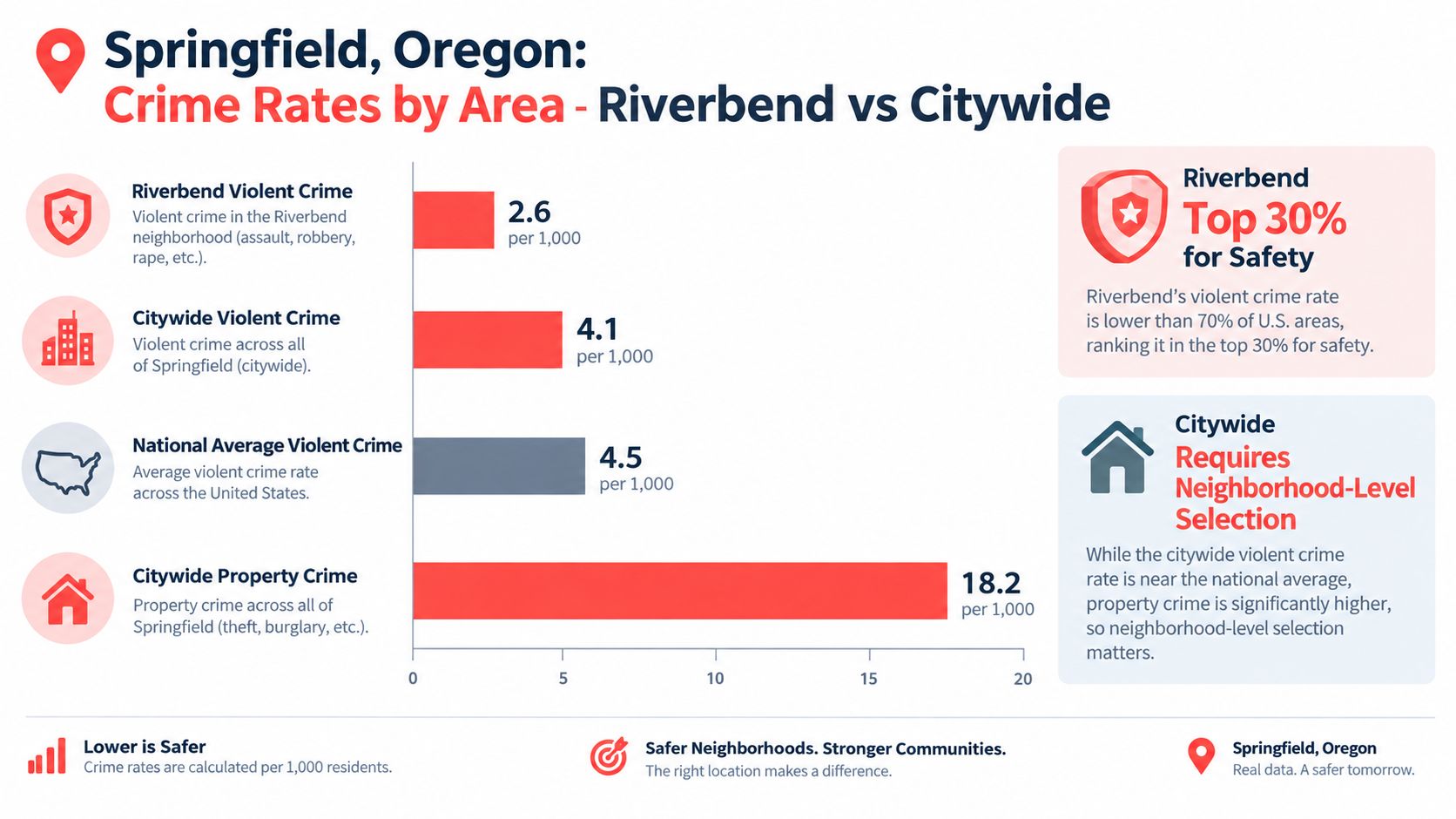
Springfield needs a neighborhood-level read, not a blanket label. The Riverbend district shows a violent-crime rate of 2.6 per 1,000 residents in its safer zones, while the broader city averages 4.1. That gap is exactly why buyers can't stop at the city name, especially in a place that mixes affordability with uneven block-by-block conditions.
Springfield works well for households that want to live near Eugene without paying Eugene prices. The upside is obvious, but the tradeoff is that the safest parts of the city need to be selected carefully. Newer residential developments and well-managed pockets near the McKenzie River area can look materially different from older commercial corridors, and the citywide average won't tell you which side of that line a listing sits on.
Where Springfield helps and where it doesn't
The city makes sense when affordability matters and the home search can be narrow enough to exclude weaker blocks. Families looking for a lower entry point into the Eugene area may find that Riverbend offers a more controlled environment than the city average suggests. Renters should be especially careful, because a citywide rate can't capture the differences between a clean, well-lit new development and a busier corridor with more turnover.
The safest approach is to compare the exact property with surrounding streets, commute routes, and nearby amenities before assuming the neighborhood is representative of the whole city. That's also where hazard context matters, because a home that looks attractive on price may carry a different exposure profile than a more expensive one elsewhere.
Springfield is a useful reminder that safety and affordability often trade places. You can have both, but usually not everywhere in the same city. The winning move is selecting the pockets where the data, the layout, and the daily routine all line up.
8. Gresham, Oregon, Springwater Corridor and West Side
Gresham is one of the clearest examples of why neighborhood selection matters more than city branding. Its west-side neighborhoods, including the Springwater area and planned communities near I-84, show violent-crime rates around 2.8 per 1,000 residents, while the city overall averages 4.3. That spread makes Gresham a mixed relocation market, not a simple yes-or-no answer.
The appeal is practical. Gresham often gives buyers and renters a closer-in option than many outer suburbs, which can make commuting easier and housing more attainable than some nearby alternatives. The best pockets are often newer or more intentionally designed, and those areas tend to benefit from stronger visibility, better maintained streets, and a more stable resident base.
What makes Gresham tricky is that safety trajectories can differ sharply by block. Community investment and redevelopment may be improving some areas, but that doesn't erase the need to screen carefully. If you're searching here, the right move is to treat the city as a starting point and the neighborhood as the decision.
A safe-feeling block in Gresham can sit a short drive from a much less predictable corridor, so the listing address matters more than the city label.
If you're choosing between Gresham and another Portland suburb, compare commute practicality, housing age, and nearby commercial activity alongside crime. The right choice may not be the lowest crime number, but the place where your daily life feels manageable and the home's surroundings match your tolerance for change.
Gresham belongs on the list because it offers a real safety opportunity for buyers who know how to narrow the search. It rewards specificity, and it punishes assumptions.
Oregon Safest Cities, 8-City Comparison
| City / Area | Violent Crime Rate | Ease of Relocation (implementation complexity) | Cost & Resource Needs (housing, transport, services) | Expected Outcomes (safety & community) | Ideal Use Cases | Key Advantages |
|---|---|---|---|---|---|---|
| Bend, OR | 2.1 per 1,000 | Moderate, growing demand, limited transit | Rising housing costs; moderate cost of living vs major West Coast cities | Low violent crime, active community policing, outdoor lifestyle supports youth engagement | Outdoor enthusiasts, families seeking safer mid‑sized city | Strong community engagement; outdoor recreation access |
| Ashland, OR | 1.4 per 1,000 | Moderate, compact city but limited job market outside education/tourism | Higher median housing (~$550K+); limited economic diversity | Very low violent crime, walkable downtown, strong civic cohesion | Arts/culture seekers, college community members, retirees valuing walkability | Exceptional safety for a small city; strong cultural amenities |
| Lake Oswego, OR | 1.8 per 1,000 | Challenging, high cost, suburban car dependence | High median homes (~$650K+); HOA fees; close to Portland services | Very safe, stable residential neighborhoods with strong school quality | Affluent families prioritizing schools and suburban stability | Top schools; planned neighborhoods and high homeownership |
| Corvallis, OR | 2.3 per 1,000 | Moderate, student turnover and seasonal variation | More affordable than larger metros; services oriented to university | Low violent crime with seasonal shifts; strong campus security coordination | Students, university staff, those seeking affordable college‑town life | University resources, walkability, bike infrastructure |
| Hillsboro, OR | 2.0 per 1,000 | Relatively easy for professionals, job access but commute congestion | Rising housing (~$520K+); improving transit options | Low violent crime, family‑oriented neighborhoods with active policing | Tech workers, families seeking suburban amenities near Portland | Strong employment base (tech); planned, visible neighborhoods |
| Pendleton, OR | 2.4 per 1,000 | Easy financially but logistically harder, remote location | Low housing costs (median ~ $260K); limited local services | Consistently low violent crime in small‑town context; tight social monitoring | Retirees, remote workers, affordability‑focused relocators | Very affordable; tight‑knit community and rural character |
| Springfield, OR (Riverbend) | 2.6 per 1,000 (Riverbend) / 4.1 (city) | Variable, neighborhood selection required | More affordable (median ~ $380K); citywide service variability | Safer pockets (Riverbend) vs higher citywide rates; neighborhood‑dependent outcomes | Families seeking affordability in safer subdivisions | Affordability with selective safe neighborhoods; family‑focused design in Riverbend |
| Gresham, OR (West Side) | 2.8 per 1,000 (safest) / 4.3 (city) | Variable, west‑side easier, citywide requires due diligence | Moderate cost (~$420K); good Portland commute via I‑84/MAX | Improving safety in redeveloped areas; mixed outcomes across city | Commuters seeking Portland access with lower cost; investors in revitalization | Transit access, west‑side redevelopment, diverse housing options |
Frequently Asked Questions
Is the lowest violent-crime city always the best place to move in Oregon?
No, it isn't. The lowest violent-crime city can still lose to a slightly higher-crime place if that other city has better schools, a shorter commute, lower housing pressure, or less hazard exposure. That's why a city like Lake Oswego can make more sense for one household than a smaller place with a lower headline crime rate, especially if the buyer needs stable access to Portland-area jobs or wants a more predictable suburban layout.
How should I judge a neighborhood when the citywide crime rate looks higher?
Use the citywide number as a filter, not a verdict. In places like Springfield and Gresham, the safer pockets can sit well below the city average, so the exact street, nearby corridors, lighting, and land use matter more than the city name alone. A good threshold is whether the neighborhood feels residential, well-lit, and separated from higher-traffic commercial strips, because those features usually give you a better read than the citywide average does.
What property-crime level matters most for families?
A family should treat property crime as a housing-selection trigger, not just a background statistic. Oregon's statewide comparisons show that property crime can differ sharply even inside otherwise safer markets, and that's especially relevant when packages, garages, and car break-ins affect daily life. The practical threshold is whether a neighborhood's property-crime pattern changes how you store deliveries, park overnight, or let kids move around outside without constant supervision.
Do higher housing costs usually buy better safety in Oregon?
Often they do, but not always in a simple straight line. Places like Lake Oswego tend to combine higher costs with stronger safety and more residential stability, while some lower-cost areas still offer good neighborhood-level safety if you choose carefully. The better question is whether the extra cost buys you lower commute stress, better schools, and a cleaner block pattern, because those benefits can matter more than the citywide ranking itself.
How does college-town seasonality affect renters?
It can change noise, parking, foot traffic, and the feel of certain streets even when the city is safe overall. Corvallis is the clearest example of a place where university rhythms can shape risk perception by block and by season, so renters should check whether a listing sits near the most active student corridors or in a quieter residential pocket. That matters if you want predictable evenings, less parking competition, or lower turnover in the building.
How do I verify FEMA or disaster-risk context before choosing a home?
Check the exact address against FEMA and other hazard layers before you treat a safe city as a safe home. Oregon's relocation picture can shift once wildfire, flood, or transport-related exposure enters the conversation, and that's especially important for buyers who are moving for long-term stability rather than just a short-term rent deal. The best workflow is to compare the city's safety reputation with the property's hazard context, then confirm whether the commute and emergency access still make sense for your household.
What's the fastest way to turn this list into a real shortlist?
Set your household thresholds first, then compare city and neighborhood context, inspect commute and disaster factors, and only then narrow to a final handful of homes. If you're between two Oregon cities, use the relevant ReloMaps city page or a property-context lookup to see whether the listing's surroundings match the safety profile you want. That sequence keeps you from overvaluing a strong city average and underestimating the exact block where you'll live.
ReloMaps gives you the missing context that city rankings leave out, including ReloScore comparisons, safety and hazard layers, and neighborhood-level location intelligence for real homes. If you're weighing an Oregon move, use ReloMaps to compare the cities, check the property context, and decide with more confidence before you make an offer.
Enjoying the blog? Subscribe to ReloMaps+ for premium area intelligence — and to keep us independent.
Subscribe today