How Do You Commute to Work Without Losing Time

Most U.S. workers drive alone for about 27 minutes each way. The useful answer to “How do you commute to work?” names your usual mode and typical time, then asks which combination of mode, cost, and location fits your actual schedule.
You may be comparing homes in a city that looks perfect on a map, only to discover that the “short” drive requires expensive parking, a fragile transit connection, or five office trips every week. Treat the commute as a weekly time and money budget, not as a single distance between an address and a workplace.
Table of Contents
- The Honest Answer to How You Commute to Work
- What Commuting Actually Looks Like Across the U.S.
- Comparing Driving, Transit, Cycling, and Walking
- How Hybrid Work Changes the Commute Calculation
- Measuring Your Actual Commute Before You Move
- Why Reliability and Access Matter More Than Minutes
- Building a Commute Plan You Can Live With
The Honest Answer to How You Commute to Work
The clearest answer has two parts:
“I drive alone for about 30 minutes each way.”
You could also say, “I take public transportation for about 40 minutes each way,” “I usually walk,” “I bike,” or “I work from home.” The mode tells people how you travel. The time tells them what the trip costs your day.
The U.S. Census Bureau's commuting guidance uses a specific framework. It asks how you usually got to work during the previous week and records the single transportation method used for the longest distance. If you drive to a rail station and take a train, report the dominant leg rather than listing every connection.
Commute time also means a typical one-way trip on a workday, including waiting for public transportation, picking up carpool passengers, and related travel activities. “I commute by car” hides the difference between a short suburban drive and a costly trip that regularly consumes an hour.
Give the answer people actually need
Use this simple formula:
- Name the usual mode.
- Add the typical one-way time.
- Mention the work arrangement if it changes the pattern.
For example, “I drive alone for about 30 minutes each way, three days a week, and work remotely the other two days” is far more useful than “I commute by car.” It communicates frequency, exposure, and the possibility that the household can live farther from the office.
That distinction matters during a move. A commute that works twice a week may be unacceptable five times a week. A transit route that looks reasonable during the morning peak may fail when you add childcare, late meetings, mobility needs, or an unreliable transfer.
What Commuting Actually Looks Like Across the U.S.
A city can advertise a short commute and still wreck your week. What matters is how many hours and dollars your household burns across a normal workweek, not whether one one-way trip looks acceptable on paper.
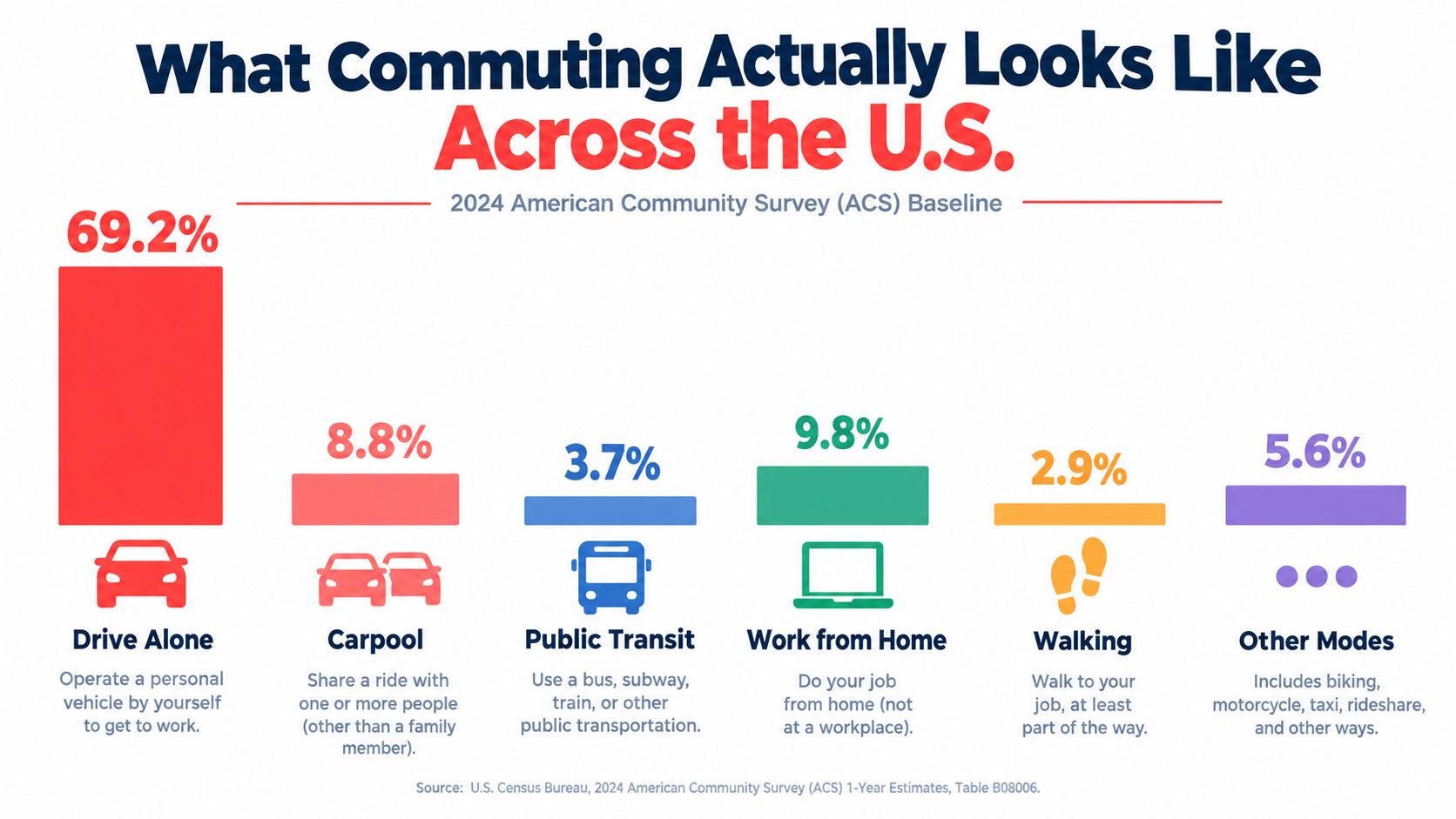
The national picture is still dominated by driving. In 2024, 69.2% of U.S. workers drove alone to work, 3.7% used public transportation, and 13.3% worked from home, according to the U.S. Census Bureau's American Community Survey commuting data. The same source reports a 27.2-minute typical one-way commute in 2024, and 9.3% of workers spent at least 60 minutes getting to work one way. That is the baseline buyers and renters should start from. Car first, remote work still meaningful, long trips common enough to matter.
Do not stop at the average.
Two places can post similar commute times and offer completely different daily lives. One household may have rail, frequent buses, sidewalks, and safe cycling routes. Another may have the same reported travel time but no realistic option beyond a car. That difference decides whether a return-to-office policy, a second job location, or a daycare stop turns an acceptable commute into a weekly drain.
Mode and frequency change the math fast. A 30-minute trip done twice a week sits in a different budget than the same trip done five times a week. A household that can switch between driving and transit has backup options. A household with one workable route has exposure. That is why commute screening on ReloMaps should start with weekly exposure: total days in office, likely modes, and whether the plan still works if hybrid flexibility shrinks.
Recent travel behavior shows why old commute comparisons age badly. The Bureau of Labor Statistics reported that Americans spent an average of 1.2 hours per day traveling in 2019 and 47 minutes per day in 2020. The share of people who traveled on a given day also fell from 84% in 2019 to 67% in 2020. Work moved closer to home, and many city patterns changed with it.
Use three filters before you trust any city's commute story: weekly time cost, real mode choice, and how often the trip is required. A single commute score misses all three.
Comparing Driving, Transit, Cycling, and Walking
Driving alone wins on flexibility, but it often loses once you count the full operating cost. Fuel is only one line item. Vehicle wear, depreciation, insurance, maintenance, parking, tolls, and the driver's time belong in the relocation budget too.
A 2025 AAA-based commuting-cost guide from Westchester County Transportation uses $0.77 per mile as a national average composite driving cost for a vehicle traveling 15,000 miles annually. Its formula is round-trip miles multiplied by $0.77. A 30-mile round trip therefore costs about $23.10 per commuting day, or approximately $5,313 across 230 commuting days, before employer parking, tolls, or the value of time. These are planning averages, not a personal invoice. The Westchester County Transportation commuting-cost guide explains why actual costs vary.
| Mode | Typical one-way time | Yearly cost (illustrative) | Best fit |
|---|---|---|---|
| Driving alone | Depends on traffic and parking | Mileage, parking, tolls, and vehicle costs | Households needing door-to-door flexibility |
| Public transportation | Route-dependent, including waits and transfers | Fares, passes, and occasional backup rides | Workers near dependable service and job centers |
| Cycling | Route and infrastructure dependent | Bike, maintenance, equipment, and weather backup | Shorter trips with safe, connected routes |
| Walking | Usually limited by distance and conditions | Footwear and weather gear | People living close to work or daily services |
Compare the bad-day version
Transit can lower driving exposure, but a cheap pass doesn't make a route dependable. Transfers, missed connections, limited late service, and the need for a backup ride can turn a seemingly efficient trip into a household logistics problem.
Cycling and walking remove fuel and parking from the equation and can add daily physical activity. They also depend heavily on route design, weather, darkness, hills, traffic exposure, storage, and the ability to arrive ready for work. An electric bike can extend practical range and reduce the physical burden, so this electric bike versus car guide from Punk Ride is useful when you're comparing a bike purchase with continued car ownership.
New York City illustrates the trade-off clearly. Dense neighborhoods can make walking and transit practical, but the right choice still depends on the workplace location, transfer pattern, and the household's tolerance for delay. Compare New York, New York on ReloMaps with the actual address rather than assuming the city's reputation describes your daily route.
Decision rule: Pick the mode you can sustain on your worst ordinary day, not the mode that looks impressive on a sunny weekend.
Price the commute annually. A daily drive can look manageable until parking and mileage become a recurring housing expense. A transit route can look affordable until occasional rides, missed connections, and schedule restrictions enter the calculation. The winning option is the one your household can repeat without constant improvisation.
How Hybrid Work Changes the Commute Calculation
Tuesday looks easy. The problem is Friday after a policy change. If you judge a move by a light hybrid week instead of the full weekly time and cost budget, you can buy into a commute that works only until your employer asks for more office days.
The Bureau of Labor Statistics telework analysis reported that 35.5 million people teleworked or worked at home for pay in the first quarter of 2024, representing 22.9% of people at work. Only 47.9% of teleworkers performed all their work hours at home, down from 54.0% in the first quarter of 2023, and teleworkers averaged 27.2 hours per week at home. That is the actual commute math. “Remote” often means partly remote, and partly remote still ties your housing choice to the office.
Run the numbers across the whole week, not one trip. A 45-minute one-way commute adds up to 3 hours per week at two office days and 4.5 hours at three. Push that same route to full-time attendance and the burden changes again. Fuel, parking, tolls, child care timing, and backup rides do not disappear because you stay home on Wednesday.
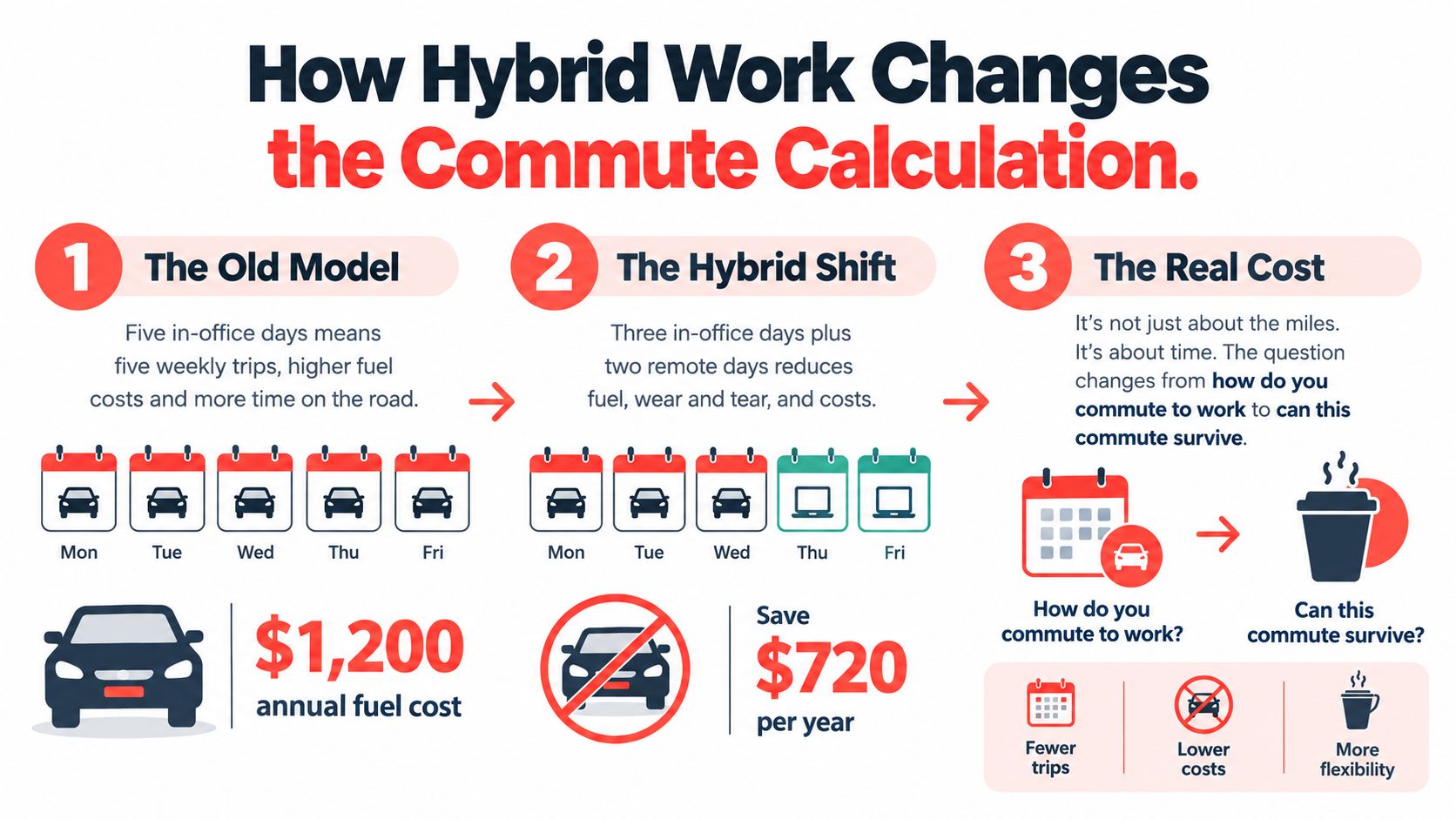
Treat office attendance as a housing stress test. Write down the policy your household is buying into: fixed office days or shifting ones, surprise meetings, whether remote status can be revoked, whether tolls or parking stay in the budget even with fewer trips, and whether you still need a second car. Listings never show any of that, but it decides whether the location still works six months later.
The Washington region is a good warning. The Metropolitan Washington Council of Governments regional telework report found regular telework fell from 65% in 2022 to 48% in 2025, while average commute distance stayed about 17 miles and average commute time remained near 40 minutes. Transit use rose, but transit commutes averaged 52 minutes. Fewer office days can lower weekly exposure. They do not make a weak route stronger.
A hybrid commute saves frequency, not fragility.
Use that standard when you shortlist places. Start with towns for remote workers on ReloMaps if remote flexibility is part of the draw, then keep only the cities that still hold up under a plausible return-to-office schedule. The weekly routine still matters, and hybrid work routine tips from Tandem Space can help you organize it. Routine fixes do not rescue a location that fails once the office calendar gets heavier.
Measuring Your Actual Commute Before You Move
Don't trust a map estimate alone. Run the route before signing a lease or closing on a home.
Test the trip in real conditions
Start with a weekday peak-hour test. Drive, take transit, cycle, or walk at the time you'd leave. Include parking, walking from the parking space, platform access, elevator waits, transfers, and the final walk to the workplace.
Then keep a one-week timed log. Record every leg, including the moments that apps tend to hide:
- Departure from the front door.
- Time spent finding parking or reaching a station.
- Waiting and transfer time.
- Walking from the stop or garage.
- Delays, missed connections, and backup rides.
- Return-trip conditions after the workday.
The purpose isn't false precision. It's to distinguish a route that works in theory from one that repeatedly breaks during ordinary life.
Turn the result into a location filter
After recording the route, open a city page such as Austin, Texas on ReloMaps. Set the commute-time filter to a realistic one-way threshold, not an optimistic off-peak estimate. Compare two or three candidate cities using ReloScore and category grades, including cost of living, safety, school fit, and quality of life.

A useful worksheet has three columns: current home, proposed home, and return-to-office case. Add weekly travel minutes, expected office trips, mileage or fares, parking, tolls, and backup transportation. Then compare the location's broader household fit. A low commute cost doesn't rescue a place that fails on safety or schools, and a strong city profile doesn't justify a route your household can't sustain.
If affordability is the deciding constraint, use a broader shortlist such as ReloMaps' guide to affordable American cities, then apply the commute threshold instead of treating low housing cost as the complete answer.
Why Reliability and Access Matter More Than Minutes
A 28-minute trip that breaks down twice a month is worse than a 35-minute trip you can count on. Treat the commute as a weekly budget, not a one-way brag number. Lost time from delays, missed pickups, backup rides, and last-minute parking changes adds up fast, and those costs get uglier when hybrid schedules shift or an employer wants more office days.
That is why access matters as much as speed.
Analysts behind the Maryland commuter survey summary found that 34% of workers experienced transportation-related lateness in the previous 30 days, including 10% who were late often. They also found transportation insecurity affected 40% of workers of color and 45% of workers with disabilities, compared with 30% and 33% among the respective comparison groups. Transit commuters faced the highest risk, with 59% classified as transportation insecure, versus 31% of solo drivers and 29% of exclusive teleworkers.
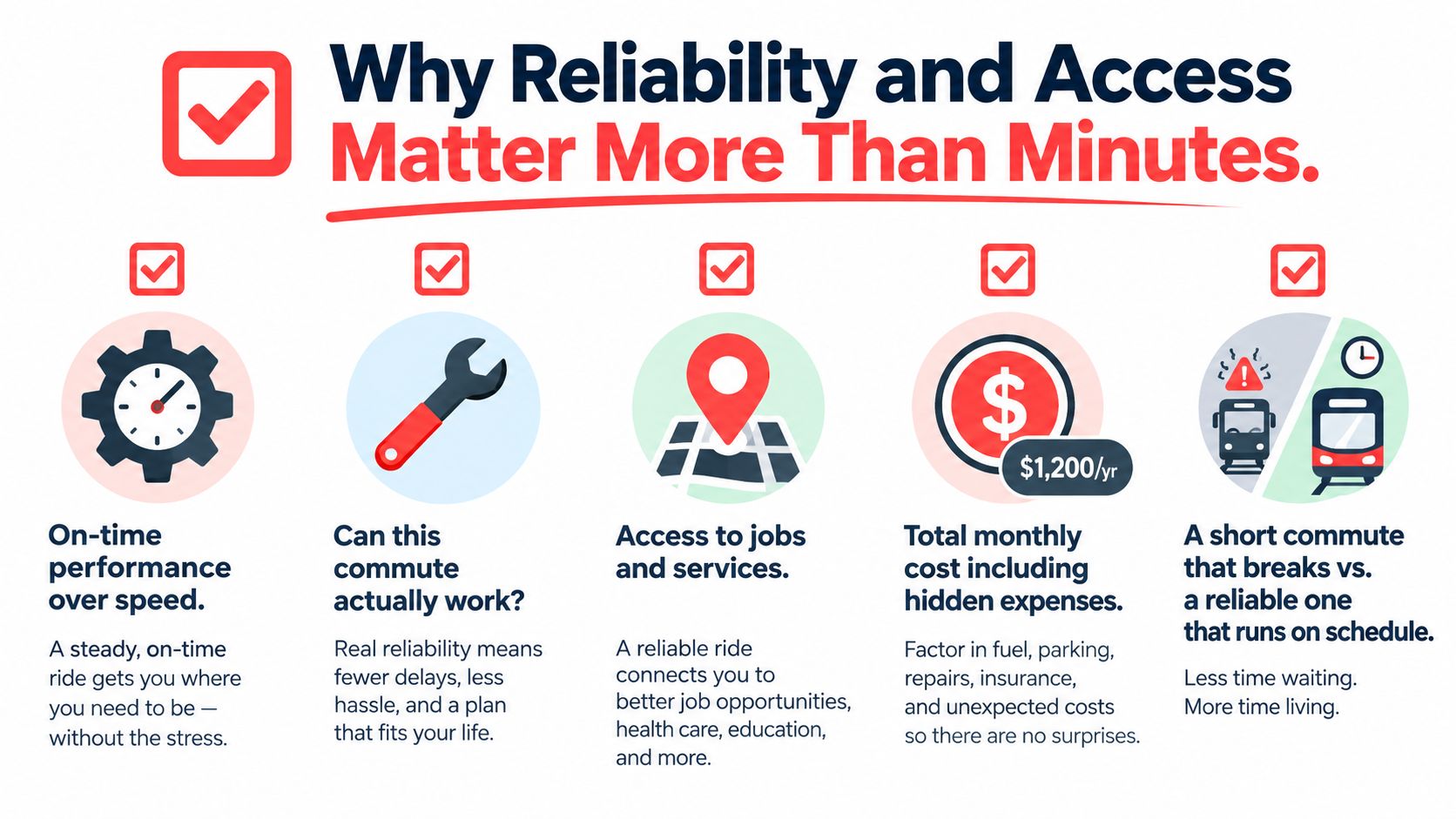
Minutes on a map do not show whether the route still works after a delayed train, a sick kid call, an elevator outage, or a meeting that runs late. Buyers get burned here all the time. They choose a place based on the best-case trip, then spend every other week paying for the exceptions.
Use a harder filter before you commit to a neighborhood:
- Delay tolerance: What does one missed connection do to your arrival time?
- Backup access: Can you switch modes without blowing up the day's budget?
- Schedule pressure: Will the route still work with school pickup, childcare, or an early shift?
- Accessibility: Are sidewalks, stations, vehicles, and transfers usable for the people who need them?
- Evening resilience: Does the trip home work reliably, not just the morning run?
A longer accessible route can beat a shorter route with one unusable transfer. A household with one car may need nearby services more than a technically faster commute. If your end time moves around, frequent evening options matter more than a quick morning trip.
Building a Commute Plan You Can Live With
Make the decision this week, before the address starts to feel emotionally inevitable.
- Name the sustainable mode. Choose the option you can use on a bad weather day, a late-meeting day, and a low-energy day.
- Write the weekly worst case. Record travel minutes, office days, mileage, fares, parking, tolls, and backup rides.
- Run a peak-hour test. Complete at least one real trip from the proposed area at the time you would travel.
- Shortlist locations systematically. Compare two or three cities on ReloMaps using commute-time, cost-of-living, and safety grades alongside household priorities.
- Recheck the plan when work changes. A new office policy can turn a manageable hybrid location into a punishing daily commute.
For the practical details that make a mixed-mode trip easier, such as carrying a laptop and work essentials, Urban Totes' commute-ready tote guide is a useful resource. The larger decision remains unchanged: price the commute in weekly minutes and annual dollars before you price the house.
The answer to “How do you commute to work?” isn't a permanent sentence. It's a living plan tied to your employer, household, transportation access, and tolerance for risk.
ReloMaps helps you compare U.S. cities and towns through commute-time filters, ReloScore, and category grades covering cost of living, safety, schools, quality of life, and other relocation factors. Visit ReloMaps to build a shortlist that still works if your hybrid schedule changes or your employer brings everyone back to the office.
Enjoying the blog? Subscribe to ReloMaps+ for premium area intelligence — and to keep us independent.
Subscribe today