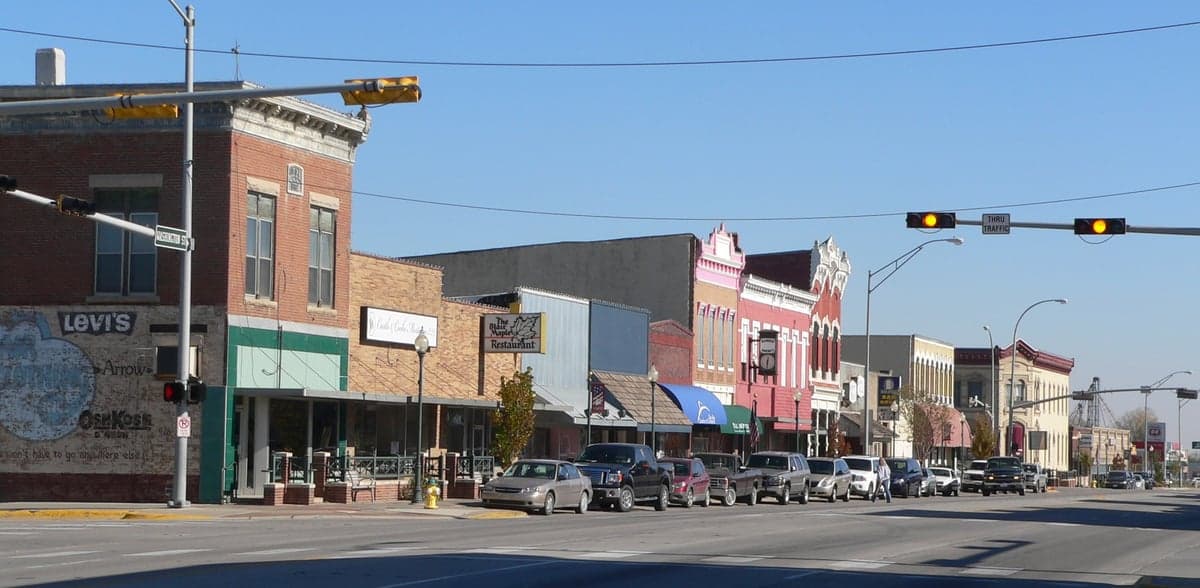
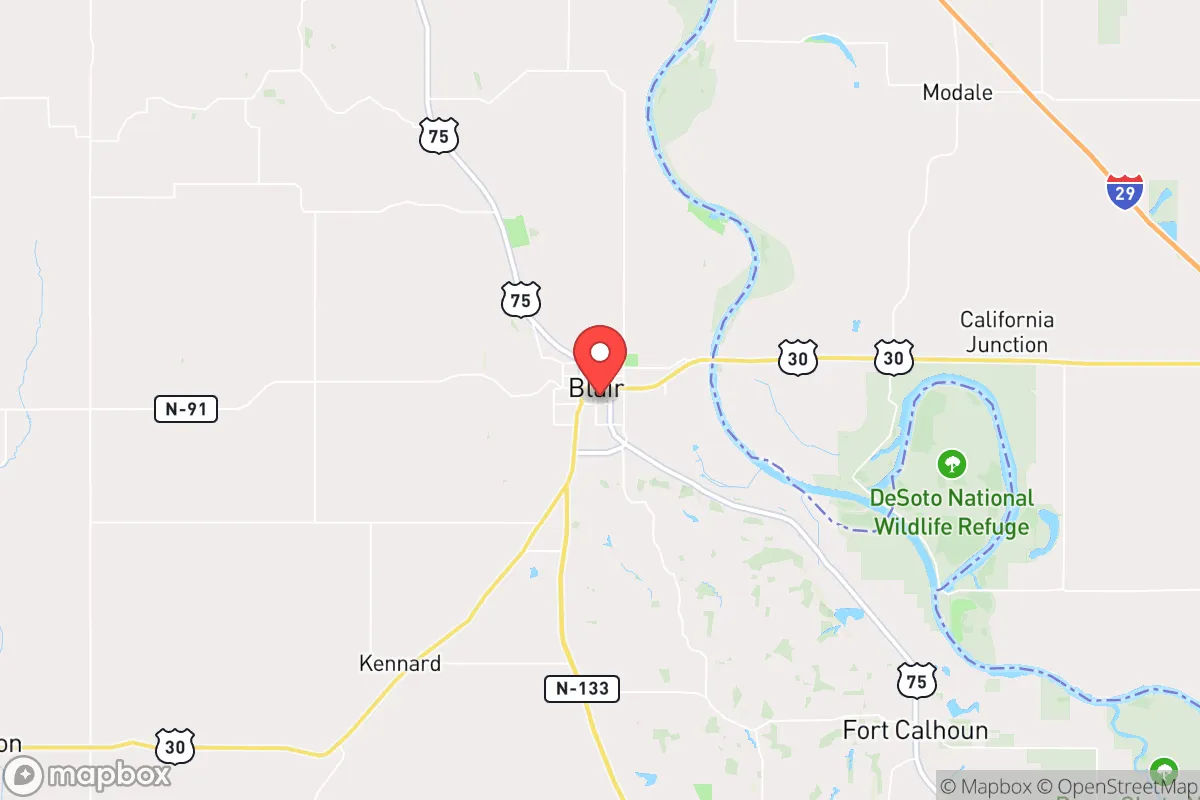
Photo: Wikipedia
Demographics of Blair, NE
Affluence Level in Blair, NE
A middle-class area roughly in line with national averages across income, home values, education, and employment.
People of Blair, NE
The people of Blair, Nebraska, today form a remarkably homogeneous community of roughly 7,868 residents, characterized by a 95.3% white population and a foreign-born share of just 0.4% — one of the lowest in the metro Omaha area. This is a place where generational roots run deep, with a strong blue-collar and agricultural heritage now blending with a growing cohort of college-educated professionals (37.0%) drawn by affordable housing and proximity to Omaha. The city’s identity is distinctly Midwestern and conservative, shaped by its Danish Lutheran founding and a century of slow, steady growth that has resisted the rapid diversification seen in larger regional hubs.
How the city was settled and grew
Blair was founded in 1869 as a stop on the Sioux City and Pacific Railroad, with the first wave of settlers being predominantly Danish and German immigrants drawn by railroad construction jobs and the promise of cheap farmland along the Missouri River. The original town plat centered on Washington Street and the railroad depot, where Danish Lutheran families built the first homes and established Dana College in 1884 — a key institution that anchored the Danish-American community for over a century. By 1900, the population had reached roughly 1,500, with a second wave of German Catholics settling in the South Blair area near the river, working in the new grain elevators and the Blair Brick Company. The North Blair neighborhood, developed in the 1910s and 1920s, became home to the town’s growing professional class — doctors, lawyers, and merchants — while the West End district, near the high school, absorbed the children and grandchildren of the original Danish farmers who had moved into town. The city’s growth remained modest through the mid-20th century, reaching about 4,500 by 1960, driven almost entirely by natural increase and the expansion of the local Cargill grain processing plant.
Modern era (post-1965)
After the 1965 Hart-Cellar Act, Blair experienced virtually no immigration-driven diversification. The foreign-born population today sits at 0.4%, and the Hispanic share (2.1%) and Black share (0.6%) remain negligible. Instead, the modern era has been defined by domestic in-migration from rural Nebraska and Iowa, as well as a slow trickle of Omaha commuters seeking lower taxes and larger lots. The Blair Hills subdivision, developed in the 1970s and 1980s, absorbed many of these newcomers — mostly white, middle-class families working in Omaha’s finance and healthcare sectors. The Viking Estates neighborhood, built in the 1990s and 2000s, became the preferred destination for younger families, with its newer homes and proximity to the elementary school. Meanwhile, the closure of Dana College in 2010 removed a key source of cultural diversity and youthful energy, accelerating the town’s demographic aging. The East/Southeast Asian population (0.2%) and Indian subcontinent population (0.0%) are essentially nonexistent, reflecting the city’s lack of the tech or academic sectors that typically attract these groups. The small Hispanic community is concentrated in South Blair, near the meatpacking and agricultural processing plants that employ a handful of migrant workers, but this population has plateaued rather than grown in recent years.
The future
Blair’s population trajectory points toward continued homogeneity and slow, aging growth. The city is not tribalizing into distinct ethnic enclaves — it is simply staying overwhelmingly white, with the small Hispanic and Black populations likely to remain stable or decline as older residents age out. The 37.0% college-educated share suggests a gradual professionalization, but without major employers or a university, the city will struggle to attract younger, diverse talent. The next 10-20 years will likely see Blair become slightly older, slightly more commuter-oriented, and slightly more conservative, as Omaha’s suburban sprawl pushes families north along U.S. Highway 30. New subdivisions on the northwest edge of town, near the Blair Municipal Airport, are being marketed to Omaha commuters and will reinforce the white, middle-class character. The foreign-born share is unlikely to rise above 1% without a major industrial shift, and the Hispanic population may grow modestly if agricultural processing expands, but Blair will remain one of Nebraska’s most demographically stable — and least diverse — small cities.
For someone moving in now, Blair offers a predictable, safe, and culturally cohesive environment where neighbors share a common background and values. The trade-off is clear: you gain a tight-knit, low-crime community with strong schools and affordable homes, but you accept a level of demographic uniformity that is increasingly rare in the 21st-century Midwest. This is a place that has changed slowly for 150 years and shows every sign of continuing that pattern.

* Values derived from national, state, county, city and local statistics and may differ in a specific area. Last updated: 2026-04-19T10:41:32.000Z
Narrative content on this page is AI-generated and may contain mistakes. Verify any details that matter before acting on them.
ReloMaps may earn a commission from affiliate links at no extra cost to you.

