 Popular
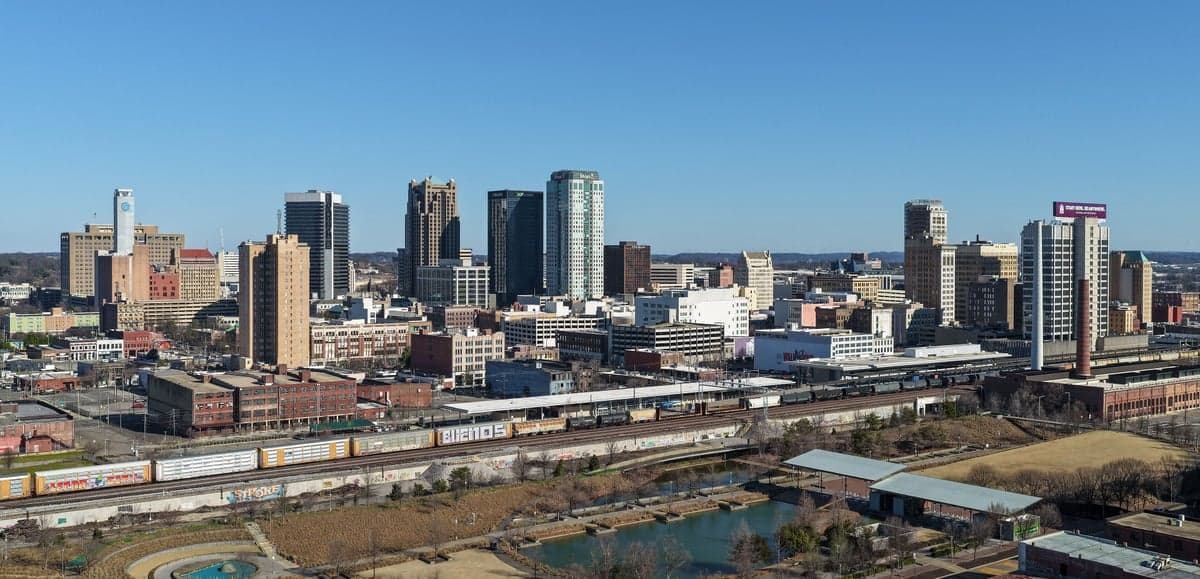
Photo: Wikipedia
Demographics of Birmingham, AL
Affluence Level in Birmingham, AL
A below-average socioeconomic profile. Incomes, home values, and educational attainment trail the U.S., with higher poverty and unemployment.
People of Birmingham, AL
The people of Birmingham, Alabama today form a majority-Black city of just under 200,000 residents, with a notably small foreign-born population of 3.4% and a white population of 24.2%. The city is characterized by a strong sense of place rooted in its industrial past, a high degree of racial residential concentration, and a population that has been shrinking for decades, though recent stabilization efforts are underway. Distinctive identity markers include a deep pride in the Civil Rights Movement legacy, a growing but still modest Hispanic community (4.9%), and a college-educated rate of 30.7% that lags behind the national average but is concentrated in specific neighborhoods.
How the city was settled and grew
Birmingham was founded in 1871 as a planned industrial city, built specifically to exploit the region's unique combination of iron ore, coal, and limestone. The original population was a mix of white American migrants from the rural South and European immigrants, primarily from Ireland, Italy, and Germany, who came to work in the iron and steel mills. These groups settled in distinct neighborhoods: the Irish built a strong presence in Avondale, while Italian immigrants concentrated in the East Lake and Woodlawn areas. The city's explosive growth from 3,000 in 1870 to over 130,000 by 1910 was fueled by the booming steel industry, which drew a massive wave of Black migrants from the Deep South seeking industrial jobs. These African American workers were largely confined to segregated neighborhoods like Smithfield and Titusville, which became the cultural and commercial heart of Black Birmingham. By 1920, Birmingham was one of the largest industrial centers in the South, with a population that was roughly 40% Black and 60% white, a ratio that held until the post-World War II era.
Modern era (post-1965)
The post-1965 period saw dramatic demographic shifts driven by white flight and suburbanization. Following the Civil Rights Movement and the desegregation of schools and public spaces, Birmingham's white population began a steady exodus to surrounding suburbs like Hoover, Vestavia Hills, and Mountain Brook. This process accelerated through the 1970s and 1980s, transforming the city from a roughly 60% white population in 1960 to a majority-Black city by the 1980 census. Today, the city is 66.9% Black, with white residents concentrated in a few revitalized historic districts such as Forest Park and Highland Park, as well as the newly gentrifying Avondale area. The foreign-born population remains very low at 3.4%, with the largest group being Hispanic residents (4.9% of the total population) who have settled primarily in the East Lake and Ensley neighborhoods. East/Southeast Asian communities make up just 0.9% of the population, and Indian-subcontinent residents account for 0.5%, with no single neighborhood showing a strong concentration of either group. The city's population peaked at 340,887 in 1960 and has declined steadily to its current 199,322, a loss of over 40%.
The future
Birmingham's population trajectory is one of slow stabilization rather than dramatic growth. The city has seen modest population gains in the last few years, driven by a combination of urban infill development, the return of some young professionals to historic neighborhoods like Avondale and Lakeview, and a small but steady influx of Hispanic immigrants. However, the overall trend remains one of demographic consolidation: the Black population share is holding steady, the white population is slowly increasing in a few specific neighborhoods but not citywide, and the foreign-born population is growing from a very low base. The city is not homogenizing; rather, it is tribalizing into distinct enclaves, with affluent white and mixed-race neighborhoods in the south and east, and predominantly Black neighborhoods in the west and north. The Hispanic community is expected to grow slowly, potentially reaching 7-8% of the population by 2040, but Birmingham will remain a predominantly Black and native-born city for the foreseeable future. The Indian and East/Southeast Asian populations are likely to remain very small, as the city lacks the tech and professional job base that attracts these groups to other Southern metros.
For someone moving to Birmingham now, the city offers a deeply rooted, majority-Black urban experience with a strong sense of history and community, but with limited ethnic diversity and a population that is still adjusting to decades of decline. The most dynamic areas are the revitalizing historic neighborhoods near downtown, while the broader city remains economically challenged and racially segregated. New residents should expect a place that is stable, proud, and slowly improving, but not one experiencing rapid demographic change or significant in-migration from outside the region.

* Values derived from national, state, county, city and local statistics and may differ in a specific area. Last updated: 2026-04-19T18:45:00.000Z
Narrative content on this page is AI-generated and may contain mistakes. Verify any details that matter before acting on them.
ReloMaps may earn a commission from affiliate links at no extra cost to you.

