Photo: Wikipedia
Demographics of Berlin, NH
Affluence Level in Berlin, NH
A below-average socioeconomic profile. Incomes, home values, and educational attainment trail the U.S., with higher poverty and unemployment.
People of Berlin, NH
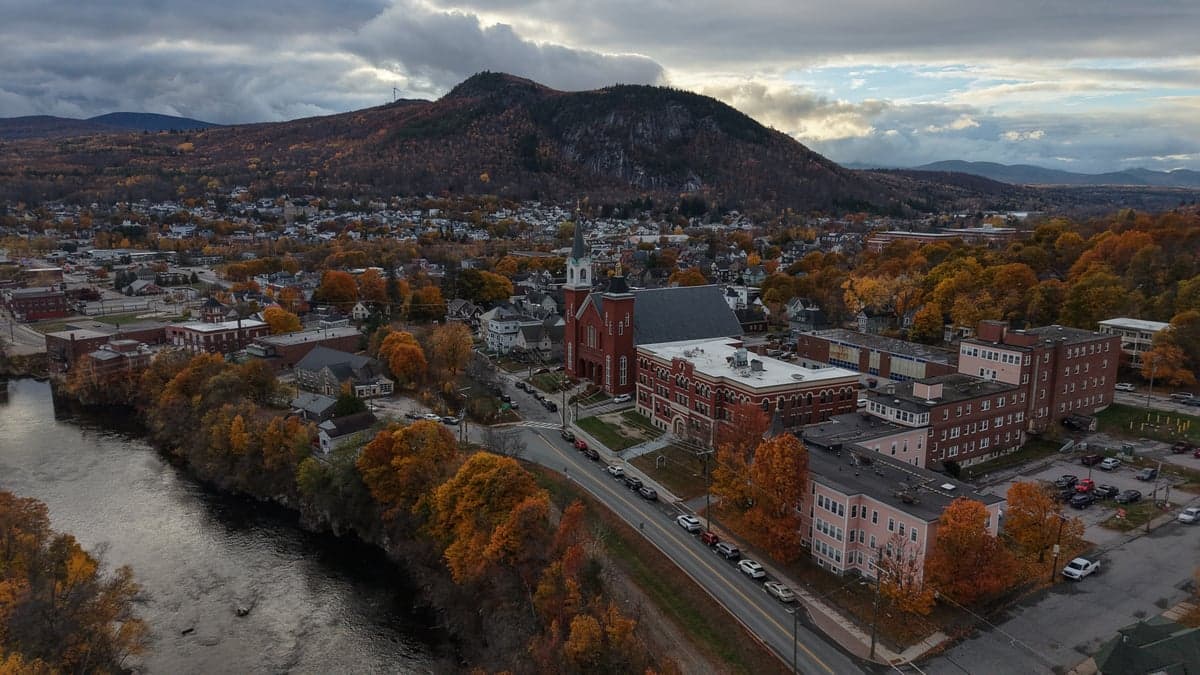
The people of Berlin, New Hampshire, today number 9,473, forming a predominantly white (85.9%) community with a small but notable Hispanic (5.2%) and Black (4.5%) presence. The city’s identity is rooted in its Franco-American and French-Canadian heritage, a legacy of the paper mill era that still shapes local culture, cuisine, and the Catholic parish life centered around St. Anne’s Church. With only 14.2% holding a college degree and a foreign-born population of just 2.6%, Berlin remains a working-class, insular city where family ties run deep and newcomers are often viewed with a mix of curiosity and caution.
How the city was settled and grew
Berlin’s population history is defined by a single industry: paper. The city was originally settled in the 1820s as a farming and logging outpost, but its explosive growth began in the 1850s when the Berlin Mills Company (later Brown Company) built a massive pulp and paper mill along the Androscoggin River. The mill drew waves of French-Canadian immigrants from Quebec, who arrived between 1870 and 1920, fleeing rural poverty and seeking steady mill wages. These families settled in the French Village neighborhood, a dense cluster of tenements and triple-deckers near the mill, where French was the primary language until the 1950s. A smaller wave of Polish and Italian immigrants arrived in the 1910s, settling in the East Side district around the Holy Family Church, while a handful of Swedish and German workers built homes in the West Side along the river. By 1920, Berlin’s population peaked at over 16,000, making it one of the largest cities in northern New England, almost entirely white and overwhelmingly Catholic.
Modern era (post-1965)
The post-1965 era brought no significant foreign-born influx to Berlin. The city’s population declined steadily after the 1970s as the paper industry mechanized and then collapsed, with the last major mill closing in 2006. The 2.6% foreign-born figure today is among the lowest in New Hampshire, and nearly all of that small share consists of Canadian-born retirees or a handful of European-born spouses. The Hispanic (5.2%) and Black (4.5%) populations are almost entirely domestic in-migrants—many from Massachusetts or southern New Hampshire—drawn by low housing costs. These newer residents have concentrated in the Hillside neighborhood, a post-war subdivision of ranch homes and split-levels, and in the Notch Street corridor, where rental properties are cheapest. The East/Southeast Asian (0.1%) and Indian-subcontinent (0.1%) populations are negligible, limited to a few professionals at the local hospital or the state prison. Berlin has not experienced the refugee resettlement or Latino labor migration seen in other New England mill towns; its demographic shifts are almost entirely driven by white out-migration and a small, gradual diversification among the remaining population.
The future
Berlin’s population is projected to continue its slow decline, with the median age rising above 45 as young adults leave for jobs in Manchester, Nashua, or out of state. The city is not homogenizing into a single enclave; rather, it is tribalizing into distinct groups: the long-established Franco-American families who still dominate the French Village and East Side, and the newer, more diverse arrivals in Hillside and Notch Street. The Hispanic and Black populations are likely to grow modestly as housing remains affordable relative to the rest of New Hampshire, but the foreign-born share will probably stay below 5% for the foreseeable future. The Indian and East/Southeast Asian communities are unlikely to expand significantly, as Berlin lacks the professional job base or university presence that attracts those groups. The next decade will likely see a continued aging of the Franco-American core, with the city becoming slightly more diverse but still overwhelmingly white and working-class.
For a conservative-leaning individual or family moving to Berlin now, the city offers a stable, low-cost, and culturally homogeneous environment where traditional values and community ties remain strong. The population is not rapidly diversifying or polarizing; it is slowly shrinking and aging, with a small but steady infusion of domestic migrants from southern New England. The key trade-off is between affordability and opportunity—Berlin is a place where a family can buy a home for under $150,000, but where job growth is minimal and the population trend is downward.

* Values derived from national, state, county, city and local statistics and may differ in a specific area. Last updated: 2026-04-19T15:58:49.000Z
Narrative content on this page is AI-generated and may contain mistakes. Verify any details that matter before acting on them.
ReloMaps may earn a commission from affiliate links at no extra cost to you.

