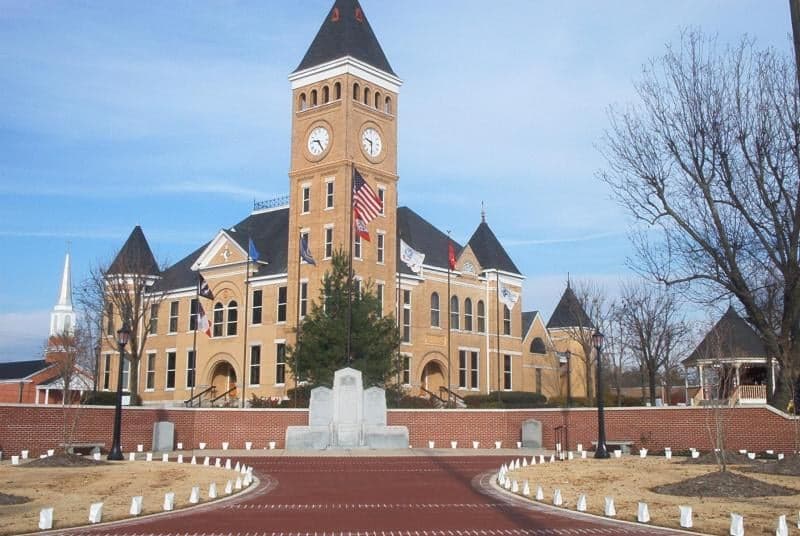
Photo: Wikipedia
Strategic Assessment of Benton, AR
Workable tactical position. Some exposure to population density or targets, but generally defensible in a crisis.
What does the Strategic Assessment tell us?
Our Strategic Assessment grades tactical survivability of an area. Major population centers, military targets, fallout zones, natural disasters, and border exposure all drive risk — lower exposure means a more defensible position in a crisis.
This is heavily inspired by Joel Skousen's Strategic Relocation book. Highly recommended you checkout the book ($)What does this tell us?
Our Strategic Assessment grades tactical survivability of an area. Major population centers, military targets, fallout zones, natural disasters, and border exposure all drive risk — lower exposure means a more defensible position in a crisis.
This is heavily inspired by Joel Skousen's Strategic Relocation book. Highly recommended you checkout the book ($)Strategic Pillars

Key Distances
Regional Safe Places
Below is our recommended "safe zones" in Arkansas and the surrounding area based on our strategic heuristics. For most people, it's unrealistic to live in a “safe zone” full-time due to work, family or other personal reasons. They tend to be more rural. However, many of these areas are perfect for second homes and retreat properties that double as a vacation home or even a short-term rental.
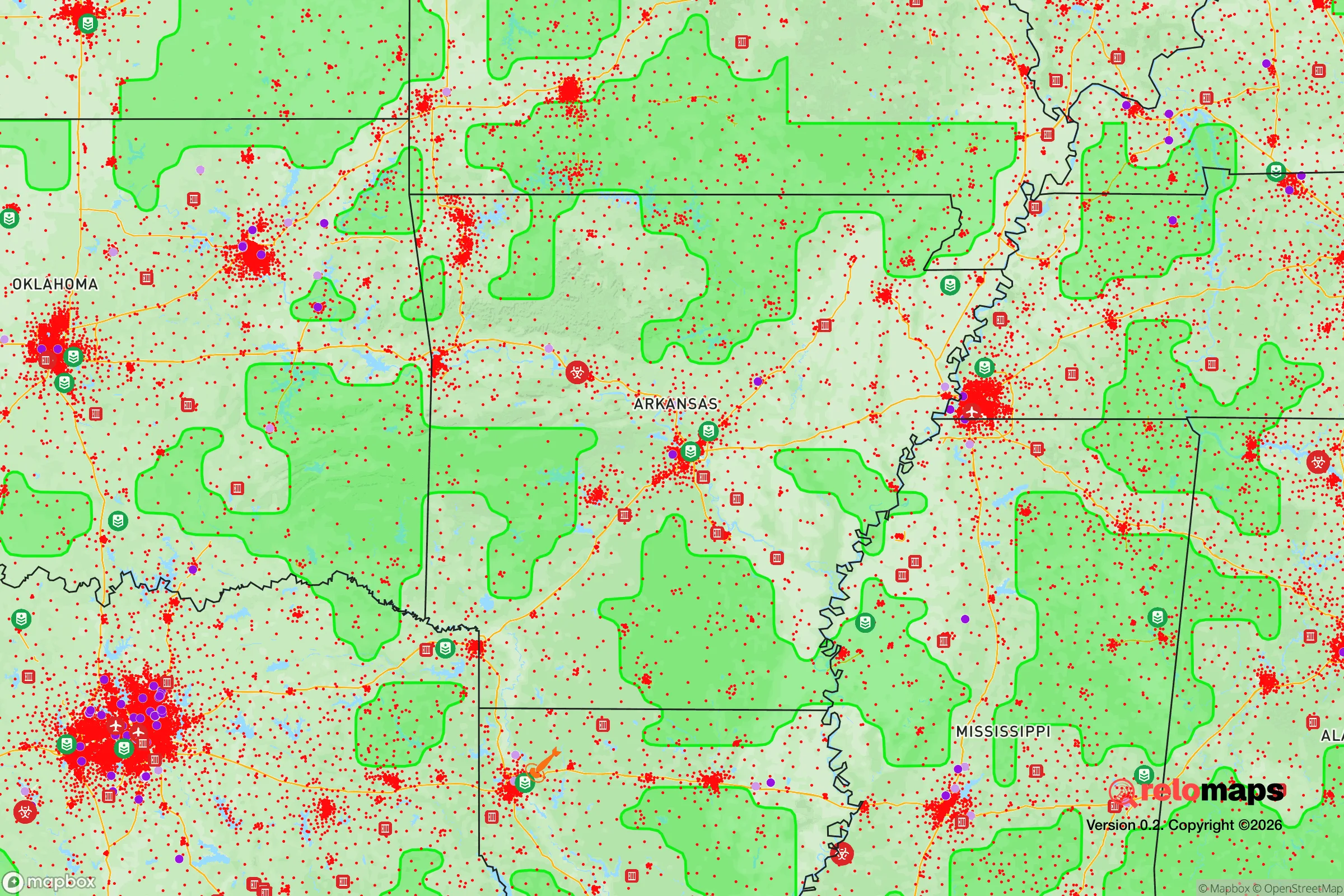
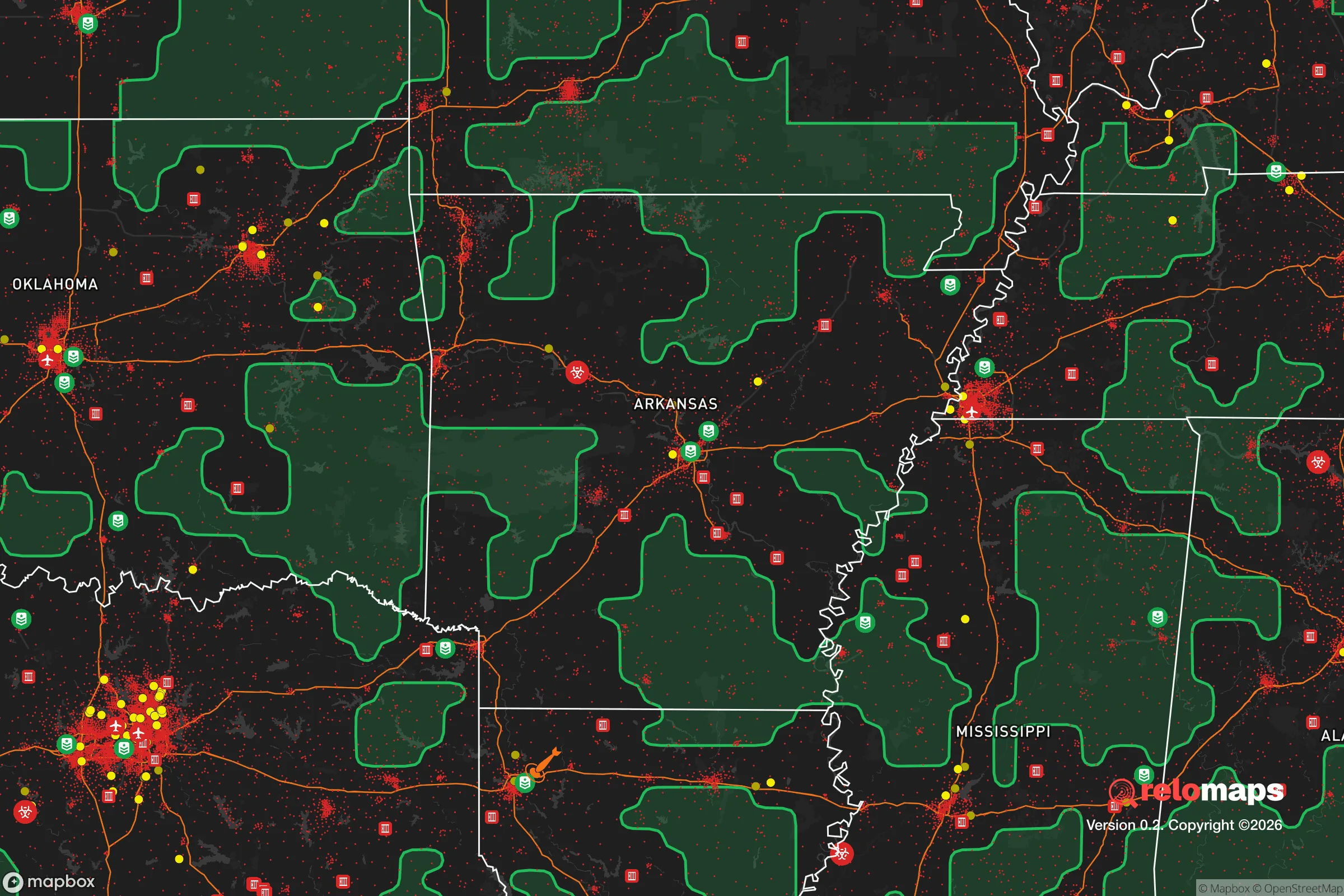


Important Note: For informational purposes only. This does not mean nothing bad ever happens in the green zones. Please use common sense. This is based on public data and modeled with AI. We tried to take a conservative approach but mistakes happen. We update this regularly as new information becomes available.
Solar Generator Recommendations
Backup power matters more here than in safer locations. We've picked three solar generators across budgets and capacity tiers — start with the budget unit if you only need a few essentials, or step up if you want to run a fridge and HVAC for days at a time.

Jackery Portable Power Station Explorer 300
Budget OptionPower on the Go: Weighing only 11 lbs, it's convenient to set up and store with book-sized foldable solar panels

BLUETTI Portable Power Station AC180
Designed for both indoor and outdoor scenarios, AC180 is highly capable as it has a robost capacity and continuous output power.

EF ECOFLOW DELTA Pro Ultra Power Station
Upgraded PickEcoFlow DELTA Pro Ultra is a whole-home energy system designed to grow with your family. Integrated with the Smart Home Panel 2, it scales to meet your evolving energy needs — keeping your home powered, intelligent, and secure through every stage of life.
We earn a commission, at no additional cost to you.
Strategic Assessment Analysis
Benton, Arkansas, sits in a geographic sweet spot that offers genuine strategic depth for those prioritizing resilience and self-sufficiency, but it is not a remote bunker. Located in Saline County, roughly 25 miles southwest of Little Rock, Benton provides a buffer from the immediate blast radius of a major urban target while still offering access to critical infrastructure and supply chains. For a conservative-leaning relocator concerned with civic unrest, mass casualty events, or systemic collapse, Benton’s position along the I-30 corridor and its proximity to the Ouachita National Forest create a layered defense: close enough to tap into regional resources, far enough to avoid the worst of urban chaos, and backed by natural terrain that complicates any large-scale movement. The area’s steady population growth—over 10% in the last decade—signals economic stability, but also means you are not alone in your thinking; the community is already filtering for like-minded individuals who value preparedness.
Geographic position and natural advantages for long-term security
Benton’s location is its primary strategic asset. The city sits at the edge of the Arkansas River Valley, where the flat Delta gives way to the forested ridges of the Ouachita Mountains. This transition zone offers natural defensibility—the terrain to the west and south becomes increasingly rugged, with elevation gains of 500 to 1,000 feet within 30 miles, creating natural chokepoints and observation points. The Saline River runs through the area, providing a reliable freshwater source that is less prone to contamination than the Arkansas River, which flows closer to Little Rock. For a prepper, this means you have multiple watersheds to draw from without relying on municipal systems that could fail during a crisis. The region also sits outside the primary tornado alley’s core, though severe weather is still a factor; the real advantage is the absence of major fault lines, hurricane storm surge zones, or wildfire corridors that plague other parts of the country. Benton’s climate is humid subtropical, with four distinct seasons that support year-round gardening and livestock management, provided you plan for summer heat and occasional ice storms.
Risks, exposures, and proximity to fallout-relevant landmarks
The most significant vulnerability for Benton is its proximity to Little Rock, a city of roughly 200,000 that hosts a major port on the Arkansas River, an Air Force base (Little Rock AFB), and several federal buildings. In a scenario involving civil unrest or a mass casualty event, I-30 becomes a funnel for both refugees and military movements, and Benton sits directly on that corridor. The interstate runs through the heart of the city, meaning any disruption in Little Rock will ripple south within hours. Additionally, the Arkansas Nuclear One plant in Russellville, about 70 miles northwest, is a potential fallout source in a catastrophic event; prevailing winds from the south and southwest could carry a plume toward Benton, though the distance provides some dilution. The city itself has a population of around 40,000, which is large enough to sustain a local economy but small enough that a sudden influx of displaced urbanites could overwhelm resources within days. The Saline County Sheriff’s Office and Benton Police Department are professional but not sized for a major crisis; mutual aid agreements with Little Rock could be strained if the capital is compromised. For the strategic relocator, the key is to establish a residence on the western or southern outskirts of Benton, away from the I-30 corridor and closer to the forested buffer zones, to reduce exposure to both fallout and human traffic.
Practical resilience for a relocator: food, water, energy, and defensibility
Benton offers a surprisingly robust foundation for practical self-sufficiency. The surrounding Saline County is largely rural, with over 60% of the land classified as timber or agricultural, meaning you can find acreage with well water, septic systems, and space for gardens or small livestock within a 15-minute drive of the city center. The local soil is loamy in the river bottoms and clay-based on the ridges, but with raised beds and composting, you can produce a significant portion of your own calories. The growing season runs from April to October, with a 200-day window for warm-season crops like tomatoes, peppers, and squash. For water, the Saline River and its tributaries (Alum Fork, Middle Fork) are perennial and generally clean, but you should budget for a deep well—depths of 100 to 300 feet are common, and the aquifer is reliable. Energy resilience is a mixed bag: Entergy Arkansas provides grid power that is moderately reliable, but ice storms in January and February can knock out lines for days. Solar is viable, with an average of 5.2 peak sun hours per day, but you will need battery storage to handle the cloudy stretches. Natural gas is available in the city limits, but propane is the standard for rural properties; plan for a 500-gallon tank to cover heating, cooking, and generator backup. Defensibility is best achieved by choosing a property with a single access point, preferably off a county road rather than a state highway, and with tree cover that provides concealment without blocking fields of fire. The local gun culture is strong—Arkansas is a constitutional carry state—and the Saline County Sheriff’s Office is known for being supportive of Second Amendment rights, which matters if you need to rely on community defense during a breakdown of order.
The overall strategic picture for Benton is one of calculated trade-offs. It is not a remote redoubt; you will have neighbors, traffic, and the constant hum of I-30 within earshot. But for a relocator who wants to maintain a professional career or access to healthcare while building a resilient homestead, Benton offers a rare combination of proximity to urban infrastructure and genuine rural escape routes. The area’s conservative political leanings—Saline County voted +37 points Republican in the 2024 presidential election—mean you are likely to find a community that shares your concerns about federal overreach, economic instability, and the erosion of local control. The key is to act before the next wave of migration from the coasts drives up land prices and crowds the buffer zones. If you secure a property with good water, defensible terrain, and a plan for energy independence, Benton can serve as a staging ground for weathering the next decade’s disruptions—provided you keep one eye on the interstate and the other on the horizon.

* Values derived from national, state, county, city and local statistics and may differ in a specific area. Last updated: 2026-04-30T02:11:08.000Z
Narrative content on this page is AI-generated and may contain mistakes. Verify any details that matter before acting on them.
ReloMaps may earn a commission from affiliate links at no extra cost to you.

