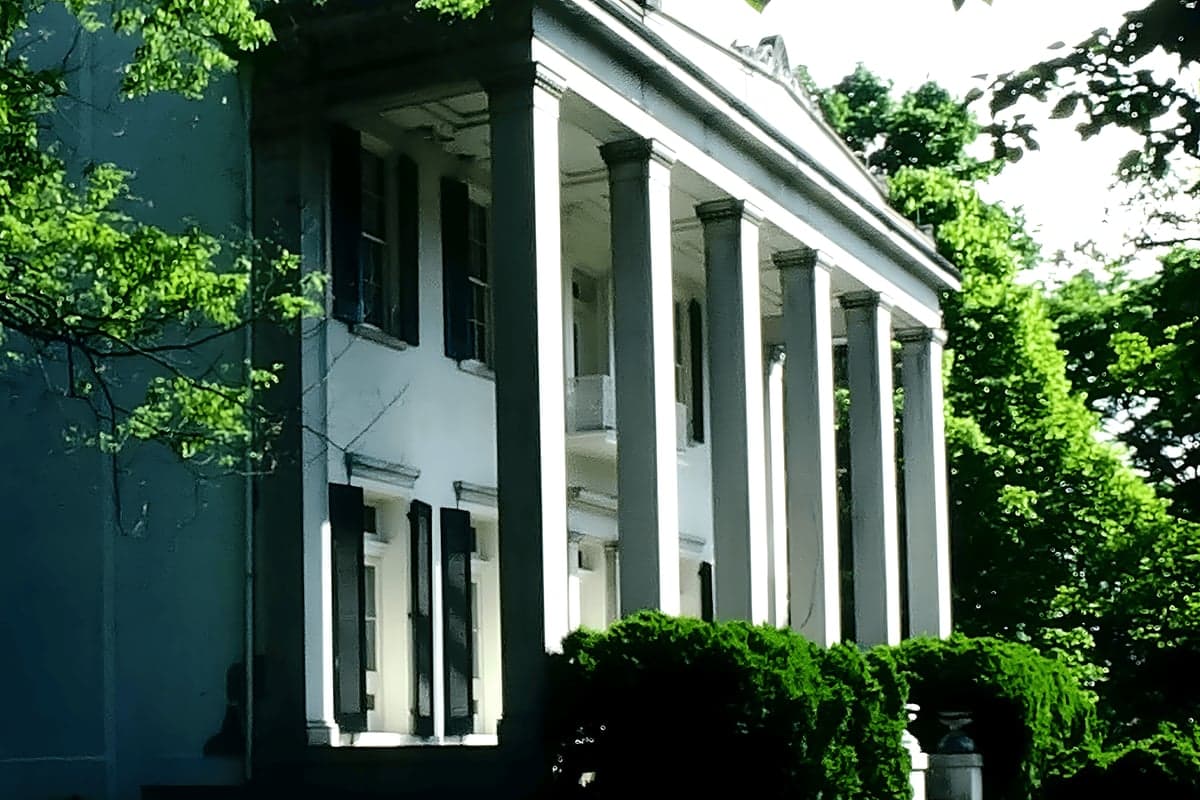
 Popular
Photo: Wikipedia
Political ClimatePolitical Climate in Belle Meade, TN
District shown is the primary district for this city’s centroid. Cities may span multiple districts.
Inherited from parent state — no local data available.
Local Political AnalysisPolitical Analysis of Belle Meade, TN
Belle Meade, Tennessee, sits comfortably as one of the most reliably conservative enclaves in the Nashville metro area, with a Cook PVI of R+8 that reflects decades of consistent Republican voting. This isn't a place that flips with the national mood; it's a community where fiscal responsibility, limited government, and traditional values have been the bedrock since the city was incorporated in 1938. If you look at the voting patterns over the last three presidential cycles, Belle Meade has held steady at around 60-65% Republican, even as Davidson County as a whole has trended bluer. The trajectory here is one of cautious stability—residents are deeply skeptical of the progressive shifts seen in nearby Nashville proper, and they've made it clear they want to keep their local government small and their personal freedoms intact.
How it compares
Drive ten minutes east into the heart of Nashville, and you're in a completely different political universe. Nashville's urban core votes reliably Democratic by margins of 30-40 points, with a city council that has pushed for things like sanctuary city policies, higher property taxes, and expanded public transit mandates. Belle Meade, by contrast, operates like a small-town government within a big city's shadow. The city has its own police force, its own zoning board, and a fiercely independent spirit. Compare it to nearby Brentwood or Franklin in Williamson County—those areas are also conservative, but they're growing fast and absorbing more of Nashville's spillover. Belle Meade is older, wealthier, and more resistant to change. The contrast is stark: while Nashville debates rent control and bike lanes, Belle Meade's biggest local controversies tend to revolve around tree preservation and historic property standards. That's not to say there aren't tensions—some residents worry that the county-level school board and Metro Nashville's influence are slowly creeping in, especially with the push for more centralized planning from the state level.
What this means for residents
For someone moving here, the political climate means you can expect a local government that stays out of your way. Property taxes are relatively low for the area, and there's no city income tax. The city council meetings are short, and the agenda is usually about road maintenance or stormwater management—not social engineering. But you should also know that the political homogeneity can feel insulating. If you lean conservative, you'll find neighbors who share your views on school choice, Second Amendment rights, and the importance of local control. The downside? If you're hoping for a politically diverse community where ideas clash and evolve, this isn't it. The real concern for longtime residents is the slow bleed of progressive ideology from Nashville into county-level decisions. The Metro Council has already passed resolutions that some see as overreach—like requiring paid sick leave for certain workers and pushing for more affordable housing mandates. Belle Meade has fought to opt out of these, but the legal battles are ongoing. The long-term worry is that as Nashville grows, the state legislature might step in to preempt local control, which could erode the very independence that makes Belle Meade attractive.
Culturally, Belle Meade is defined by its quiet wealth, its historic estates, and a deep-seated belief that the best government is the one you barely notice. There's no downtown strip, no coffee shop politics—just tree-lined streets and a country club where the biggest debate is about the golf course renovation. The policy distinction that matters most here is the city's strict zoning code, which has kept commercial development at bay and preserved the residential character. That's a double-edged sword: it keeps out the chaos, but it also means you're driving to Green Hills or Berry Hill for groceries. For residents, the trade-off is worth it. The political climate isn't flashy, but it's reliable—and in a world where government overreach feels like a growing threat, that reliability is exactly what keeps people here generation after generation.

State Political ClimatePolitical Climate in Tennessee
State Political AnalysisPolitical Environment in the State
Tennessee has been a reliably red state for decades, but the nature of that conservatism has deepened and shifted significantly over the past 10-20 years. The dominant coalition is a blend of rural, small-town, and suburban voters who have pushed the state from a more moderate, Blue Dog Democratic past to a solidly Republican supermajority in both chambers of the legislature. While the state hasn’t flipped in a presidential race since 2004, the real story is the hardening of the GOP’s grip—the state legislature now holds a supermajority that can override gubernatorial vetoes, and the 2024 election saw Donald Trump win the state by over 30 points. This isn’t a purple state trending blue; it’s a red state that’s been painted a deeper shade of crimson.
Urban vs. rural divide
The political map of Tennessee is a textbook case of the urban-rural split, but with a twist. The major metros—Nashville (Davidson County), Memphis (Shelby County), and to a lesser extent Chattanooga (Hamilton County)—are the blue islands in a sea of red. Nashville has become a reliably Democratic stronghold, driven by a booming population of young professionals, creatives, and transplants from bluer states. Memphis remains heavily Democratic, anchored by its large African American population and union history. However, the real action is in the suburbs. Williamson County (south of Nashville) was once a GOP lock but has seen a slight softening as affluent professionals move in, though it still votes heavily Republican. Meanwhile, Rutherford County (Murfreesboro) and Wilson County (Lebanon) have become some of the most reliably conservative suburban counties in the South, with Trump winning them by 30+ points. The rural counties—like those in the Upper Cumberland Plateau, West Tennessee, and East Tennessee—are deep red, with many precincts voting 80%+ Republican. The divide isn’t just about party; it’s about culture. A new resident moving to Franklin will find a different political world than someone moving to Knoxville, which is more of a mixed bag with a conservative base.
Policy environment
Tennessee’s policy environment is aggressively pro-business and low-tax, with a strong emphasis on personal responsibility. There is no state income tax on wages—only a Hall Tax on investment income, which is being phased out and will be gone by 2029. Sales tax is high (around 9.55% average combined rate), but the trade-off is that the state relies on consumption rather than earnings. The regulatory posture is light: no state-level minimum wage above the federal $7.25, no mandatory paid leave, and a right-to-work law that has kept union influence minimal. On education, the state has expanded school choice significantly, with the 2023 Education Freedom Scholarship Act creating a universal ESA program for all K-12 students, a major win for parental rights. Healthcare is a mixed bag: Tennessee did not expand Medicaid under the Affordable Care Act, and the state operates a limited 1115 waiver program (TennCare) that covers fewer people than full expansion would. Election laws have tightened: the 2023 law requiring photo ID for absentee ballots and limiting drop boxes was passed to ensure election integrity, though critics call it restrictive. The state also passed a 2024 law banning ranked-choice voting statewide, a preemptive strike against any future progressive experiments. For a conservative, this is a policy environment that prioritizes fiscal restraint, school choice, and election security.
Trajectory & freedom
On the freedom front, Tennessee has been moving in a decidedly libertarian-conservative direction over the past five years, but with some caveats. The biggest expansion of personal liberty came in 2021 with the constitutional carry law, allowing permitless carry of handguns for anyone 21 or older who can legally possess a firearm. This was a major win for Second Amendment advocates. On parental rights, the 2022 law banning instruction on sexual orientation and gender identity in K-3 classrooms (the “Don’t Say Gay” bill) was expanded in 2023 to cover all grades, and the 2023 law requiring schools to notify parents of any changes in a student’s mental or physical health (including pronoun changes) was a direct assertion of parental authority. Medical autonomy took a hit with the 2023 law banning gender-affirming care for minors, which conservatives see as protecting children from irreversible procedures. On property rights, the state has been generally pro-landowner, with no statewide rent control and limited eminent domain abuse. However, there are concerns: the 2024 law allowing the state to take over local school districts in “failing” counties (like Memphis) is a centralization of power that some see as government overreach. Overall, the trajectory is toward more freedom in the traditional conservative sense—less government in your wallet, your home, and your child’s education—but with a strong hand in social policy.
Civil unrest & political movements
Tennessee has seen its share of political flashpoints, but they’ve been more localized than in some other states. The most visible recent unrest was the 2023 Nashville school shooting at Covenant School, which sparked a massive protest movement for gun control that included the “Tennessee Three” state representatives (Justin Jones, Justin Pearson, and Gloria Johnson) who were expelled for disrupting the House floor. This was a major left-wing mobilization, but it was met with an equally strong conservative counter-movement that defended the state’s gun laws. Immigration politics are less heated here than in border states, but the 2024 law requiring local law enforcement to cooperate with ICE (the “Truth in Sentencing” bill) was a clear statement. There is no sanctuary city movement of note; Nashville considered it but backed down. Election integrity controversies have been minimal, though the 2020 election saw some local disputes over absentee ballot procedures. The most visible political movement on the right is the Tennessee Freedom Coalition, which has been active in school board races and local elections, pushing for parental rights and curriculum transparency. On the left, the Tennessee Justice Center and Indivisible groups are active but have limited impact outside of Nashville and Memphis. A new resident in Brentwood or Collierville will likely see little to no visible unrest; in downtown Nashville, they might encounter the occasional protest, but it’s not a daily reality.
Projection
Looking ahead 5-10 years, Tennessee is likely to become more conservative, not less, despite the in-migration of people from blue states. The key factor is who is moving in. The bulk of new residents are coming from California, Illinois, and New York, but they are disproportionately conservative-leaning—people fleeing high taxes, crime, and progressive policies. They are settling in the suburbs of Nashville, Knoxville, and Chattanooga, and they are voting for the same Republican policies that attracted them. The urban cores (Nashville, Memphis) will continue to drift left, but the state legislature is gerrymandered to protect rural and suburban seats, and the supermajority is likely to hold. The biggest wild card is the growing Hispanic population in Middle Tennessee, which could shift the calculus if they vote more Democratic, but so far, they are not a monolithic bloc. Expect more school choice expansion, further tax cuts (the Hall Tax phase-out will be complete), and continued resistance to Medicaid expansion. The state will also likely see more preemption of local ordinances—Nashville’s attempts at rent control and sanctuary policies have already been struck down by the legislature. For a conservative moving in, the projection is clear: Tennessee will remain a safe harbor for traditional values and limited government for at least the next decade.
For a new resident, the bottom line is this: Tennessee offers a political environment that is stable, predictable, and aligned with conservative principles. You won’t find the political whiplash of a swing state or the creeping progressivism of a blue state. The state government is firmly in the hands of people who believe in low taxes, school choice, gun rights, and parental authority. If you’re moving here, you can expect your vote to count in Republican primaries (which are the real elections in most districts), your taxes to stay low, and your children’s education to be free from the kind of ideological experiments you might see elsewhere. Just be aware that the urban islands of Nashville and Memphis are a different world—if you want the full Tennessee experience, stick to the suburbs and small towns where the values that made this state great are still thriving.
* Values derived from national, state, county, city and local statistics and may differ in a specific area. Last updated: 2026-04-27T14:19:43.000Z
Narrative content on this page is AI-generated and may contain mistakes. Verify any details that matter before acting on them.
ReloMaps may earn a commission from affiliate links at no extra cost to you.

