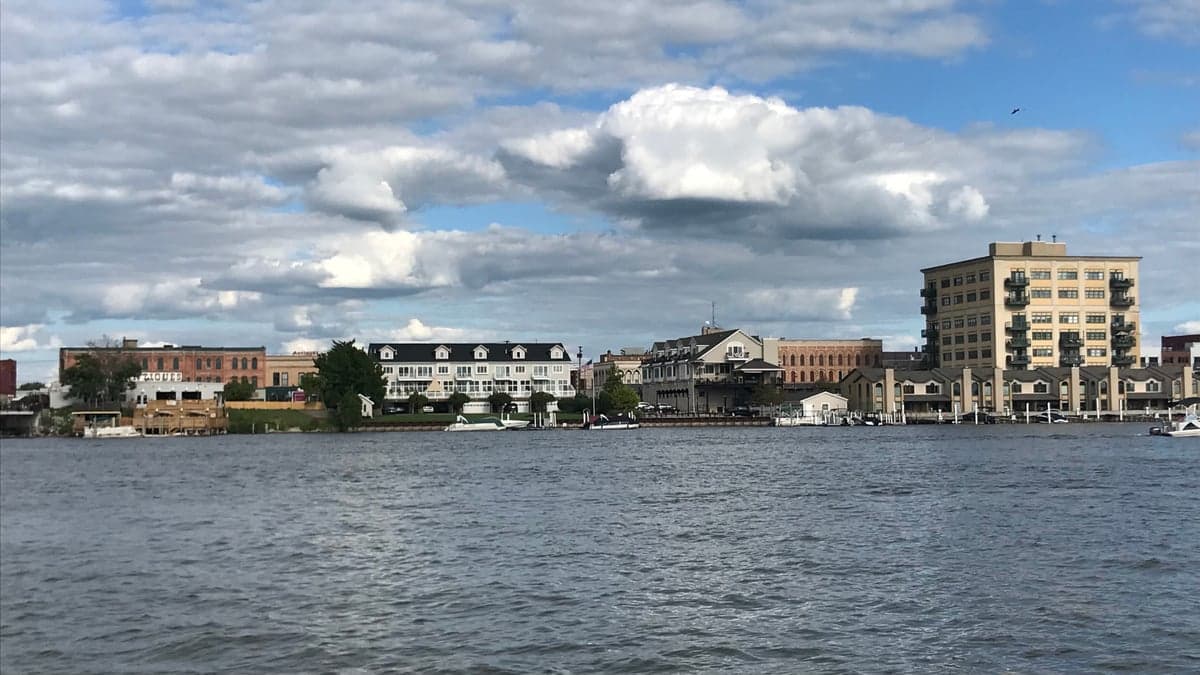
Photo: Wikipedia
Demographics of Bay City, MI
Affluence Level in Bay City, MI
A below-average socioeconomic profile. Incomes, home values, and educational attainment trail the U.S., with higher poverty and unemployment.
People of Bay City, MI
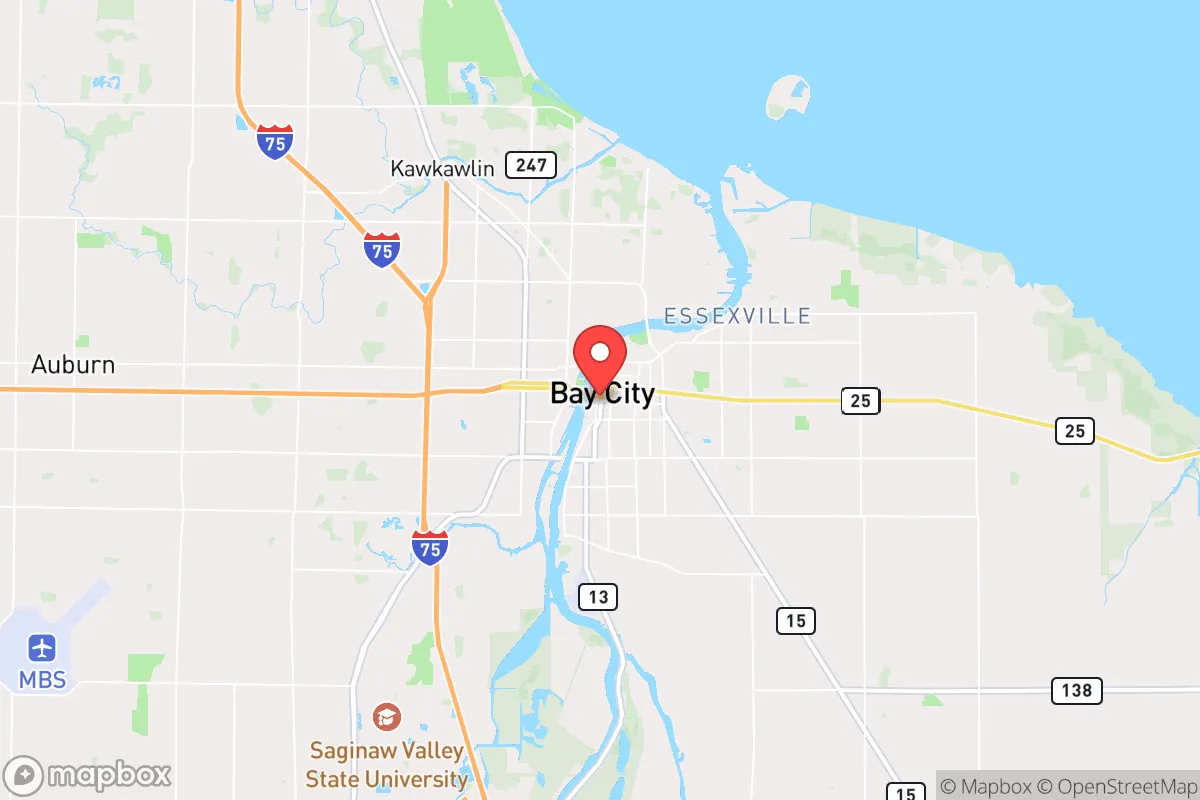
Bay City, Michigan, is a historically industrial Great Lakes community of 32,445 residents that remains overwhelmingly white (80.8%) with a growing Hispanic minority (10.7%) and very small Black (2.4%) and East/Southeast Asian (0.5%) populations. The city’s character is shaped by its working-class roots in lumber and manufacturing, a Catholic and union-influenced civic culture, and a population density of roughly 1,900 people per square mile that gives it a compact, walkable older core surrounded by quieter residential neighborhoods. Distinctive identity markers include a strong local pride in the annual River Roar boat races and the historic Wenonah Park district, alongside a lingering sense of economic caution after decades of industrial downsizing. Foreign-born residents make up just 0.9% of the population, making Bay City one of the least internationally diverse cities in Michigan’s Lower Peninsula.
How the city was settled and grew
Bay City’s population history begins with the Ojibwe people, who used the Saginaw River and Bay shoreline for fishing and trade before European contact. The first permanent white settlers arrived in the 1830s, drawn by the dense white pine forests that fueled the Great Lakes lumber boom. By the 1850s, the city was a booming sawmill town, attracting waves of German, Polish, and Irish immigrants who built the South End neighborhood around St. Stanislaus and St. James parishes. The Polish community was especially concentrated in the South End, where they established Catholic churches, fraternal organizations, and the city’s first ethnic grocery stores. A second wave of French-Canadian lumberjacks and millworkers settled in the West Side along the river, while German immigrants clustered in the Center Avenue corridor, building the grand Victorian homes that still define that district. By 1900, the lumber industry had collapsed, but the city pivoted to shipbuilding, automotive parts, and sugar beet processing, drawing a smaller wave of Dutch and Belgian farmers and factory workers to the North End and Kramer’s Corners area. The city’s population peaked at roughly 50,000 in the 1930 census, supported by the industrial jobs at Defoe Shipbuilding and the Monitor Sugar Company.
Modern era (post-1965)
After the 1965 Hart-Cellar Act, Bay City saw almost no new international immigration. The foreign-born share has remained below 1% for decades, a stark contrast to larger Michigan cities like Detroit or Grand Rapids. Instead, the post-1965 demographic story is one of domestic out-migration and suburbanization. White flight from the older, denser South End and Center Avenue neighborhoods accelerated in the 1970s and 1980s as manufacturing jobs disappeared; many families moved to the West Side subdivisions or to outlying townships like Bangor and Hampton. The South End, once the heart of Polish Bay City, saw its population drop by roughly 40% between 1970 and 2000, leaving behind an older, poorer, and more heavily white population. The Hispanic population, now 10.7% of the city, began growing in the 1990s, driven by Mexican and Puerto Rican families moving into the North End and Kramer’s Corners for work in agriculture and light manufacturing. This growth has been steady but modest, and the Hispanic community remains largely concentrated in those two neighborhoods rather than spreading citywide. The Black population (2.4%) is small and scattered, with no single dominant neighborhood, while the East/Southeast Asian population (0.5%) is almost entirely composed of a few dozen families, many connected to Dow Chemical in nearby Midland. The Indian-subcontinent population is 0.0%, reflecting the city’s lack of tech or medical-research sectors that attract such immigrants elsewhere.
The future
Bay City’s population is slowly homogenizing rather than diversifying. The white share has declined from roughly 90% in 1990 to 80.8% today, but this is almost entirely due to an aging white population and low birth rates, not replacement by other groups. The Hispanic share is growing but at a slowing pace—likely plateauing around 12-14% over the next decade as the agricultural and factory jobs that drew earlier arrivals become less available. The foreign-born share is expected to remain below 2%, as the city lacks the refugee resettlement programs, university recruitment, or high-skilled job base that drive international migration in other Michigan cities. The South End and Center Avenue districts will likely continue to see population loss as older residents die or move to assisted living, while the West Side and North End may stabilize or grow slightly if the city attracts young families priced out of Midland or Saginaw. No major ethnic enclave formation is expected; the city is too small and too white for tribalization into distinct ethnic neighborhoods.
For someone moving in now, Bay City is becoming a quieter, older, and more uniformly white working-class community with a modest Hispanic minority concentrated in two neighborhoods. It offers low housing costs and a strong sense of local history, but little demographic dynamism or international diversity. The city’s future is one of slow decline or gentle stabilization, not growth or transformation.

* Values derived from national, state, county, city and local statistics and may differ in a specific area. Last updated: 2026-04-19T05:50:32.000Z
Narrative content on this page is AI-generated and may contain mistakes. Verify any details that matter before acting on them.
ReloMaps may earn a commission from affiliate links at no extra cost to you.

