
Photo: Wikipedia
Political ClimatePolitical Climate in Batesville, MS
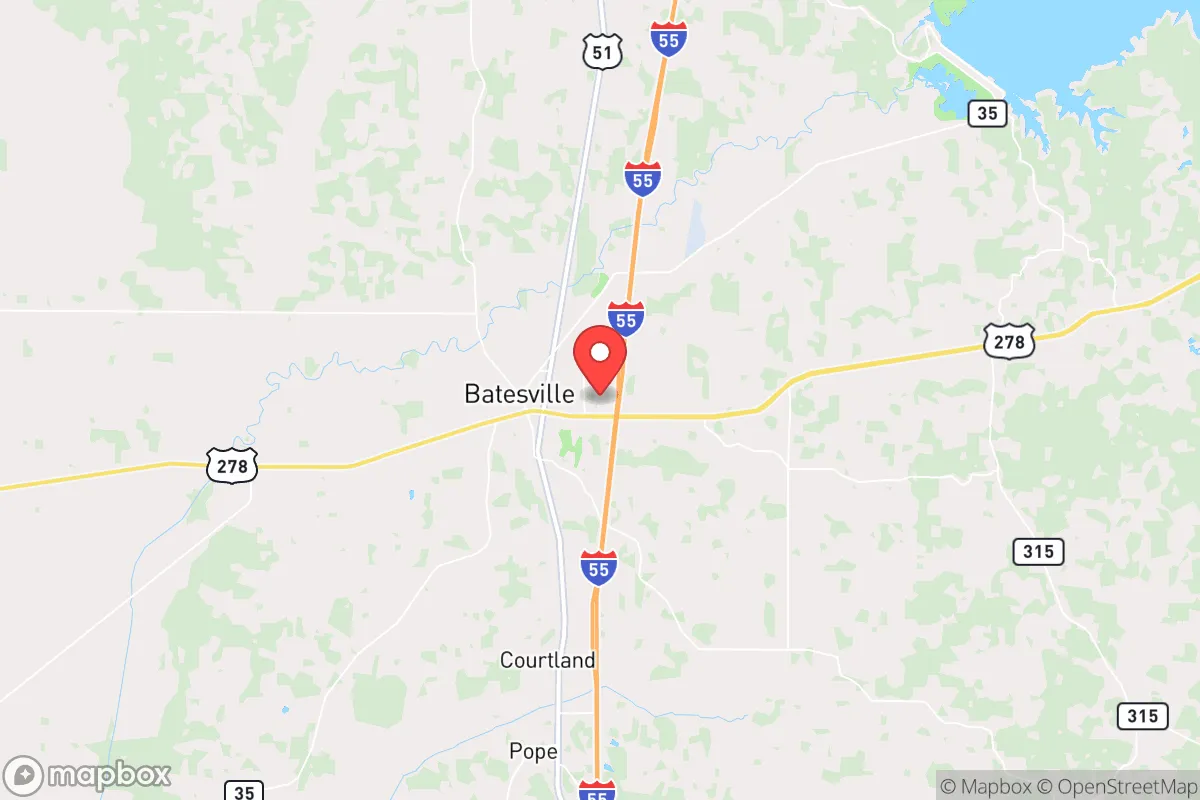
District shown is the primary district for this city’s centroid. Cities may span multiple districts.
Local Political AnalysisPolitical Analysis of Batesville, MS
Batesville is a genuine political outlier in Mississippi, a blue dot in a deeply red state. The area carries a Cook PVI of D+11, meaning it votes about 11 points more Democratic than the national average, while the state of Mississippi as a whole is rated R+11. That’s a 22-point gap between the town and the state—a split you don’t see many other places in the South. This isn’t a recent fluke; it’s a long-standing pattern rooted in the area’s demographics and economic base. The political lean here has been reliably Democratic for decades, though the margin has tightened a bit as national trends have shifted, and it’s likely to stay that way for the foreseeable future.
How it compares
To understand how unusual Batesville is, you have to look at the surrounding counties. Panola County, where Batesville sits, is one of the few counties in Mississippi that still leans Democratic in statewide races. Drive 30 miles south to Grenada or 40 miles east to Oxford, and you’ll find places that are more competitive but still lean Republican in most elections. Head 50 miles west to Cleveland, and you’re in another Democratic-leaning area, but it’s not as pronounced as Batesville. The real contrast is with the rest of the state: places like DeSoto County (just north of the state line) or Rankin County (near Jackson) are solidly Republican, often voting +20 or more for GOP candidates. Batesville’s D+11 rating puts it in a category with a handful of other Mississippi towns like Greenville and parts of the Delta, but it’s distinct because of its manufacturing base—the Nissan plant and its suppliers bring in a workforce that tends to vote more Democratic than the state average. The trajectory here is stable: the area isn’t flipping red anytime soon, but the margin could narrow as younger, more conservative-leaning residents move in for jobs.
What this means for residents
For conservative residents, living in a D+11 area means you’re in the minority locally, but you’re still in the majority statewide. You’ll find plenty of like-minded folks at church, in local business groups, and at the county Republican Party meetings, but you won’t see many Republican candidates winning local offices like sheriff or chancery clerk. State and federal elections are where your vote carries more weight—Mississippi’s R+11 rating means your preferred candidates usually win the state. For liberal residents, the opposite is true: you’re in the majority locally, so you’ll see Democratic representation on the county board and in the state legislature from this district. But you’ll feel the state-level policies—like restrictive abortion laws, limited Medicaid expansion, and conservative education mandates—that don’t reflect the local political will. In practice, this creates a kind of political friction: local ordinances might lean progressive on issues like economic development incentives or infrastructure, but state law overrides on social and fiscal matters. It’s not a hostile environment for either side, but it does mean you have to be aware of which level of government controls what.
One cultural distinction that sets Batesville apart is the strong influence of the local labor unions, particularly the United Auto Workers at the Nissan plant. That union presence gives the area a working-class Democratic character that’s more common in the industrial Midwest than in the Deep South. You’ll hear more talk about wages, job security, and worker protections than you might in other parts of Mississippi. The local Democratic Party here is also more moderate than the national party—socially conservative on some issues but economically populist. That blend means you can find common ground across party lines on things like supporting local schools, funding the hospital, and keeping the industrial base strong. The political climate here isn’t as polarized as in many other places; it’s more about practical, bread-and-butter issues than culture war battles. That’s likely to continue as long as the manufacturing economy stays healthy, even as the rest of the state moves further right.

State Political ClimatePolitical Climate in Mississippi
State Political AnalysisPolitical Environment in the State
Mississippi is one of the most reliably Republican states in the country, with a Cook Partisan Voting Index of R+11, meaning it votes about 11 points more Republican than the national average in presidential elections. The state hasn't voted for a Democratic presidential candidate since Jimmy Carter in 1976, and the GOP now holds every statewide office, both U.S. Senate seats, and a supermajority in the state legislature. Over the last 20 years, the shift has been dramatic — as late as the 1990s, Democrats still controlled the legislature and many local offices, but the realignment of white conservative voters, particularly in the Delta and Pine Belt regions, has turned Mississippi into a deep-red stronghold where Democratic wins are now confined to a handful of majority-Black counties and the state's few urban centers.
Urban vs. rural divide
The political map of Mississippi is starkly divided along racial and geographic lines. The state's three major metro areas — Jackson, the Gulf Coast, and the DeSoto County suburbs of Memphis — each tell a different story. Jackson, the capital and largest city, is overwhelmingly Democratic and majority-Black, consistently voting 80-90% for Democratic candidates; Hinds County, which contains most of Jackson, is the state's Democratic stronghold. On the Gulf Coast, Harrison County (Biloxi, Gulfport) leans Republican but is more competitive, often voting 55-60% GOP, while Hancock County to the east is reliably red. The fastest-growing part of the state is DeSoto County, just south of Memphis, which is solidly Republican and has become a magnet for conservative families fleeing Tennessee's higher taxes. The rural Black Belt counties along the Mississippi River — places like Bolivar, Washington, and Leflore counties — vote heavily Democratic, but their populations have been shrinking for decades. Meanwhile, the Pine Belt region around Hattiesburg and the northeastern hill country around Tupelo and Oxford are reliably Republican, with the University of Mississippi in Oxford creating a small liberal pocket in an otherwise conservative area. The state's most reliably Republican counties are typically rural, white, and located in the eastern half of the state — places like Rankin County (east of Jackson), Lamar County (near Hattiesburg), and Lee County (Tupelo) routinely vote 75-80% Republican.
Policy environment
Mississippi's policy environment is shaped by a conservative legislature that has moved steadily rightward over the past decade. The state has no income tax on Social Security benefits and a flat personal income tax rate of 4.7% that is being phased down to 4% by 2026, with a long-term goal of eliminating the income tax entirely. Sales tax is 7% on most goods, one of the highest in the nation, and local options can push it higher. Property taxes are among the lowest in the country, with no state-level property tax and local rates averaging around 0.8% of assessed value. The state is a right-to-work state with weak labor unions, and it has some of the most permissive gun laws in the country — permitless carry was enacted in 2016, and the state does not require a license to carry a concealed firearm. On education, Mississippi has a school choice program that includes charter schools and education savings accounts for students with disabilities, but the state's public schools rank near the bottom nationally in test scores and funding per pupil. Healthcare policy is dominated by the state's refusal to expand Medicaid under the Affordable Care Act, leaving roughly 100,000 low-income residents in a coverage gap. Election laws include strict voter ID requirements, no-excuse absentee voting is not permitted, and the state requires a notarized affidavit for absentee ballots. Abortion is effectively banned after the state's trigger law took effect in 2022, with no exceptions for rape or incest.
Recent policy direction
Over the last five years, Mississippi has moved aggressively on several fronts that matter to relocators weighing personal liberty and government power. On gun rights, the state passed a "stand your ground" law in 2006 and permitless carry in 2016, and in 2023 it enacted a law prohibiting state and local enforcement of federal gun regulations that don't exist under state law — a direct challenge to any future federal gun control. On education and parental rights, the 2022 "Parents' Bill of Rights" gives parents the right to review instructional materials and opt their children out of certain lessons, and the state has banned instruction on sexual orientation and gender identity in K-3 classrooms. On medical freedom, Mississippi was one of the first states to ban COVID-19 vaccine mandates for state employees and contractors, and it prohibits businesses from requiring proof of vaccination for service. On property rights, the state has a strong eminent domain law that limits government takings, and it does not have a statewide zoning code, leaving land-use decisions to local governments. On voting, the state has tightened absentee ballot rules and purged voter rolls aggressively, but it has not adopted the kind of election integrity measures seen in states like Georgia or Texas. On taxation, the 2022 tax cut package accelerated the phase-down of the income tax and eliminated the 4% bracket entirely for lower earners, with the goal of full elimination by the late 2020s if revenue allows.
Civil unrest & political movements
Mississippi has a quieter political landscape than many states, but it has seen its share of flashpoints. The 2020 George Floyd protests in Jackson were largely peaceful but drew attention to the state's history of racial inequality and its current reality of stark economic disparities. The state's Confederate symbols have been a recurring battleground: in 2020, the legislature voted to remove the Confederate battle emblem from the state flag after decades of resistance, a move that was driven by business pressure and a bipartisan coalition. On immigration, Mississippi is not a border state and has relatively few foreign-born residents (about 2.5% of the population), but the state has passed laws requiring E-Verify for employers and prohibiting sanctuary cities, though no such cities exist. The state's election integrity debate has been less heated than in some other states, but the 2020 election saw Trump win Mississippi by 16 points, and Republican officials have since tightened absentee ballot rules. There is no significant secessionist movement in Mississippi today, though the state's political culture includes a strong strain of states' rights rhetoric, particularly around gun laws and federal overreach. The most visible political activism in the state comes from conservative Christian groups, which have been instrumental in pushing abortion restrictions and religious liberty legislation, and from the Mississippi Economic Council, a business group that has advocated for education reform and infrastructure spending.
Projection
Over the next 5-10 years, Mississippi is likely to remain deeply Republican, but the nature of that conservatism may shift. The state's population is aging and growing slowly — it lost a congressional seat after the 2020 census — and the fastest-growing parts of the state are the conservative suburbs of DeSoto County and the Gulf Coast, which will reinforce the GOP's dominance. The Black Belt counties will continue to shrink, reducing the Democratic base. The biggest wild card is the state's economy: if Mississippi can attract more manufacturing and logistics jobs — it has been successful in luring automotive plants and data centers — it could see modest in-migration from other states, but those newcomers are likely to be conservative-leaning families from the Midwest and South. The income tax elimination push will continue, and the state will likely become one of the nine states with no income tax within a decade, which could accelerate growth. On social issues, the state is unlikely to moderate — the legislature is more conservative than the governor's office, and the 2023 election of a Republican governor who is more focused on economic development than culture wars suggests a pragmatic conservatism that still votes for cultural restrictions. A relocator moving in now should expect to find a state that is reliably Republican, low-tax, and socially conservative, with a growing economy in the suburbs and a shrinking rural base, and little chance of a political shift in the foreseeable future.
For someone considering a move to Mississippi, the bottom line is straightforward: you will be living in one of the most conservative states in the country, where Republican candidates routinely win by double digits and the policy environment reflects that. If you are conservative, you will find a state that is friendly to gun rights, low taxes, school choice, and traditional values, with a government that is generally responsive to conservative priorities. If you are liberal, you will find a state where your vote is unlikely to matter in statewide elections, where social policies are restrictive, and where the political culture can feel insular and resistant to change. The practical reality is that Mississippi offers a low-cost, low-regulation environment that appeals to many families and retirees, but it comes with a political and social landscape that is deeply conservative and unlikely to shift anytime soon. The state's trajectory is toward even lower taxes, continued cultural conservatism, and slow but steady economic growth in its suburban and coastal areas, while its rural and urban cores continue to struggle with poverty and population loss.
* Values derived from national, state, county, city and local statistics and may differ in a specific area. Last updated: 2026-08-16T13:19:05.000Z
Narrative content on this page is AI-generated and may contain mistakes. Verify any details that matter before acting on them.
ReloMaps may earn a commission from affiliate links at no extra cost to you.

