
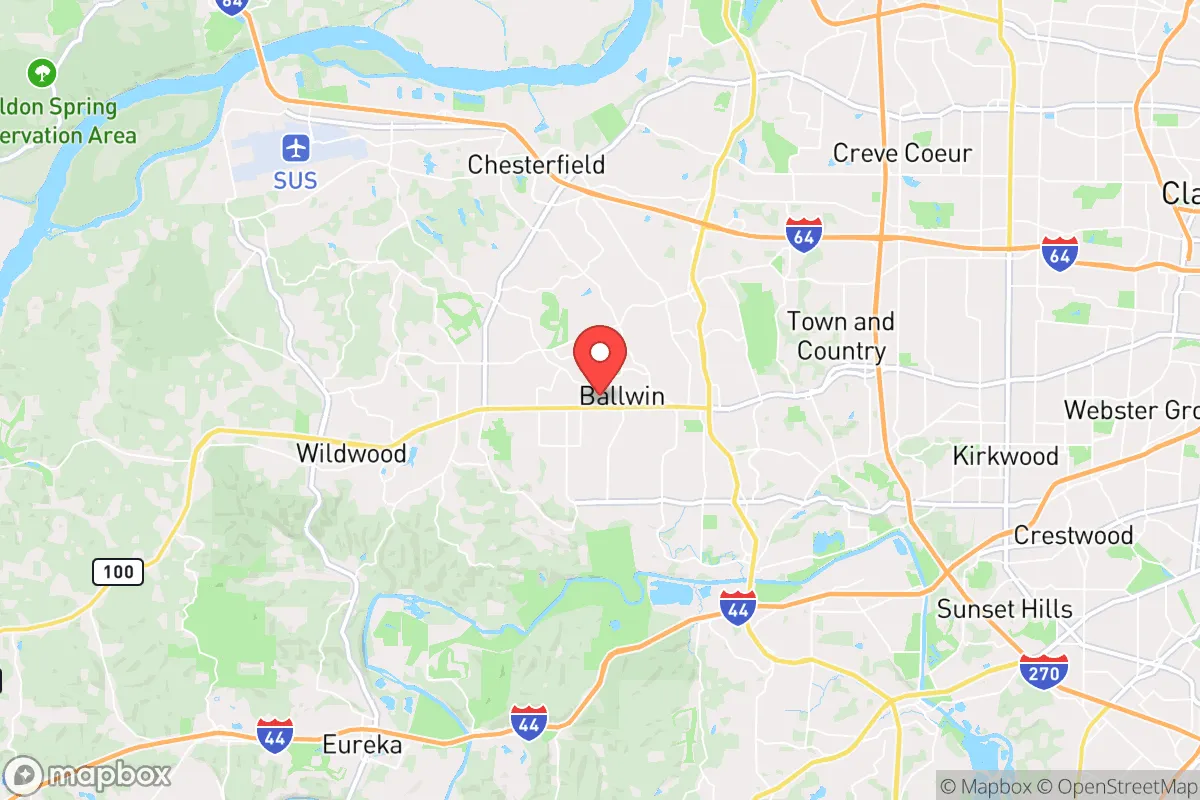
Photo: Wikipedia
Quality of Life in Ballwin, MO
A high quality of life with strong walkability, manageable living costs, healthy neighborhood signals, and solid amenity access.
What does Quality of Life tell us?
Quality of Life blends cost of living, nearby amenities, socioeconomic signals, and neighborhood character. City-level scores represent the whole municipality; individual neighborhoods can differ.
What does this tell us?
Quality of Life blends cost of living, nearby amenities, socioeconomic signals, and neighborhood character. City-level scores represent the whole municipality; individual neighborhoods can differ.
Cost of Living
22% above national average
The Real Cost of Living in Ballwin, MO for 2026
| Tier | Individual | Family (4) |
|---|---|---|
| Survival | $22k | $42k |
| Comfortable | $69k | $101k |
| Luxury | $183k+ | $284k+ |
| Elite (Top 5%) | $216k+ | $335k+ |
120%
The Area Signal
A metric tracking the socioeconomic signals of the area.


Hobbies
Explore the areaGroceries
1 within 10 miles
Gas
0 within 10 miles
Hospital
3 within 20 miles
Airport
MCI — Kansas City International
Post Office
USPS — St. Louis, MO
Critical Amenities
Quality-of-Life Analysis
Ballwin, Missouri, is an affluent western St. Louis suburb where the cost of living index sits at 122 — 22 percent above the national average — reflecting a community of established professionals, growing families, and retirees who prioritize space, safety, and strong schools. The city’s population of roughly 30,000 is predominantly white-collar, with a median household income well above the St. Louis metro average, and the housing stock is dominated by single-family homes on generous lots. This is not a transient or rental-heavy suburb; it is a place where residents tend to stay for a decade or more, drawn by a stable tax base and a reputation for low crime and high civic engagement.
Cost of living, housing prices, and how Ballwin compares to nearby suburbs
Ballwin’s housing market is the primary driver of its above-average cost of living. The median home value is $353,400, roughly 30 percent higher than the St. Louis metro median of about $270,000, but still significantly below pricier inner-ring suburbs like Clayton or Ladue, where medians exceed $500,000. Median rent sits at $1,386, which is competitive for West County — comparable to Chesterfield and Wildwood, but notably cheaper than the $1,600+ averages seen in Clayton and downtown St. Louis. Property taxes in Ballwin are moderate for St. Louis County, typically ranging from 1.1 to 1.3 percent of assessed value, and there is no city earnings tax, a perk that saves residents roughly 1 percent of income compared to living inside St. Louis city limits. The average commute of 24.7 minutes is slightly longer than the national average of 26 minutes, but most residents drive west on Manchester Road or Highway 141 to reach employment hubs in Chesterfield, Town and Country, or Creve Coeur, making the trade-off of larger homes and lower density acceptable for most.
Parks, schools, and what daily life is like for families
Daily life in Ballwin revolves around the Rockwood School District, one of Missouri’s top-rated public systems, where all four high schools (Marquette, Lafayette, Eureka, and Rockwood Summit) consistently earn A ratings and send graduates to flagship universities at high rates. The city itself operates 14 parks covering over 200 acres, anchored by the 40-acre Ballwin Pointe Park with its accessible playground, fishing lake, and sports fields. The Ballwin Community Center at North Pointe offers a fitness center, indoor pool, and senior programs that see heavy daily use. Retail and dining are concentrated along Manchester Road, with national chains like Target and Dierbergs alongside local staples such as the Ballwin Family Restaurant and the annual Ballwin Days festival each June. For entertainment beyond the suburb, downtown St. Louis is a 30-minute drive east, providing access to the Zoo, Art Museum, and Cardinals baseball. The city’s violent crime rate is roughly 80 percent below the national average, and property crime is similarly low, making it one of the safest municipalities in St. Louis County.
Ballwin is best suited for families who want a classic suburban lifestyle with top-tier public schools, low crime, and a strong sense of community, but who are willing to pay a premium for those benefits. Empty-nesters and retirees also find the city appealing due to its quiet neighborhoods, accessible medical services (including nearby Mercy Hospital St. Louis), and proximity to golf courses like the public Ballwin Golf Course. Singles and young professionals may find the social scene limited compared to the Central West End or Soulard, and the lack of walkable commercial districts means a car is essential for nearly every errand. For those prioritizing safety, school quality, and a stable property investment in West County, Ballwin delivers consistently high marks.

Crime in Ballwin, MO
Lower crime rates than 94% of comparable U.S. locations.
Violent CrimeViolent Crime Analysis
Property CrimeProperty Crime Analysis
Crime Analysis
Ballwin, Missouri, is one of the safest cities in the St. Louis metropolitan area, with a violent crime rate of just 51.8 incidents per 100,000 residents and a property crime rate of 437.2 per 100,000. These figures place Ballwin far below both the Missouri state averages and the national benchmarks, making it a standout community for safety-conscious families and professionals. However, residents should be aware that Ballwin’s low crime rates exist within a broader regional context where progressive prosecutorial policies in St. Louis County and the city of St. Louis have been linked to higher recidivism and reduced public confidence in the justice system.
Crime in context
Ballwin’s violent crime rate of 51.8 per 100,000 is roughly 85% lower than the national average of 380 per 100,000 and a fraction of Missouri’s statewide rate of 540 per 100,000. Property crime in Ballwin (437.2 per 100,000) is also well below the national average of 1,954 per 100,000 and the Missouri average of 2,800 per 100,000. These numbers reflect a community where serious offenses like homicide, robbery, and aggravated assault are rare events. By comparison, nearby St. Louis City reported a violent crime rate of over 2,000 per 100,000 in 2024, underscoring the stark safety divide between Ballwin and the urban core. The disparity is partly attributable to Ballwin’s local policing and municipal court approach, which contrasts with the more lenient, offender-focused policies seen in St. Louis County under progressive prosecutors like Wesley Bell.
What residents experience
For those living in Ballwin, the daily reality is one of low fear and high community engagement. The most common crimes are non-violent property offenses such as theft from vehicles and package theft, which occur sporadically but rarely escalate. Residents report feeling safe walking their neighborhoods at night and letting children play in yards without constant supervision. The Ballwin Police Department maintains a visible presence through community policing initiatives, and the city’s proactive code enforcement further deters disorder. However, because Ballwin is part of the larger St. Louis region, residents are not insulated from the downstream effects of progressive justice policies in neighboring jurisdictions. Offenders released under St. Louis County’s pretrial diversion programs or reduced sentencing guidelines have been known to travel into suburban communities, a pattern that has prompted Ballwin to invest in license plate readers and regional information-sharing agreements.
Neighborhood-level variation in Ballwin is minimal, with most subdivisions and apartment complexes experiencing similarly low crime rates. The western and southern sections of the city, near the Meramec River and the border with Wildwood, tend to have the fewest incidents, while areas closer to Manchester Road (MO-141) see slightly higher property crime due to commercial traffic. Overall, Ballwin offers a level of safety that is exceptional for the St. Louis metro, but residents should remain vigilant about regional justice trends that could erode this advantage over time.
* Values derived from national, state, county, city and local statistics and may differ in a specific area. Last updated: 2026-04-19T11:25:07.000Z
Narrative content on this page is AI-generated and may contain mistakes. Verify any details that matter before acting on them.
ReloMaps may earn a commission from affiliate links at no extra cost to you.

