Photo: Wikipedia
Political ClimatePolitical Climate in Boone County
Showing district-level results — no local-only data available.
Local Political AnalysisPolitical Analysis of Boone County
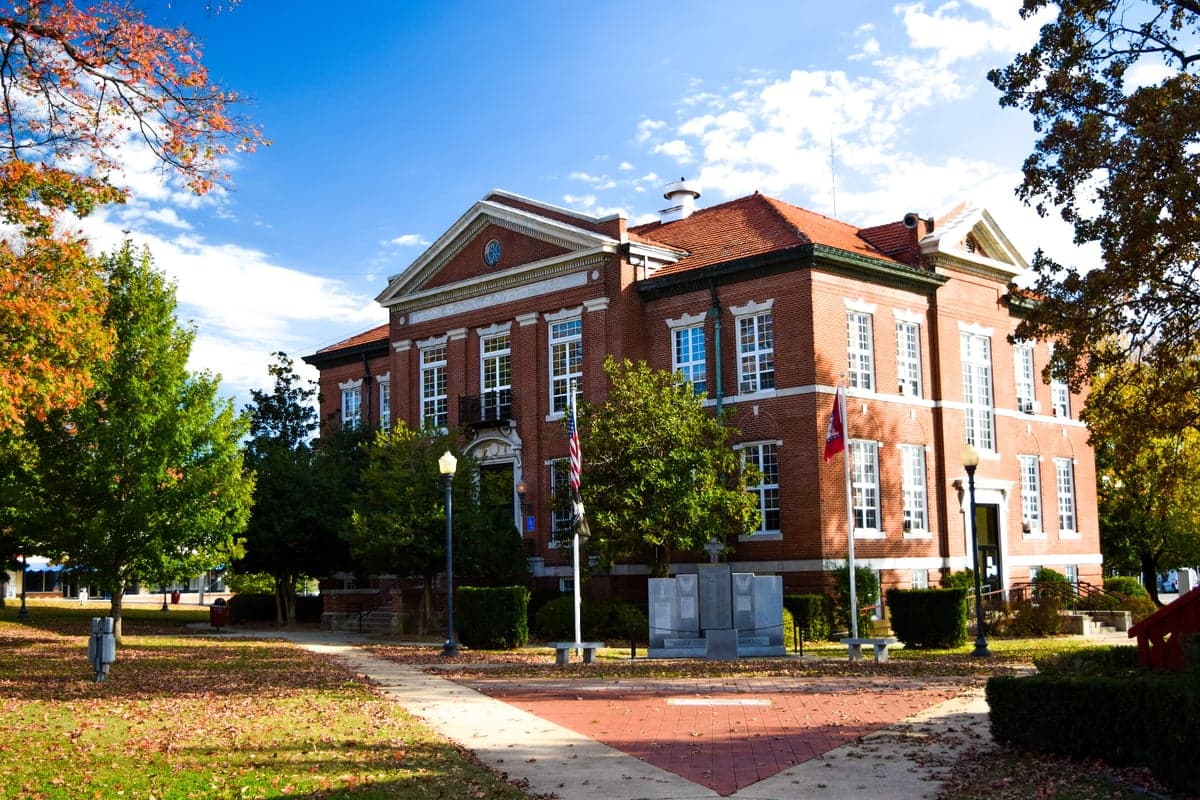
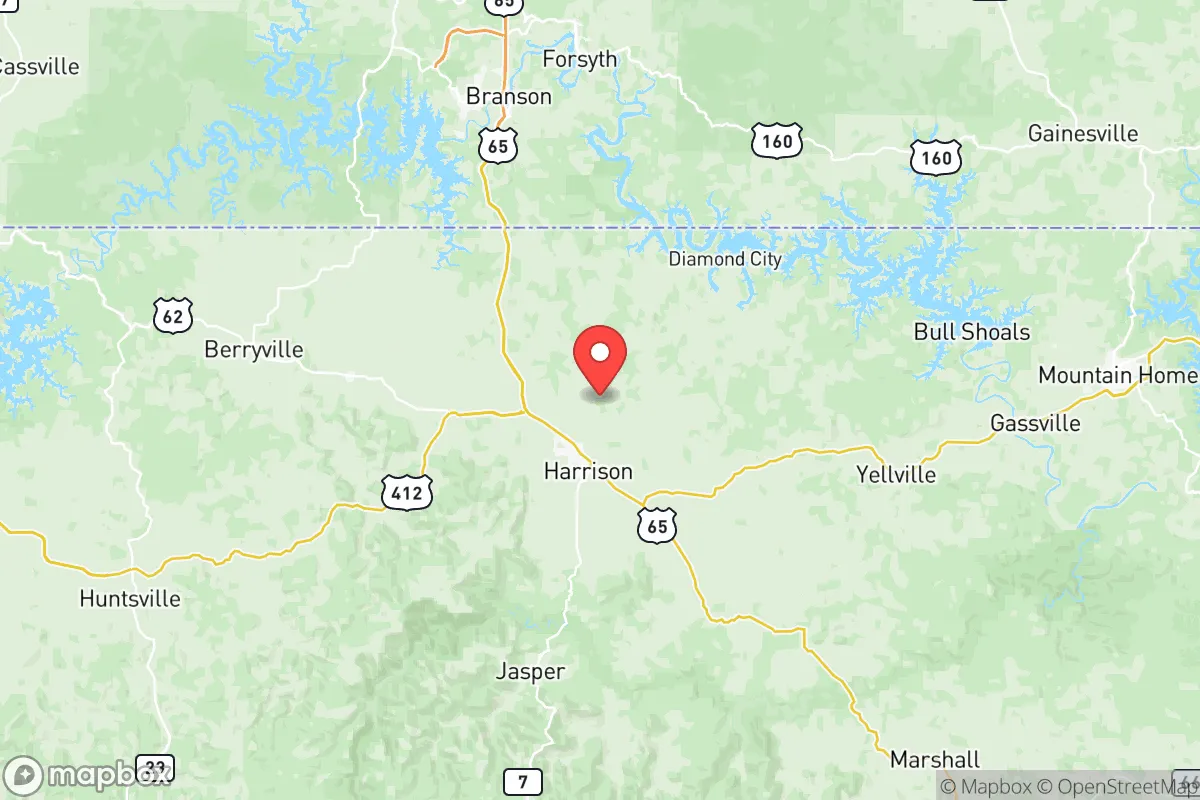
Boone County, Arkansas, is a reliably conservative area with a Cook Partisan Voting Index (PVI) of R+23, making it significantly more Republican than the state of Arkansas as a whole, which sits at R+16. This isn't a recent shift; the county has been a Republican stronghold for decades, and the trend has only solidified in the last two presidential cycles. The county seat, Harrison, anchors this lean, but there's a subtle political geography at play—the more rural, western parts of the county, like the areas around Lead Hill and Diamond City, tend to be the most deeply red, while the city of Harrison itself, particularly its downtown and the neighborhoods near North Arkansas College, show slightly more competitive margins, though still comfortably Republican.
How it compares
The seven-point gap between Boone County (R+23) and the state (R+16) is meaningful. In practice, this means that while Arkansas statewide races are often decided by double-digit margins, Boone County's results are even more lopsided. For example, in the 2024 presidential election, the county voted for Donald Trump by a margin roughly 7-8 points higher than the state average. This isn't just a rural vs. urban divide; it's a reflection of a deeply ingrained cultural conservatism that's less pronounced in the more moderate, suburban parts of Northwest Arkansas (like Benton and Washington counties) or the historically Democratic Delta region. The county's politics are more closely aligned with the neighboring, deeply red counties of northern Arkansas and southern Missouri than with the state's more diverse urban centers.
What this means for residents
For conservative residents, Boone County feels like a natural fit. Local elections are often decided in the Republican primary, and the county's elected officials—from the county judge to the state representatives—are almost uniformly conservative. Policy debates at the local level tend to focus on issues like property rights, tax rates, and Second Amendment protections, with little pushback from a significant Democratic minority. For liberal or moderate residents, the political climate can feel isolating. There's no organized Democratic party infrastructure to speak of, and progressive viewpoints are rarely represented in local government or public discourse. However, the area is not a monolith; the presence of North Arkansas College and a growing number of remote workers moving to the area for the lower cost of living has introduced a small but noticeable cohort of more moderate voters, particularly in Harrison's newer subdivisions.
Culturally, Boone County's politics are intertwined with a strong sense of local independence and a wariness of state and federal overreach. This manifests in practical ways: the county has a robust network of private and home schools, reflecting a preference for local control over education. Gun rights are taken very seriously, with open carry being common and few local restrictions. The county's political identity is also shaped by its history as a sundown town, a legacy that still influences perceptions and demographics today—the county remains overwhelmingly white (over 95%), and conversations about diversity and inclusion are often met with resistance. For anyone moving here, understanding that the political climate isn't just about voting patterns but about a deeply rooted cultural identity is key. It's a place where the local newspaper's letters to the editor are a reliable barometer of the community's values, and where a candidate's stance on federal land management can be as important as their position on taxes.

State Political ClimatePolitical Climate in Arkansas
State Political AnalysisPolitical Environment in the State
Arkansas is a deeply red state with a Cook PVI of R+16, meaning it consistently votes about 16 points more Republican than the national average in presidential elections. The state hasn't backed a Democrat for president since Bill Clinton (a native son) in 1996, and the GOP now holds every statewide office, both U.S. Senate seats, and supermajorities in the state legislature. Over the last 10-20 years, the shift has been dramatic — Arkansas was a reliably Democratic state at the local level as recently as the early 2000s, but a combination of national party realignment, rural cultural conservatism, and the collapse of the old "Blue Dog" Democratic coalition has turned it into one of the most reliably Republican states in the country.
Urban vs. rural divide
The political map of Arkansas is a textbook case of the urban-rural split. The state's two major population centers — Little Rock (Pulaski County) and Fayetteville (Washington County) — are the only real Democratic strongholds. Pulaski County, home to the state capital, voted for Joe Biden in 2020 by about 15 points, while Washington County, driven by the University of Arkansas and a growing tech and retail hub, has been trending blue and is now a true swing county. Outside these two islands, the state is overwhelmingly Republican. Benton County (home to Walmart's headquarters in Bentonville) is a deep-red suburban powerhouse, voting +30 points for Trump in 2020. The Arkansas Delta, once a Democratic bastion due to Black voters and unionized farm labor, has flipped hard — Crittenden County (West Memphis) is now reliably red, while Jefferson County (Pine Bluff) remains one of the few remaining Democratic counties due to its large Black population. The Ozarks and Ouachita Mountains — places like Boone County (Harrison) and Polk County (Mena) — are among the most conservative in the nation, often voting +50 points or more for Republicans. The rural-to-urban divide is stark: if you live in a town under 10,000 people, you're almost certainly in a deep-red precinct.
Policy environment
Arkansas's policy environment is aggressively conservative. The state has a flat income tax rate of 4.4% (down from 7% in 2015), with a goal of reaching 3.9% by 2027. There is no state-level property tax on vehicles or business inventory, and the sales tax is 6.5% (local add-ons push it to 9-10% in some cities). The state is a "right-to-work" state, meaning union membership is optional and union power is weak. Education policy is dominated by school choice: Arkansas has a robust charter school system and, as of 2023, a universal school voucher program (the LEARNS Act) that allows any family to use state funds for private school tuition. The state has some of the most restrictive abortion laws in the country — a near-total ban with no exceptions for rape or incest, only to save the mother's life. Election laws are moderately restrictive: voter ID is required, early voting is available for 15 days, and absentee voting requires an excuse. The state has no ballot initiative process for constitutional amendments (only legislative referrals), which limits direct democracy.
Recent policy direction
The last three years have seen a flurry of legislation that solidifies Arkansas's position as a national leader in conservative governance. On gun rights, the state passed constitutional carry (permitless carry) in 2021, and in 2023, it passed a law prohibiting state and local enforcement of federal gun laws (the "Second Amendment Sanctuary" act). On parental rights and education, the LEARNS Act (2023) banned "critical race theory" and "indoctrination" in public schools, required schools to post all curriculum materials online, and created a universal school voucher system. On speech and privacy, the state passed a law in 2023 requiring public libraries to create policies for removing "obscene" materials, and a 2024 law restricts minors' access to social media without parental consent. On medical and bodily autonomy, the abortion ban is total, and the state has also banned gender-affirming care for minors (2023). Property rights are strong — Arkansas is a "stand your ground" state, and there is no state-level property tax on homesteads for disabled veterans or seniors over 65 (up to a certain value). On voting, the state passed a law in 2021 limiting absentee ballot drop boxes and requiring a copy of a photo ID with absentee applications. The overall direction is unmistakable: Arkansas is moving further right on every front, with no sign of moderation.
Civil unrest & political movements
Arkansas is not a state known for large-scale civil unrest, but there are visible political flashpoints. The most prominent is the ongoing controversy over the LEARNS Act — in 2023, thousands of teachers and parents protested at the state capitol in Little Rock, leading to a brief teacher walkout in several districts. The state's immigration politics are relatively quiet, as Arkansas has a small foreign-born population (about 5%), but there is a vocal movement in Springdale and Rogers (northwest Arkansas) around immigration enforcement, driven by the large Marshallese and Hispanic communities in those areas. There is no sanctuary city policy anywhere in the state. Secession or nullification rhetoric is minimal — Arkansas was a Confederate state, but modern "nullification" talk is mostly limited to the Second Amendment sanctuary movement. Election integrity controversies have been low-key; the 2020 and 2022 elections were conducted without major incident, though the state GOP has pushed for tighter laws. The most visible political movement is the "Moms for Liberty" chapter in Benton County, which has been active in school board races and library board meetings. Overall, political activism is real but localized — you'll see more yard signs and church bulletin announcements than street protests.
Projection
Over the next 5-10 years, Arkansas is likely to become even more Republican, but with a twist. The northwest Arkansas corridor — Bentonville, Fayetteville, Rogers, and Springdale — is growing rapidly, driven by Walmart, Tyson Foods, and JB Hunt. This area is attracting a younger, more educated, and slightly more moderate population, which could turn Washington County into a permanent swing county and possibly flip Benton County from deep red to lean red. Meanwhile, the Delta and rural Ozarks are losing population, which will amplify the GOP's rural advantage but also concentrate Democratic votes in Little Rock and Fayetteville. The state's tax-cutting trajectory will continue — expect the income tax to drop to 3.9% or lower by 2030. The LEARNS Act will likely be expanded, and further restrictions on abortion and transgender rights are probable. The biggest wild card is in-migration: if northwest Arkansas continues to attract Californians and Texans (as it has been), the state could see a slow but real demographic shift toward purple in the northwest, while the rest of the state stays deep red. For a new resident, the next decade will look very similar to the last one — a solidly conservative state with a small, growing liberal pocket in the northwest.
Bottom line for a new resident: If you're a conservative, you'll find Arkansas's political climate comfortable and aligned with your values — low taxes, strong gun rights, school choice, and a government that actively promotes traditional social policies. If you're a liberal, you'll find it challenging: your vote will be diluted outside of Little Rock and Fayetteville, and state policy will consistently oppose your views on abortion, education, and civil rights. Either way, the state is stable, with no serious risk of political violence or upheaval. The practical takeaway is that your experience will depend heavily on where you live — choose northwest Arkansas for a more moderate, growing environment, or the Ozarks for a deeply conservative, rural lifestyle. The state's politics are predictable, and that predictability is a feature for many relocators.
* Values derived from national, state, county, city and local statistics and may differ in a specific area. Last updated: 2026-06-12T18:58:57.000Z
Narrative content on this page is AI-generated and may contain mistakes. Verify any details that matter before acting on them.
ReloMaps may earn a commission from affiliate links at no extra cost to you.

