Photo: Wikipedia
Demographics of Arkadelphia, AR
Affluence Level in Arkadelphia, AR
A below-average socioeconomic profile. Incomes, home values, and educational attainment trail the U.S., with higher poverty and unemployment.
People of Arkadelphia, AR
Arkadelphia, Arkansas, is a small city of 10,316 residents where the population is notably stable and rooted, with a character shaped by its role as a regional education and healthcare hub. The city’s identity is defined by a majority-white population (59.2%) alongside a substantial Black community (29.8%), a small but growing Hispanic presence (5.9%), and a very low foreign-born share of just 0.9%. This is a place where generational ties run deep, and the population’s history is one of gradual, layered settlement rather than rapid boom cycles.
How the city was settled and grew
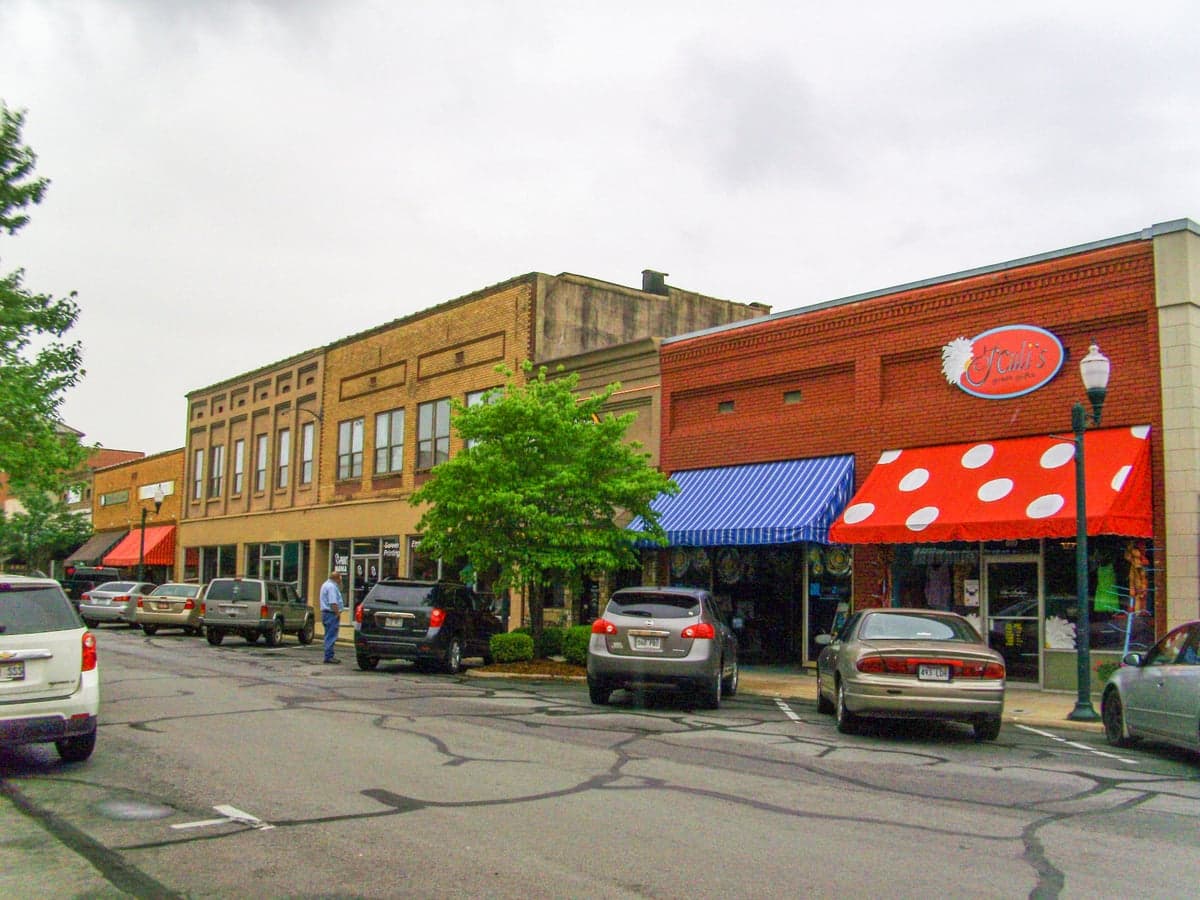
Arkadelphia’s original population was drawn by the region’s fertile bottomlands along the Ouachita River and the arrival of the Cairo and Fulton Railroad in the 1870s. The city was incorporated in 1857, but its real growth came after the Civil War, when timber and agriculture—especially cotton—dominated the economy. The earliest white settlers, largely of Scots-Irish and English descent, clustered near the river in what is now the Historic Downtown district, building the commercial core around the Clark County Courthouse. By the early 1900s, a Black community had formed in the South 10th Street area, drawn by work in the timber mills and as sharecroppers on surrounding farms. This neighborhood became the historic heart of Arkadelphia’s African American population, anchored by churches like St. John Baptist Church and the now-closed Peake High School. A smaller wave of Lebanese and Syrian merchants arrived around 1900, settling near the downtown rail depot and opening dry goods stores; their descendants remain a small but distinct presence in the city’s business community today.
Modern era (post-1965)
The post-1965 period brought significant demographic shifts, driven by the expansion of Henderson State University and the consolidation of the local medical sector. The Hart-Cellar Act had little direct effect on Arkadelphia—the foreign-born population remains under 1%—but domestic migration patterns changed. The city’s Black population, which had been concentrated in the South 10th Street area, began to spread into previously white neighborhoods like College Heights (near Henderson State) and the Pleasant Hill subdivision east of Highway 7, as school desegregation and fair housing laws took effect. The white population, meanwhile, suburbanized into newer developments like DeGray Estates and the North 26th Street corridor, where larger lots and newer homes attracted families seeking space. The Hispanic population, though small at 5.9%, began to grow noticeably after 2000, with families settling primarily in the West End area near the poultry processing plants and construction firms that employ many of them. This group remains largely first- and second-generation, with Spanish spoken in a handful of local churches and businesses.
The future
Arkadelphia’s population is likely to remain stable or shrink slightly over the next decade, as the city lacks the job growth to attract large numbers of new residents. The white population is aging and slowly declining, while the Black population is holding steady, supported by family networks and the presence of Henderson State. The Hispanic share is the only segment showing clear growth, though it remains small and concentrated in the West End; assimilation into the broader community is proceeding slowly, with most children attending local public schools and English becoming dominant by the second generation. The East/Southeast Asian population (0.8%) is tiny and stable, tied to faculty and medical professionals at Henderson State and Baptist Health Medical Center. No new immigrant enclaves are forming, and the city is not experiencing the tribalization seen in larger metro areas. Instead, Arkadelphia is slowly homogenizing into a more integrated, if still majority-white, community where neighborhood boundaries are fading.
For someone moving in now, Arkadelphia offers a low-cost, low-crime environment where the population is friendly but insular—most social networks are built through church, school, or university ties. The city is becoming slightly more diverse but remains deeply rooted in its Southern, small-town character, making it a good fit for families and retirees seeking stability rather than rapid change.

* Values derived from national, state, county, city and local statistics and may differ in a specific area. Last updated: 2026-04-30T04:41:47.000Z
Narrative content on this page is AI-generated and may contain mistakes. Verify any details that matter before acting on them.
ReloMaps may earn a commission from affiliate links at no extra cost to you.

