Demographics of Anna, TX
Affluence Level in Anna, TX
A middle-class area roughly in line with national averages across income, home values, education, and employment.
People of Anna, TX
The people of Anna, Texas, today number roughly 20,975, forming a rapidly growing, family-oriented community that is notably more diverse than its rural Collin County past. The city’s character is defined by a young, largely native-born population—only 5.9% foreign-born—with a demographic profile that is 60.3% White, 19.4% Hispanic, and 16.2% Black, reflecting a mix of long-time local families and recent domestic migrants drawn by affordable housing and new master-planned developments. Distinctive markers include a high proportion of married couples with children, a strong presence of evangelical Protestant churches, and a civic identity still rooted in its agricultural and railroad origins, even as it rapidly suburbanizes.
How the city was settled and grew
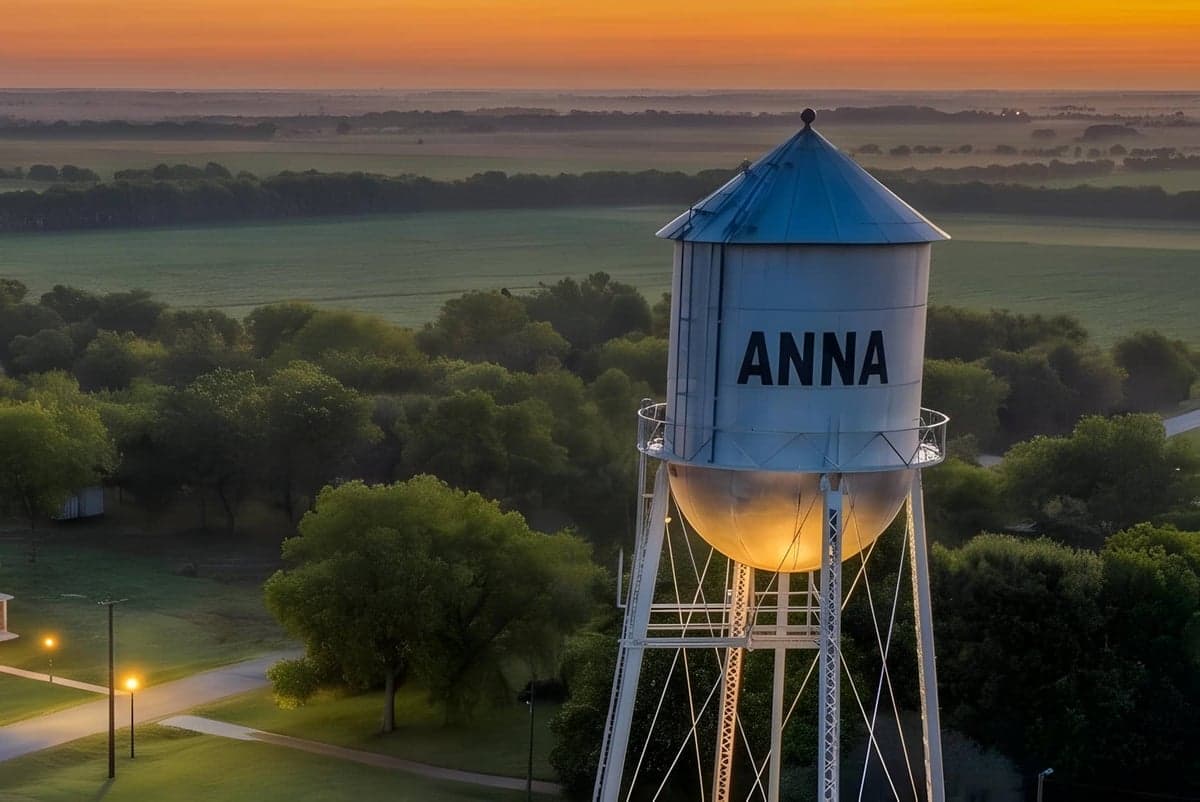
Anna was founded in 1867 as a stop on the Houston and Texas Central Railway, originally named "Anna" after the wife of a railroad official. The earliest settlers were Anglo-American farmers and ranchers from the U.S. South, drawn by cheap land grants along the rail line and the promise of cotton and grain markets. These founding families built the original town core around the depot, an area now known as Historic Downtown Anna, where many of their descendants still own property and businesses. A second wave arrived in the early 1900s, composed of German and Czech immigrants who established small farms and a tight-knit rural community in what is now the West Anna district, centered on the old schoolhouse and Lutheran church. By 1950, Anna remained a tiny, overwhelmingly White farming town of fewer than 500 residents, with little in-migration beyond the original ethnic groups.
Modern era (post-1965)
The post-1965 era brought gradual change, driven not by international immigration but by domestic suburbanization from the Dallas-Fort Worth metroplex. The 1980s and 1990s saw the first significant influx of White middle-class families seeking larger lots and lower taxes, settling in the Anna Crossing subdivision, a neighborhood of single-family homes built on former cotton fields. After 2000, the city’s population exploded as developers targeted Anna for master-planned communities. The Westwood Village area, built in the 2010s, attracted a mix of White and Hispanic families, many of them first-time homebuyers from Collin County’s service and construction sectors. The Black population, which was negligible before 2000, grew to 16.2% by 2025, concentrated in newer subdivisions like Heritage Ranch and Preserve at Anna, where affordable new construction drew African American families from Dallas and southern Collin County. The Hispanic share rose to 19.4%, with many families settling in the East Anna corridor along Highway 5, where older mobile home parks and newer townhomes provide entry-level housing. East/Southeast Asian residents (0.6%) and Indian-subcontinent residents (0.3%) remain small, scattered across newer developments rather than forming ethnic enclaves. The foreign-born share of 5.9% is well below the Texas average, indicating that Anna’s growth has been overwhelmingly domestic.
The future
Anna’s population is heading toward continued rapid growth, with projections exceeding 40,000 by 2040, driven by ongoing master-planned expansions like the Anna Lakes development and the North Creek district. The city is not homogenizing into a single demographic; rather, it is tribalizing into distinct enclaves by housing type and price point. West Anna and Historic Downtown remain predominantly White and older, while Heritage Ranch and Preserve at Anna are becoming majority-Black and Hispanic. The immigrant communities—mostly Hispanic and a small number of Vietnamese and Indian families—are plateauing as a share of the population, since most new arrivals are domestic movers from other Texas counties. The next 10-20 years will likely see Anna become a more economically stratified suburb, with higher-income White families in gated lakefront sections and lower-income minority families in denser rental areas, while the city’s political culture remains conservative and family-focused.
For someone moving in now, Anna is becoming a classic Sun Belt exurb: fast-growing, politically conservative, and increasingly diverse by income and race, but with distinct neighborhood identities that shape daily life. The city offers affordable housing and good schools, but newcomers should expect a community where where you live strongly signals who you are, and where the old farming roots are giving way to a new suburban order.

* Values derived from national, state, county, city and local statistics and may differ in a specific area. Last updated: 2026-05-11T15:38:05.000Z
Narrative content on this page is AI-generated and may contain mistakes. Verify any details that matter before acting on them.
ReloMaps may earn a commission from affiliate links at no extra cost to you.

