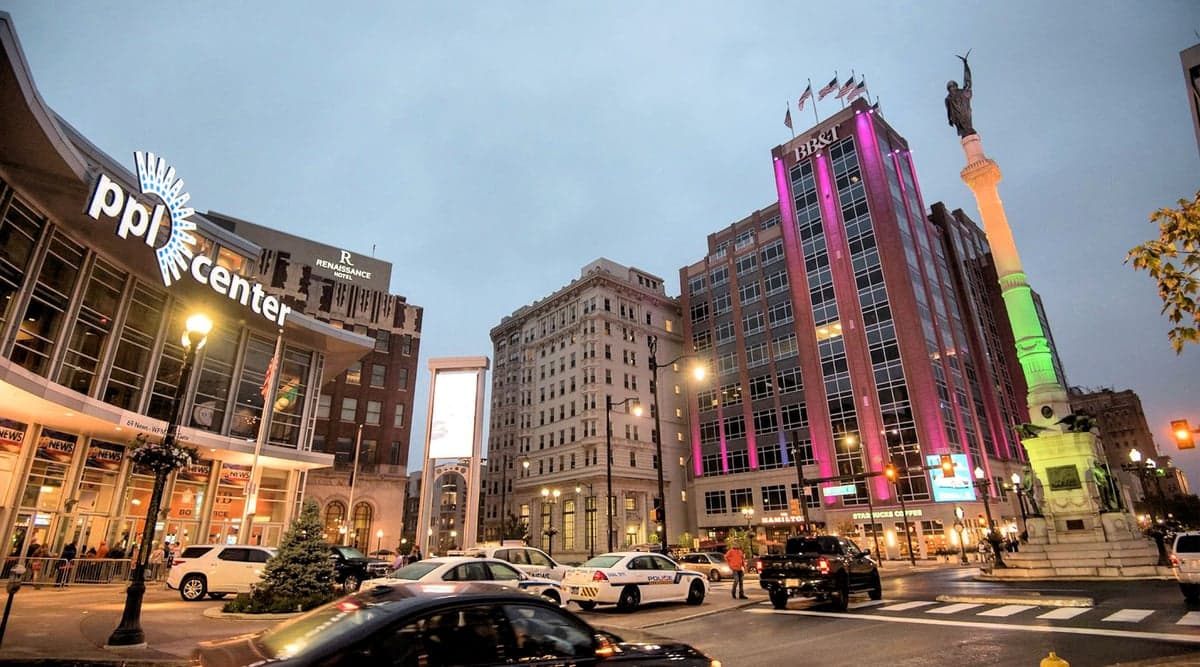
Photo: Wikipedia
Political ClimatePolitical Climate in Allentown, PA
District shown is the primary district for this city’s centroid. Cities may span multiple districts.
Local Political AnalysisPolitical Analysis of Allentown, PA
Allentown, Pennsylvania, sits in a political tug-of-war that’s gotten a lot more tense over the last decade. The Cook PVI clocks the Lehigh Valley at R+1, meaning the district leans just barely Republican, but if you’ve lived here as long as I have, you know that number hides a real shift. Back in the 90s and early 2000s, this was a reliably blue-collar Democratic stronghold—union guys, factory workers, folks who voted their pocketbook but kept their values pretty traditional. Now, you’ve got a fast-growing progressive push, especially from newer transplants out of New York and New Jersey, and it’s turning what was a stable, common-sense area into a battleground where personal freedoms feel like they’re on the line more and more.
How it compares
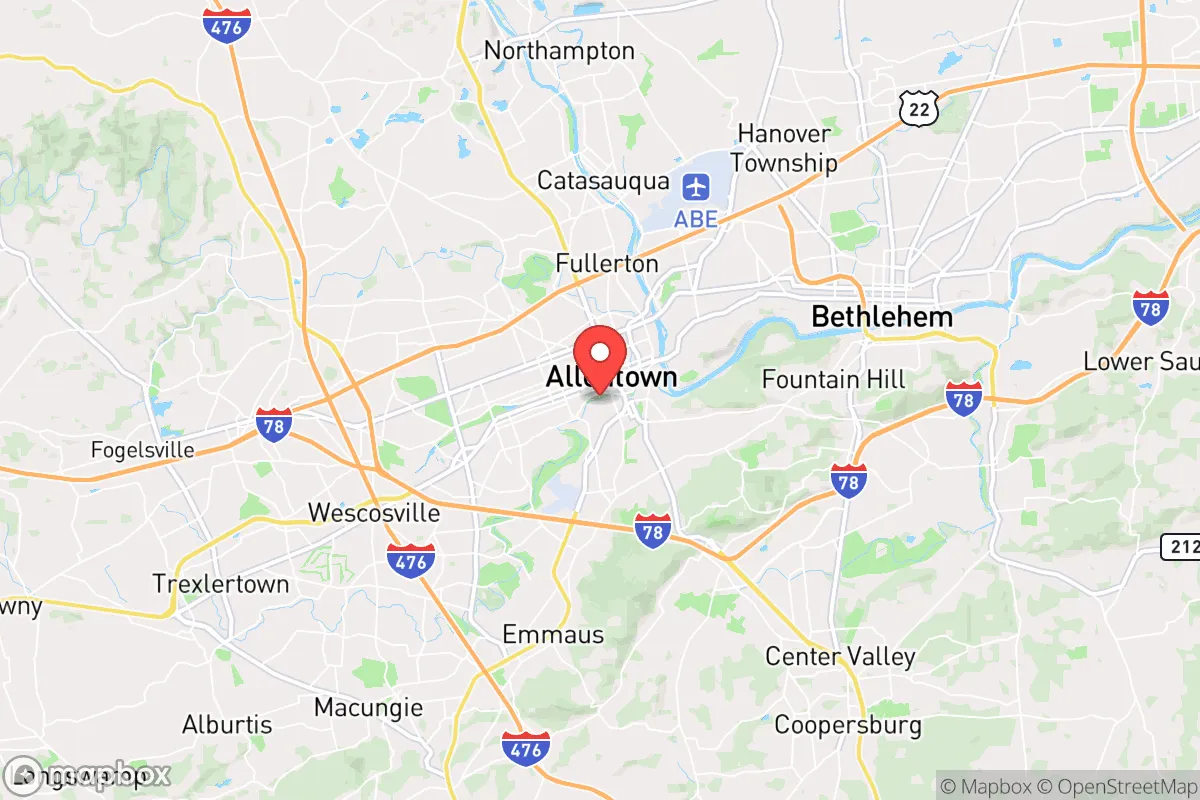
Drive 15 minutes south to Bethlehem, and you’ll feel the difference immediately—Bethlehem’s city council has gone full speed ahead on progressive zoning and police reform measures that make Allentown’s more cautious approach look almost quaint. Head west toward Reading, and you’ll find a similar story: both cities have embraced sanctuary policies and higher local taxes for social programs. Meanwhile, the rural townships surrounding Allentown—like Lower Macungie and Upper Saucon—vote solidly red, with school boards pushing back hard on curriculum mandates and mask requirements. Allentown itself is the hinge: it’s got the urban density and diversity that attracts progressive activists, but the old guard still remembers when the city’s biggest worry was keeping the steel mills open, not debating gender ideology in third-grade classrooms. That tension is what makes the R+1 rating feel both accurate and deceptive—it’s a district that could flip either way in a given cycle, but the direction of travel is concerning for anyone who values limited government.
What this means for residents
For the average family here, the biggest red flag is how fast local government has started reaching into daily life. The Allentown School Board, for instance, has pushed through policies on library books and bathroom access that would have been unthinkable ten years ago, and the city council has floated proposals for rental registration fees and noise ordinances that feel less about public safety and more about control. Property taxes have crept up to fund new social services, and there’s a growing sense that your rights—to speak your mind at a meeting, to opt your kid out of a lesson, to run a small business without a dozen permits—are getting squeezed. The old Allentown was live-and-let-live; the new one seems to want to tell you how to live. That’s the real story behind the R+1: it’s not a comfortable purple, it’s a battleground where the progressive agenda is testing how far it can push before the silent majority pushes back.
One thing that still sets Allentown apart from its neighbors is the lingering influence of the region’s Pennsylvania Dutch and Eastern European roots—there’s a stubborn streak here that doesn’t roll over for every new mandate. You see it in the way the local gun shops stay busy, the way the volunteer fire companies resist consolidation, and the way folks at the diner will tell you straight up that they don’t need the government deciding what’s best for their kids. But that culture is eroding as the city grows, and the next few elections will decide whether Allentown stays a place where personal freedom is the default or becomes another example of a once-practical town getting swallowed by ideology. Keep an eye on the school board races and the county commissioner seats—that’s where the real fight is happening, not in the presidential vote.

State Political ClimatePolitical Climate in Pennsylvania
State Political AnalysisPolitical Environment in the State
Pennsylvania is a classic purple state, but the purple is fading fast toward a deeper blue, especially in the southeast. The state’s 20 electoral votes have flipped from reliably Republican in the 1980s and 1990s to a toss-up that went for Biden by just 1.2 points in 2020, then saw Trump lose it again in 2024 by a similar margin. The dominant coalition is now a union-heavy, suburban-educated bloc in the Philadelphia collar counties, combined with Pittsburgh’s urban core, that consistently outvotes the redder central and northern tiers. Over the last two decades, the state has shifted left on social issues and election administration, while remaining more moderate on energy and taxes—but the trendline is unmistakably progressive.
Urban vs. rural divide
The political map of Pennsylvania is a tale of two states. The southeastern quadrant—Philadelphia, its suburbs (Montgomery, Delaware, Chester, Bucks counties), and the Lehigh Valley (Allentown, Bethlehem, Easton)—drives the Democratic margin. Philadelphia alone delivers about 600,000 Democratic votes per cycle, enough to offset massive Republican margins in the rest of the state. Pittsburgh and its Allegheny County base add another 200,000 Democratic votes. Meanwhile, the vast rural expanse—from the northern tier (Tioga, Bradford, Susquehanna counties) down through the central spine (Centre, Clinton, Lycoming) and into the southwest (Fayette, Greene, Washington counties)—votes Republican by 60-70% margins. The key battlegrounds are the “collar counties” around Philadelphia (Bucks, Chester, Delaware, Montgomery), which have flipped from swing to solidly Democratic over the past decade, and the Luzerne County (Wilkes-Barre) area, which flipped from Obama to Trump and remains a toss-up. Erie County on the lake has also trended blue, while York and Lancaster counties remain reliably red but are seeing suburban drift toward the center.
Policy environment
Pennsylvania’s policy environment is a mixed bag that leans left on social issues but stays relatively moderate on fiscal matters. The state income tax is a flat 3.07%, one of the lowest among states with a broad-based income tax, and the sales tax is 6% (8% in Philadelphia and Pittsburgh). Property taxes are high, averaging about 1.5% of home value, and vary wildly by school district. The regulatory posture is moderate: Pennsylvania is a major natural gas producer (Marcellus Shale) and has no state-level price controls, but the Department of Environmental Protection can be aggressive on permitting. Education policy is a flashpoint: the state funds public schools through a complex formula that heavily favors wealthy suburban districts, and a 2023 court ruling declared the system unconstitutional, opening the door to a potential statewide tax hike. Election laws are a major concern for conservatives: no-excuse mail-in voting was expanded in 2019 (Act 77), and while voter ID is required for in-person voting, mail-in ballots have looser verification. The state has a Democratic governor (Josh Shapiro) and a split legislature (Republican Senate, Democratic House), creating gridlock on most culture-war issues.
Trajectory & freedom
On the freedom scale, Pennsylvania is sliding downward. The most significant recent contraction of liberty came with Act 77 (2019), which expanded mail-in voting without the voter ID safeguards that conservatives wanted. In 2022, the state passed a red flag law (HB 1018) allowing courts to temporarily confiscate firearms from individuals deemed a threat, a move that gun-rights advocates see as a due-process violation. On the positive side, Pennsylvania is a constitutional carry state (no permit needed for open or concealed carry) as of 2022, and it has a strong preemption law preventing local governments from enacting their own gun bans. Parental rights took a hit in 2023 when the state board of education adopted new health standards that include LGBTQ+ topics in K-12 curriculum, overriding local control. Medical freedom is limited: the state has strict vaccine mandates for schoolchildren (with narrow religious exemptions) and a COVID-era emergency powers law that gave the governor broad authority to shut down businesses and churches—authority that was partially rolled back in 2022 via a constitutional amendment limiting emergency declarations to 21 days without legislative approval. Property rights are generally respected, but the state’s Act 13 (2012) zoning law for natural gas drilling was partially struck down by the state Supreme Court, giving local municipalities more power to restrict drilling.
Civil unrest & political movements
Pennsylvania has seen its share of political flashpoints. The 2020 election integrity controversy was centered in Philadelphia, where Republican poll watchers alleged they were denied access to ballot counting. This led to years of litigation and a 2022 state Supreme Court ruling that mail-in ballots without a handwritten date must be counted, a decision that still rankles conservatives. The 2021 “Stop the Steal” rally in Harrisburg drew thousands, and the state has a robust grassroots conservative movement, particularly in the Pennsylvania Freedom Caucus in the state House. On the left, the Black Lives Matter protests in Philadelphia in 2020 were among the largest in the nation, with looting and property damage that led to a permanent police reform package. Immigration politics are relatively quiet compared to border states, but Philadelphia is a sanctuary city (since 2016), and the state has a law (Act 40) that prohibits local governments from contracting with ICE for detention, which conservatives view as a magnet for illegal immigration. There is no serious secession or nullification movement, but the “Second Amendment sanctuary” movement has passed resolutions in over 30 counties, declaring they will not enforce state gun laws they deem unconstitutional.
Projection
Over the next 5-10 years, Pennsylvania is likely to continue its slow leftward drift, driven by in-migration from New York and New Jersey into the Philadelphia suburbs and the Lehigh Valley. These newcomers tend to be more educated, more secular, and more progressive on social issues. The rural population is aging and shrinking, while the urban and suburban populations are growing. The state’s electoral votes will likely remain competitive but tilt Democratic in presidential years, while state-level races will stay close due to gerrymandered legislative districts. The biggest wildcard is the Marcellus Shale natural gas industry: if the state moves to ban fracking (as Governor Shapiro has hinted at), it could devastate the economy of the western and northern tiers, accelerating their decline and further concentrating power in the southeast. A new resident moving in now should expect to see higher taxes (especially property taxes) as the school funding lawsuit is resolved, more restrictive gun laws if Democrats ever take the state Senate, and continued erosion of local control in education and health policy.
For a conservative moving to Pennsylvania, the bottom line is this: you can find a good life here, but you need to pick your county carefully. The rural northern tier and the central counties (like Centre, Clinton, and Lycoming) still offer a strong sense of community, low crime, and conservative values. The suburbs of Pittsburgh (like Butler and Washington counties) are also solidly red. But the state government in Harrisburg is trending left, and the Philadelphia metro area is increasingly dominant. If you value low taxes, gun rights, and local control, Pennsylvania is still a decent bet compared to New York or New Jersey—but the window is closing. Keep an eye on the 2026 gubernatorial election: if a Republican wins, the slide could slow; if a Democrat wins, expect a full-on blue state makeover within a decade.
* Values derived from national, state, county, city and local statistics and may differ in a specific area. Last updated: 2026-05-02T01:09:54.000Z
Narrative content on this page is AI-generated and may contain mistakes. Verify any details that matter before acting on them.
ReloMaps may earn a commission from affiliate links at no extra cost to you.

