Where to Move in the US: 10 Best Fits

For a national starting point, 27 states gained income-tax filers through interstate migration in 2022–2023, but the best place depends on your household's priorities. Families should start with Raleigh or Charlotte, remote workers with Austin or Boise, active or healthcare-oriented retirees with Denver or Raleigh, and homesteaders with smaller communities surfaced through ReloMaps filters, while each option carries trade-offs in insurance, commute, taxes, housing, or disaster exposure.
That migration pattern points toward the South and Sun Belt, but it doesn't prove that any destination is universally better. Texas led the latest IRS migration comparison with a net gain of 56,473 filers, followed by Florida, North Carolina, South Carolina, Tennessee, Arizona, Georgia, and Colorado, while California recorded a net loss of 100,397 filers. The IRS migration data measures changes in tax-filer addresses, so it's a useful directional signal, not a complete measure of every household move.
A family may put school and safety grades first. A remote worker may care more about work-from-home fit, housing, and occasional office access. A retiree may weigh taxes, healthcare access, and hazard exposure, while a homesteader may need acreage, property rights, low-density demographics, and reliable disaster screening.
The goal isn't to find a perfect city. It's to eliminate places that fail your household's non-negotiables.
ReloMaps provides a comparison layer for that process, combining a ReloScore, category grades, city and neighborhood context, commute measures, demographic indicators, tax factors, and disaster-risk filters. The ten recommendations below aren't a universal ranking. They're starting points for different relocation intents, followed by a workflow for turning broad interest into a defensible shortlist.
Table of Contents
- 1. Austin, Texas
- 2. Denver, Colorado
- 3. Nashville, Tennessee
- 4. Raleigh, North Carolina
- 5. Boise, Idaho
- 6. Portland, Oregon
- 7. Charlotte, North Carolina
- 8. Top Cities Summary
- 9. Methodology and Data Notes
- 10. How to Use ReloMaps
- Top 10 U.S. Cities: Relocation Comparison
- Turn a Broad Search Into a Defensible Shortlist
- Budget the move beyond the listing price
- Test daily life before signing
- Frequently Asked Questions
- How much should I reserve for hidden relocation costs?
- What safety-grade floor should a family use?
- How can a hybrid worker test commute tolerance accurately?
- What insurance question should I ask before making an offer?
- How do I screen a rural location for disaster resilience?
- How should homesteaders use demographic filters without overrelying on them?
- What should I verify after ReloMaps identifies a finalist?
1. Austin, Texas
Austin remains a logical first screen for remote workers, technology professionals, and households seeking a large-city lifestyle with strong cultural identity. Its appeal comes from the combination of employment access, entertainment, outdoor spaces, and a broad range of urban and suburban environments. The trade-off is that a desirable lifestyle can become expensive once housing, property taxes, insurance, and peak-time travel are considered together.
A household comparing central Austin with Cedar Park, Round Rock, or another outer-area community shouldn't judge the region by a single metro average. Compare the commute to the actual office, the school and safety grades, the property's hazard exposure, and the likely insurance position. A low purchase price doesn't automatically mean low carrying costs, particularly in a market where taxes, coverage, and maintenance can change the long-term calculation.

Who Austin fits best
Austin is strongest for a worker who can keep a coastal salary while choosing a lower-cost lifestyle, or for a family willing to trade central convenience for more space. It's a weaker fit for anyone who treats a nominally affordable listing as proof of affordability without checking insurance, taxes, commute frequency, and neighborhood-level safety.
Use ReloMaps to compare Austin neighborhoods and nearby towns by ReloScore, commute, work-from-home fit, safety, schools, home values, and disaster exposure. The cheapest cities in Texas can broaden the search beyond the most visible Austin neighborhoods. If you're moving near Cedar Park, arrange hiring licensed movers near Cedar Park early, then verify the full cash requirement for deposits, storage, travel, and temporary housing.
2. Denver, Colorado
Denver fits active professionals, outdoor-oriented households, and retirees who want urban services near recreation. The city offers a different relocation proposition from Austin: access to mountain activities and a strong lifestyle identity can outweigh the cost of housing for people who'll use those amenities regularly. For others, the same geography creates exposure to wildfire corridors, winter disruption, and longer drives toward recreation or healthcare.
A Denver shortlist should distinguish central neighborhoods, transit-connected areas, and car-dependent suburbs. A remote worker who rarely travels to an office may accept a quieter location, while a hybrid employee needs to test the ordinary weekday route rather than relying on a map's off-peak estimate. Retirees should add hospital access, winter mobility, home maintenance, and emergency routes to the comparison.

The risk screen matters more here
Mountain access can put a home closer to wildfire exposure, while waterways and drainage patterns create different flood questions. FEMA's National Risk Index reports risk at both county and Census-tract levels across 18 hazards, including wildfire, flooding, tornadoes, hurricanes, earthquakes, extreme heat, winter weather, and strong wind. Use that FEMA risk framework to screen a property before lifestyle preferences take over the decision.
The best places for young professionals in the Mountain West can help widen the comparison beyond Denver. A lower-density alternative may deliver more space, but it can also mean weaker transit, longer emergency-response routes, and greater dependence on a personal vehicle.
3. Nashville, Tennessee
Nashville attracts creative professionals, entrepreneurs, remote workers, and families seeking a growing Southern metro with a strong cultural scene. It can suit someone who values entertainment and employment variety, but growth changes the calculation. A neighborhood that looks convenient on a map may bring a longer commute, more development pressure, or a safety profile that differs sharply from the surrounding suburb.
Families should compare Nashville proper with Franklin, Brentwood, Green Hills, and other communities using the same criteria. Don't treat a highly rated suburb as automatically practical if the job is elsewhere. A school advantage can be offset by a burdensome commute, while a central neighborhood can be appealing only if its safety grade matches the household's tolerance.
A growth market needs a resilience check
Tornado exposure deserves more than a general “weather” label. Ask whether the prospective home has a suitable shelter arrangement, whether insurance covers the relevant hazards, and how evacuation or emergency access would work. The Treasury's insurance analysis found that homeowners in the highest climate-risk ZIP codes faced policy nonrenewal rates about 80% higher than those in the lowest-risk ZIP codes. It also reported that annual nonrenewal notices rose by nearly 30% between 2018 and 2022, reaching more than 620,000.
That evidence changes the Nashville question from “Is this house inexpensive?” to “Can this house remain insurable at a cost the household can carry?” ReloMaps filters can narrow safety, housing, commute, and hazard choices before you spend time on individual listings.
4. Raleigh, North Carolina
Raleigh rewards constraint-based searching. It can suit families, technology and life-science workers, and retirees who want access to healthcare and education, but the right location depends on the household's destination, tolerance for driving, and exposure to rising carrying costs.
Families should start with school requirements, safety grades, and a maximum door-to-door commute. Remote workers should check internet service, healthcare access, and whether local amenities justify the housing cost. Retirees may prioritize hospital access, manageable property taxes, and fewer daily car trips. Homesteaders should examine parcel rules, water access, soil, wildfire and storm exposure, and distance from essential services.
Compare Raleigh by corridor, not by city label
Use ReloScore to create a baseline, then apply category grades for housing, commute, safety, demographics, taxes, and disaster risk. Compare Cary to Research Triangle Park with North Raleigh to downtown Raleigh. The first corridor may suit a worker tied to RTP, while the second may fit a household prioritizing central access. Set a maximum commute threshold before comparing homes, and test both routes during typical travel hours.
Cary, Chapel Hill, Durham-area communities, and Raleigh neighborhoods can produce different school assignments, insurance conditions, housing costs, and demographic profiles. A high overall score should not override a failing requirement, such as an unacceptable commute or weak safety grade.
Start with North Carolina relocation comparisons, then verify county taxes, insurance availability, flood and wind exposure, school boundaries, and service access at the property level. Growth supports demand, but it does not guarantee affordability or resilience.
5. Boise, Idaho
Boise fits remote workers, families, and outdoor-focused movers who prefer a smaller urban environment. Its appeal is practical as well as emotional: a household may value shorter local trips, access to nature, and a less intense metropolitan feel. The risk is that a destination can become less attractive to newcomers once housing costs, insurance, wages, and services are evaluated together.
Remote workers should compare their current compensation with local opportunities instead of assuming that a move preserves income. A household dependent on one employer should also test internet reliability, backup power, healthcare access, and the distance to essential services. Families considering Eagle or Meridian need to compare schools and commute patterns rather than using “Boise” as a proxy for the whole area.

Don't confuse lifestyle value with financial value
Boise can work when the household actively uses its outdoor access and accepts the local labor market. It's less compelling when the move depends on fast appreciation, a coastal salary, or an assumption that a smaller city automatically has lower total costs.
Wildfire smoke, winter driving, and changing housing supply belong in the pre-offer analysis. Use ReloMaps to compare work-from-home rates, property crime, housing, commute, demographics, and disaster indicators at the local level. For a homesteading-leaning buyer, add acreage, zoning, water access, property rights, and distance to hospitals instead of stopping at a scenic setting.
6. Portland, Oregon
Portland is a fit for lifestyle-driven movers, creative professionals, and outdoor enthusiasts who value progressive civic culture, walkable neighborhoods, and access to regional recreation. It isn't a neutral choice. State taxes, neighborhood-level safety, visible homelessness, and the difference between downtown living and residential neighborhoods can materially change the experience.
A buyer should compare the exact neighborhood, not just the city brand. Walkability may reduce some driving, but it doesn't answer questions about school access, property crime, street conditions, insurance, or the commute to an office outside the core. A remote worker may tolerate a different set of trade-offs from a family with daily school travel or an older household planning for healthcare access.
Portland rewards precise neighborhood filtering
Use ReloMaps safety and lifestyle filters to compare neighborhoods west of the core, southwest areas, and east-side communities without treating any one label as definitive. The platform's category grades can help expose a mismatch between a strong quality-of-life score and a weak safety, affordability, or commute score.
Climate comfort also means different things to different households. Some people value a mild environment, while others need to assess seasonal light, air quality, and the effect of weather on mood and outdoor plans. A serious Portland comparison should include taxes, insurance, transit, proximity to services, and the household's tolerance for visible urban problems.
7. Charlotte, North Carolina
Charlotte is a strong candidate for families, finance professionals, healthcare workers, and technology employees who want a growing metro with suburban options. Its main advantage is flexibility. A household can compare established neighborhoods, newer development, and communities farther from the urban core, but that flexibility comes with a commute trade-off.
South Charlotte communities such as Ballantyne and Weddington may appeal to families prioritizing schools and residential amenities. Myers Park offers a different urban-suburban balance. The right choice depends on whether the household values school access, office proximity, neighborhood character, housing space, or lower-density living most.
Commute and safety should be tested together
A highly rated suburb can fail a hybrid worker if the office journey is exhausting. The Census Bureau's commuting data reports that 13.3% of U.S. workers worked from home in 2024, down from 13.8% in 2023, while 3.7% used public transportation, up from 3.5%. Those national figures show why remote and hybrid households still need to evaluate office frequency, parking, transit, and peak-time travel.
Charlotte also requires a neighborhood-level safety screen and a hurricane-risk discussion. A family may accept a longer commute for a school or safety advantage, but it should price the time, fuel, vehicle wear, and weather disruption rather than treating the trade as free.
8. Top Cities Summary
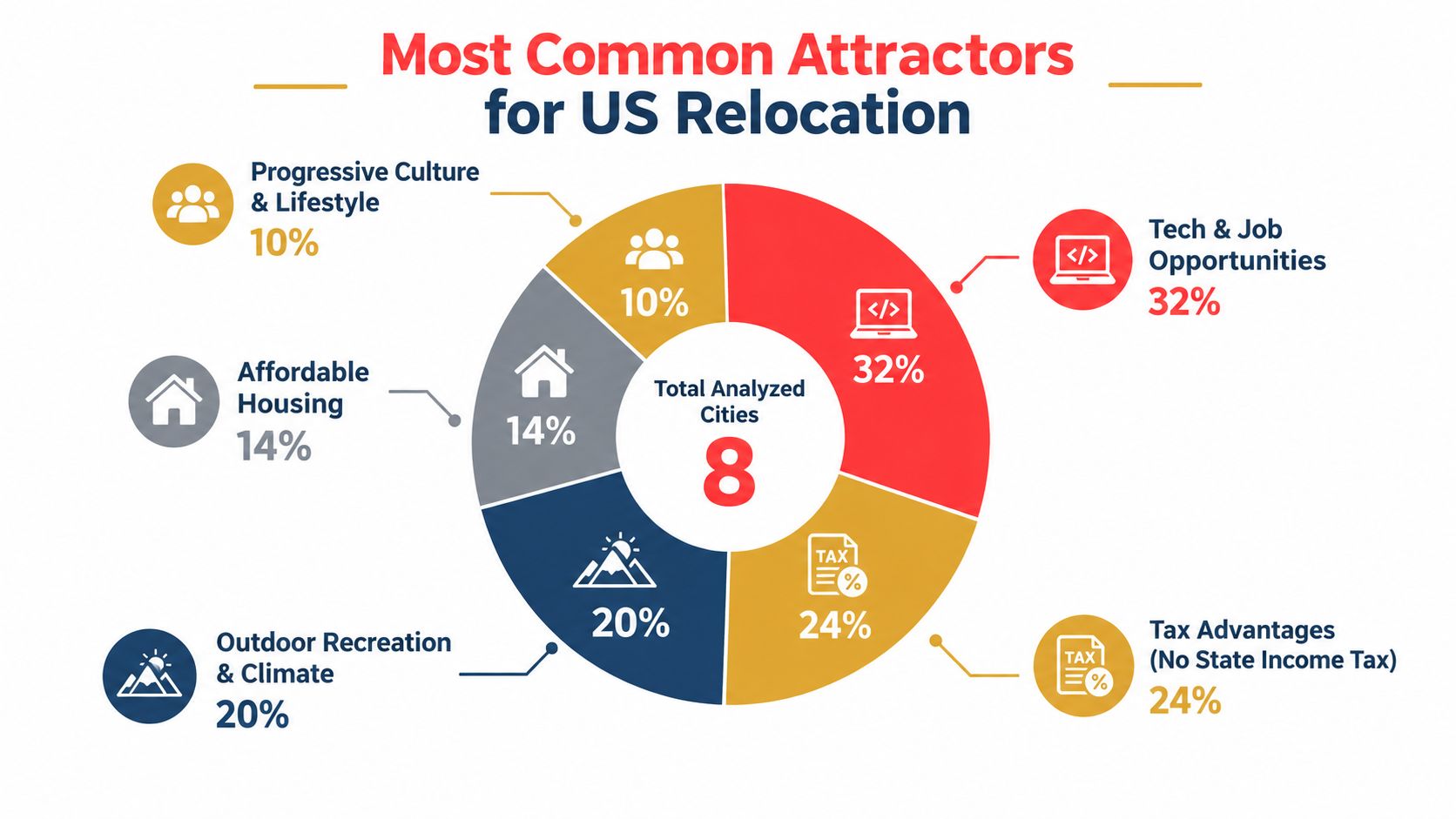
The seven cities are useful starting points, not universal winners. Austin, Denver, Nashville, Raleigh, Boise, Portland, and Charlotte should be screened against the household's constraints, then compared at the neighborhood or county level.
- Families: Set a minimum ReloScore, require a safety grade that meets your standard, and reject locations whose ordinary school or office commute exceeds the household's limit. Compare Raleigh and Charlotte only after checking boundaries, healthcare access, and insurance exposure.
- Remote workers: Require reliable work-from-home infrastructure and a commute that fits occasional office travel, even if daily commuting is unnecessary. Use tax burden, housing cost, insurance, and employer location as filters before comparing Austin, Boise, or other candidates.
- Retirees: Set minimum grades for healthcare access, safety, and quality of life. Then test winter conditions, mobility, taxes, hospital distance, and disaster recovery capacity. A strong lifestyle fit does not offset weak service access.
- Homesteaders: Filter for low density, acreage, property rights, homeschool freedom, service access, and disaster exposure. Major metros may be reference points rather than final destinations.
Migration can identify markets for further research, but it cannot establish affordability or resilience. South Carolina recorded a migration-driven population increase of 1.12%, while Delaware gained 0.77%, per the IRS migration data. Those figures describe past movement, not the best fit for a specific household.
9. Methodology and Data Notes
A defensible relocation comparison combines national evidence with local verification. IRS migration data can show where tax filers moved, while FEMA can screen hazard exposure at the county and Census-tract levels. The Treasury's insurance findings add a recurring-cost test that ordinary housing comparisons often miss. Census commuting data helps remote and hybrid workers evaluate whether a home's location actually fits the work arrangement.
ReloMaps adds a consistent comparison layer through ReloScore and A+–F category grades covering factors such as affordability, safety, demographics, education, quality of life, commute, strategic location, and disaster exposure. Its filters can also surface work-from-home rates, rents, home values, homeownership, tax burden, property rights, homeschool freedom, and other personal priorities.
Important limits
No score can replace a property inspection, an insurance quote, a school-boundary confirmation, or a drive at the time you'll commute. IRS migration counts also exclude some groups, including people who don't file federal returns. FEMA's baseline identifies exposure, but it doesn't tell you whether a particular insurer will renew a policy or whether a road will remain usable after a disaster.
Use scores to reduce uncertainty, not to outsource judgment.
10. How to Use ReloMaps
Start with the household segment, then apply hard filters. A family might set a minimum safety grade, an education requirement, and a maximum commute. A remote worker might filter for work-from-home rates, housing, airport proximity, and disaster exposure. A retiree can add healthcare access and lower transportation dependence. A homesteader may need low density, property rights, acreage potential, and a minimum distance from hazards.
Use quick filters to reduce the national map, then switch to advanced filters for the constraints that determine daily life. Compare at least three candidates using the same categories. If one location scores well overall but poorly on insurance-relevant hazard exposure, don't let its broad ReloScore conceal that weakness.
Verify the property, not only the city
ReloMaps supports property-context lookup through Zillow or Redfin URLs. Paste the listing URL to investigate the neighborhood and city context, then verify the result with county records, an insurer, local authorities, and the relevant school district.
Keep a written comparison for each finalist:
- Financial fit: Housing, taxes, insurance, utilities, deposits, storage, and travel.
- Daily fit: Office frequency, commute timing, schools, healthcare, shopping, and transit.
- Resilience fit: Flood, wildfire, wind, tornado, winter weather, evacuation, and utility dependence.
- Household fit: Demographics, density, property rights, political alignment, and community expectations.
Top 10 U.S. Cities: Relocation Comparison
| City / Item | Cost (median home / 1BR rent) | Taxes & Cost of Living | Job Market & Expected Outcomes | Safety (crime profile) | Relocation Complexity / Key Considerations | Ideal Use Cases / Key Advantages |
|---|---|---|---|---|---|---|
| Austin, Texas | Median home ~$625,000; 1BR rent ~$1,500 | No state income tax; COL index 105; rising property taxes | Strong tech hub, 15k+ tech openings; median tech salary ~$125K | Violent crime ~30% below avg; property crime ~18% above | Avg commute 27 min (I-35 bottleneck); summer heat; gentrification | Remote-first tech workers, entrepreneurs, families seeking tax savings and vibrant culture |
| Denver, Colorado | Median home ~$550,000; 1BR rent ~$1,450 | State income tax 4.63%; COL index 108; lower property tax rate (~0.5%) | Strong tech, energy, aerospace; median tech ~$115K; startup ecosystem | Violent crime ~5% above; property crime ~15% above; downtown/Northeast hotspots | Elevation (5,280 ft) acclimation 1–3 weeks; winter weather; good transit | Outdoor-focused tech professionals and families valuing recreation and schools |
| Nashville, Tennessee | Median home ~$425,000; 1BR rent ~$1,300 | No state income tax; COL index 98; rising property taxes | Music/entertainment and healthcare dominant; growing tech sector | Violent crime ~45% above national average; concentrated corridors | Infrastructure strain, traffic avg 28 min; summer heat, tornado risk | Music/creative professionals, tax-sensitive movers, families targeting suburbs |
| Raleigh, North Carolina | Median home ~$380,000; 1BR rent ~$1,200 | State income tax 4.75%; COL index 95; affordability eroding | Research Triangle tech/biotech (50k+ jobs); median tech ~$108K | Violent crime ~5% below; property crime ~8% above downtown | Commute avg 24 min; growing congestion; hurricane/flood risk in low areas | Tech/biotech professionals, families prioritizing schools and value |
| Boise, Idaho | Median home ~$390,000; 1BR rent ~$1,150 | State income tax 5.8%; COL index 92; fastest home appreciation | Growing regional tech hub (10k+ jobs); median tech $95K–$110K | Violent crime ~2% above; property crime ~18% above; north Boise safer | Shortest commute ~20 min; wildfire smoke season; rapid growth changing character | Remote-first workers, outdoor enthusiasts, families seeking short commutes and value |
| Portland, Oregon | Median home ~$475,000; 1BR rent ~$1,350 | State income tax 9.9%; COL index 109; no sales tax | Tech and creative jobs (25k+ tech roles); varied salaries | Violent crime ~85% above; property crime ~40% above; visible homelessness | I-5 congestion avg 27 min; downtown livability concerns; mild climate | Creative/lifestyle-focused movers and outdoor enthusiasts prioritizing culture |
| Charlotte, North Carolina | Median home ~$340,000; 1BR rent ~$1,250 | State income tax 4.75%; COL index 97; affordable housing | Finance-dominant (40k+ jobs); growing tech and healthcare sectors | Crime ~28% above; concentrated corridors; south Charlotte safer | Commute avg 26 min; infrastructure strain; seasonal hurricane risk | Finance professionals, families seeking affordability and strong suburban schools |
| Top Cities Summary | Varied; rapid home-price appreciation common | Trade-offs: no-income-tax states vs. higher property/state taxes | Common attractors: tech, outdoor rec, culture; WFH 25–32% | Crime concentrated in urban cores; varies widely by neighborhood | Infrastructure strain and closing affordability windows (e.g., Boise, Raleigh, Austin) | Use neighborhood filters; model total tax impact; plan 3–5+ year horizons |
| Methodology & Data Notes | Based on median home/rent and COL indices; subject to change | Tax estimates use state rates; local property taxes vary | Job counts and medians estimated from public/regional sources | Safety grades synthesize neighborhood crime trends; verify locally | Dataset is a starting point; verify with live filters and local sources | Guidance for research; follow up with school, assessor, and site visits |
| How to Use ReloMaps | Tool filters for cost, commute, and school ratings | Compare total tax burden with toggle scenarios | Filter by employer locations and job corridors | Apply crime and climate risk overlays (wildfire, flood, hurricane) | Bookmark neighborhoods, iterate filters, prioritize commute/safety | Practical neighborhood-level relocation steps for personalized shortlists |
Turn a Broad Search Into a Defensible Shortlist
The best place to move in the US is the location that satisfies the household's constraints with the fewest unacceptable compromises. Raleigh may be stronger for a family that values schools and healthcare access. Charlotte may suit a finance household that wants suburban choice. Austin can work for a remote worker who values culture and employment access, while Boise may appeal to someone prioritizing a smaller setting and outdoor access. Denver can fit an active retiree, but hazard exposure and winter conditions need explicit testing. A homesteader may find a better fit in a smaller community that never appears on a mainstream “best cities” list.
Begin by writing the household segment and the requirements you cannot compromise on. Put an actual ceiling on commute time, a minimum safety grade, a required school standard, a hazard tolerance, and a maximum monthly housing burden. Don't use a vague goal such as “affordable” when the true requirement is “insurable, serviceable, and manageable on one income.”
Then use ReloMaps quick filters to reduce the national map. Apply advanced filters for ReloScore, category grades, commute, taxes, safety, demographics, work-from-home rates, home values, rents, and disaster exposure. Compare at least three candidates side by side. A national migration trend can justify investigating a region, but it can't choose a neighborhood for you.
Inspect city and neighborhood pages rather than relying on metro averages. Two areas in the same metro can differ materially in flood, wildfire, storm, crime, school, and commute conditions. FEMA's National Risk Index is useful for screening because it combines expected annual loss, social vulnerability, and community resilience across hazard categories, but it remains a baseline rather than a guarantee of insurability or recovery speed.
Budget the move beyond the listing price
Your relocation budget should include deposits, temporary housing, storage, travel, utility setup, moving labor, vehicle costs, and cash needed at closing. For most civilian households, employer reimbursement rules matter more than assumptions about a federal deduction. The IRS guidance on moving expenses says active-duty Armed Forces members may deduct qualifying unreimbursed expenses, or exclude qualifying reimbursements, when a military order causes a permanent change of station or qualifying reassignment. The IRS also says meals aren't deductible, and reimbursed expenses can't be deducted again.
Insurance deserves the same attention as rent or mortgage. Ask an insurer whether the property is currently eligible, what exclusions apply, how deductibles work, and whether coverage depends on mitigation features. A cheaper home in a hazard-exposed ZIP code may be less affordable than a costlier home with stable coverage.
Test daily life before signing
For hybrid work, drive the route during the actual peak period on more than one ordinary weekday. Include parking, transit connections, school drop-off, weather, and the number of required office days. A home that looks ideal for a fully remote employee may become frustrating when an employer changes attendance expectations.
For families, confirm the assigned school rather than relying on a neighborhood label. For retirees, locate hospitals, pharmacies, primary care, and emergency routes. For homesteaders, verify zoning, water, access roads, internet, power reliability, and the distance to supplies. For every household, review demographic and community indicators against real expectations rather than using a score as a substitute for visiting.
Frequently Asked Questions
How much should I reserve for hidden relocation costs?
Reserve a separate cash buffer for temporary housing, storage, deposits, travel, utility setup, and closing-related expenses rather than treating the moving quote as the full budget. Military households should separate qualifying expenses from meals and government-paid costs because the IRS says those categories receive different treatment. Civilian households should request the employer's reimbursement rules in writing before accepting a relocation package.
What safety-grade floor should a family use?
A family should set a minimum safety grade before comparing school or lifestyle features, then reject any finalist that falls below it unless the household has a documented reason to accept the risk. Review the exact neighborhood or tract, not just the city grade, and check how the score aligns with school travel, evening routines, and emergency access. A household with small children, irregular work hours, or limited transportation may need a stricter floor than a household with different routines.
How can a hybrid worker test commute tolerance accurately?
A hybrid worker should complete the proposed route during the peak period on an ordinary weekday and multiply the result by the required office frequency. Include parking, tolls, fuel, transit fares, vehicle wear, and school or caregiving detours. The Census Bureau's national data shows that work-from-home remains significant but not universal, so the employer's written attendance policy should be treated as a financial input, not a casual assumption.
What insurance question should I ask before making an offer?
Ask an insurer whether the property can be covered now, what hazards are excluded, what mitigation is required, and whether the carrier will write or renew the policy in that location. Treasury found materially higher nonrenewal rates in the highest climate-risk ZIP codes, so a buyer should obtain an insurance indication before becoming financially committed. Request flood, wildfire, wind, and replacement-cost details separately when the market requires it.
How do I screen a rural location for disaster resilience?
Screen the Census tract and county for relevant hazards, then inspect the access road, evacuation options, utilities, nearest hospital, communications coverage, and recovery dependencies. A major disaster was associated with an average 0.2% decline in a state's net migration rate in the following year, according to the Society of Actuaries' 2025 climate migration analysis. That finding doesn't predict a specific property's outcome, but it supports testing whether a fast-growing or scenic location can recover after disruption.
How should homesteaders use demographic filters without overrelying on them?
Homesteaders should use demographic filters to identify low-density communities, then verify zoning, acreage potential, water access, road maintenance, internet, healthcare distance, and local property rules. Demographic similarity doesn't guarantee social fit or practical self-sufficiency. A location with the right population profile but weak emergency access or unreliable utilities may fail the household's actual purpose.
What should I verify after ReloMaps identifies a finalist?
Verify the listing's school assignment, county taxes, insurance eligibility, hazard exposure, permits, zoning, utility service, and weekday commute with primary sources and local professionals. Use the ReloMaps property lookup for neighborhood context, but don't treat any platform score as a substitute for an inspection, insurer review, county confirmation, or an in-person visit. The final decision should survive both a spreadsheet test and a normal day living there.
ReloMaps brings city and neighborhood context, ReloScore comparisons, household-oriented filters, property lookup, and disaster-risk indicators into one relocation research workflow. Visit ReloMaps to narrow the map by your priorities and build a shortlist you can verify before moving.
Enjoying the blog? Subscribe to ReloMaps+ for premium area intelligence — and to keep us independent.
Subscribe today