What to Do Before Moving Out of State

You've found a home in another state, booked the movers, and started thinking about boxes. Before anything gets loaded, submit your USPS change of address, identify the new state's residency deadlines, schedule utilities, and verify that the destination works at the neighborhood level, not just on a state ranking. The practical answer to what to do before moving out of state is to treat the move as an administrative, financial, and lifestyle transition, not just a transportation project.
A smooth relocation protects four things at once: your official records, your access to essential services, your financial accounts, and your confidence in the place you're entering. The order matters. If you choose a neighborhood before checking its everyday conditions, or wait to arrange internet until arrival, the most expensive problems can appear after the lease is signed.
Table of Contents
- The Reality of Interstate Relocation
- Evaluating Destination Tradeoffs and Neighborhood Context
- Coordinating Logistics and Utility Transfers
- Updating Residency and Legal Obligations
- Managing Mail Forwarding and Financial Accounts
- Building a Realistic Pre-Move Timeline
- Frequently Asked Questions
- What should I do if my financed car is titled in another state?
- Can I keep my current health insurance after moving across state lines?
- How should remote employees document an interstate move?
- What happens to stock options when I move during a vesting period?
- Should I rent before buying in an unfamiliar city?
- What should I do when the new address is not finalized?
The Reality of Interstate Relocation
Moving day often exposes weak planning. The truck is scheduled, the old home is nearly empty, and then you discover that mail is still going to the previous address, the new utility account hasn't been activated, or your vehicle documents require an appointment you didn't know about. Those problems aren't caused by poor packing. They come from treating an interstate move as a single event instead of a chain of connected obligations.
Start with three priorities:
- Secure mail forwarding. Submit the official USPS change-of-address request before departure and choose the date forwarding should begin. USAGov warns that third-party services may charge $40 or more for a process USPS provides for $1.10 through its official site. Use the official USPS change-of-address guidance, not a paid intermediary.
- Map the new state's obligations. Check requirements for your driver's license, vehicle registration, voter registration, insurance, professional credentials, and tax filing. Many state DMV rules require an address or license update within 30 days, while some guidance identifies a 30-to-90-day range depending on the state, so confirm the exact rule with the new state.
- Validate the destination locally. A state can look attractive in a migration ranking while a particular city, suburb, or neighborhood fails your requirements for safety, schools, commute, taxes, or disaster exposure. Use ReloMaps Explore to compare local context before committing to a lease or purchase.
The IRS treats migration as a formal administrative event by building migration data from year-to-year address changes reported on individual income tax returns. That illustrates the underlying issue: crossing state lines changes how agencies identify your residence, and a missed update can interfere with notices, refunds, benefits, insurance, or tax filings.
Practical rule: Don't let a moving company's schedule become your relocation plan. Your legal address, utilities, insurance, and destination research need their own calendar.
Evaluating Destination Tradeoffs and Neighborhood Context
A popular destination isn't automatically a suitable destination. Relocation data for 2025 shows strong inbound flows into states including South Carolina, Arkansas, Idaho, and North Carolina, while outbound lists also repeatedly include Louisiana, West Virginia, Wyoming, Delaware, Nebraska, Arizona, Iowa, Oklahoma, South Dakota, and South Carolina in the 2025 National Movers Study. South Carolina appearing in both patterns is a useful warning. Results can differ by source, population covered, and whether the measure emphasizes inbound or outbound movement.
State-level popularity is a screening signal, not a decision. Start with the city, then test the neighborhood around the specific property. A low-cost state can still produce a poor household outcome if the chosen area brings an exhausting commute, limited school options, high hazard exposure, or rules that conflict with how you intend to live.
Compare the location against your actual constraints
Build a short list of priorities before browsing listings. For a family, that might include school quality, crime context, housing costs, and access to healthcare. For a remote worker, internet availability, backup connectivity, workspace suitability, and occasional travel to a major city may matter more than a low asking price. For a homesteader or policy-conscious household, tax burden, property rights, homeschool freedom, firearm policy, marijuana status, and disaster exposure deserve explicit review.
ReloMaps consolidates city and neighborhood context into category grades and a ReloScore, with filters for economics, demographics, education, home values, rents, commute times, work-from-home rates, hazards, and lifestyle preferences. Its property lookup can also use a Zillow or Redfin URL to retrieve context for the neighborhood around a listing. You can compare affordable cities in America, then verify whether a particular property actually fits the household's priorities.
The point isn't to outsource judgment to a score. It's to expose tradeoffs early enough to investigate them. A charming weekend visit won't show a weekday commute, school-boundary limitation, internet gap, or recurring flood concern.
Test ordinary Wednesday conditions
Ask practical questions before you sign:
- Daily travel: How long will the commute take during the hours you'll travel?
- Household services: Where are the nearest groceries, pharmacies, doctors, schools, and veterinary providers?
- Risk exposure: Is the property near flood, wildfire, tornado, hurricane, or other hazard zones?
- Remote work: Can the address support dependable service, and what's the backup if the primary connection fails?
- Regulatory fit: Do local rules, HOA restrictions, parking limits, or property regulations conflict with your plans?
For households moving to rural areas, investigate securing internet for remote work before assuming a lower housing cost is a saving. Connectivity is part of the work environment, not an afterthought.
Coordinating Logistics and Utility Transfers
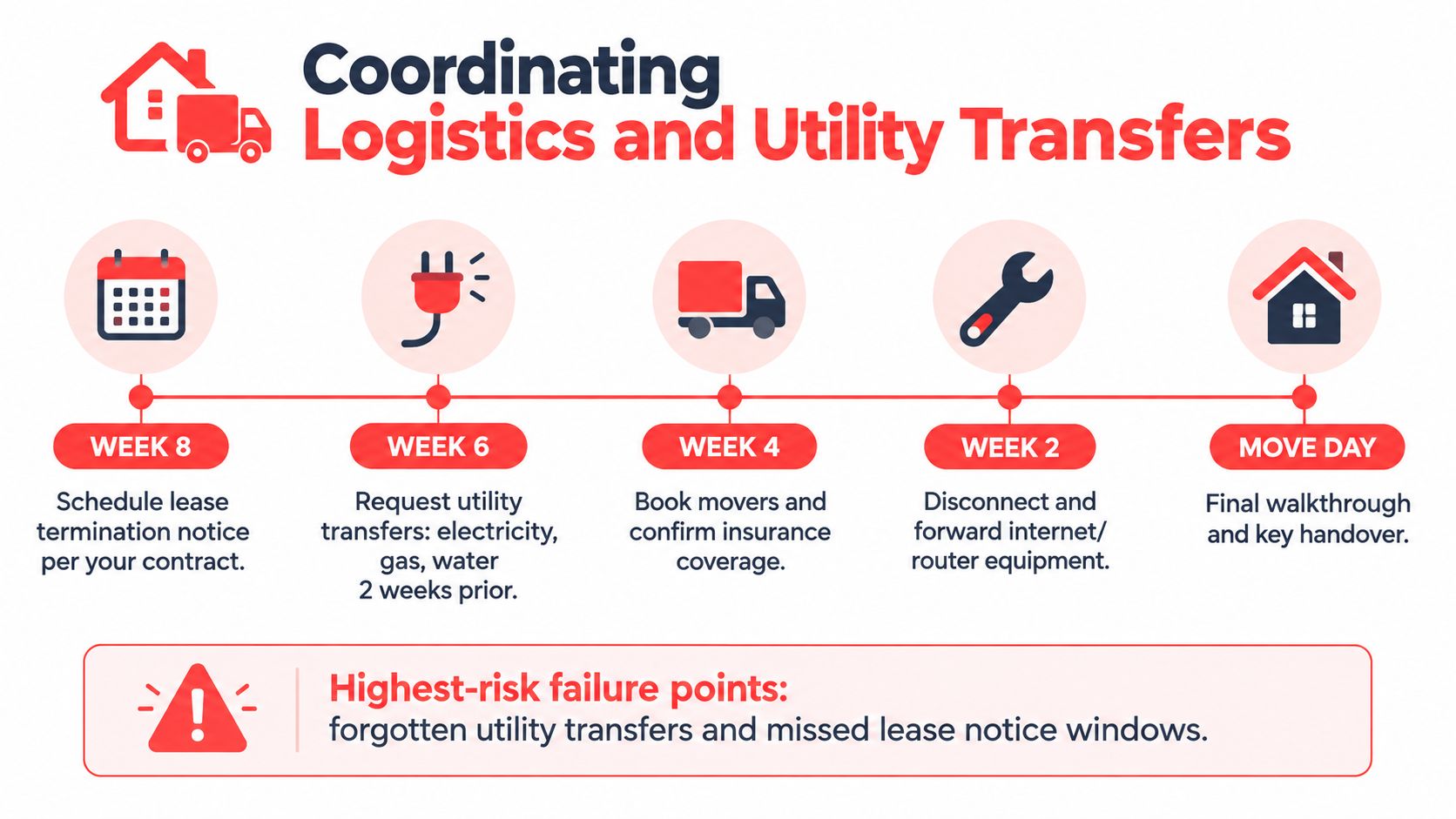
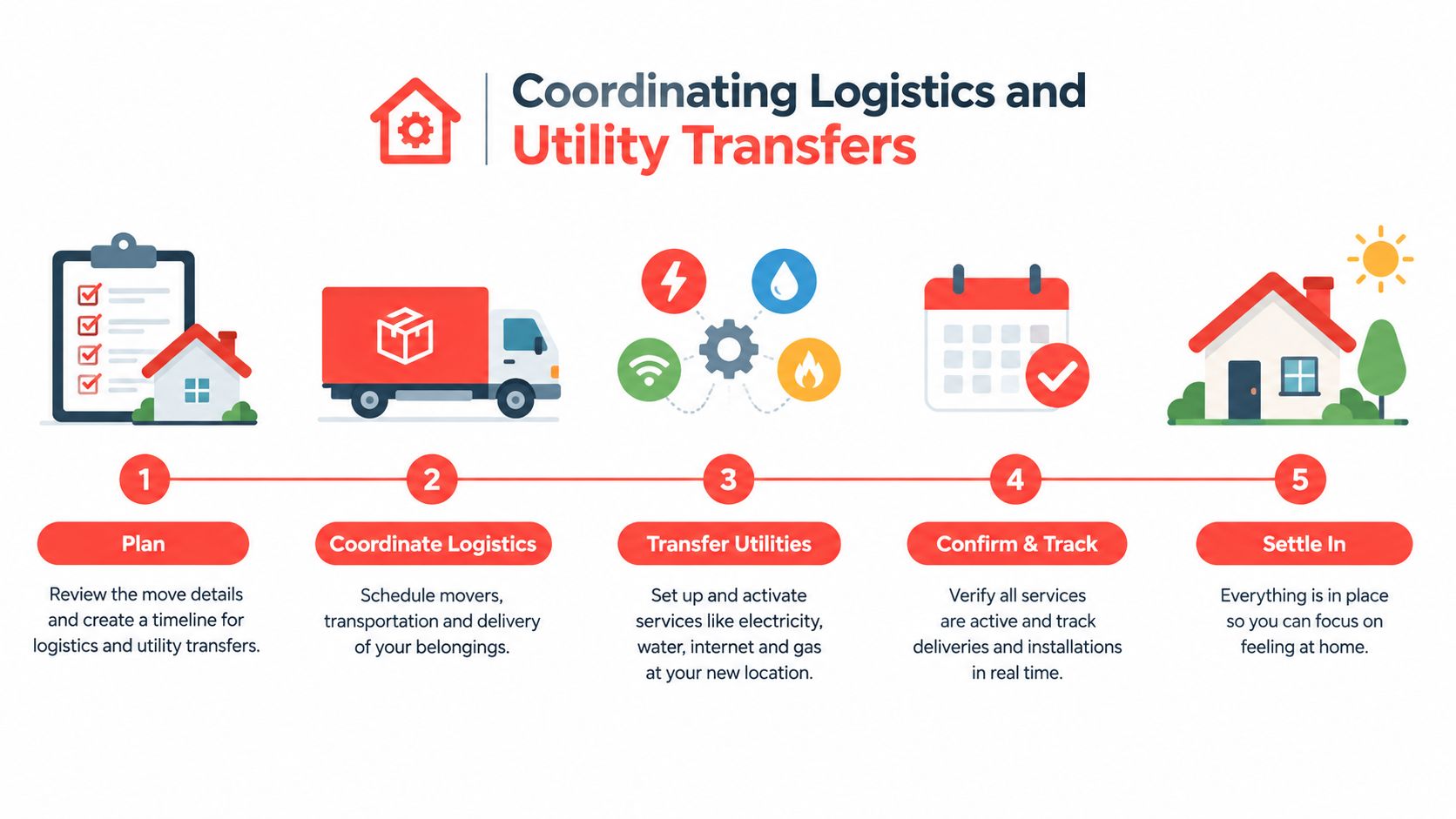
Utilities create some of the most avoidable failures in an interstate move. A household can tolerate a delayed box. It can't easily tolerate arriving without electricity, water, heating, cooling, or an internet connection needed for work. Schedule the old-home disconnection and new-home activation around the move date, with written confirmation from every provider.
UPack recommends contacting utility companies at least 30 days in advance, confirming whether service can transfer or must be opened as a new account, arranging final meter readings, and updating billing details in its utility-transfer guidance. Internet and cable deserve special attention because installation appointments can fill before other utility slots. Ask for activation the day before or on move-in day, and confirm whether equipment must be returned, shipped, or carried with you.
Build the move around fixed dates
Your lease, closing, mover, utility, and travel dates should agree with one another. Renters should read the termination clause, notice method, inspection process, cleaning standard, and forwarding-address requirement. Sending notice by text when the lease requires written notice can create a preventable dispute. Homeowners need a separate handoff plan covering the closing date, final walkthrough, key transfer, utilities, insurance, and any period when the property remains vacant.
Keep a single relocation folder with:
- Provider confirmations: Account numbers, activation dates, disconnection dates, and confirmation codes.
- Property records: Lease notices, inspection photographs, closing paperwork, and key instructions.
- Mover documents: Estimate, inventory, insurance details, bill of lading, and delivery contacts.
- Access details: Parking instructions, elevator reservations, gate codes, and building restrictions.
Declutter before receiving the final moving estimate or confirming the inventory. Interstate pricing commonly reflects the amount transported and the distance, so selling, donating, or discarding low-value bulky items can be more sensible than paying to move them and replace them later. Don't rely on a verbal promise that the price won't change. Request a written inventory and understand what happens if the shipment gains items, requires stairs, or needs special handling.
If the household will drive separately while the vehicle travels independently, compare delivery timing, insurance, pickup access, and whether the carrier provides door-to-door service. A resource covering vehicle shipping with flat-rate pricing can help you evaluate that option against driving the car yourself.
Updating Residency and Legal Obligations
An address change becomes a residency issue when the new state becomes your home for legal, tax, licensing, and civic purposes. The move year can require careful documentation because your residence changes during the tax period. Save the dates that establish when you left the old state, when you occupied the new home, where you worked, and where your family lived during the transition.
The IRS migration methodology compares current residence with residence one year earlier, which reflects how official address information supports tax administration. A mid-year move may require part-year state returns, but the exact filing treatment depends on income sources, domicile, work location, property ownership, and each state's rules. Keep pay statements, lease or closing records, utility confirmations, travel records, and prior-year tax documents together so your preparer can reconstruct the transition accurately.
Handle state documents as a linked system
Don't update one document and assume the others follow automatically. Make a state-specific checklist for:
- Driver's license: Confirm identity documents, proof of residency, testing, and the deadline.
- Vehicle registration: Check title, lienholder, insurance, inspection, emissions, and local tax requirements.
- Voter registration: Use the new state's official portal and verify the registration is active.
- Insurance: Update auto, homeowners, renters, health, and umbrella policies before coverage changes.
- Professional credentials: Ask licensing boards whether endorsement, reciprocity, exams, or continuing education apply.
- Benefits and federal records: Update agencies and employers whose notices or payments depend on your address.
Every state sets its own voter-registration deadline. North Carolina, for example, requires an update no later than 25 days before an election when the voter moved more than 30 days before Election Day, according to USAGov's voter-registration guidance. That example isn't a nationwide rule. It shows why checking the new state immediately is safer than relying on a general checklist.
For households comparing fiscal tradeoffs, use lowest-tax cities as a research starting point, then verify the specific state and local rules with official agencies or a qualified tax professional. A low headline tax burden can coexist with higher insurance, property, transportation, or service costs.
Managing Mail Forwarding and Financial Accounts
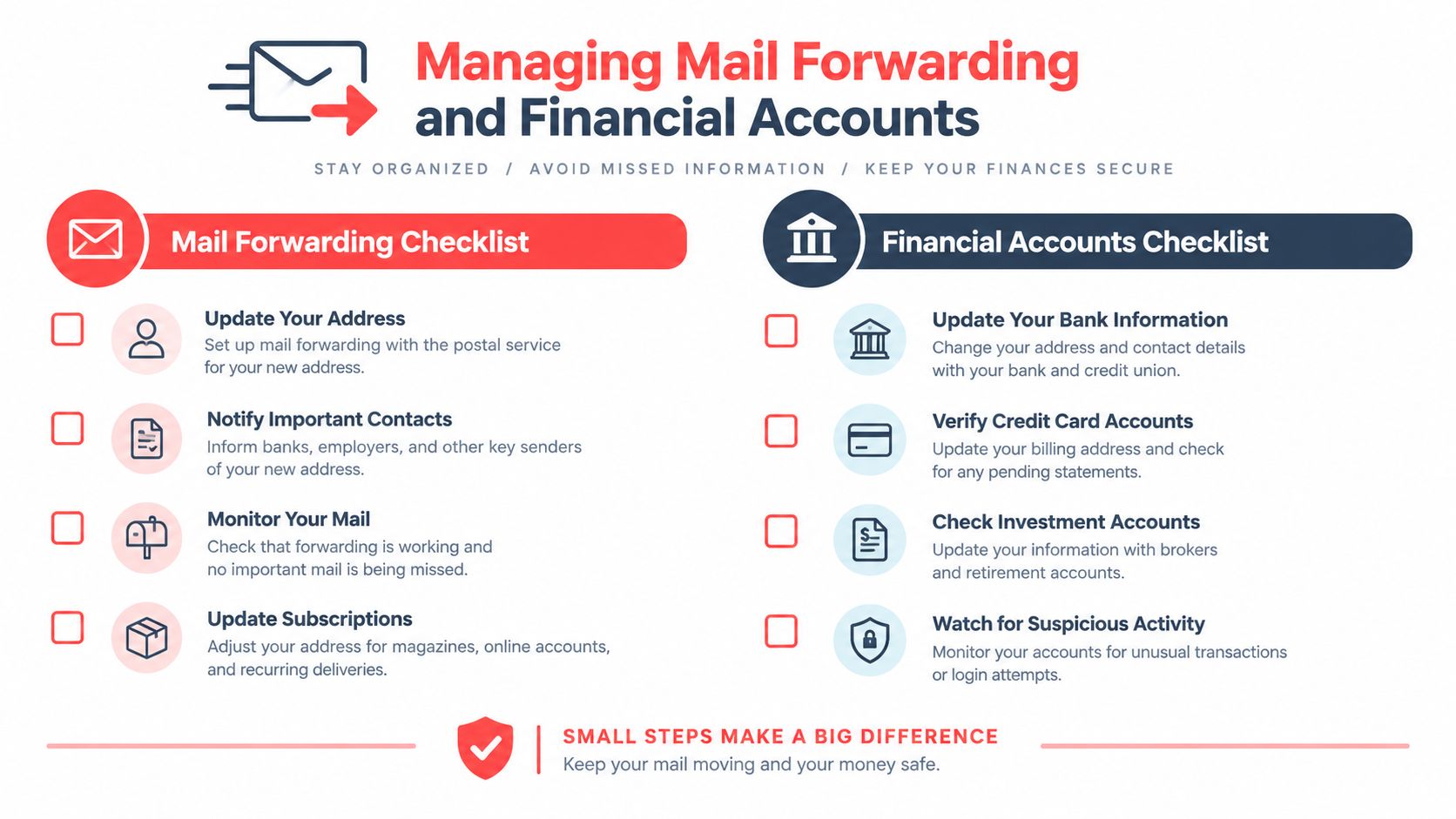
Submit the USPS request before moving so forwarding begins on the date you select. USPS says mail forwarding lasts 12 months and can be extended for 6, 12, or 18 additional months; online identity verification carries a $1.25 fee, as described in the USPS forwarding information. USPS also says you can complete a change of address online or at one of more than 33,000 Post Office locations, according to its change-of-address basics.
Forwarding is a safety net, not a substitute for updating accounts directly. It can delay delivery, fail to catch every communication, or leave an organization with an outdated address in its own records. Use the USPS confirmation as a tracking reference, but don't assume it proves every bank, insurer, employer, or government account has changed.
Update accounts in an order that reduces friction
Begin with institutions that can block access or create compliance problems if the address doesn't match:
- Banks and credit cards: Change the residential and mailing address, then review fraud-alert settings and statement delivery.
- Investment and loan accounts: Update brokerage, retirement, mortgage, student-loan, and other servicing records separately.
- Insurance providers: Confirm the effective date for auto, renters, homeowners, health, life, and specialty coverage.
- Employer and payroll: Update personnel records, tax withholding information, benefits, and remote-work documentation.
- Recurring services: Change subscriptions, prescriptions, deliveries, memberships, and professional associations.
Financial institutions may request proof of the new address under their identity-verification procedures. Keep a lease, closing statement, utility confirmation, or government document accessible, and ask the institution which documents it accepts before submitting an update. Don't upload sensitive records through an unsolicited email link. Use the institution's authenticated website or a verified phone number.
Scan important records into secure storage, but keep originals in your personal travel bag. Birth certificates, Social Security cards, passports, titles, registrations, insurance cards, medical information, school records, and pet documents shouldn't travel inside an inaccessible moving-truck box.
Building a Realistic Pre-Move Timeline
A reliable timeline assigns every task a deadline and an owner. The household doesn't need to complete everything at once. It needs to prevent fixed-date tasks, especially lease notices, utility appointments, vehicle documents, and voter registration, from being buried under packing.
Eight weeks before departure
Research the destination at city and neighborhood level. Compare the property against commute, schools, safety, taxes, work-from-home needs, hazards, and lifestyle rules. Obtain mover estimates, verify interstate authority, review insurance, and decide what to sell or leave behind.
Notify your employer, schools, healthcare providers, and licensing boards early. Request records that may take time to process, and create a document folder that stays with you.
Four to six weeks before departure
Give lease notice according to the contract, not according to a generic calendar. Contact electricity, gas, water, waste, internet, security, and other providers. Confirm whether the new address is eligible for the service you need and whether installation requires an appointment.
Submit USPS forwarding, then update banks, insurers, investment accounts, payroll, and recurring services directly. Begin packing non-essentials, photograph valuable items, and retain receipts and confirmation numbers.
Two weeks before departure
Confirm the mover's pickup window, inventory process, payment method, contact information, access requirements, and insurance terms. Confirm new-home keys, parking, elevator reservations, cleaning, and utility activation. If driving, service the vehicle, confirm the route, and keep documents and medication with you.
Final seven days
Finish packing except for daily essentials. Prepare a travel bag and first-night kit with documents, chargers, medicines, toiletries, basic clothing, food, and cleaning supplies. Complete the old-home walkthrough, record its condition, collect keys or access devices, and make sure the new-home provider confirmations are in your phone and offline folder.
The best timeline is not the longest checklist. It's the one that separates tasks you can reschedule from tasks that depend on an agency, landlord, utility provider, election office, or moving crew.
Frequently Asked Questions
What should I do if my financed car is titled in another state?
Contact the lienholder before visiting the new DMV because the lender may need to release the title or send title documentation directly. Ask whether the new state requires an electronic title transfer, a power of attorney, an odometer statement, a local inspection, or proof that the lien remains recorded. Update the auto insurer before registration so the policy reflects the vehicle's garaging address, not merely the mailing address.
Can I keep my current health insurance after moving across state lines?
You may be able to keep the policy, but you can't assume your existing provider network will remain available in the new state. Ask the insurer whether the move creates a special enrollment opportunity, whether your plan has in-network providers at the destination, and how prescriptions and emergency care are handled across the service area. Obtain written confirmation before canceling the old plan, especially if ongoing treatment depends on a particular specialist.
How should remote employees document an interstate move?
Remote employees should obtain written confirmation from their employer covering the work location, payroll withholding, expected hours, equipment, and any state-specific registration or compliance process. A home address can affect employer obligations even when the employee never visits an office. Keep the effective date of the work-location change aligned with payroll records and retain copies of approvals, tax forms, and benefits communications.
What happens to stock options when I move during a vesting period?
Moving during a vesting period can create multi-state tax complexity because taxation may depend on where services were performed during the earning period, not only where you live when shares vest. Request the equity-plan statement, vesting schedule, grant agreement, and employer's state-tax analysis before moving. Ask a tax professional to review grants that span the move, particularly if you exercise options after changing residence or continue working for the same employer.
Should I rent before buying in an unfamiliar city?
Renting first can reduce the risk of committing to a neighborhood whose weekday conditions differ from its visitor appeal. Before signing, confirm lease termination terms, renewal rules, utility responsibility, parking, pet restrictions, internet availability, school boundaries, and insurance requirements. Use the rental period to test commute patterns, services, noise, weather exposure, and the actual cost of living rather than relying only on listing photos or a short visit.
What should I do when the new address is not finalized?
Use a legitimate temporary mailing solution, such as an approved Post Office arrangement or a trusted recipient, and update the address again once the permanent residence is secured. Don't use an uncertain address for vehicle registration, voter registration, insurance, or tax residency records. Maintain a dated record of where you lived and when each address became effective.
Before you book the truck, use ReloMaps to compare city and neighborhood conditions, including affordability, safety, commute, hazards, and lifestyle factors that listing sites often leave out. Validate the exact property or shortlist before signing, then carry those findings into your utility, residency, and financial planning.
Enjoying the blog? Subscribe to ReloMaps+ for premium area intelligence — and to keep us independent.
Subscribe today