Vibes Brunswick Maine: What Living Here Actually Feels Like

It's easy to fall for Brunswick, Maine, on a sunny visit, then wonder whether the walkable downtown and coastal calm hold up once you're handling a winter commute, shopping for a home, or trying to make rent work. The vibes in Brunswick are a blend of college-town culture, a compact walkable center, and a more car-dependent outer town, with housing costs and property-level flood risk that deserve a close look. It's a strong fit for people who can afford the housing and choose their neighborhood carefully, not an automatic bargain for every household drawn to the scenery.
Table of Contents
- What the Vibes in Brunswick Maine Actually Feel Like
- The Institutional Anchors That Shape Brunswick's Character
- Walkability, Commutes, and How Brunswick Actually Moves
- Dining, Arts, and the College Calendar That Runs the Town
- Who Brunswick Actually Fits, in Demographic Terms
- Housing Math, Property Taxes, and the Full Cost of Relocating
- Infrastructure, Construction, and the Hazards Underneath the Charm
- Who Thrives Here, Who Should Look Twice, and How to Verify Before You Move
What the Vibes in Brunswick Maine Actually Feel Like
On a Tuesday morning, the difference between Brunswick's postcard image and its day-to-day life is already visible. Near Maine Street and Bowdoin College, you can walk for coffee, errands, or a campus visit; farther out, getting to work or the grocery store is more likely to mean a car. That mix of college-town energy, walkable blocks, and coastal calm is the town's real character.
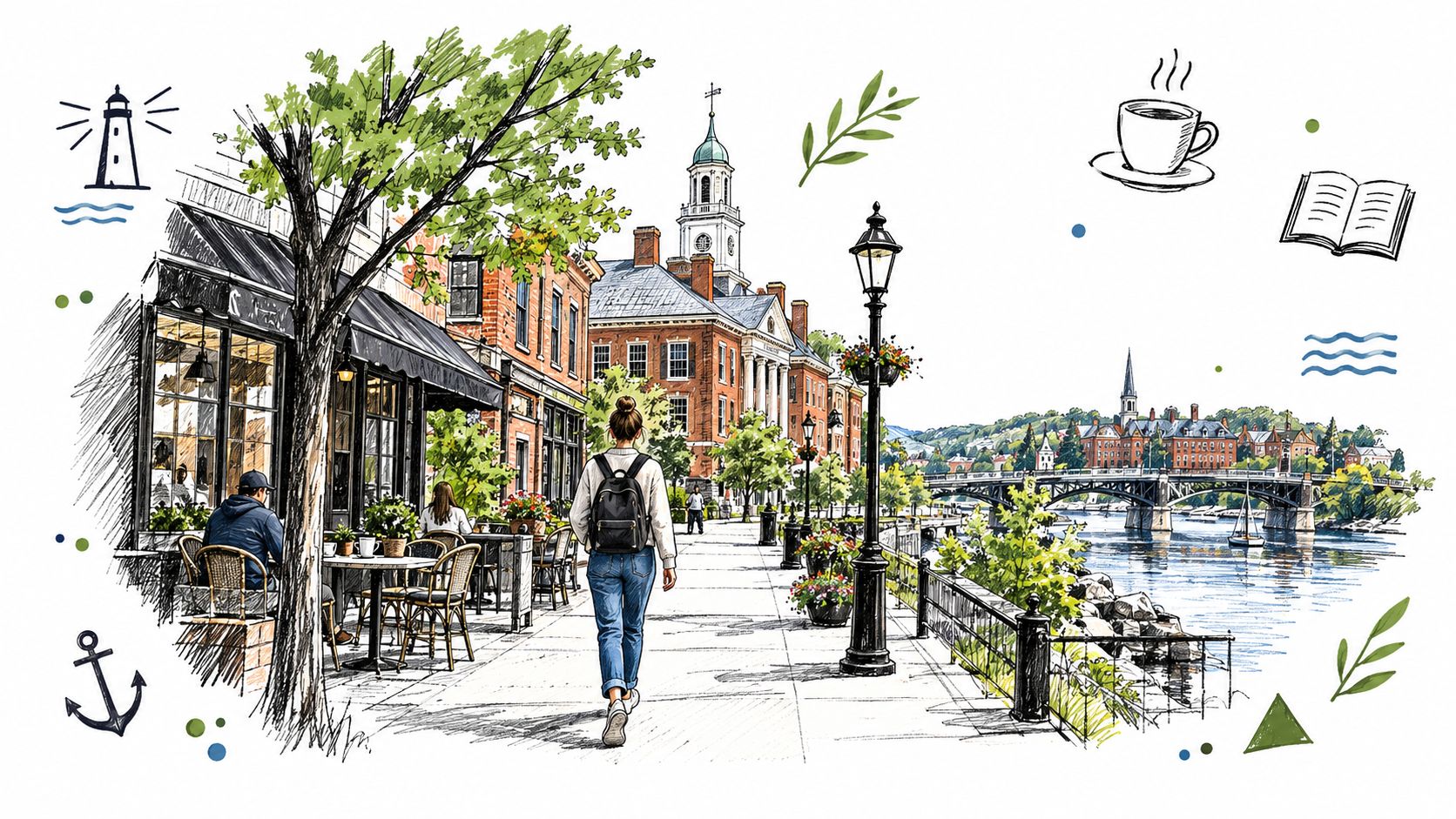
On a Thursday evening, downtown feels social without needing to become a big-city night out. The Bowdoin campus gives the center a cultural pulse, while the Androscoggin River and the former Naval Air Station grounds add a broader sense of place beyond the shops and restaurants. Route 1, by contrast, is the reminder that Brunswick is also a working regional hub, where errands and commutes don't all happen on foot.
Saturday brings a different tempo. The market and downtown draw people out, but the town doesn't feel like a resort built around visitors. The seasons matter: summer gives the midcoast a livelier feel, while winter and the shoulder seasons expose the quieter routines and the practical limits of a small town.
A good ordinary Wednesday here might mean walking from a downtown block to campus, then driving to a job or appointment elsewhere. Brunswick feels walkable by neighborhood, not universally walkable as a whole. If you want a tidy coastal town with cultural activity and a grounded, everyday rhythm, it delivers. If you expect beach-town ease or dense urban convenience, you'll need to recalibrate.
The Institutional Anchors That Shape Brunswick's Character
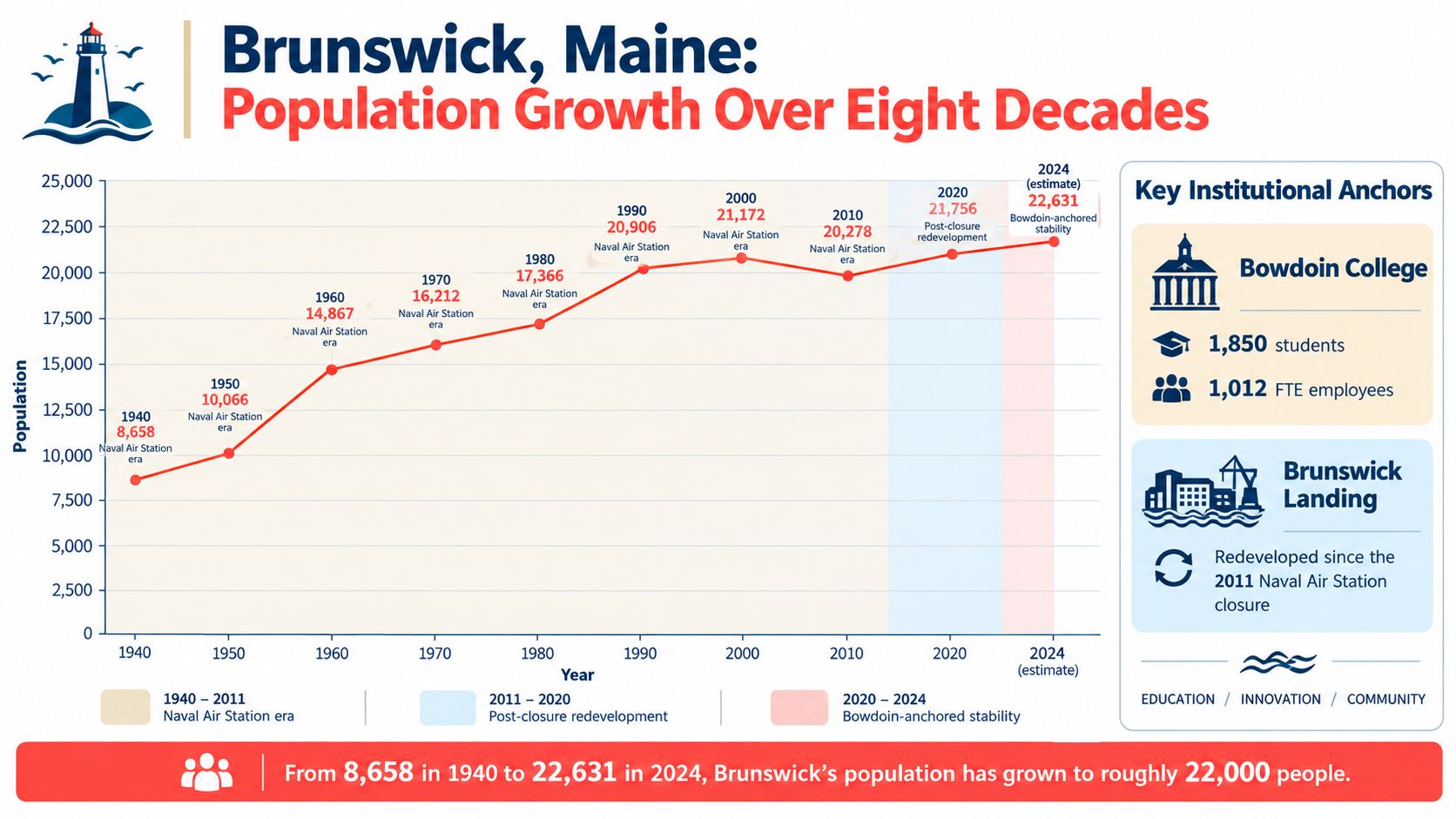
Brunswick's cultural density makes more sense once you look at the institutions behind it. Bowdoin College, chartered in 1794, enrolled approximately 1,850 students in fall 2023 and employed about 1,012 full-time-equivalent workers, including 211 faculty members, according to Bowdoin's campus and facilities information. For a town of Brunswick's size, that's a substantial source of employment, activity, and ongoing educational investment.
The other defining institution was military. Brunswick Naval Air Station helped drive population growth after World War II, supported the regional service economy, and eventually employed more than 5,000 military personnel. Its closure in 2011 delivered a local economic shock, but the former base didn't remain frozen in time. Part of the site became Brunswick Landing, and Bowdoin acquired 130 acres of the former station for civilian and educational use.
The population story reflects both that history and later redevelopment. Brunswick grew from 8,658 residents in 1940 to 20,906 in 1990, then stood at 21,756 in the 2020 Census. The Census Bureau's 2024 estimate was 22,631. Those figures describe a community shaped by military investment, higher education, and its place in the broader Portland-area market, not just by coastal appeal (U.S. Census Bureau QuickFacts for Brunswick).
That institutional foundation helps explain why a modest-sized town can sustain lectures, exhibitions, civic events, and a varied local economy. It also makes Brunswick worth considering alongside other places in Maine, rather than comparing it only with nearby beach destinations. Bowdoin and Brunswick Landing aren't decorative details. They've helped create the work, cultural life, and redevelopment story that residents experience every day.
Walkability, Commutes, and How Brunswick Actually Moves
Brunswick's downtown is walkable, but the commuting picture is still car-oriented. In the town's summary of 2022 American Community Survey five-year estimates, 61.7% of residents drove alone to work, 8.3% carpooled, 16.6% worked from home, 10.6% walked, and 0.9% bicycled (Brunswick's economy inventory).
Those figures aren't contradictory. People living close to Maine Street, Bowdoin, and nearby services may have a realistic walking routine, while households on suburban or rural edges can depend on a car for daily errands and work. Remote work further changes the equation: a person who works from home most days may care more about local services and broadband than peak-hour access, while a daily commuter should test the actual route, not rely on a map's straight-line distance.
Route 1 access matters, but so do pedestrian connections and winter maintenance. A home may look close to downtown and still feel inconvenient if the walk involves an uncomfortable crossing or a route that's hard to use in poor weather. The town-wide walking share doesn't tell you whether a specific block has sidewalks, safe crossings, or a practical path to everyday destinations.
Practical rule: Choose the block first, then verify the commute and errands from that address.
For a remote or hybrid household, run the test on a weekday: walk to the places you'd use, drive the commute at its real departure time, and check whether the route still works when the weather turns. Brunswick's walkability is a local advantage, but it's not a substitute for checking the location.
Dining, Arts, and the College Calendar That Runs the Town
Before you book dinner around a Bowdoin event, check when it ends and whether the restaurant will still be serving. That pairing matters more to your evening than a long list of local amenities. A lecture, exhibition, or performance becomes a useful part of life here only when its schedule fits yours.
Use the college calendar to identify events you would attend. Check admission requirements, public access, and start times rather than assuming every campus listing is an option for residents. Then compare those listings with local arts calendars. Keep separate lists for an ordinary weeknight and a planned weekend outing. That shows whether Brunswick supports your habits or offers an appealing occasional visit.
Visit twice if you can: once during a campus event weekend and once in February.
On each visit, try the same kind of evening. Check restaurant hours, whether reservations are needed, and what remains available after the event. Ask restaurant staff about reduced hours during slower months. For galleries, confirm opening days before building an afternoon around them. These checks turn the town's cultural reputation into a schedule you can use.
Brunswick suits people whose regular night out means dinner, a performance, a lecture, or a relaxed drink. If you want a broad late-night circuit and plenty of spontaneous choices, compare your actual evening plans with those available in Portland, Maine. Make that comparison around the hours you go out, not just the number of venues.
Before choosing Brunswick, put a realistic month of dinners and events on a calendar. Include the ordinary evenings when nothing special is scheduled. Choose it if that routine feels satisfying without frequent trips elsewhere.
Who Brunswick Actually Fits, in Demographic Terms
Judge Brunswick by whether your household can find a foothold, not by how appealing it feels on a visit. During 2019–2023, 73.8% of occupied housing units were owner-occupied, and 85.8% of residents lived in the same house one year earlier, according to Census QuickFacts for Brunswick. Those figures suggest a settled population. They don't establish that newcomers can find suitable housing.
Start with your income, household size, and whether you intend to rent or buy.
A renter seeking a modest-priced apartment faces different choices from a buyer seeking a detached home. Income-restricted housing adds another filter: your household must qualify, and an appropriate unit must be available. Check both before counting a development as an option.
Nearby Fairview Commons in Topsham illustrates that distinction. In 2025, applications opened for 38 income-restricted apartments, with two-bedroom rents of $1,314–$1,376, three-bedroom rents of $1,518–$1,939, and an eligibility cap of $58,380 for a four-person household (Portland Press Herald coverage of Fairview Commons). That supply serves eligible households; being priced out of market housing alone does not establish eligibility.
For buyers, Wilbur's Woods offered income-limited homeownership opportunities alongside a planned income-restricted rental building. Treat those as targeted options. Their existence does not establish affordability across ordinary listings.
The uncomfortable distinction: A town can look accessible on paper while available units don't match your income, household size, or preferred tenure.
Brunswick deserves a closer look from remote workers, Bowdoin-affiliated households, and retirees whose budgets support living here. Moderate-income workers and larger families should put inventory and eligibility ahead of the town's cultural appeal. Choose it when the housing fits your household, not when the atmosphere does.
Housing Math, Property Taxes, and the Full Cost of Relocating
A home's asking price is only one part of the budget. Brunswick's median owner-occupied home value was $343,600 during 2019–2023. Median monthly owner costs were $1,854 for homeowners with a mortgage and $886 for those without one; median gross rent was $1,341 (Census QuickFacts for Brunswick). These figures measure different costs. Use them as town-wide reference points, not forecasts for your household.
If you're buying, budget for property taxes, insurance, utilities, maintenance, and financing costs beyond the Census median. Check the property's assessment before making an offer. Brunswick calculates municipal tax by multiplying taxable assessed value by the applicable rate, and the owner of record on April 1 is responsible for the tax (town property-tax information).
For fiscal year 2025–2026, the town listed a rate of $13.22 per $1,000 of taxable valuation. At that rate, a $343,600 assessment would mean approximately $4,541 in annual municipal property tax, before exemptions, abatements, or assessment changes. An assessment may differ from the purchase price, so confirm the parcel's current valuation and the rate for the relevant fiscal year.

Renters should compare available units with their income and household size. The town-wide median gross rent does not show what a suitable apartment costs today. Nearby income-restricted apartments have eligibility rules and unit-specific rents, while reported market rents in the wider area were approximately $2,500–$2,600 for a two-bedroom and $3,000 for a three-bedroom. A 2022 study found 80% of Brunswick households could not afford the median home price, a clear warning that the town's appeal does not guarantee an affordable purchase.
Before relocating, verify the assessment, tax rate, exemptions, insurance, and likely utility and maintenance costs. Renters should check actual listings and eligibility rather than relying on area-wide averages. Brunswick can fit your budget, but only after you price the specific home or unit.
Infrastructure, Construction, and the Hazards Underneath the Charm
Coastal character doesn't make every address equally resilient or convenient. Brunswick's infrastructure planning includes projects that could improve connections and drainage, but also construction periods that may affect traffic, noise, and access. Buyers should check both what exists now and what's planned near the property they're considering.
MaineDOT's 2026–2028 work plan lists $311,000 in 2026 and $328,000 in 2027 for runway and taxiway new construction at Brunswick Executive Airport, with design and permitting for reconstruction of Runway 1R–19L planned for 2028 (MaineDOT's Brunswick work plan). Separately, town planning materials describe a proposed approximately $32.5 million RAISE application for work that includes Mill Street and U.S. Route 1 pavement, drainage, and sidewalk upgrades, an intersection realignment, Riverwalk connectivity, and a possible two-way Pleasant Street conversion.
Those projects could improve access and stormwater handling over time. During construction, however, the same corridors may bring detours, dust, noise, and temporary access constraints. For a specific address, ask which phase is funded or proposed, whether construction is likely to affect your route, and how close the property sits to airport influence areas.
The hazard question is just as local. A federal watchdog review identified Brunswick Landing as vulnerable to sea-level rise, storm surge, and inland flooding from heavy rainfall, and raised concern that cleanup plans didn't fully account for worsening flood and storm exposure. A proposed 48-unit affordable project at 41 River Road also falls within shoreland-protection and flood-protection overlays. Housing opportunity and exposure can sit side by side.
If you're weighing a waterfront or near-water property, waterfront house plans can help you think through how a home's design responds to its setting, but design doesn't replace parcel-level due diligence. Check flood pathways, stormwater, contamination information, evacuation access, and likely municipal costs before you treat a coastal location as an uncomplicated benefit.
Who Thrives Here, Who Should Look Twice, and How to Verify Before You Move
Brunswick suits households that can enjoy its walkable center and local institutions without relying on the town to solve every logistical or financial problem. Remote workers can make good use of the downtown routine. Bowdoin-affiliated households already have a connection to one of the town's anchors. Midcareer couples may like the cultural life and quieter pace, while retirees with room in their budget may appreciate the settled feel.
The fit gets harder for some residents. Moderate-income service workers may find that available housing doesn't match their eligibility or budget. Larger families may need more space than the affordable inventory offers. Anyone considering a river-adjacent property should assess how its location fits their daily needs and the town's changing conditions before committing.
The income-restricted supply and eligibility caps described earlier still define who the town's housing serves. A low asking price compared with another market does not settle the question. Check whether your household qualifies, whether the unit size works, and whether the location supports your routine.
Before making an offer, check the address, not just the town's reputation:
- Pull the parcel assessment: Compare the current assessed value with the asking price, then confirm the applicable tax rate with the town.
- Book two weekday visits: Go once during the school-year peak and once in the winter shoulder season. Compare what is open, how the streets feel, and which trips remain practical.
- Walk the target block: Check sidewalks, crossings, nearby errands, and the feel of the area on a weekday evening.
- Confirm housing eligibility: Match the program's income limit to your household size, and verify current availability rather than assuming an advertised unit is open.
- Review planned work: Ask whether nearby airport or roadway projects are proposed, funded, or under construction, and what that means for access to the property.
For a wider regional comparison, use New England's best small towns as a starting point. Then compare specific neighborhoods and housing options. Brunswick's appeal is real, but the fit depends on the household, the budget, and the block. Don't buy the town-wide vibe. Test the address where you would live.
Frequently Asked Questions
What income qualifies a four-person household for nearby income-restricted apartments?
Eligibility depends on the specific property and program. Check directly with the property for the current income limits, unit availability, and application status.
Is Brunswick Landing outside flood risk because it has been redeveloped?
Redevelopment doesn't remove the location's flood exposure. A federal watchdog review flagged Brunswick Landing for sea-level rise, storm surge, and inland flooding from heavy rainfall. Check environmental and cleanup records for the specific property before buying nearby.
When should I check for airport construction impacts?
Check the planned timeline before choosing a property near Brunswick Executive Airport. MaineDOT's work plan lists runway and taxiway construction in 2026 and 2027, with design and permitting for Runway 1R–19L reconstruction planned for 2028. Verify project status and the affected area with the relevant agencies before you move.
Will Brunswick's property tax be calculated from my purchase price?
No. The town calculates the bill using taxable assessed value and the applicable rate. Confirm the parcel's assessment, any exemptions or abatements, and the current fiscal-year rate instead of applying the rate directly to your offer price.
How can I tell whether working from home has changed my commute needs?
Compare your actual office days with the walking, transit, and driving options from the exact address you're considering. If you work from home one day in a typical ten-day stretch, plan as a regular commuter rather than a remote worker.
ReloMaps helps you compare towns and neighborhoods using location, cost, commute, housing, and hazard context instead of listings alone. If Brunswick is on your shortlist, explore ReloMaps to compare it with other places that fit your budget and priorities.
Enjoying the blog? Subscribe to ReloMaps+ for premium area intelligence — and to keep us independent.
Subscribe today