Swillburg Rochester NY: Complete Neighborhood Profile
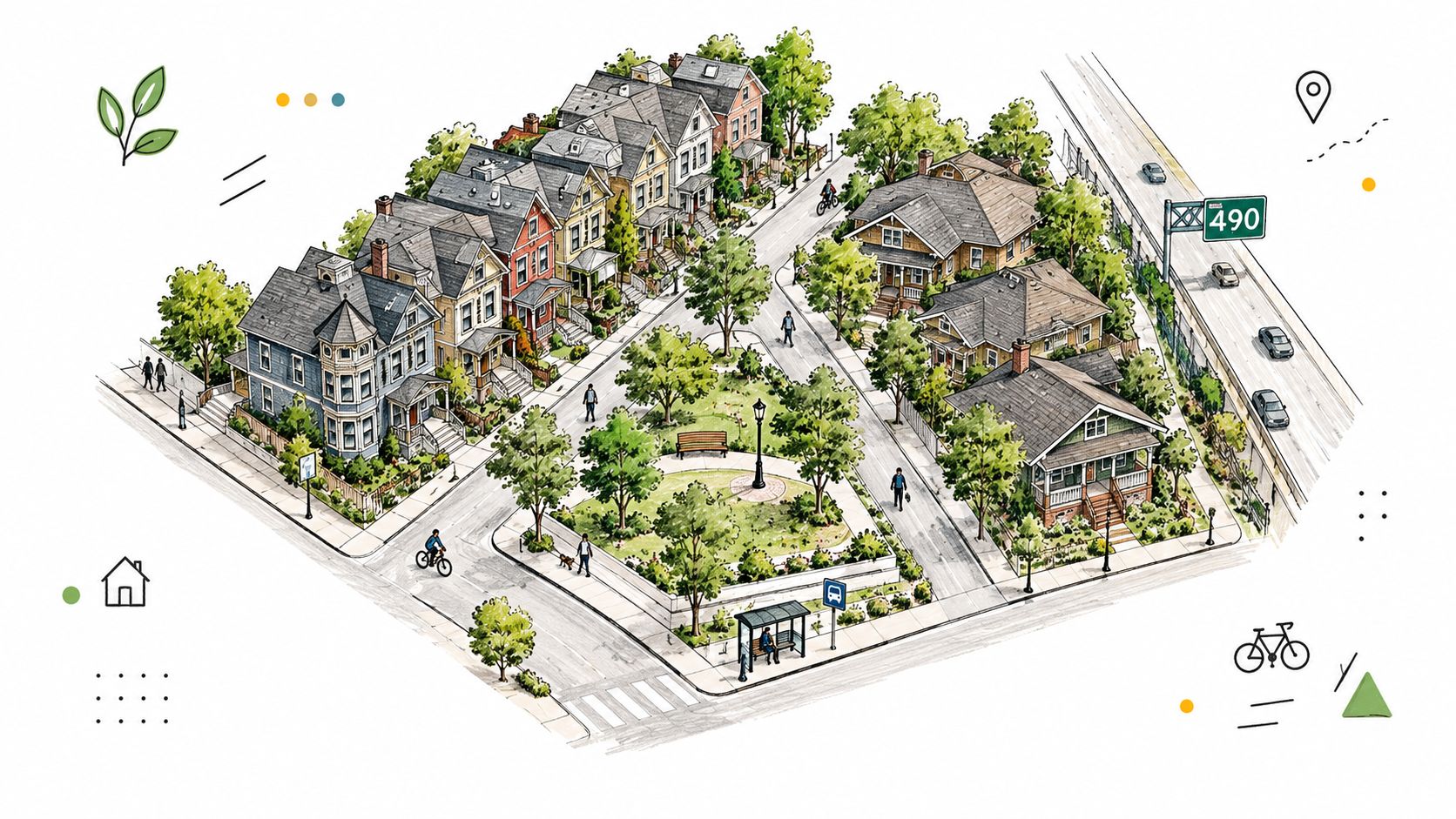
Swillburg has approximately 1,818 residents, a density of 11,596 people per square mile, a median home value of $178,697, and median rent of $1,427. Those figures make Swillburg one of Rochester's most historic and densely populated neighborhoods, but they don't fully answer whether its “urban village” identity works for everyday relocation.
The practical question is less about charm than tradeoffs. Swillburg is a small, triangular community with older housing, narrow streets, restaurants, shops, parks, and proximity to major corridors and I-490. That combination can support a compact urban lifestyle, yet it can also create parking, maintenance, school-access, and commuting constraints that broad neighborhood profiles often leave unexplained.
Table of Contents
- Swillburg Overview and Location
- Historical Development and Naming Origins
- Demographics and Household Economics
- Housing Stock and Architectural Character
- Community Activism and Preservation History
- Walkability and Practical Relocation Considerations
- Frequently Asked Questions
- Is Swillburg Rochester NY suitable for renters on a fixed monthly budget?
- Should buyers assume an older Swillburg home will need immediate renovation?
- Does Swillburg's density prove that residents can live without a car?
- Is Swillburg older than Rochester overall?
- What should hybrid workers verify before choosing Swillburg?
Swillburg Overview and Location
Swillburg's about 20-block footprint is compact, but its relocation implications are practical rather than merely visual. The triangular central Rochester neighborhood supports the “urban village” label through concentrated streets and nearby services. That scale can reduce trip distances, while older blocks may limit off-street parking and leave households dependent on careful vehicle or transit planning. Its historical overview documents the neighborhood's boundaries and development context.
Available estimates place Swillburg at 1,818 residents and 11,596 people per square mile, versus 5,917 people per square mile for Rochester overall, according to Swillburg demographic estimates. For relocation decisions, that density points to closely spaced housing and greater competition for curb space, not a lively neighborhood atmosphere.
The age profile also differs from the city average. Swillburg's median age is 38.5, compared with 32.4 for Rochester, using the same source. This indicates a somewhat older population profile, but it cannot establish household composition, school needs, or block-level noise conditions.
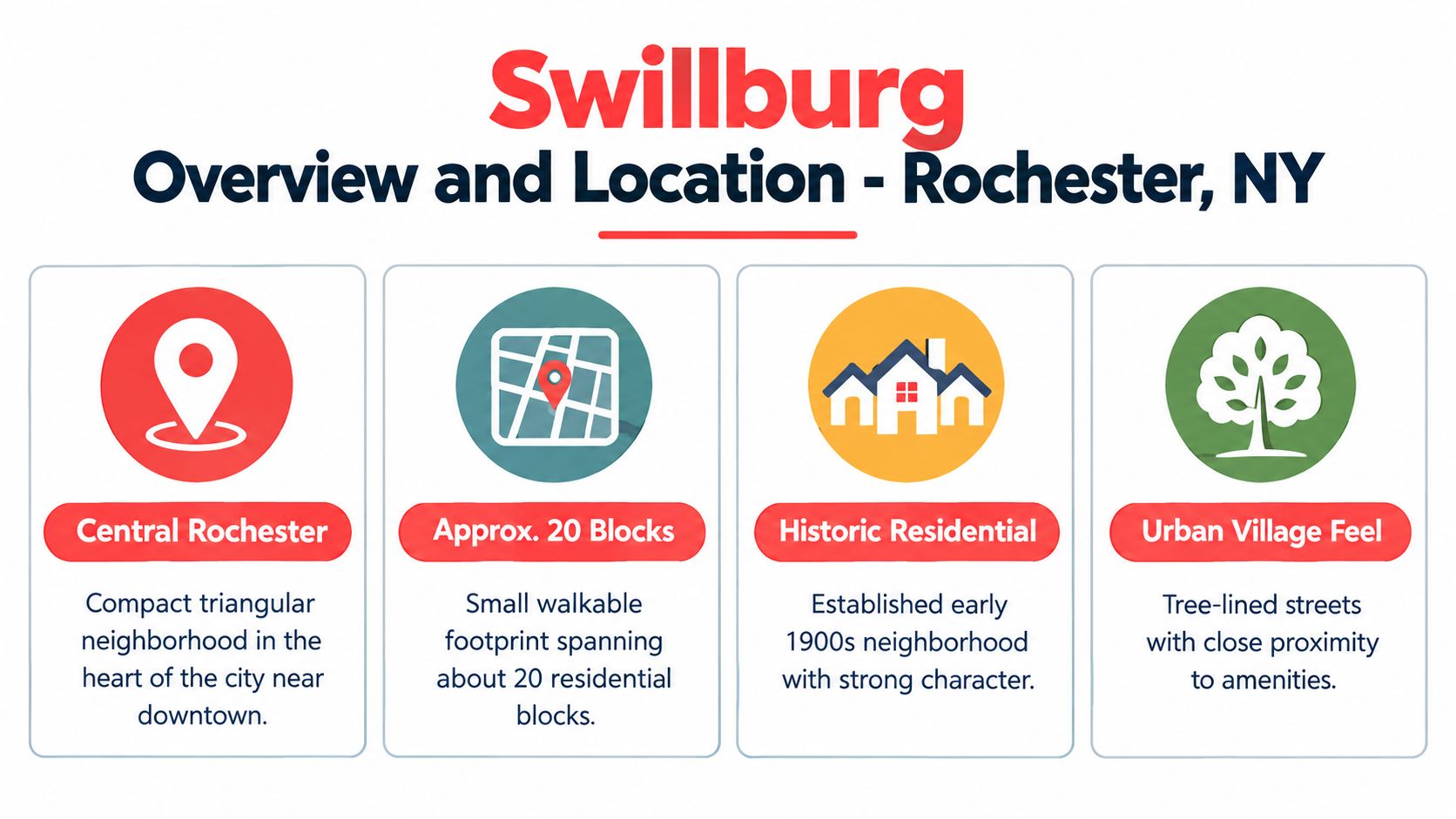
| Relocation factor | What the available evidence indicates |
|---|---|
| Scale | A compact neighborhood of about 20 blocks |
| Density | 11,596 people per square mile |
| Population | Approximately 1,818 residents |
| Age profile | Median age of 38.5, older than Rochester's 32.4 |
Location creates a second tradeoff. Swillburg sits near busy corridors and I-490, which may shorten regional journeys while bringing traffic, noise, and more complicated crossings. Relocators comparing New York location data should evaluate the area as a dense central neighborhood, including parking and road exposure, rather than assume that “urban village” means low-friction daily living.
Historical Development and Naming Origins
Swillburg's current street pattern reflects a transition from working farmland to compact residential development. In the 19th century, the area supported livestock and agriculture before Rochester's expansion converted former fields into housing after the Erie Canal era. For buyers, that sequence has a practical implication: older land divisions can help explain compact parcels, closely spaced homes, and limited street widths that may constrain parking, additions, or vehicle access.
The name is linked to George Goebel's pig farm near Henrietta Street and South Goodman Avenue. According to the neighborhood's historical account, Goebel fed pigs “swill” associated with the old Erie Canal. The term became attached to the surrounding community. It sounds informal, but it records a specific agricultural use rather than a recent branding concept.
Swillburg therefore developed through successive land uses, not one unified modern plan. Agriculture came first, followed by industrial-era growth and immigration that shaped the housing pattern. Later, residents defended parts of the existing urban fabric against highway expansion. That history helps distinguish the neighborhood's “urban village” description from the physical constraints a relocator must inspect on individual blocks.
Street names as historical evidence
Karges Place preserves another reference to the area's farming period. The narrow street commemorates the Karges farm, showing how the present residential district replaced an earlier agricultural setting without fully removing its markers. A buyer comparing properties should treat these references as clues to inherited street and parcel geometry, not as evidence of uniform architectural conditions.
The Erie Canal connection places Swillburg within Rochester's wider growth pattern. Canal-era development helped convert peripheral farmland into city neighborhoods, while Swillburg retained a name tied to that change. Its present identity rests on land-use continuity: the name, street layout, and surviving references connect current residences to the agricultural setting that preceded them.
Demographics and Household Economics
Swillburg's relocation profile depends on how income, housing costs, and source definitions align. One neighborhood profile reports median household income of $59,525 and approximately 11,956 households. Separate estimates place median home value at $178,697 and median rent at $1,427, according to Swillburg demographic and housing data.
The household figure needs careful handling. It appears unusually high beside the reported resident estimate of approximately 1,818, so combining both figures to calculate household size would create false precision. The defensible use is narrower: treat the income figure as a comparison point, then confirm population and household definitions before making neighborhood-level affordability judgments.
| Measure | Reported figure | Relocation meaning |
|---|---|---|
| Median household income | $59,525 | Use as a baseline for affordability comparisons |
| Median home value | $178,697 | Compare with current listings and property condition |
| Median rent | $1,427 | Verify against current listing, parking and utility inclusions before budgeting |
| Median age | 38.5 | Indicates a more mature profile than Rochester overall |
Why rent estimates diverge
The available housing guide reports an average rent closer to $2,325, while the demographic source reports median rent of $1,427, as described in the Swillburg neighborhood housing guide. The measures describe different points in the same distribution. A median identifies the midpoint, while an average can rise when larger, renovated, or otherwise higher-priced units enter the sample.
Renters should therefore test both figures against the specific property. A median-based budget can fall short for a renovated apartment, while an average-based budget can overstate the cost of a modest unit. Check the current asking rent, lease terms, parking, utilities, and renovation level before treating either measure as a monthly forecast.
The “urban village” label also leaves out ownership costs. Lower-priced older housing may still require maintenance, and rental prices can change sharply with building condition and unit type. These figures support comparison between listings and household income. They do not guarantee that every Swillburg address fits the same budget.
Housing Stock and Architectural Character
Swillburg's strongest physical differentiator is its age. 77.5% of residential real estate was built no later than 1939, placing the neighborhood among the most historic housing concentrations in the United States, according to Swillburg housing data.
That statistic changes the relocation analysis. Buyers aren't choosing an older appearance. They're choosing a building environment in which construction details, prior renovations, drainage, insulation, electrical systems, masonry condition, and exterior maintenance can vary substantially from property to property.
What the architecture reveals
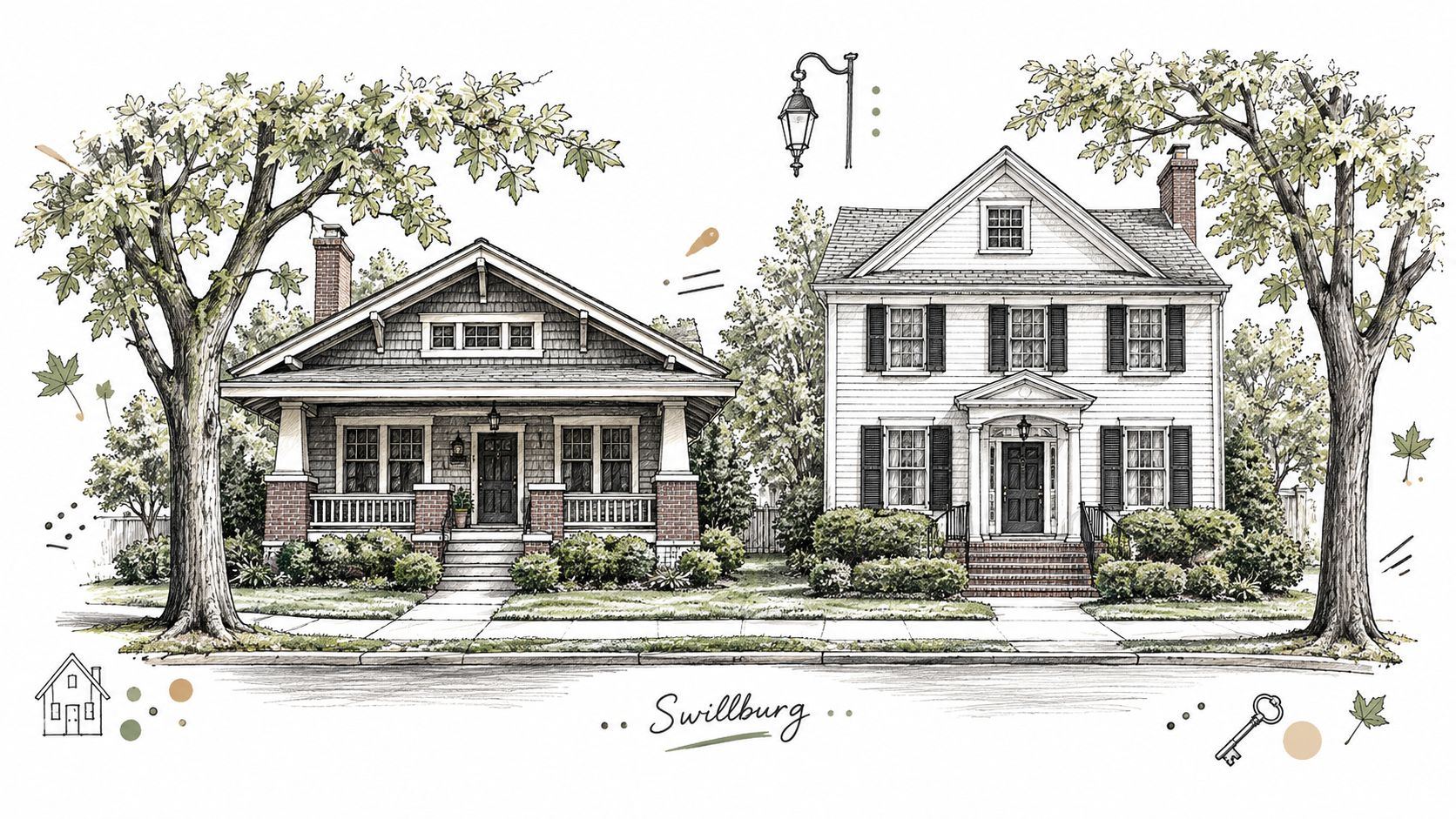
The neighborhood's built environment includes late-Victorian homes, Craftsman forms, double-shotgun houses, and American foursquares, according to the historical account of Swillburg's housing and heritage. This mixture reflects immigration-driven residential growth and the area's proximity to industrial employment.
The forms matter because they produce different ownership experiences. A compact house may use space efficiently but offer less storage. A larger foursquare may provide more interior capacity while presenting more exterior surface, stairs, windows, and roof area to maintain. A wood-frame structure and a masonry building can also respond differently to moisture, weather exposure, and renovation work.
Buyer rule: Treat architectural character as a condition-assessment issue, not only as a visual preference.
For buyers, the inspection should test the relationship between historic fabric and modern use. Review the roof, foundation, drainage, windows, heating equipment, insulation, wiring, plumbing, and any converted spaces. Investors should also examine whether a renovation plan respects the building's configuration rather than assuming that an older property can be remodeled like postwar tract housing.
Maintenance and renovation sensitivity
Older wood-frame and masonry homes generally bring more envelope variability, greater dependence on retrofits, and more renovation sensitivity than newer standardized housing. That doesn't make them poor investments or unsuitable homes. It means the purchase decision requires property-level evidence.
A listing in nearby Buffalo, New York housing data can provide a useful regional comparison, but Swillburg properties still need individual inspections. Neighborhood-level age data identifies the likely risk of variation. It cannot confirm the condition of a particular roof, foundation, or mechanical system.
The main conclusion is straightforward. Swillburg's historic stock creates architectural continuity and potential character, but buyers should preserve a separate budget and inspection process for age-related work. The lower median home value doesn't eliminate that obligation.
Community Activism and Preservation History
Swillburg's present form reflects organized resident intervention. In the 1970s, residents opposed a proposed highway extension that would have cut through the community. Historical accounts indicate that the campaign helped defeat the expressway within the city, preventing the displacement of homes and the division of existing blocks.
Highway construction can remove housing, fragment parcels, weaken pedestrian connections, and redirect public investment toward road infrastructure. Residents challenged those effects before the project became permanent, making activism part of Swillburg's development history rather than a symbolic community story.
Otto Henderberg Square Park
Otto Henderberg Square Park serves as a memorial to the highway fight. Its significance is civic as well as recreational: the park marks a specific preservation outcome and connects a visible public space with resident-led political action.
For relocation analysis, the practical implication is institutional. A neighborhood with a history of organized opposition may subject major transportation or redevelopment proposals to closer local scrutiny. That does not establish a permanent barrier to construction, nor does it guarantee a quiet environment. It does indicate that future projects should be evaluated through public records, zoning documents, and permit activity rather than through the neighborhood's “urban village” branding alone.
Preservation here is best understood as an outcome of political participation, not as an accidental survival of old buildings.
The history also matters to property owners and investors. Opposition to the highway helped preserve a block pattern that can make large-scale redevelopment more difficult, especially where older parcels have separate ownership, narrow frontage, or existing residential improvements. Those conditions can raise the coordination burden for parcel assembly and reduce the feasibility of projects requiring a single, consolidated site.
The result is a development context shaped by both market demand and resident participation. Buyers should treat historic character as evidence of past civic action, not as proof that every building is protected or that change is impossible. Current zoning, ownership records, and project-specific approvals remain the better tests of what can be altered.
Walkability and Practical Relocation Considerations
Swillburg's compact footprint supports the possibility of short local trips, but available neighborhood descriptions don't establish that it functions as a fully car-light district. They mention about 20 blocks, narrow streets, restaurants, shops, and parks, yet they don't provide the practical details a relocating household needs, such as parking availability, school access, transit frequency, or the share of errands that can be completed without driving.
That gap separates marketing language from relocation evidence. “Urban village” describes an atmosphere and physical scale. It doesn't answer whether a household with children, a hybrid worker, multiple vehicles, mobility limitations, or a regional commute can operate comfortably within the neighborhood.
A practical screening method
Evaluate the neighborhood against your actual weekly pattern rather than against its branding:
Map essential destinations. Identify work, school, groceries, healthcare, childcare, and regular social destinations. A restaurant nearby doesn't compensate for a difficult school or grocery trip.
Test the property's parking reality. Ask whether parking is on-site, shared, permitted, leased separately, or dependent on street availability. Narrow streets and older lot patterns can make the difference between convenient ownership and daily friction.
Check the commute at the relevant times. I-490 may improve regional access, but adjacency to a highway also places the home near a busy transportation corridor. Test the actual route rather than assuming that proximity equals a short or predictable commute.
Verify school logistics directly. Neighborhood proximity doesn't establish enrollment eligibility, program availability, transportation, or the time required for drop-off and pickup.
A household that works remotely and keeps errands local may find Swillburg's compact form useful. A household that needs frequent cross-city trips may experience the same layout as constrained, particularly if parking or school transportation adds repeated vehicle movements.
The comparison with Niagara Falls, New York location data is useful only if the household compares the same criteria across both places. Don't compare “village feel” with “regional access” as if they were equivalent measures. Score each location for housing condition, parking, commute, schools, transit, and daily errands.
Swillburg can be a strong fit for buyers who value historic housing, centrality, and a compact neighborhood structure. It's a weaker fit for anyone seeking modern standardized construction, abundant private parking, or an easy assumption that every daily need is walkable. The evidence supports a targeted site visit and property-level due diligence, not a blanket walkability verdict.
ReloMaps helps relocators compare neighborhoods and cities using housing costs, demographics, safety, commute context, quality-of-life indicators, and broader location risks in one framework. Visit ReloMaps to test Swillburg against alternative Rochester-area locations and build a shortlist around your household's actual constraints.
Frequently Asked Questions
Is Swillburg Rochester NY suitable for renters on a fixed monthly budget?
Swillburg can suit budget-conscious renters, but the $1,427 median rent should be treated as a comparison point rather than a guaranteed asking price. Another neighborhood source reports average rent closer to $2,325, so renters should request the full monthly cost for the exact unit, including parking, utilities, deposits, and any fees. The difference between median and average figures is an edge case that can materially affect a fixed-income move.
Should buyers assume an older Swillburg home will need immediate renovation?
Buyers should assume that an older Swillburg home requires detailed inspection, not that every property needs immediate renovation. Because 77.5% of residential real estate was built no later than 1939, condition can vary across roofs, foundations, windows, masonry, insulation, wiring, plumbing, and heating systems. Make the offer contingent on inspections that match the property's construction type and renovation history.
Does Swillburg's density prove that residents can live without a car?
Swillburg's density doesn't prove car-free feasibility. The neighborhood has 11,596 people per square mile, but the available data doesn't establish transit frequency, school access, grocery proximity, parking supply, or the percentage of errands completed on foot. A car-light decision should rely on a household-specific destination map and a parking check at the exact address.
Is Swillburg older than Rochester overall?
Swillburg has an older median age than Rochester overall, 38.5 compared with 32.4. That difference can help relocation analysts identify a more mature demographic profile, but it can't reveal block-level variation, household composition, or the age of individual neighbors. Use it as a screening signal, not as a substitute for an in-person visit.
What should hybrid workers verify before choosing Swillburg?
Hybrid workers should verify commute timing, indoor work space, parking, noise exposure, and internet service at the property. Swillburg's proximity to I-490 can support regional access while also creating a corridor-related tradeoff for homes near busy roads. Older buildings may also have layouts or electrical capacity that require closer review before creating a dedicated office.
Enjoying the blog? Subscribe to ReloMaps+ for premium area intelligence — and to keep us independent.
Subscribe today