10 States with Lowest Cost of Living for Retirees

Mississippi, Arkansas, Oklahoma, Alabama, West Virginia, Kansas, Tennessee, Kentucky, Missouri, and South Carolina are among the states with the lowest cost of living for retirees, thanks to lower housing costs and, in some cases, favorable treatment of Social Security and retirement income. The best fit depends on whether a city's housing, healthcare access, taxes, and insurance costs keep the total budget manageable.
You may be weighing a home that looks affordable online against a move that has to work on a fixed income, year after year. Statewide cost indexes can help narrow the search, but they don't tell you what a specific home will cost to insure or how far you'll travel to see a specialist. The Bureau of Economic Analysis puts Arkansas, Mississippi, Iowa, and Oklahoma among its lowest-price states for broad consumer spending, with 2024 Regional Price Parities of 86.9 to 87.8 against a national benchmark of 100. That offers a useful starting point, not a complete retirement budget. The BEA's state and metro price data cover more than housing, but local home costs can still dominate what a retiree pays.
Housing accounts for 32.9% of older households' average annual expenditures, according to the Bureau of Labor Statistics' analysis of older Americans' spending. Add healthcare, property taxes, utilities, and homeowners insurance, and a cheaper home may no longer be the cheaper place to live. The following shortlist weighs statewide affordability alongside the city-level tradeoffs that can change the math, especially the contrast between inland communities and exposed coastal markets.
For more possibilities beyond these picks, compare this list with ten appealing states for retirees.
Table of Contents
- 1. Mississippi
- 2. Arkansas
- 3. Oklahoma
- 4. Alabama
- 5. West Virginia
- 6. Kansas
- 7. Tennessee
- 8. Kentucky
- 9. Missouri
- 10. South Carolina
- 10 Lowest-Cost States for Retirees: Comparison Table
- Stretch Your Dollars Without Shrinking Your Life
- Frequently Asked Questions
- How much should I budget for insurance before buying in a coastal retirement town?
- How do I check whether a Medicare plan will work in a rural retirement community?
- What property-tax cushion should I leave in my retirement budget?
- Is the cheapest state always the cheapest place to age?
1. Mississippi
Mississippi is one of the strongest starting points for retirees who want a low overall price level and tax treatment that can suit common retirement income sources. The BEA's 2024 Regional Price Parity for the state was 87.0, below the national benchmark of 100. Mississippi also exempts Social Security benefits, pensions, IRA distributions, and 401(k) withdrawals from state income tax, although federal taxes and other state and local costs still matter. The state tax comparison from Kiplinger outlines that treatment.
The choice of city matters. Oxford offers a university setting and a walkable downtown, while Jackson and Madison County put residents closer to larger hospital systems. Ocean Springs and Biloxi bring coastal access, but retirees considering the Gulf Coast should price windstorm coverage and check flood exposure before treating a low purchase price as a bargain.
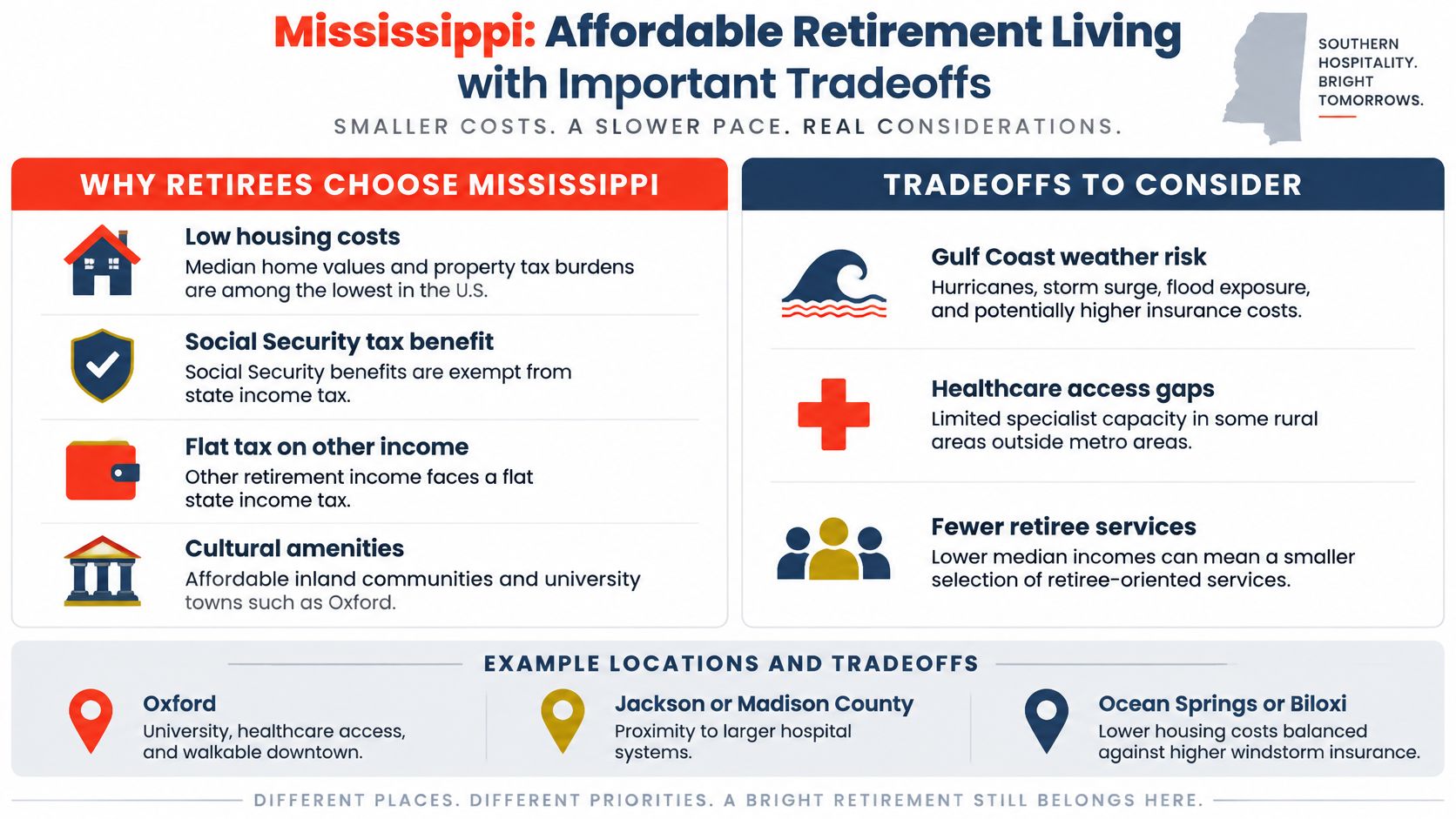
Practical rule: Get insurance quotes for the actual address, not just the town. Coastal premiums and coverage restrictions can change the monthly budget enough to outweigh savings on the home.
Before moving, confirm that nearby hospitals and specialists accept your Medicare coverage, and compare Jackson, Mississippi and Oxford, Mississippi using ReloMaps' guide to retirement locations. For retirees focused on access to care, a more expensive home near a hospital may be a better long-term value than a remote property with a lower asking price.
A closer look at Mississippi's retirement tradeoffs is available in this video.
2. Arkansas
Arkansas pairs a low broad price level with a range of settings, from lake country to university towns. The BEA reported a 2024 Regional Price Parity of 86.9, meaning the state's average price level was about 13.1% below the national benchmark. That can support a retirement budget, but it doesn't make every Arkansas market equally inexpensive.
Hot Springs offers thermal springs, lake recreation, and a long-established retiree community. Eureka Springs may suit someone who values a historic downtown and smaller-town character, while Fayetteville provides university amenities and healthcare access, with costs that can be higher than in many other parts of the state. Northwest Arkansas has grown quickly, so compare actual neighborhoods rather than assuming the statewide figure describes a particular home.

A lake view can be a lifestyle benefit, but it doesn't replace a check on medical access, property upkeep, and local weather exposure.
Ask a tax professional how Arkansas retirement-income exemptions apply to your age and income sources before using them in a budget. Then compare Hot Springs and Fayetteville on ReloMaps, and check the specific property's severe-weather exposure. A town's affordability is only useful if the home, services, and tax treatment work for your household.
3. Oklahoma
Oklahoma ranks near the low end of available cost comparisons, but insurance and healthcare access still deserve a place in the calculation. The MERIC-based 2025 comparison lists Oklahoma's composite cost-of-living index at 86.0, against a national benchmark of 100. The state comparison also places Mississippi, Kansas, and Alabama below the benchmark, though a state composite can conceal differences between its cities.
Tulsa and Oklahoma City offer larger hospital systems and more services than many rural communities. Edmond provides a suburban option near Oklahoma City, while Broken Arrow and Bartlesville may appeal to retirees looking for a smaller-city environment. Whichever market you choose, request a homeowners insurance quote for the exact address before making an offer. Wind and hail coverage, roof condition, and the availability of a storm shelter can affect both the cost and practicality of a home.

Compare Tulsa and Edmond on ReloMaps for a city-level view of affordability and local risk. You can also use its cheapest cities in America comparison to build a shortlist, then verify medical providers and insurance terms independently. The lowest listing price isn't a saving if the property needs a new roof or leaves you far from care.
4. Alabama
Alabama can be an attractive choice for retirees seeking moderate housing costs and a slower pace, but the best-value location may not be the best-known one. Social Security benefits are exempt from state income tax, and the state offers retirement-income exemptions; confirm how the rules apply to your particular income before estimating your after-tax budget.
Fairhope combines a walkable downtown with Mobile Bay access, but waterfront appeal can come with higher housing and insurance costs than inland communities. Huntsville offers healthcare and a strong economy, though growth has pushed up prices in some areas. Dothan and the Wiregrass region are worth comparing for a lower-cost, less urban option.
Look beyond the purchase price: Compare property taxes, homeowners coverage, flood exposure, and the cost of driving to routine care. For Baldwin County properties, request separate quotes for wind and flood coverage and compare them with an inland alternative. Summer heat can also make utility expenses important, particularly in a home that needs substantial cooling.
Huntsville and Dothan illustrate why the state label alone isn't enough. Use ReloMaps to compare their city-level cost and location context, then check whether the hospital and specialist network you'd use is accessible from the neighborhood. A coastal lifestyle may be worth paying more for, but retirees should decide that with a full annual-cost estimate rather than a home-price comparison alone.
5. West Virginia
West Virginia offers mountain scenery and lower home prices than many eastern markets, but rural healthcare access and flood exposure can change the practical value of a move. Social Security is exempt from state income tax, which can help retirees whose budgets depend heavily on that benefit. Still, the cost of reaching hospitals, specialists, and everyday services should be part of the comparison.
Morgantown is a university town with medical care and cultural activities. Charleston concentrates more of the state's hospital and professional services, while Lewisburg may suit someone seeking a smaller historic community and mountain surroundings. These places offer different levels of convenience, so choose based on how often you expect to need care and how far you're comfortable driving.
Check the parcel, not just the town. A home near a river or creek may face a different flood risk from a property on higher ground a short distance away.
Before buying, check the property's flood designation and ask local hospitals whether they accept your Medicare plan. A lower-priced home in a remote mountain area can be a poor fit if regular appointments require long drives or a limited provider network. Compare Morgantown and Charleston on ReloMaps to weigh local costs against services and location risks, then visit in the season when weather and travel conditions are most challenging.
6. Kansas
Kansas offers below-benchmark living costs in the available state comparisons, but retirees should check the tax rules for their specific income and the insurance history of the neighborhood they're considering. The 2025 MERIC-based comparison gives Kansas a composite index of 88.8, below the U.S. benchmark of 100. That statewide measure is useful for screening, but it doesn't replace a local housing and healthcare comparison.
Lawrence brings university events, arts, and walkable areas. Wichita offers a larger service market, while Overland Park has suburban amenities and healthcare options in the Kansas City metro, often at a higher cost than smaller Kansas communities. Manhattan may appeal to retirees who want a university-driven setting without choosing a major metro.
Kansas has changed how it treats Social Security income, so verify the current rule for your household rather than relying on an old relocation checklist. Also ask about hail and wind claims when evaluating a home. Roof condition can matter as much as the listing price when you compare long-term ownership costs.
Compare Lawrence and Wichita on ReloMaps to see how local housing and community context differ. Then get an insurance estimate for the property and confirm your preferred doctors are accessible. A lower state index won't help if the neighborhood's home, coverage, and care arrangements push the monthly budget above what you planned.
7. Tennessee
Tennessee stands out for retirees seeking a state without income tax on wages, investment income, or Social Security benefits. That doesn't mean every location is inexpensive: property and sales taxes still affect household spending, and rapid growth has raised housing costs in parts of Nashville and its suburbs.
Maryville and Sevierville offer access to mountain scenery, while Cookeville combines a smaller-city setting with a university and healthcare services. Knoxville has cultural venues and a university, but it differs from Nashville in housing pressures and day-to-day feel. Compare neighborhoods and home types, not just city reputations.

Model the full tax burden, including property and sales taxes, rather than treating the lack of income tax as the whole answer. If you're buying in a fast-growing area, look at road construction and nearby development that could affect noise, traffic, or the character of the neighborhood. Compare Knoxville and Nashville on ReloMaps, and use its lowest-tax cities comparison as a starting point for further tax research, not as a substitute for household-specific advice.
8. Kentucky
A home near Lexington's hospitals and cultural venues may cost more than a rural property, where specialist appointments can mean longer drives. Kentucky's statewide cost-of-living index was below the national average, according to MERIC's cost-of-living data. Treat that as a starting point: housing, healthcare access, and insurance costs vary by location.
Kentucky uses a flat individual income tax rate. Social Security benefits are exempt from state income tax, while pensions and withdrawals from retirement accounts may be taxable, subject to eligibility rules and exemptions. Check the current rate and the rules for your income sources with the Kentucky Department of Revenue before estimating your after-tax retirement income.
Lexington offers major hospitals, cultural events, and a university setting. Bowling Green provides a smaller-city option with healthcare access, while Lake Cumberland communities attract retirees seeking waterfront recreation. These places differ in services and daily travel. Compare Bowling Green and Lexington on ReloMaps, then check how far your preferred home is from the care you expect to use.
For a river or lake property, review its flood history and confirm which water-related damage the insurance policy covers or excludes. Ask about prior claims, too. Compare the total cost of waterfront and inland homes, including maintenance, insurance, and access to routine and specialist care. A lower asking price may not stay low once travel and coverage costs are included.
9. Missouri
Missouri gives retirees a broad choice of markets, from major metros to university towns and lake communities. MERIC ranked the state sixth for low cost of living in 2025, with a composite index of 88.9, meaning measured costs were about 11.1% below the benchmark of 100. MERIC averages participating city and metro-area indexes, so the result reflects multiple markets rather than one unusually inexpensive town. The Missouri Economic Research and Information Center report is useful for statewide screening, not for predicting your exact housing or healthcare costs.
Springfield offers a regional healthcare hub and university amenities, while Columbia combines a university-town environment with medical access. Lake of the Ozarks communities suit retirees drawn to waterfront recreation, but seasonal activity, property taxes, and storm exposure deserve attention. Social Security benefits are exempt from Missouri state income tax, though that doesn't settle the tax treatment of every other income source.
Check property taxes for the actual county and school district, then ask about storm coverage and shelter options. Compare Springfield and Columbia on ReloMaps to weigh cost and quality-of-life context. The right choice depends on your expected routine: a lake home may fit an active, recreation-focused retirement, while a regional city may make healthcare and everyday errands easier.
10. South Carolina
South Carolina offers a mix of inland cities, smaller historic communities, and coastal living, but retirees shouldn't assume that a beach address is the best value. The state allows a deduction for some retirement income, with eligibility depending on the income source and household circumstances. Check the rules before building a tax estimate around them.
Greenville combines healthcare, a growing downtown, and access to the mountains. Aiken offers a historic center and equestrian culture, while Myrtle Beach appeals to retirees who want coastal recreation. Inland locations can avoid some coastal housing and insurance pressures, although each property still needs its own cost and risk review.
Compare coastal and inland insurance quotes before committing to a beach property. Ask what the policy covers, what exclusions apply, and whether separate wind or flood coverage is needed. A lower home price near the coast may be offset by recurring insurance costs or the expense of preparing for severe weather.
ReloMaps can help compare Greenville and Myrtle Beach by city-level context, but verify local tax treatment and provider access directly. If you're choosing between an inland home and a coastal one, calculate the annual ownership burden for both, including taxes, insurance, utilities, and maintenance. The best value is the place that remains affordable after the first year.
10 Lowest-Cost States for Retirees: Comparison Table
| State | Affordability | Retirement Tax Treatment | Healthcare and Amenities | Key Trade-Offs | Best Fit / Example Locations |
|---|---|---|---|---|---|
| Mississippi | Very low housing and everyday costs | Social Security exempt; flat tax on other income | Stronger services in metro areas and university towns | Rural specialist gaps; Gulf Coast hurricane and flood risks | Oxford for university amenities; Jackson or Madison County for hospital access |
| Arkansas | Low costs in many towns; higher prices in Northwest Arkansas | Retirement income exemptions vary by age and income | Outdoor recreation; growing healthcare hubs | Rural specialist access; tornado and severe-storm risk | Hot Springs for lakes and recreation; Fayetteville for university and healthcare access |
| Oklahoma | Low housing, utility, and grocery costs | Social Security exempt from state income tax | Major medical centers in Tulsa and Oklahoma City | Wind, hail, and tornado exposure; hot summers | Tulsa for healthcare and affordability; Edmond for metro services |
| Alabama | Low costs outside Huntsville and coastal areas | Social Security exempt; retirement income provisions | Stronger healthcare options in Huntsville and Birmingham | Gulf Coast hurricane and flood costs; summer heat; rising Huntsville prices | Dothan for lower costs; Huntsville for healthcare and services |
| West Virginia | Very low home prices and property taxes | Social Security exempt from state income tax | University and medical amenities in Morgantown; broader services in Charleston | River-valley flood risk; rural healthcare and service gaps | Morgantown for medical and cultural access; Lewisburg for small-town living |
| Kansas | Low housing and overall living costs | Social Security exemptions apply to many retirees; confirm current rules | Major healthcare in Wichita and the Kansas City area | Tornado, hail, and winter weather; rural specialist gaps | Lawrence for university amenities; Wichita for metro healthcare |
| Tennessee | Moderate costs outside major metros | No state income tax on wages, investments, or Social Security | Strong healthcare systems in major cities; access to mountains and lakes | Higher sales tax; rising metro housing costs and congestion | Knoxville for city amenities; Cookeville for smaller-city living |
| Kentucky | Low housing and everyday costs | Flat income tax; retirement provisions and exemptions apply | Major healthcare and cultural amenities in Louisville and Lexington | Flood risk; rural healthcare gaps; tax treatment varies by income source | Bowling Green for moderate costs; Lexington for healthcare and culture |
| Missouri | Low housing costs outside major metros | Social Security exempt from state income tax | Major healthcare in Kansas City and St. Louis; regional hubs such as Springfield | Tornado risk, humid summers, and variable property taxes | Springfield for regional services; Lake of the Ozarks for waterfront recreation |
| South Carolina | Moderate costs; inland areas often offer better value | Partial retirement income deductions for many residents | Growing healthcare hubs and extensive outdoor recreation | Coastal prices, insurance, hurricane exposure, and traffic | Greenville for healthcare and mountain access; Aiken for lower-cost historic-town living |
Stretch Your Dollars Without Shrinking Your Life
Two states can look equally affordable on a statewide ranking, yet leave very different monthly budgets once housing, taxes, healthcare, and insurance are considered. Treat the ranking as a shortlist, then compare actual cities and neighborhoods. National consumer-expenditure data show that housing made up 33.4% of total spending in 2024, while average annual housing expenditures rose 3.3% that year, according to the Bureau of Labor Statistics' consumer spending report.
Compare two cities from the states on this list, such as Tulsa, Oklahoma, and Knoxville, Tennessee. Keep the assumptions consistent: compare the same type of home and whether you would rent or own, then account for taxes, insurance, healthcare access, utilities, and travel. ReloMaps offers city and neighborhood context through cost, quality-of-life, safety, and location-risk grades. That can help distinguish a low listing price from a location that remains affordable after routine expenses and local risks are considered.
Use a practical checklist:
- Compare housing scenarios: Build separate budgets for renting and owning. Include property taxes, maintenance, insurance, and any HOA costs.
- Check health access: Locate the hospitals, primary-care offices, and specialists you expect to use. Confirm provider availability and Medicare-plan participation before choosing a neighborhood.
- Get address-specific insurance estimates: Ask about exclusions, deductibles, flood or wind coverage, and requirements for roof repairs or mitigation. Coastal and inland properties can have different insurance costs, even within the same state.
- Review retirement taxes: Check how state rules apply to your income sources, including Social Security, pensions, and retirement-account withdrawals.
- Allow for changing care needs: A low-cost community may become expensive if you need home health support, assisted living, or frequent specialist visits. The 2025 Milliman Long-Term Care Index estimates that a typical 65-year-old needs about $135,000 today for expected lifetime formal long-term-care costs.
The MIT Living Wage Calculator methodology can help compare local costs such as housing, healthcare, transportation, and food. It models working-age household needs, so use it as a baseline rather than a ready-made retirement budget. Add Medicare costs, property-tax exposure, insurance, and likely care needs to make the comparison more useful. You can also estimate medical costs after retirement as part of your planning.
Frequently Asked Questions
How much should I budget for insurance before buying in a coastal retirement town?
Get a written quote for the specific property before making an offer, including any separate wind or flood coverage it may require. Ask the insurer to spell out exclusions, deductibles, roof requirements, and whether the policy covers temporary housing after a covered loss. Compare the quoted annual cost with an inland property. A statewide average may not reflect the cost of insuring that address.
How do I check whether a Medicare plan will work in a rural retirement community?
Confirm that your primary-care doctor, preferred hospital, and key specialists are in network for the exact plan and service area. Check directly with both the insurer and each provider. A nearby hospital may not accept your plan. If you expect regular specialist care, choose a home that lets you reach an in-network provider without a long or difficult drive.
What property-tax cushion should I leave in my retirement budget?
Start with the property's current tax bill, then ask the county how reassessment, exemptions, or a change in ownership could affect it. The seller's bill may not match yours after purchase. Leave enough room in your monthly budget for a higher assessment or insurance renewal, rather than depending on unplanned investment withdrawals.
Is the cheapest state always the cheapest place to age?
No. A low home price can be offset by limited healthcare access, higher insurance costs, or the expense of moving later to find care. Compare the specific community's full costs, including how you would reach medical services and what support would be available if your needs change.
Compare finalist cities and neighborhoods with ReloMaps, which brings cost, healthcare context, quality-of-life grades, and location risks into one relocation research process. Use it to narrow your choices, then verify insurance, taxes, and medical providers for the exact home before you move.
Enjoying the blog? Subscribe to ReloMaps+ for premium area intelligence — and to keep us independent.
Subscribe today