10 Safest States to Raise a Family in 2026
Massachusetts and New Hampshire are the strongest overall candidates among the safest states to raise a family in 2026, with Vermont and Maine close behind for families who care about low-risk daily life, strong schools, and stable community environments. The right answer still depends on your priorities, because state averages don't tell you enough about one city, one school district, or one commute.
The safest choice for one household can be a poor fit for another. A family with a remote job may value low crime and winter resilience, while a family tied to a metro employer may care more about school boundaries, healthcare access, and whether the drive stays manageable in bad weather.
Table of Contents
- The Safest States Depend on More Than Crime Rates
- 1. Maine
- 2. Vermont
- 3. New Hampshire
- 4. Idaho
- 5. Wyoming
- 6. South Dakota
- 7. Montana
- 8. Utah
- 9. North Carolina
- 10. Colorado
- Top 10 Safest States for Families Comparison
- Turn a Statewide Shortlist Into a Safer Move
- Frequently Asked Questions
- Which is safer for families, a state ranking or a neighborhood score?
- How close should healthcare be for a family move?
- Why do school district boundaries matter so much in safe states?
- How should hybrid workers test commute reliability before moving?
- What hidden costs should families budget for in colder states?
- How can families compare statewide safety with local crime patterns?
The Safest States Depend on More Than Crime Rates
Statewide rankings are useful because they show patterns, not just anecdotes. Massachusetts, for example, reached 1st overall in WalletHub's 2026 family ranking with a 68.88 total score, while also placing 1st in education and child care, 5th in health and safety, and 1st in affordability (WalletHub family ranking). That matters because a family-safe state usually blends crime exposure, child well-being, school access, and cost pressure, not just one headline safety number.
New Hampshire tells a different version of the same story. ConsumerAffairs reported a violent-crime rate of 1.1 crimes per 1,000 people and childhood poverty of 7%, alongside strong livability markers like 6.6 state parks and 15.6 libraries per 100,000 people (ConsumerAffairs family-state analysis). That mix is why it keeps showing up in safety conversations for families who want low risk without giving up community infrastructure.
Practical rule: Treat a state ranking as the first filter, then test the exact city, district, and neighborhood. A safe state can still hide weak school zones, longer healthcare drives, or housing costs that push a family into a less secure tradeoff.
ReloMaps is built for that second step. It helps compare city-level safety, ReloScore grades, schools, demographics, commute patterns, cost factors, and disaster-risk context so you can see whether a state's family-friendly reputation holds up in a specific place.
1. Maine
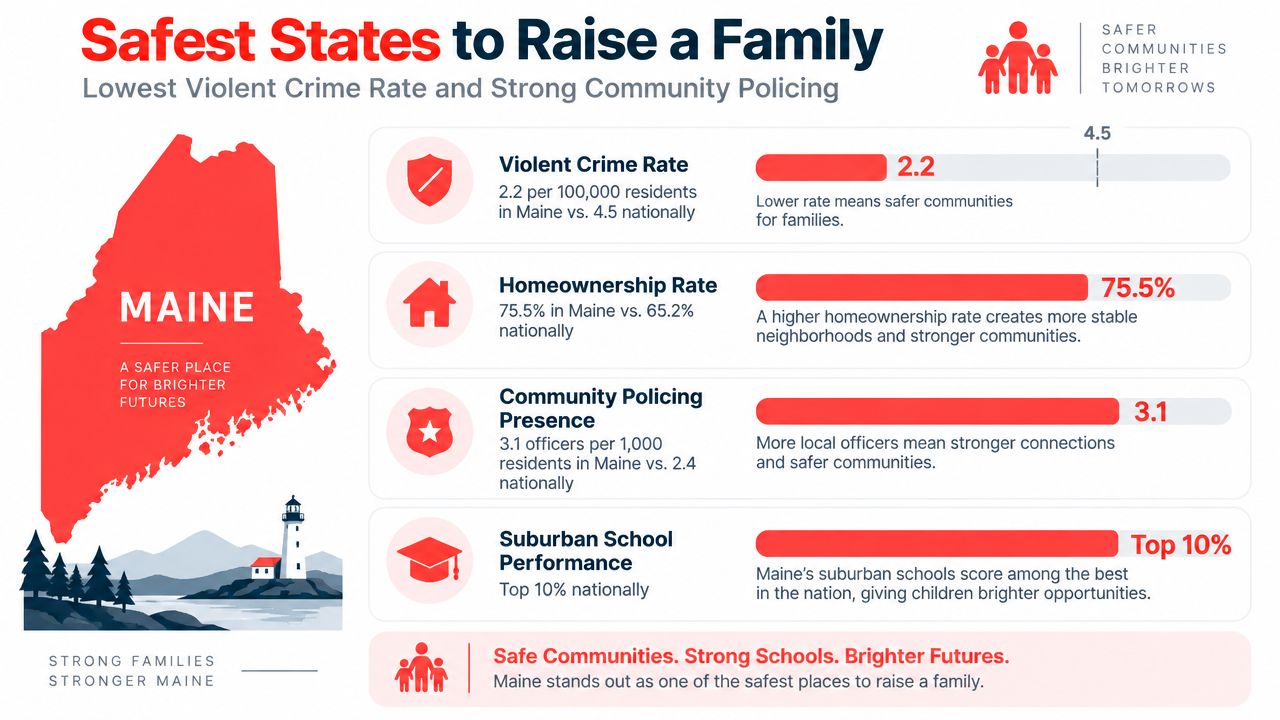
Maine ranks near the top for families because day-to-day life tends to feel calm, manageable, and predictable. That shows up in school runs, evening walks, and neighborhoods where the bigger concern is logistics than constant disruption. An infographic highlighting Maine as a safe state for families, showing crime rates, homeownership, and schools.
The statewide picture still needs a local lens. Portland gives families an urban option with walkable blocks and more activity, while towns like Yarmouth or Cape Elizabeth usually appeal to buyers who want quieter streets and a more suburban pace. Compare New England family destinations on ReloMaps to see how Maine towns stack up against Vermont and New Hampshire.
Where Maine works best for families
The strongest Maine search starts with town-level checks, not a broad assumption that every coastal community offers the same experience. Families should look at local police funding, after-school programs, and district performance, then compare those details with commute length and winter upkeep.
- Portland for access: Useful if you want job reach, urban amenities, and a busier community calendar.
- Yarmouth for stability: Often fits families looking for a quieter suburban setting and a more predictable school environment.
- Cape Elizabeth for a premium lifestyle tradeoff: Works for households that value school reputation and a calmer neighborhood feel more than affordability.
Maine also asks families to plan for the practical side of safety. Seasonal maintenance, snow readiness, and heating costs can matter as much as street crime in daily life. City-level safety is the first filter, then school district quality and winter logistics decide whether a move works for your household.
2. Vermont
Vermont works well for families who value low-density living, close community ties, and a slower pace that naturally limits some forms of everyday risk. It's one of the strongest choices for people who want neighbors to know each other, kids to have room to move around, and daily life to feel less compressed.

The tradeoff is that Vermont's safety comes with real structural constraints. Families often need to think harder about remote work eligibility, winter isolation, and whether mental health support is easy enough to reach in the colder months. That's why Vermont tends to reward households that are organized, flexible, and comfortable with a more self-sufficient rhythm.
Why the Vermont model is different
Vermont's appeal is not just low crime, it's the way community structure changes the family experience. Small towns can make school pickup, local volunteering, and extracurriculars feel integrated into daily life instead of spread across long commutes.
Practical rule: In Vermont, test the move against the winter calendar, not just the summer visit. A town that feels charming in July can feel much less practical if services, social life, and work all get harder to reach by January.
Montpelier and the suburbs around Burlington can give families some urban access without losing the small-town feel. Stowe and Woodstock offer resort-town energy and tourism support, which can help with services and seasonal activity. For many households, Vermont is the best fit when family life is intentionally local and work can travel with you.
3. New Hampshire
New Hampshire stands out for families because safety is paired with a high degree of personal control. That matters in practice, since a low-crime profile is only useful if schools, healthcare access, commute patterns, and housing costs still make daily life workable.
WalletHub's family ranking placed the state 5th overall, with 2nd in health and safety and 5th in education and child care (WalletHub family ranking). SafeHome's child-safety ranking also put New Hampshire 1st among states to raise children (ConsumerAffairs summary of SafeHome ranking). State tax pressure also shapes the family equation. New Hampshire has no broad-based income tax, but property taxes can be a real factor in the move math, so a “safe” town still needs a careful affordability check.
That mix makes the state a strong option for households comparing suburban stability with small-town predictability. It tends to work best for families that want a quieter daily routine and can keep housing, schooling, and work requirements aligned.
What families should verify before moving
Local variation is still the deciding factor. Portsmouth, Exeter, Hanover, Conway, and North Conway each offer a different version of family life, from coastal access to mountain-oriented living.
A family that likes New Hampshire's overall profile can still run into very different realities once the exact town is chosen. School quality, winter road access, and the ease of reaching pediatric care can vary more than statewide rankings suggest. For remote workers, internet reliability should be checked at the address level, not assumed from the state reputation. For on-site workers, commute length and snow response matter just as much as the safety score.
ReloMaps city-level safety comparisons and ReloScore-style tradeoff checks fit this kind of decision well, because they separate statewide reputation from neighborhood conditions. New Hampshire is strongest for households that want privacy, stability, and a careful balance between freedom, weather, and day-to-day practicality.
4. Idaho
Idaho deserves attention for a different reason than many of the states above. Safety here is tied to growth pressure, school choice, healthcare reach, and whether a household can still buy into the communities that fit its routine. Boise and nearby suburbs often appeal to families that want outdoor access without giving up daily convenience.

That mix explains why Idaho shows up on family shortlists. Boise offers the clearest job center and service base, Meridian and Eagle draw buyers who want more predictable school and neighborhood conditions, and Coeur d'Alene appeals to households that value recreation and a smaller daily footprint. The safety question is not just statewide crime levels, but whether the local version of family life still matches the budget and the commute.
Housing pressure is part of the story. Boise's median home price was about $515,000 in May 2024, according to Zillow, which makes the affordability tradeoff visible even before a family compares schools or drive times. In practice, that means the same safety profile can cost more than it did a few years earlier, especially in the most visible growth corridors.
How Idaho shifts the family decision
Idaho works best for households that can choose location first and job fit second, especially if remote work or a stable professional role reduces dependence on the local labor market. That frees families to focus on neighborhood safety, school district quality, and access to pediatric care.
Browse the best places for families in the Mountain West to compare Boise, Meridian, and Coeur d'Alene at the city level: https://relomaps.com/explore/best-places-for-families-in-the-mountain-west
Boise fits families that want a wider mix of services and employment. Meridian and Eagle are the better suburban fit when school consistency and daily routines matter more than being close to the urban core. Coeur d'Alene makes sense for households that prioritize recreation and a more compact pace of life.
Idaho also demands some practical checks that do not show up in a statewide ranking. Water access, irrigation, and summer heat can matter more than expected. Rural homes need more due diligence than a standard suburban move, and a family should verify the school district, healthcare access, and commute reality before treating affordability as settled. ReloMaps city-level safety comparisons and ReloScore-style tradeoff checks help separate the statewide image from the actual decision a family has to make.
5. Wyoming
Wyoming offers a very different family safety profile. It's the state for households that want space, privacy, and very little urban pressure, not for families looking for constant service density or easy access to everything.
The strongest appeal is structural. Low population density changes the experience of safety because there's less crowding, less noise, and fewer everyday friction points. That can feel liberating for parents who want children to grow up with more independence and more outdoor freedom.
Jackson, Cheyenne, and Cody each present their own version of that lifestyle. Jackson adds resort-town services, Cheyenne gives you state-capital practicality, and Cody leans into small-town identity and outdoor recreation. The tradeoff is that none of these choices should be made casually, because distance starts to matter quickly once you need healthcare, specialist care, or dependable broadband.
The Wyoming reality check
Wyoming works best for families who already have a remote income source or a very clear local job plan. It also rewards households that are comfortable building their own safety net through preparation, community involvement, and smarter property selection.
Practical rule: In Wyoming, the safest home is often the one with the best plan. Verify internet service, emergency access, and winter readiness before you get distracted by land, views, or privacy.
Families also need to budget for healthcare travel and severe-weather readiness, not just mortgage or rent. A state can feel safer because it's quieter, but it can also be less forgiving if the nearest services are far away. Wyoming's strength is freedom. Its weakness is that freedom comes with more responsibility.
6. South Dakota
South Dakota works for families because safety feels tied to routine, not just to crime figures. Housing still tends to be more manageable than in many coastal markets, and that matters when school choice, commute time, and child care all have to fit into the same budget. The tradeoff is plain. You get more space to plan a stable life, but you still need to choose your town carefully.
Sioux Falls is the clearest option for households that want jobs, schools, and services in one place. Brookings offers a college-town setting that can make family life feel more organized. Rapid City gives a different path, with more access to outdoor recreation and a lifestyle that feels less compressed. Those differences matter because statewide safety only becomes useful when it lines up with daily needs.
ReloMaps city-level safety comparisons can help separate places that look similar at the state level but feel different once you account for neighborhood patterns and commute realities. That is useful in South Dakota, where the right city can reduce day-to-day stress even if the broader state profile already looks solid.
Why South Dakota stays on family shortlists
The state's appeal comes from predictability. Communities often support family routines, and that can make the move feel easier for parents who want a straightforward social environment rather than constant churn.
- Sioux Falls for access: Best for families that want the widest mix of jobs and services.
- Brookings for a balanced pace: A good fit when you want a smaller-city feel without giving up too much structure.
- Rapid City for outdoor access: Better for households that care about scenery and recreation as part of family life.
The practical checks still matter. School quality can vary town by town, especially outside the bigger population centers, so families should compare districts directly instead of assuming the whole state works the same way. Winter driving also affects daily life, especially for parents balancing work schedules, activities, and medical appointments. South Dakota makes the most sense when a family wants steady routines, manageable housing pressure, and a community that feels connected enough to support them.
7. Montana
Montana is one of the clearest choices for families who want independence, outdoor access, and a low-density environment that naturally reduces some kinds of everyday stress. The state's appeal is tied to wilderness, self-reliance, and a strong preference for space over congestion.
Bozeman, Missoula, and Whitefish each offer a different version of that story. Bozeman combines college-town energy with outdoor access, Missoula adds a more arts-oriented feel, and Whitefish leans toward resort-town family living. That variety matters because Montana is not one kind of place, it's a set of tradeoffs built around different levels of convenience and remoteness.
The risk side is just as important. Families moving there need to think about wildlife awareness, emergency preparedness, winter conditions, and how much daily life depends on a car that can handle bad weather. The state is safe in a broad sense, but it asks more of the household than a denser suburban market would.
When Montana makes sense
Montana is strongest for families who want a lifestyle centered on nature and community rather than convenience. Remote work helps a lot, because it lets you choose a town for fit rather than local job scarcity.
Practical rule: If the home search is in Montana, verify property-level internet and access first. A beautiful location isn't family-safe if your work, schooling, or medical planning breaks down in winter.
Outdoor clubs, volunteer groups, and local service organizations can be especially important in building support quickly. That social layer matters in a state where isolation can be part of the package. Montana can be an excellent family fit, but only for households that treat planning as part of the move, not an afterthought.
8. Utah
Utah stands out because family life is built into the state's social fabric. That does not mean every community is equally safe, but it does mean many suburbs are shaped around schools, recreation, and routines that fit households with children.
The practical difference shows up city by city. Salt Lake City offers more urban access and family neighborhoods, Provo brings a college-town feel with a strong community identity, and Sandy and South Jordan tend to fit families looking for suburban structure with easy access to the outdoors. That mix matters because a statewide safety ranking only tells part of the story, and the daily experience can change fast once you compare one metro area with another.
Utah's main tradeoffs are environmental and growth-related. Winter inversions can make air quality a real concern in the Salt Lake Valley, while rapid development puts pressure on roads, housing, and schools. Families who focus only on the safety label can miss the parts of daily life that shape stress, commute times, and access to services.
How Utah changes the relocation conversation
Utah works best for households that want a family-oriented culture and can accept growth pressure in exchange for access and community support. It also fits families who want recreation to be part of normal weekly life, not something reserved for weekends away.
- Salt Lake City for access and growth: Better suited to families that need urban services and broader job access.
- Provo and nearby communities for family focus: Often appealing when school culture and community identity matter more than size.
- Sandy and South Jordan for suburban balance: Useful if you want a more traditional family setup with outdoor access.
Families should compare neighborhoods closely, because school quality, traffic, and housing pressure can vary sharply. Utah can be a strong fit for a household that values family culture, but only if the air, commute, and housing math still work.
9. North Carolina
North Carolina is a reminder that statewide safety averages can hide huge regional differences. The Research Triangle, especially Raleigh-Durham-Chapel Hill, often looks very different from other parts of the state because universities, job growth, and neighborhood planning all shape the family experience.
Chapel Hill, Durham suburbs, Raleigh suburbs, and Cary are the names families usually start with for a reason. They combine stronger schools, better job access, and more predictable suburban living than many other areas. That doesn't mean the whole state belongs on a family-safe shortlist automatically. It means you need to zoom in hard.
The relocation process gets practical here. A family might like North Carolina's broader climate and job opportunities but still need to pick a very specific neighborhood to get the safety and school results they want. Neighborhood-level tools matter more in this context than in many states because the difference between a good and mediocre block can be material.
Why the Triangle deserves a closer look
The Triangle tends to work because it mixes education, employment, and family demand in one region. That creates a stronger ecosystem for families than a state-level label can show on its own.
ReloMaps can help here with North Carolina family and city comparisons, which is the right way to compare Raleigh-area suburbs against your own priorities. If you're moving for work, school, or hybrid commuting, that local comparison is more useful than a broad statewide ranking.
Families should also plan for hurricane preparedness and spring weather volatility. The state can be a strong choice, but only if the exact suburb, school district, and commute pattern match the household's needs.
10. Colorado
Colorado belongs on a family safety list because many suburban and mountain communities combine strong livability with good access to jobs and outdoor recreation. The state's appeal is especially strong for families who want a more active lifestyle without giving up metro access completely.
Denver suburbs, Boulder, Fort Collins, and mountain communities like Telluride, Vail, and Aspen each offer a different safety profile. Denver suburbs can work well when school quality and neighborhood selection are handled carefully. Boulder adds college-town energy. Fort Collins often attracts families who want a more balanced northern Colorado fit.
The hard part is that Colorado's desirability can make the best areas expensive fast. That means the family-safe choice isn't always the obvious one. It might be the neighborhood that gives you a reasonable commute, a good school boundary, and a house you can keep long term.
The Colorado tradeoff families need to price in
Colorado is strongest when you want safety to come with access to recreation and jobs. It becomes less attractive when home prices, altitude adjustment, or drought concerns start to outweigh the benefits.
Practical rule: Compare Colorado suburbs at the neighborhood level, not just the metro level. One school zone can feel very different from another even when the zip code looks similar.
Families should also check how quickly schools are filling, how much commute time changes in winter, and whether the property makes sense for long-term water and climate pressure. Colorado works best for households that want mobility, outdoor access, and a carefully chosen neighborhood rather than a broad state-level bet.
Top 10 Safest States for Families Comparison
| State | Violent crime rate (per 100k) | Relocation complexity | Resource requirements | Expected outcomes | Ideal use cases | Key advantages |
|---|---|---|---|---|---|---|
| Maine | 2.2 | Moderate, seasonal climate and limited rural jobs; proximity to Portland reduces complexity | Need for winter readiness; verify local schools and policing budgets; possible remote work | High neighborhood safety, stable communities, strong schools in suburbs | Multigenerational families; those prioritizing low violent crime | Low violent crime, strong community policing, neighborhood stability |
| Vermont | 1.9 | High, isolated towns and limited local jobs; remote work often essential | Remote income or local small-economy plan; higher property taxes; limited healthcare access | Very low crime, strong community bonds, outdoor lifestyle | Rural-oriented families; homeschooling and outdoor-focused households | Lowest violent crime, tight-knit rural communities, outdoor recreation |
| New Hampshire | 2.3 | Moderate, tax advantages but high property taxes; commute access to Boston available | Assess total tax burden; research school funding variability; good commuter infrastructure near border | Low crime with strong parental autonomy and financial advantages | Families valuing tax structure and homeschooling; Boston commuters | No state income tax, strong property rights, education autonomy |
| Idaho | 2.8 | Moderate, booming growth creates infrastructure strain in metros | Secure remote/work opportunities; monitor school expansion and water access | Affordable family housing, growing peer networks, outdoor lifestyle | Value-conscious and outdoor-oriented families; entrepreneurs | Low cost of living, outdoor recreation, growing tech hubs |
| Wyoming | 3.8 | High, extreme isolation, limited local jobs; remote income required | Reliable internet and emergency planning essential; long travel distances for services | High privacy and independence; rural self-reliance, limited services | Homesteading/off-grid families; those seeking maximum land/privacy | Vast land/privacy, low population density, strong property rights |
| South Dakota | 3.0 | Moderate, affordable housing but limited job diversity outside metros | Consider Sioux Falls for jobs; prepare for winter and rural service gaps | Affordable homeownership, agricultural community values, safe small towns | Families prioritizing affordability and traditional/agricultural lifestyles | Very low cost of living, strong schools in many towns, community values |
| Montana | 3.7 | High, geographic isolation and limited local employment; remote work recommended | Emergency and wildlife preparedness; verify internet and healthcare access | Wilderness-centered childhoods, strong self-reliance, privacy | Outdoor-oriented and homesteading families; remote workers | Extensive public lands, low density, outdoor skill development |
| Utah | 2.8 | Moderate, rapid growth creates infrastructure pressure; cultural fit to consider | Research community cultural fit; monitor air quality and school capacity | Family-centric communities, strong schools, abundant activities | Young families seeking suburban safety with job access | Young population, strong education funding, integrated family culture |
| North Carolina | 4.0 (Research Triangle 2.9) | Variable, depends on region; Research Triangle easier to relocate to | Neighborhood-level research required; school and crime variation matters | Suburban safety with urban job access in Research Triangle; variable elsewhere | Tech/biotech professionals; families seeking strong schools near universities | Strong job markets (Research Triangle), university resources, affordable metros |
| Colorado | 4.1 (suburbs lower) | Moderate, desirable suburbs have high demand and rising costs | Verify neighborhood crime, school capacity and water concerns; plan for altitude | Outdoor recreation plus urban job access; quality suburban schools | Families seeking outdoor amenities with urban jobs (tech/professional) | Outdoor lifestyle, strong job markets, high suburban school performance |
Turn a Statewide Shortlist Into a Safer Move
The best way to use a list of the safest states to raise a family is to turn it into a short, practical comparison. Start with the essentials, then compare each candidate city against the realities that shape daily life, school assignment, healthcare access, commute reliability, winter exposure, and whether the budget still works after housing and local taxes.
State rankings can point you in the right direction, but they can't tell you whether one neighborhood sits too far from pediatric care, whether a school boundary changes the move, or whether your hybrid schedule will survive the commute. That's why families should verify the city, not just the state, and then pressure-test the move against an ordinary weekday. If the plan works on a Tuesday in January, it'll usually hold up better everywhere else too.
ReloMaps is useful at that stage because it brings together city and neighborhood safety context, ReloScore grades, school indicators, demographics, commute and work-from-home data, cost factors, and disaster-risk context in one place. That helps you compare states like Massachusetts, New Hampshire, Vermont, and the others here against the specific town you would live in. If you're also moving with pets, stress-free pet relocation advice can help you think through the logistics beyond the house itself.
Frequently Asked Questions
Which is safer for families, a state ranking or a neighborhood score?
A neighborhood score is usually more useful for the final decision. State rankings are good for narrowing the field, but they can hide major differences inside the same state, especially around school quality, commuter corridors, and local services.
How close should healthcare be for a family move?
Families should verify that routine pediatric and urgent care are reachable without turning every sick-day errand into a long drive. If specialist care matters because of a child's medical needs, the move should be judged on actual drive time and appointment availability, not just the presence of a hospital in the region.
Why do school district boundaries matter so much in safe states?
School boundaries can change both daily logistics and long-term property value. A home can sit in a safer-feeling town but feed into a less convenient or less desirable district, so buyers should confirm the exact attendance zone before they make an offer.
How should hybrid workers test commute reliability before moving?
They should test the route during the exact hours they'd travel, then repeat it in bad weather if possible. A commute that looks fine on a map can break down because of school traffic, winter conditions, or one bad highway interchange that adds stress every week.
What hidden costs should families budget for in colder states?
Families should budget for winter maintenance, vehicle readiness, and higher heating or repair costs linked to seasonal weather. In places like Vermont, Maine, New Hampshire, and Wyoming, those costs can shape monthly comfort as much as rent or mortgage payments do.
How can families compare statewide safety with local crime patterns?
They should use statewide rankings only as a screening step, then compare the actual city or suburb where they'll live. A safe state can still contain pockets with very different exposure, and the family experience depends more on the immediate neighborhood than the statewide average.
If you're comparing states for a move, use ReloMaps to check the city-level safety picture, school and demographic context, commute patterns, and disaster-risk signals before you decide. Start with the state shortlist here, then visit ReloMaps to pressure-test the exact city or neighborhood against the way your family lives.
Enjoying the blog? Subscribe to ReloMaps+ for premium area intelligence — and to keep us independent.
Subscribe today