Safest City in Tennessee: 8 Places Compared
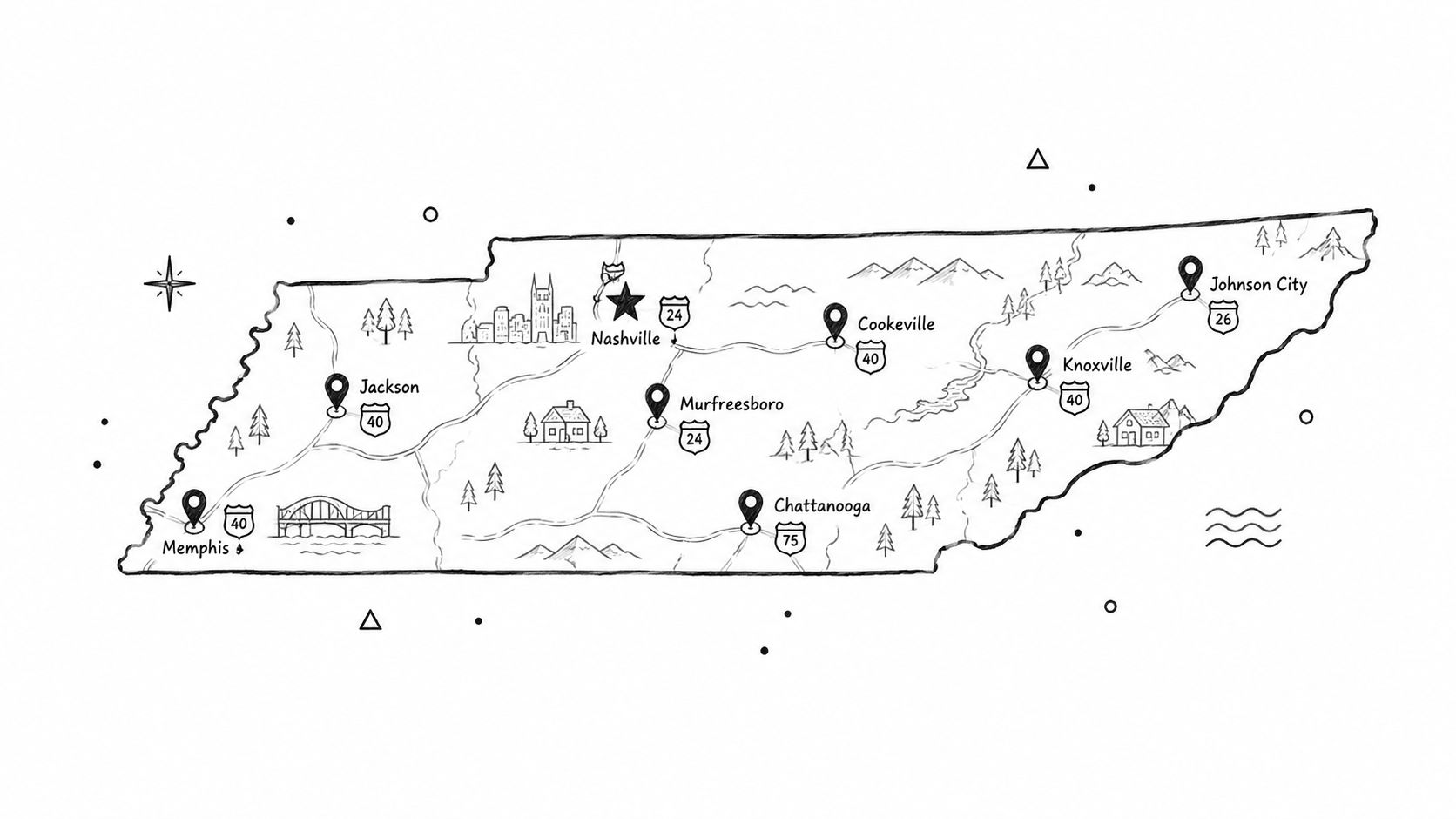
Signal Mountain is the leading candidate for the safest city in Tennessee in this comparison, with a reported violent-crime rate of 0.00 per 1,000 residents and property crime of 3.48 per 1,000. That doesn't make it risk-free, and the best choice can change if you prioritize absolute crime rates, access to Chattanooga, affordability, or neighborhood-level context over a statewide ranking.
The answer also depends on what “safe” means in practical relocation research. Crime rates are useful screening tools, but they don't show every difference between a mountain community, an affluent Nashville suburb, a federal research town, and a low-crime neighborhood inside a larger city. Small populations can make annual rates look unusually high or low, while citywide averages can conceal differences between commercial corridors and residential blocks.
The comparison below uses the supplied crime evidence where it exists and treats unsupported details cautiously. It also considers ReloScore-style dimensions such as cost of living, affluence, strategic location, demographic context, hazard exposure, and neighborhood variation. ReloMaps can help organize those categories alongside city and neighborhood context, so a safety shortlist doesn't become a decision based on one crime statistic.
For homeowners and neighborhood associations, safety also includes how residents, visitors, emergency responders, and service providers move through a property. An HOA's access control and emergency access systems should be evaluated as part of the community's practical risk management, not treated as proof that a place has no crime.
Table of Contents
- 1. Signal Mountain, Tennessee, Small Mountain Town with Near-Zero Violent Crime
- 2. Brentwood, Tennessee, Established Affluent Suburban Safety
- 3. Germantown, Tennessee, Professional Suburb with a Different Memphis Trade-Off
- 4. Collierville, Tennessee, Affluent Suburban Stability East of Memphis
- 5. Franklin, Tennessee, Low-Crime Suburban Access with Higher-Cost Trade-Offs
- 6. Oak Ridge, Tennessee, Institutional Security and Moderate-Cost Context
- 7. Smyrna, Tennessee, Growing Suburb with a Military-Connected Identity
- 8. Knoxville East, Tennessee, Neighborhood Safety Inside a Larger City
- 8-City Tennessee Safety Comparison
- Choose the Safety Profile That Fits Your Move
- Frequently Asked Questions
- Is Signal Mountain always the safest city in Tennessee?
- How can a small population distort a safety ranking?
- How far beyond the city average should a buyer investigate?
- What separates Brentwood from Signal Mountain for a budget-conscious buyer?
- How should hybrid workers compare access to Chattanooga, Nashville, Memphis, and Knoxville?
- Does a zero reported violent-crime rate mean a home has no safety risk?
- Should gated access determine which Tennessee suburb I choose?
- Which data should a buyer request before making an offer?
1. Signal Mountain, Tennessee, Small Mountain Town with Near-Zero Violent Crime
Signal Mountain is the strongest absolute-crime candidate among these eight places because the supplied figures report 0.00 violent crimes per 1,000 people and 3.48 property crimes per 1,000 people in a 2026 safety ranking (Eufy's Tennessee safety comparison). A zero reported violent-crime rate is an unusually clear screening signal, but it shouldn't be read as a guarantee that every street, household, or future reporting period will remain free of incidents.
The number also needs scale. Signal Mountain is a relatively small residential community, and small populations can make a single incident produce a noticeable change in a per-capita rate. That doesn't invalidate the figure. It means a buyer should pair the annual ranking with current local incident records, the exact subdivision, and the distance to everyday services.
The safety advantage has a lifestyle cost
Signal Mountain's appeal is strongest for households that value residential separation, lower urban exposure, and a quieter setting. The trade-off is access. A buyer working in Chattanooga should test the actual route during normal work hours rather than assuming that a short map distance will feel convenient every day.
HOA rules also deserve close attention. A community with strong access controls, architectural standards, or neighborhood oversight may support a more orderly environment, but those same rules can limit renovations, parking choices, exterior changes, rentals, or home-based activities.
Practical rule: Treat the zero violent-crime figure as a reason to investigate Signal Mountain first, not as a reason to stop investigating.
A useful verification sequence is straightforward:
- Check the time span: Ask whether the ranking reflects one reporting period or a longer pattern.
- Inspect the exact area: Compare the property's immediate surroundings with the broader city.
- Test the commute: Drive toward Chattanooga at the hours you'd normally travel.
- Review governance: Read HOA covenants, emergency-access procedures, and security responsibilities before making an offer.
Signal Mountain is therefore the best fit for a buyer who wants the lowest supplied violent and property figures and accepts a more residential lifestyle. It may be a weaker fit for someone who needs dense amenities, flexible housing rules, or a short, predictable urban commute.
2. Brentwood, Tennessee, Established Affluent Suburban Safety
Brentwood remains a benchmark for Tennessee safety discussions because separate reported figures place it near the top of statewide comparisons. One earlier ranking cited 0.80 violent crimes per 1,000 residents and 9.26 property crimes per 1,000, while a later local-news summary reported 0.71 violent crimes per 1,000 and 9.41 property crimes per 1,000 (the supplied Brentwood safety source). The changing figures show why buyers should compare the reporting year and methodology before treating one list as definitive.
Brentwood offers a different safety profile from Signal Mountain. Its appeal is not only a low reported violent-crime rate, but also the combination of an established suburban environment, proximity to Nashville, and a larger housing market. Those advantages can matter more than a small difference in a city ranking for a household whose daily life depends on employment access, schools, medical services, or a broader choice of homes.
Compare neighborhoods, not just the city label
Affluent suburbs aren't uniform. Commercial activity, major roads, multifamily housing, school traffic, and neighborhood design can all affect the type and location of reported incidents. A buyer should request current incident information from the relevant police department and compare the immediate area around a prospective home with nearby alternatives.
The cost trade-off is equally important. A high-safety reputation can attract demand and reduce the number of homes that fit a fixed budget. Buyers should price taxes, insurance, HOA obligations, maintenance, and commuting costs alongside the purchase price rather than treating safety as a free feature.
For broader relocation context, compare Brentwood with other safest cities in America using the same categories rather than switching between inconsistent rankings.
Brentwood fits buyers who want a well-known suburban safety option near Nashville and are prepared to pay for location, demand, and established amenities. It isn't automatically the best value, and its ranking should not substitute for a block-level review.
3. Germantown, Tennessee, Professional Suburb with a Different Memphis Trade-Off
Germantown belongs in this comparison as a methodology case, not because the available material supplies a verified citywide crime rate. The supplied research describes an upscale professional suburb with favorable safety conditions, but its specific crime, income, policing, housing, and trend figures are not included in the confirmed data. Those measurements should not be presented as established facts.
The practical question is how Germantown performs across the same categories used for other Tennessee places: reported violent and property crime, neighborhood variation, ReloScore factors, housing costs, and access to employment and services. That approach prevents a suburban reputation from replacing current local evidence.
Memphis context is useful, but it is not Germantown data
Germantown's location creates a distinct trade-off. Residents may seek suburban separation while remaining within reach of Memphis employment, healthcare, entertainment, and other services. The same location makes jurisdiction and travel patterns more important. A home near a commercial corridor or major arterial may present a different daily environment from one in a quieter residential subdivision.
Memphis provides context for interpreting regional change, not a substitute for Germantown records. A one-year review by the SAFE Task Force reported a 37% drop in serious crimes and a 16% drop in calls for service, followed by a plateau rather than continued improvement (Action News 5's coverage of the review). Those figures describe Memphis. They do not establish Germantown's crime level or trend.
A Germantown relocation review should answer four narrower questions:
- Confirm the jurisdiction: Identify which police agency and municipality cover the property.
- Compare nearby settings: Review residential streets, retail areas, commuter routes, and multifamily developments separately.
- Price the trade-off: Assess housing, taxes, insurance, maintenance, and commuting costs alongside the safety profile.
- Check current records: Use multiple reporting periods and property-specific information rather than relying on a general city reputation.
Germantown may fit families and professionals seeking a suburban setting connected to the Memphis region. Its case depends on evidence gathered at the municipal and neighborhood levels. Buyers should treat metro trends as background, then verify the exact address, surrounding blocks, daily routes, and affordability before comparing it with other Tennessee options.
4. Collierville, Tennessee, Affluent Suburban Stability East of Memphis
Collierville's case rests on suburban stability with direct access to the Memphis employment market. The town has an established residential identity, a range of subdivisions, and a setting that can feel distinct from the larger metro area. That combination makes it a useful comparison for households weighing neighborhood conditions against commuting and service access.
Collierville's published crime figures are not verified for this article, so the strongest evidence to check is the Collierville Police Department's annual report. Its current violent- and property-crime figures per 1,000 residents should provide the local baseline, rather than relying on a general reputation for affluence or safety.
The practical question is whether the address delivers the benefits suggested by the city label. A home near commercial activity, major roads, or older retail corridors may have a different incident pattern from one in a quieter subdivision. Review the responsible law-enforcement agency, recent records for the surrounding area, and the routes the household will use every day.
A suburban profile with measurable trade-offs
Memphis access can improve employment options, medical access, entertainment, and airport convenience. It can also add commuting time, traffic exposure, and costs that do not appear in a crime comparison. Housing fit should therefore include taxes, insurance, maintenance, and travel expenses, not only the purchase price.
A ReloScore comparison is more useful when its categories remain separate. Safety records can support one conclusion, while schools, affordability, amenities, and commute conditions support another. School reputation may affect demand and household composition, but it cannot replace crime records. Likewise, a quiet appearance does not rule out property-related incidents.
For City data, start with the police department's annual report and identify the reporting period behind each figure. For Neighborhood data, compare residential streets, retail areas, multifamily properties, and routes near major access points. Assess Future change by checking planned development, since new construction can alter traffic, density, and service demand.
Collierville may suit buyers who want a stable suburban setting without giving up Memphis connections. The trade-off is that safety, affordability, and convenience may vary by address. A sound decision requires comparing the exact property with alternatives across all three, then testing the result against the household's daily travel pattern.
5. Franklin, Tennessee, Low-Crime Suburban Access with Higher-Cost Trade-Offs
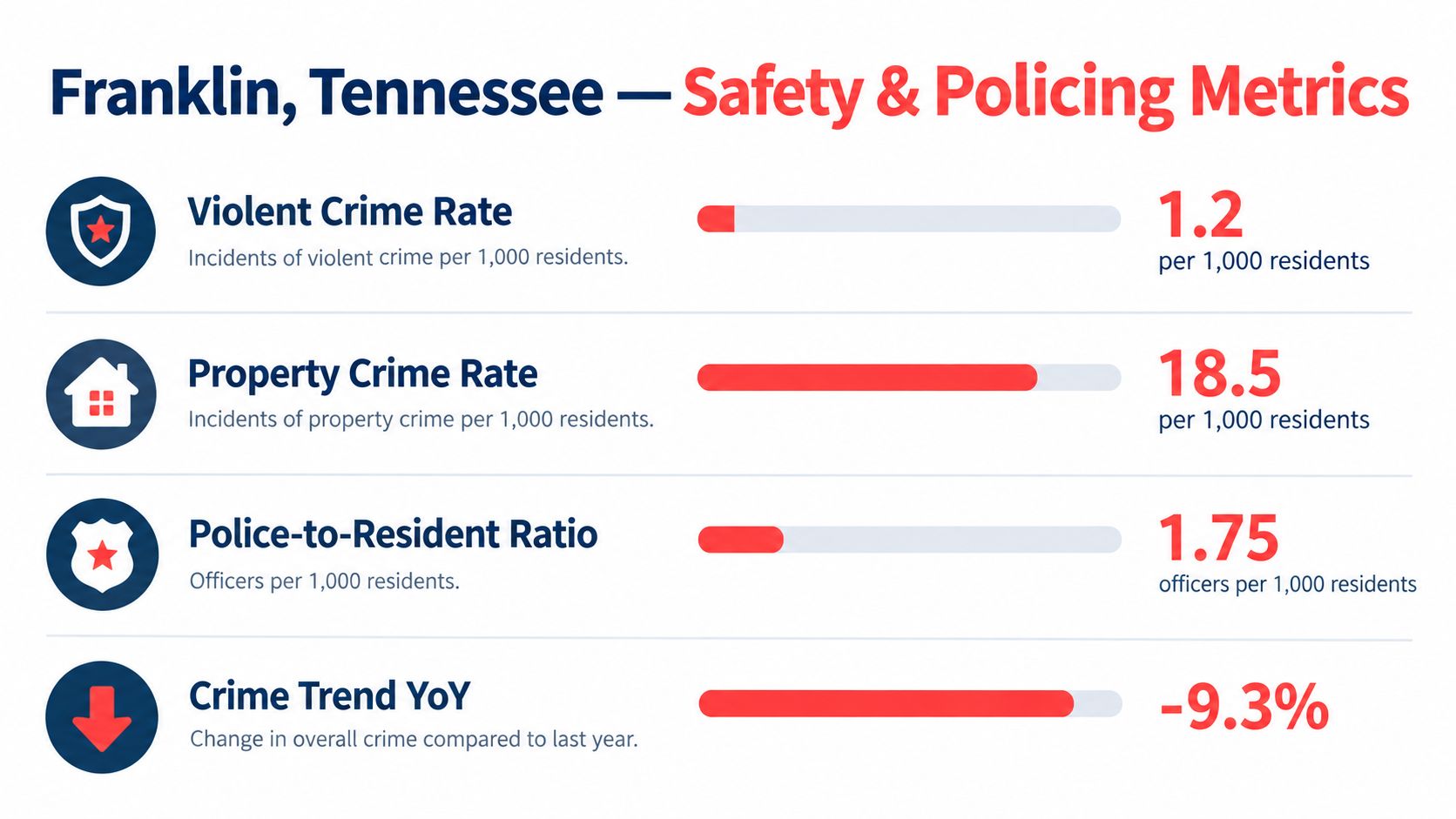
Franklin is a major reference point in Tennessee relocation searches because it combines a high-profile suburban market with access to the Nashville region. The planning material describes several precise Franklin crime, income, staffing, tax, and neighborhood figures, but those numbers aren't included in the verified data. They should therefore remain unquoted.
Franklin still belongs in a safety comparison because it tests an important assumption: the safest city in Tennessee isn't necessarily the city with the best overall relocation fit. A larger, more established market can offer employment access, services, and housing variety that a smaller community cannot, even if a smaller place posts a stronger isolated crime figure.
A lower-risk choice can still be expensive
Franklin buyers should examine the full monthly cost of the move. Property taxes, insurance, HOA charges, commuting, home maintenance, and the price of land can change the affordability calculation even when the crime profile is attractive. Safety may be one reason households accept those costs, but it shouldn't hide them.
Neighborhood context matters here as much as city identity. Commercial corridors and major roads naturally bring more visitors and activity than quiet residential streets. A buyer comparing two Franklin homes should request current incident information for both locations, visit at different times, and examine lighting, traffic, parking, and access points.
Use Tennessee places to live on ReloMaps to put Franklin's safety context beside affordability, demographics, strategic location, and other relocation dimensions.
Franklin suits households that prioritize Nashville-area access and a broad suburban ecosystem. It may not suit a buyer whose first priority is the lowest available absolute crime figure or who would rather accept isolation to reduce housing and traffic pressure.
6. Oak Ridge, Tennessee, Institutional Security and Moderate-Cost Context
Oak Ridge's safety profile is shaped partly by its federal research and government infrastructure, including Oak Ridge National Laboratory. That institutional presence can influence security practices, employment patterns, and the town's overall identity. However, the precise crime rates, staffing levels, income figures, and clearance claims supplied for Oak Ridge are not verified for this article.
A visible security presence does not describe every residential area. Campus protections may be specialized, while nearby neighborhoods face different conditions involving property crime, traffic, access, and emergency response. Buyers should separate the security of an institution from the day-to-day experience of the surrounding community.

Institutional anchors create a specific relocation trade-off
Oak Ridge may suit households seeking research-oriented employment, a smaller-city setting, and an institution with formal security requirements. Those advantages come with trade-offs. A concentrated employment base can increase sensitivity to institutional decisions, while some properties may have rules or expectations uncommon in ordinary neighborhoods.
A practical review should begin with the address:
Jurisdiction means confirming which agency serves the home and how it coordinates with nearby institutions. Security boundary requires separating campus procedures from ordinary residential protections. Employment exposure involves assessing whether household income depends heavily on one institutional sector. Neighborhood character calls for comparing areas near major facilities with outlying residential locations.
That comparison also helps distinguish Oak Ridge from the affluent-suburban model found elsewhere in Tennessee. Its appeal rests more on institution-shaped stability and a moderate-cost context than on a verified claim of uniformly low crime. Current city data, visits at different times, and an assessment of employment resilience provide a sounder basis for a move than checkpoints or security personnel alone.
Compare Oak Ridge with other safe places to live in the Southeast, while considering hazard exposure, strategic location, and job access alongside safety.
7. Smyrna, Tennessee, Growing Suburb with a Military-Connected Identity
Smyrna adds a military-connected suburban model to the list. The planning material attributes specific crime rates, population, military-household share, policing results, growth, and neighborhood-watch participation to Smyrna, but those figures aren't present in the verified data and shouldn't be repeated as established facts.
The qualitative comparison remains useful. A military or institutional anchor can bring stable employment networks, community associations, and a clear local identity. It can also create exposure to changes in mission, staffing, commuting patterns, aircraft activity, or contractor demand. Those are relocation issues even when crime is low.
The exact address matters more near a base
Military-connected buyers should investigate more than a city ranking. Ask how far the home is from the installation, whether aircraft noise affects daily life, which roads carry shift traffic, and whether the neighborhood changes noticeably during transfers or training periods. A property that looks ideal on a map may feel very different after a week of early departures and evening returns.
Civilian buyers should also avoid assuming that military presence automatically creates a uniform safety advantage. Base-adjacent streets, commercial areas, older housing, and newer subdivisions can operate under different conditions. The local police department and military authorities may have separate responsibilities, so the buyer should identify who responds to incidents at the property.
A military connection can strengthen community networks, but it can also concentrate economic and traffic risk in the same place.
Smyrna may fit military families, contractors, and households seeking a suburban setting with an institutional employment connection. It may be less suitable for buyers who want a fully diversified local economy, minimal aircraft exposure, or a community whose growth isn't linked to a single anchor.
The practical test is simple: visit the home during different operating periods, ask residents about noise and traffic, and compare current incident data with nearby non-base neighborhoods.
8. Knoxville East, Tennessee, Neighborhood Safety Inside a Larger City
Knoxville East is the clearest reminder that citywide safety labels can hide meaningful neighborhood differences. The planning material identifies Bearden, Sequoyah Hills, and Fountain City as lower-crime areas within Knoxville. However, the verified material does not provide precise citywide or neighborhood crime rates, income figures, policing changes, or burglary comparisons for these locations.
That evidence gap changes how a buyer should interpret the comparison. Knoxville's overall reputation cannot determine the conditions at a particular address. The more useful questions concern the neighborhood, corridor, block, and agency or district responsible for local response and records.
Urban access comes with more variables
A larger-city neighborhood may provide walkability, independent businesses, cultural institutions, and access to major employers that smaller Tennessee towns do not offer. Those benefits come with greater variation over short distances. Commercial activity, university influence, arterial roads, rental concentration, and nighttime foot traffic can all affect the surrounding environment.
A Knoxville East decision should therefore begin with the property rather than the city label:
Start with the block: Review incidents near the address, not only Knoxville's summary.
Visit repeatedly: Walk or drive through during daytime, evening, and weekend periods.
Check boundaries: Determine whether the home sits near a commercial area, campus, major road, or other transition zone.
Compare alternatives: Examine adjacent neighborhoods before treating the first property as the only viable option.
This approach also helps place crime metrics and any relocation scoring categories in context. A score can support comparison across Tennessee places, while neighborhood-level evidence shows whether a specific home matches the buyer's priorities.
Knoxville East may suit households that value urban access and are willing to conduct more detailed local research. A city can carry a less favorable overall reputation while containing residential areas that feel materially different. For relocation decisions, that distinction makes neighborhood evidence more useful than a statewide “safest city” label.
8-City Tennessee Safety Comparison
| City | Governance & Implementation Complexity | Resource Requirements | Expected Outcomes (Safety & Trends) | Ideal Use Cases | Key Advantages |
|---|---|---|---|---|---|
| Signal Mountain, TN | Low complexity: community norms, strong HOA governance, small municipal PD | Modest: 18 officers (2.3/1k), volunteer auxiliary, limited budget | Extremely low violent crime 0.4/1k; property 8.2/1k; flat for 15+ years | Remote workers, retirees seeking maximum safety with small-town feel | Very low violent crime, high institutional trust, affordable vs elite suburbs |
| Brentwood, TN | High complexity: proactive, zero‑tolerance policing and advanced tech deployments | High: 180+ officers (4.2/1k), highest per‑capita police spending, ALPR/ShotSpotter | Very low violent crime <0.8/1k; property 12.3/1k; declining ~6–8% annually | Affluent families seeking elite policing, rapid response and preventative programs | Exceptional police presence, advanced technology, proactive crime prevention |
| Germantown, TN | Data‑driven policing with expanding PD and growth management | Moderate‑high: 98 officers (2.5/1k), investment in analytics and hot‑spot policing | Violent 0.9/1k; property 13.6/1k; strong declines (~7.8% YoY violent) | Families prioritizing top schools and improving safety at reasonable cost | Fastest improving safety trajectory, strong schools, professional demographic |
| Collierville, TN | Community policing plus neighborhood associations and private security partnerships | Moderate: 100+ officers (~2.0/1k) + active neighborhood patrols | Violent 1.1/1k; property 15.8/1k; steady decline (5.2% YoY) | Budget‑conscious families wanting suburban safety near Memphis | Strong neighborhood engagement, lower cost than elite suburbs, solid schools |
| Franklin, TN | Well‑funded municipal policing with 24/7 patrols and gated neighborhoods | High: 140+ officers (~1.75/1k), funded by higher local taxes | Violent 1.2/1k; property 18.5/1k; notable decline (-9.3% YoY) | Affluent families seeking suburban amenities and consistent policing | Low violent crime in the metro area, high community engagement and surveillance |
| Oak Ridge, TN | Complex multi‑layered security: federal DOE protocols integrated with local PD | Very high specialized resources: 900+ DOE security personnel + 90 local officers | Violent 1.5/1k; property 14.2/1k; flat to modest decline (-2–3% YoY) | Government/research employees valuing institutional security and moderate cost of living | Unique federal security layers, strong interagency coordination, employment stability |
| Smyrna, TN | Dual civilian‑military coordination with base‑anchored community structures | Moderate: 90+ officers (~1.9/1k) plus military law enforcement support | Violent 1.4/1k; property 14.9/1k; declining (~-4.1% YoY) | Military families, base contractors, value‑seeking households | Military demographic stabilization, affordable housing, coordinated security |
| Knoxville East (Bearden/Sequoyah Hills), TN | Micro‑targeted urban policing within larger city framework; concentrated resource allocation | Enhanced local focus from Knoxville PD (citywide 500+ officers); private security supplements in neighborhoods | Micro‑area violent 1.3/1k vs city 5.2; property 16.4/1k vs city 32.1; micro‑areas improving (~-3.2% YoY) | Urban residents wanting walkability and cultural amenities with low‑crime pockets | Urban amenities plus suburban‑level safety in selected neighborhoods; lower entry cost than suburbs |
Choose the Safety Profile That Fits Your Move
Signal Mountain leads this eight-place comparison on the supplied absolute crime figures, especially its reported 0.00 violent-crime rate and 3.48 property-crime rate per 1,000 people (the cited Signal Mountain ranking). That result answers the narrow search query, but it doesn't settle the relocation decision. A buyer who needs Chattanooga access, flexible housing, or broader services may prefer a different profile.
Brentwood and Germantown represent affluent suburban models, although their advantages come with different metropolitan relationships. Brentwood is tied to Nashville-area access and a highly established suburban market. Germantown offers a Memphis-region alternative that should be judged through municipal and neighborhood data rather than assumptions about the wider metro.
Knoxville East shows why city averages can mislead. The relevant decision may be made at neighborhood or block level, especially where urban amenities, commercial corridors, university activity, and residential streets meet. Oak Ridge and Smyrna show another pattern. Institutional anchors can influence community stability, security practices, employment, traffic, and long-term risk, but they also introduce dependencies that a buyer should price into the move.
Nolensville belongs in the statewide context even though it isn't one of the eight detailed entries. It is consistently identified as Tennessee's safest city in recent statewide rankings, and one 2026 analysis reports 22 violent crimes per 100,000 residents and 257 total crimes per 100,000 people, described as 84% below the Tennessee average (SafeWise's Tennessee safety research). A separate comparison places Nolensville's population base within a range of roughly 9,000 to 18,000, depending on the dataset, which is a reminder that population definitions and methodology affect rankings (the supplied SafeHome comparison).
Tennessee's statewide context is also unusually important. The same SafeWise source reports a state violent-crime rate of 8.91 incidents per 1,000 people, compared with a national average of 4.43, and identifies Tennessee as third-highest among U.S. states. A city-level outlier therefore deserves attention, but it still shouldn't be treated as a guarantee.
Use this verification sequence before making an offer:
- Compare current records: Review the latest available city and neighborhood incident data, not only a ranking published for one year.
- Inspect the exact property: Look at lighting, access points, surrounding uses, traffic, vacant buildings, and the route home takes at night.
- Test the commute: Drive toward Chattanooga, Nashville, Memphis, or Knoxville at the times your household would travel.
- Price the whole move: Include taxes, insurance, HOA charges, maintenance, fuel, and any security or access-system costs.
- Check non-crime risks: Review flood, tornado, wildfire, hazard proximity, and emergency-access context.
- Use comparable location data: ReloMaps can help place city and neighborhood context beside safety, affordability, demographics, and strategic-location factors.
The safest city in Tennessee for one household may be the wrong fit for another. Choose the place whose safety evidence, neighborhood conditions, commute, budget, and lifestyle constraints work together.
Frequently Asked Questions
Is Signal Mountain always the safest city in Tennessee?
No, Signal Mountain is the leading candidate in this comparison, while Nolensville is repeatedly identified as Tennessee's safest city in statewide rankings. Rankings can change with reporting periods, population estimates, agency participation, and the crime categories included, so buyers should compare the methodology before treating any winner as permanent.
How can a small population distort a safety ranking?
A small population can make a single reported incident produce a large per-capita movement from one reporting period to another. That makes multi-year records, raw incident counts, and the city's reporting completeness useful checks before a buyer interprets a dramatic rate as a durable trend.
How far beyond the city average should a buyer investigate?
A buyer should investigate the immediate neighborhood and the property's surrounding corridors, especially near highways, retail areas, campuses, large rental concentrations, or jurisdictional boundaries. The farther a home sits from the typical residential environment represented by the city average, the less useful that average becomes as a stand-alone screening tool.
What separates Brentwood from Signal Mountain for a budget-conscious buyer?
The central trade-off is not a verified price gap. Brentwood generally represents a more established Nashville-area suburban market, while Signal Mountain offers the strongest supplied absolute crime figures but may require a buyer to accept a more residential setting and assess Chattanooga access carefully. Compare the full monthly cost, commute, taxes, insurance, HOA obligations, and available housing rather than relying on city reputation.
How should hybrid workers compare access to Chattanooga, Nashville, Memphis, and Knoxville?
Hybrid workers should test the complete door-to-door trip on the days they expect to travel, including local roads, parking, weather alternatives, and the cost of repeated commuting. A location that looks convenient for occasional office visits may become expensive or tiring when the schedule changes, so compare commute reliability with housing and neighborhood trade-offs.
Does a zero reported violent-crime rate mean a home has no safety risk?
No, it means the cited reporting period produced a zero rate under that source's methodology. Buyers should still review property crime, traffic hazards, emergency response, weather exposure, neighborhood design, and the possibility that a small population can make future rates volatile.
Should gated access determine which Tennessee suburb I choose?
No, gated access is only one layer of a safety plan and doesn't replace city, neighborhood, and property-specific crime research. Confirm who controls the gate, how emergency responders enter, who maintains the system, and whether the community's rules and fees fit your household.
Which data should a buyer request before making an offer?
Request current incident information for the exact neighborhood, the responsible law-enforcement jurisdiction, emergency-access procedures, HOA rules, insurance requirements, and any available hazard information. Compare those records with an in-person visit at different times of day, then use a location-intelligence profile to evaluate affordability, demographics, commute, and strategic location together.
ReloMaps brings city and neighborhood safety, crime, affordability, demographics, commute, and hazard context into one location-intelligence workflow for Tennessee relocation research. Use ReloMaps to compare shortlisted places and investigate the neighborhood around a specific listing before you make an offer.
Enjoying the blog? Subscribe to ReloMaps+ for premium area intelligence — and to keep us independent.
Subscribe today