Safest City in Indiana: 7 Places to Compare in 2026

Columbus is the safest city in Indiana in 2026, but that answer depends on which crime dataset and ranking rules you trust. It leads SafeWise on both violent and property crime, while other FBI-based views still reward different cities when you narrow the lens to a single metric.
Table of Contents
- The Safest City in Indiana Depends on the Dataset
- 1. ReloMaps
- 2. SafeWise
- 3. MoneyGeek
- 4. NeighborhoodScout
- 5. FBI Crime Data Explorer
- 6. Niche
- 7. CrimeGrade.org
- Safest City in Indiana: 7-Source Comparison
- Turn a Safety Ranking Into a Move-Ready Shortlist
- Frequently Asked Questions
- Is Columbus really the safest city in Indiana right now?
- Why do different safety rankings name different Indiana cities?
- How should I use a city ranking if I work remotely?
- What should I check if a city looks safe but I'm worried about hidden relocation costs?
- How do I handle incomplete crime reporting?
- What's a practical crime threshold for deciding between two Indiana suburbs?
The Safest City in Indiana Depends on the Dataset
Columbus stands out because it combines the weakest reported crime profile in the 2026 SafeWise ranking with unusually low violent and property crime rates in the underlying dataset. SafeWise says Columbus is the only city on its Indiana list to report fewer than 1 property crime per 1,000 residents, and it lists a 2026 violent-crime rate of 0.1, down from 0.2 in 2025 (SafeWise Indiana safest cities).
That still doesn't settle the relocation question by itself. Another FBI-based comparison ranks Auburn first on violent crime alone, while Columbus ranks third on that same measure and looks stronger on property crime, which is why a true shortlist has to compare both categories, not just the label safest city in Indiana (OpenCrime Indiana comparison).
The practical move is simple. Use a city-ranking source for the snapshot, then use ReloMaps to check whether the city that looks safest on paper also fits your housing budget, commute, demographics, and hazard exposure. The fastest way to get tripped up is to confuse a crime ranking with a full relocation decision.
1. ReloMaps
ReloMaps is the best starting point when you want to turn a crime ranking into a moveable shortlist. Its ReloScore uses an A+ to F scale with transparent sub-scores, so you can compare places on Crime & Safety, Cost of Living, Quality of Life, Strategic Location, and related categories without forcing every decision through a single safety label. Explore its broader Indiana context on ReloMaps Indiana and its curated view of safer places on safest cities in America on ReloMaps.
That matters because safety is only one part of relocation friction. ReloMaps also folds in filters for commute, remote work, home values, rents, homeownership, tax burden, and civic-life signals such as firearm freedom, property rights, homeschool freedom, marijuana status, and gambling status. For people comparing Columbus with suburban alternatives like St. John or Noblesville, that wider filter set can surface trade-offs a crime list won't show.
Practical rule: If two cities are close on crime, let commute time, rent, and hazard exposure break the tie.
The platform also handles property-context research well. You can paste a Zillow or Redfin URL and pull neighborhood and city data around that listing, which is useful when a city looks safe overall but the actual home sits near a busier corridor or a different school zone. That kind of lookup is especially helpful for remote workers, families, and buyers who don't want to overpay for a clean headline and under-check the neighborhood.
Pros
- Transparent comparison: A single grading system makes cross-city screening easier.
- Broader context: Civic, legal, and hazard indicators add relocation depth.
- Property-link parsing: A listing URL can become a local research entry point.
Cons
- Not a listing marketplace: It helps you shortlist, not transact.
- Pricing details aren't surfaced in the provided content: You may need to check the site directly.
2. SafeWise
Columbus is SafeWise's leading Indiana candidate, but no single ranking settles the relocation decision. Its 2026 state list offers a quick, readable comparison, while the linked SafeWise Indiana safest cities report explains which cities met its reporting criteria and how violent and property crime were considered.
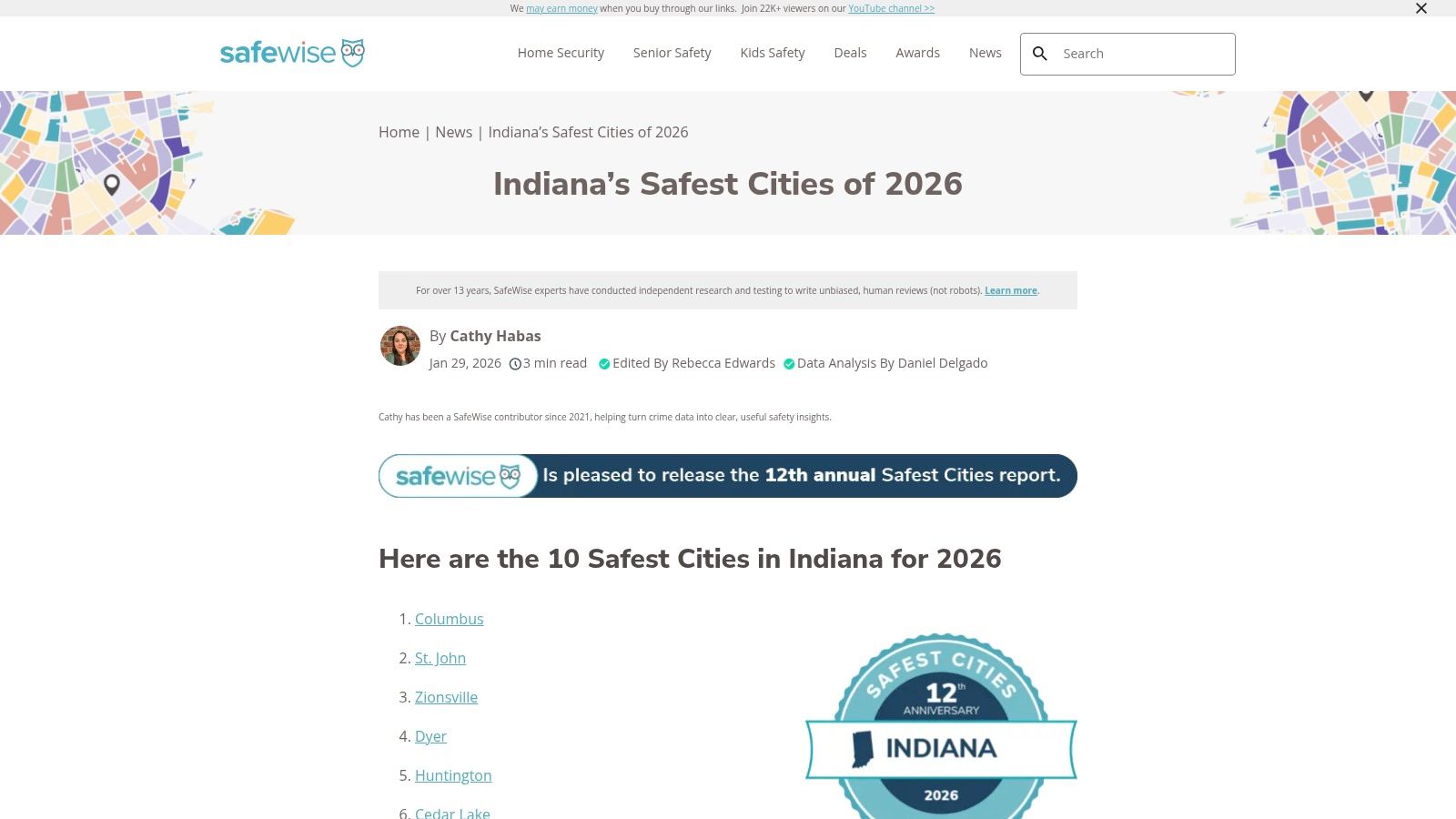
SafeWise is useful for a first screen because it separates crime categories and presents the results without requiring readers to reconstruct the calculation. That makes it practical for comparing St. John, Zionsville, Dyer, and Columbus under one consistent state-level framework. Its accessible format is a strength, especially when the goal is to identify candidates for closer review.
The limits are methodological and geographic. SafeWise relies on FBI-based reporting and applies eligibility criteria, so the result reflects both reported crime and which communities supplied usable data. Another FBI-based source may produce a different order because it handles coverage, time periods, population comparisons, or scoring differently. The list therefore supports comparison, not certainty.
Read SafeWise as a shortlist, not a final decision.
Use the report alongside ReloMaps when a move involves more than crime rankings. ReloMaps can place safety beside housing, commute, demographics, quality of life, and hazard context, helping test whether Columbus still fits after broader relocation trade-offs are considered. For a final choice, check current local reporting, neighborhood conditions, and the specific address rather than relying on the statewide headline alone. The report's presentation is also captured by SafeWise.
3. MoneyGeek
MoneyGeek is useful when you want to compare Indiana cities against a wider national frame instead of only looking at state rankings. Its value is methodological clarity, it uses a transparent crime cost model built from recent FBI city-level data, which helps you think about safety as both a risk and an economic burden (MoneyGeek safes cities resource).
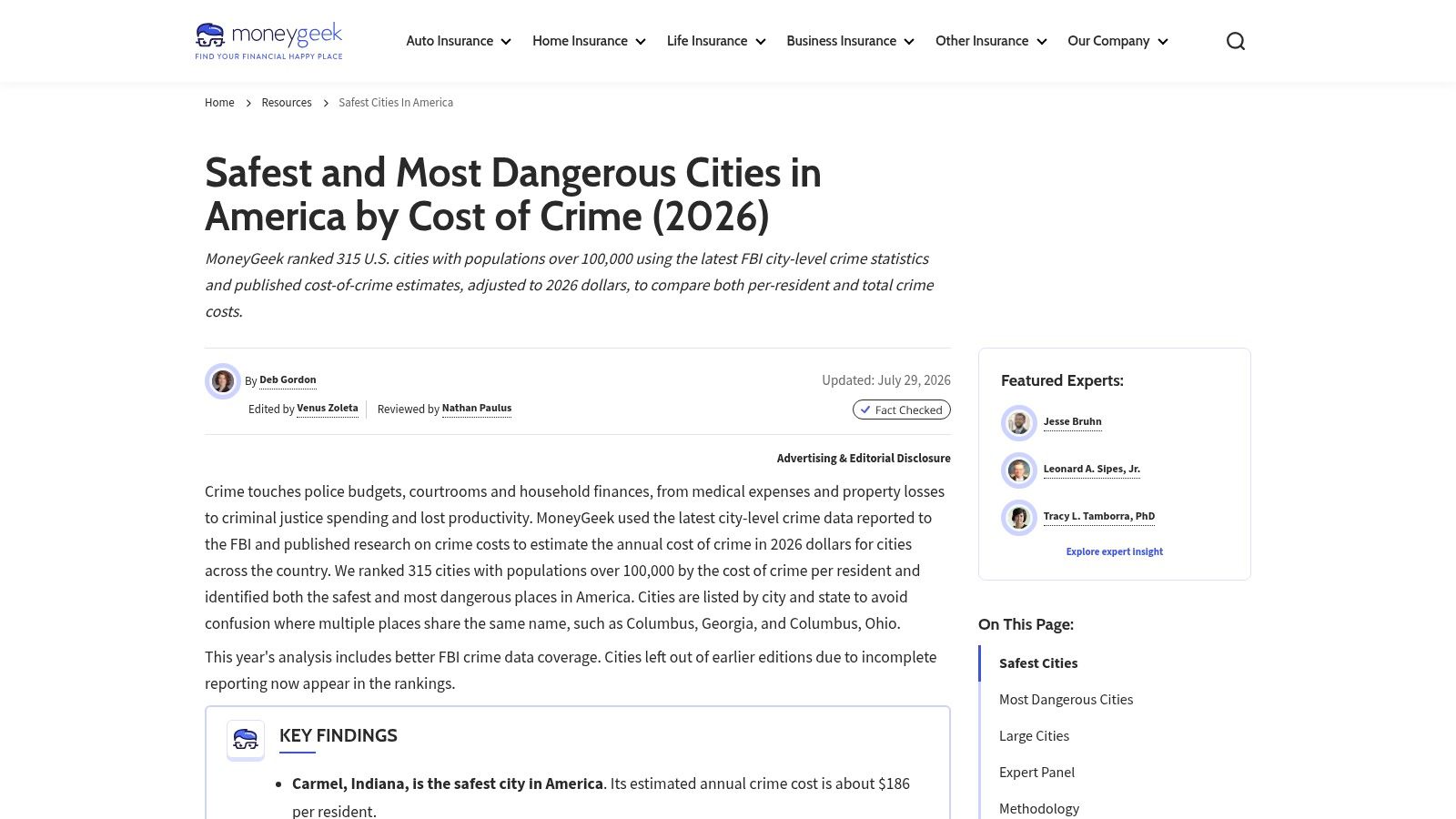
That matters for relocation because people rarely move for crime alone. They move for a job, a mortgage payment, a commute, and a certain kind of daily life, then realize the safety choice changes the budget in other ways. MoneyGeek's national scope helps you test whether an Indiana city is merely the safest in-state or competitive against places in other states with similar housing profiles.
The platform is strongest when you already have a few Indiana candidates in mind and want to see how they sit in a broader benchmark. It's weaker for state-only browsing, because the national structure means you have to do a little more filtering to stay focused on Indiana. Smaller places can also be missing when FBI reporting isn't complete, so it's best used with an eye toward coverage rather than as a final word.
For a practical shortlist, pair it with a housing-first platform like cheap and safe cities in Indiana on ReloMaps. That pairing helps you avoid a common mistake, choosing the city with the cleaner crime story and then discovering the housing trade-off erased the advantage.
4. NeighborhoodScout
NeighborhoodScout is the right tool when a citywide label isn't specific enough. Its Indiana pages break crime into violent and property categories, add trend views, and let you drill down into neighborhood-level differences, which is critical in larger metros and edge suburbs where one area can feel very different from another (NeighborhoodScout Indiana crime pages).
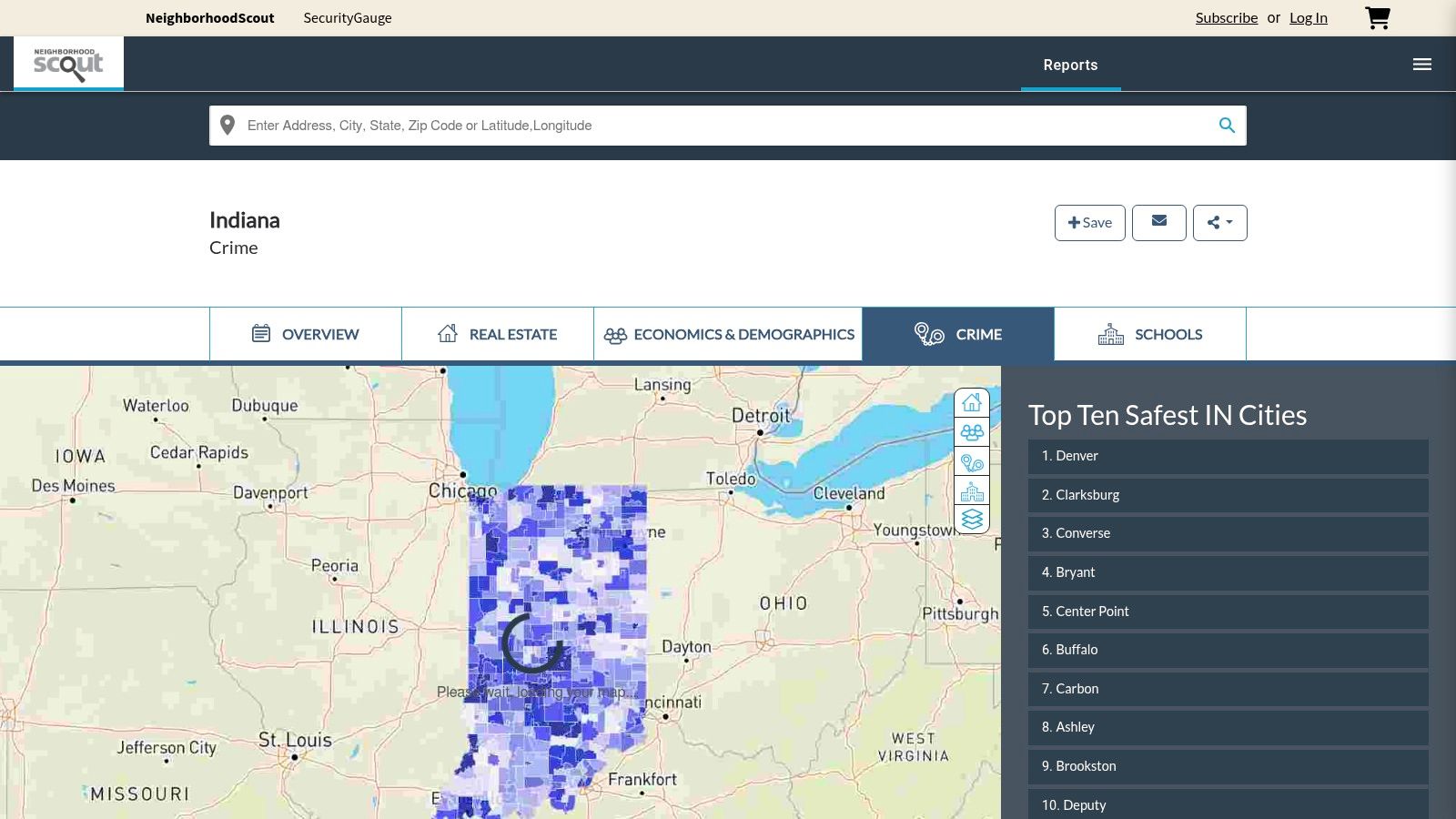
That neighborhood lens is the clear advantage. A city can rank well overall and still contain pockets that deserve a closer look, especially if you're comparing suburban corridors, commuting routes, or homes near higher-traffic commercial zones. NeighborhoodScout helps you ask the next question after the ranking, which is often the one that matters for the actual move.
It's also a useful reconciliation tool when different rankings disagree. If one source is pushing a city because of a stronger violent-crime picture and another is favoring it on property crime, NeighborhoodScout lets you inspect whether the pattern is broad or localized. The downside is that many of the best features sit behind a subscription, so casual readers may only get a partial view.
The best use case is side-by-side screening after a city already made your cut. If Columbus looks strongest overall but you're comparing it with nearby alternatives, NeighborhoodScout can help you determine whether the safer read holds at the neighborhood level or whether a specific area changes the picture.
5. FBI Crime Data Explorer
The FBI Crime Data Explorer provides the strongest common reference for comparing Indiana cities because it exposes the underlying federal crime data. Its value depends on reporting coverage, however. Cities and agencies may differ in whether their records are available and how consistently incidents are reported, which limits direct comparisons.
Use the Explorer to test what a ranking measures. A list may emphasize violent crime, property crime, incident totals, or rates adjusted for population. SafeWise says it uses recent FBI-reported violent and property crime data, but the comparison can still change when analysts select different agencies, years, or rate calculations. A favorable result therefore supports a conclusion only within that method.
Columbus remains a leading candidate when the broader comparisons are considered, but no single ranking settles the decision. If Columbus leads one list while Auburn, Dyer, or St. John performs better in a narrower category, the FBI data can show whether the gap reflects a broader pattern or a different comparison frame. It is less convenient than a consumer ranking, yet it offers the clearest way to audit the assumptions behind one.
The practical sequence is straightforward: verify the city's reporting picture, then compare relocation conditions. Use ReloMaps city-level Indiana context to assess housing, commute, demographics, quality of life, and hazard context alongside safety. A lower reported crime rate may not offset a poor commute, limited housing fit, or greater hazard exposure.
Use the FBI data before you build a move list, not after.
6. Niche
Niche is strongest when you don't want safety separated from the rest of the relocation picture. Its Indiana rankings combine safety with community context such as schools, housing, demographics, and user feedback, which is useful when you're choosing where to live, not just where crime appears lower (Niche safest places in Indiana).
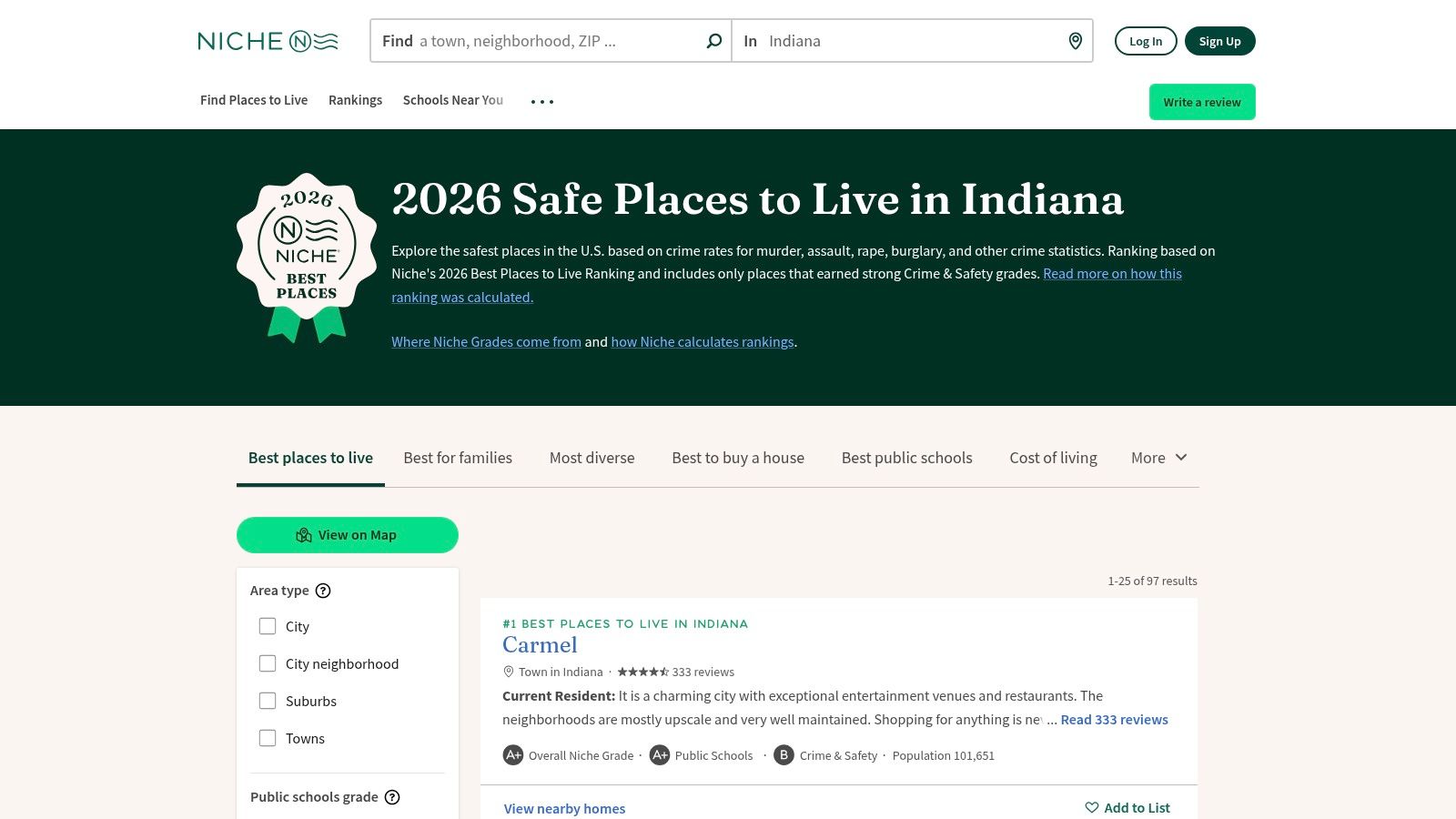
That combination is helpful, but it comes with a trade-off. Once survey sentiment and broad livability factors enter the picture, the result can become less reproducible from raw FBI rates alone. For readers who want a hard crime-only answer, that's a limitation. For families and first-time movers, it can be the better starting point because it aligns safety with school and housing considerations in one place.
Niche also helps you sense whether a city's appeal is broad or niche. A place that scores well on safety but poorly on the rest of the relocation mix may not be the best overall fit, especially if your household priorities lean toward school options, yard size, or a more specific demographic profile. That's why it works well after SafeWise, not before it.
Use Niche as a reality check against overfitting to crime alone. If a city like Columbus wins the safety race but another Indiana suburb better fits your school and housing needs, the smarter choice is often the one that reduces total relocation friction, not just incident rates.
7. CrimeGrade.org
CrimeGrade.org is the fastest way to visualize safety patterns on a map instead of reading them as a list. Its Indiana pages separate violent, property, and other categories, then present city and neighborhood grades that make it easier to spot pockets of risk near borders and commuter corridors (CrimeGrade Indiana safety map).
The strength of this format is spatial intuition. If you're deciding between neighboring suburbs or checking whether a city boundary hides a less-safe edge, a map-based tool can be more revealing than a leaderboard. It's especially handy for buyers who already know the metro they want and now need to figure out which side of town belongs on the shortlist.
The downside is that grades can abstract away details that matter in a move. A model-driven letter grade is easier to read than raw data, but it can differ from FBI-based rankings because it applies its own methodology and may work with sparse data in smaller places. That means it should complement, not replace, a source like SafeWise or the FBI portal.
For practical screening, use it after you've narrowed the field. If Columbus is still the leading candidate, a map view can help you inspect whether the surrounding area supports that choice or whether a different pocket better matches your commute and housing search.
Safest City in Indiana: 7-Source Comparison
| Item | Implementation complexity | Resource requirements | Expected outcomes | Ideal use cases | Key advantages |
|---|---|---|---|---|---|
| ReloMaps | Low, web UI, no technical setup | Web access; some premium reports may require subscription | Detailed, graded place intelligence with hazard & civic context | Relocation shortlisting, risk-aware home search, lifestyle-driven moves | Transparent ReloScore, civic/legal indicators, hazard metrics, Zillow/Redfin link parsing |
| SafeWise | Very low, readymade lists and profiles | None; free web content | Quick media-grade safest-cities snapshot | Quick references, journalism, consumer summaries | Readable lists, high-level methodology, easy to cite |
| MoneyGeek | Low, report browsing and filters | Web access; free content | Economic framing of crime; national benchmarking | Cross-state comparisons, cost-of-crime analysis | Transparent crime-cost model, regularly updated with FBI data |
| NeighborhoodScout | Moderate, interactive tools with learning curve | Subscription for advanced metrics and maps | Deep city/neighborhood analytics and trend comparisons | Detailed local analysis and neighborhood drilldowns | Neighborhood-level granularity, structured analytic outputs |
| FBI Crime Data Explorer (CDE) | High, technical interface and raw datasets | Data literacy and processing time; free access | Authoritative primary-source crime data for verification | Methodology validation, original analyses, fact-checking | Official federal data, documentation on coverage and estimation |
| Niche | Very low, consumer-facing profiles and grades | Mostly free; user reviews accessible online | Safety grades combined with schools, housing, demographics | Relocation research linking safety to livability and schools | Integrates crime data with school ratings and user reviews |
| CrimeGrade.org | Low, interactive map and graded pages | Web access; free, ad-supported | Fast spatial visualization of safety by category | Quick neighborhood checks, spotting local pockets of risk | Clear maps, plain-language grades, category-specific views |
Turn a Safety Ranking Into a Move-Ready Shortlist
Columbus is the named safest city in Indiana in the most current SafeWise ranking, but your personal safest fit can still be different once you account for commute, housing, and neighborhood variation. A ranking tells you which place looks strongest under one methodology, not which one solves your full relocation problem.
Use a verification sequence instead of stopping at the headline. First, check whether the city was included under complete FBI reporting, because coverage gaps can change who enters the comparison. Next, compare violent crime and property crime separately, since a city can rank well on one and less well on the other.
Then drill down to the neighborhood level if you're buying or renting in a larger metro. A safe city can still have busy corridors, different school zones, and pockets that feel nothing alike after dark. After that, test the move against real-world constraints, especially commute time, monthly housing cost, and how often you'll be in the area you're researching.
Hazard and quality-of-life context belong in the same decision. Flood risk, wildfire exposure, airport proximity, tax burden, and home-rule preferences can all matter more than a slightly better crime rank once the move becomes real. ReloMaps is built for that second pass, where you stop asking only “Which city is safest?” and start asking “Which city is safest, affordable, and workable for my household?”
Frequently Asked Questions
Is Columbus really the safest city in Indiana right now?
Yes, Columbus is the safest city in Indiana in the latest SafeWise ranking. SafeWise also says it was the only city on the 2026 list with fewer than 1 property crime per 1,000 residents, which makes it the cleanest all-around answer under that methodology.
Why do different safety rankings name different Indiana cities?
They differ because they weight crime categories and coverage differently. If one list emphasizes violent crime alone, another may favor a city with stronger property-crime numbers, so the right decision rule is to compare both categories before you shortlist a move.
How should I use a city ranking if I work remotely?
Use it as a starting filter, not a final answer. For remote workers, the more useful threshold is whether the city's safer profile still works with your housing budget, internet options, and the amount of time you'll spend in local traffic or neighborhood errands.
What should I check if a city looks safe but I'm worried about hidden relocation costs?
Check rent, home values, taxes, and commute shape before you commit. A city with a stronger crime profile can still become the more expensive choice once you add longer drives, larger homes, or higher local carrying costs.
How do I handle incomplete crime reporting?
Treat the result as partial until you verify coverage in the FBI Crime Data Explorer. If a city's reporting is incomplete, don't assume it's safer or riskier than the ranking suggests, use another comparable city with fuller reporting or a stricter neighborhood-level review.
What's a practical crime threshold for deciding between two Indiana suburbs?
Pick the city with the lower violent-crime rate only if property crime stays competitive too. If the violent numbers are close, let property crime, commute time, and housing fit decide, because those factors usually affect daily life more than a tiny difference in a headline ranking.
ReloMaps turns a safety headline into a real move shortlist by putting crime, housing, commute, demographics, and hazard context in one place. If you're weighing Columbus against other Indiana cities, visit ReloMaps and compare the trade-offs before you choose where to live.
Enjoying the blog? Subscribe to ReloMaps+ for premium area intelligence — and to keep us independent.
Subscribe today