7 Safest Cities in West Virginia to Consider

New Martinsville, Weirton, Ranson, Hurricane, Charles Town, Morgantown, and Vienna are the strongest West Virginia safety shortlist if you start with reported crime rates alone. New Martinsville leads one independent ranking at 139 total crimes per 100,000 residents, while Weirton stands out across multiple sources with 137.7 violent crimes per 100,000 residents and 330.6 property crimes per 100,000.
That answer is more complicated than most “safest cities in West Virginia” roundups admit. Different rankings disagree because they use different city pools, reporting rules, and weighting between violent crime, property crime, resident sentiment, and composite grades.
This list ranks seven cities by blending reported crime evidence with how a relocation tool like ReloMaps helps you pressure-test the result against population context, daily practicality, disaster exposure, and household fit. The goal isn't to crown one universally safest place. It's to identify which cities still look strong after you stop treating one crime leaderboard as the whole story.
The safest-looking city is not automatically the safest choice for every household.
One concise way to read the market is this: New Martinsville and Weirton look strongest on reported crime, Ranson and Hurricane hold up well as practical midsize options, Charles Town and Morgantown require more context around lifestyle fit, and Vienna earns a place because official violent-crime reporting keeps it in the statewide conversation even when some popular top-10 lists reshuffle.
If you're comparing cities for a move, read the ranking alongside violent and property crime rates, ReloScore safety grades, population size, cost signals, hazard exposure, and whether the place fits a family routine or retirement plan.
Comparison infographic: Compare the seven ranked cities by available crime metrics, ReloScore safety grades, population context, cost signals, disaster-risk notes, and best-fit audience before narrowing your shortlist. Use “N/A” where a source doesn't publish a metric rather than filling the gap with guesses.
Table of Contents
- 1. ReloMaps
- 2. SafeWise
- 3. Niche
- 4. FBI Crime Data Explorer CDE
- 5. West Virginia State Police Uniform Crime Reporting WVIBRS Publications
- 6. NeighborhoodScout
- 7. CrimeGrade.org
- Safest West Virginia Cities, 7-Source Comparison
- Turn the Ranking Into a Safer Move
- Frequently Asked Questions
- How should I interpret a small city's crime rate if only a few incidents can change the ranking?
- What does it mean when two safest-city lists disagree on West Virginia?
- How can I test a neighborhood instead of relying on a city average?
- Can a city rank well on crime and still be a risky relocation choice?
- How should hybrid workers compare otherwise safe West Virginia cities?
- Is West Virginia becoming safer overall, or are city rankings just snapshots?
1. ReloMaps
ReloMaps is the strongest starting point if you want a safety ranking that holds up after real-world tradeoffs are added back in. Instead of stopping at a crime list, it lets you compare cities through a composite ReloScore and separate category grades, then test whether a place still works once cost, disaster exposure, commute patterns, and household priorities enter the picture.
That framing matters in West Virginia because local conditions vary sharply by city, and raw crime comparisons do not always answer the relocation question on their own. A statewide comparison from Crime by City's West Virginia page shows Weirton far below Beckley on total reported crime per 100,000 residents. Useful signal, but with limits. Aggregators can differ in update timing, offense grouping, and city-boundary handling, so the gap is best treated as directional evidence rather than a stand-alone verdict.
Why it adds more value than a simple safest-city list
ReloMaps works well for shortlist building because it keeps safety in view without pretending safety is the only input that matters. You can compare overall scores, isolate safety and cost patterns, review quality-of-life context, and check practical constraints such as home values, commuting, remote-work fit, and access to services.
For this article's seven-city comparison, that is the right sequence. Start with the West Virginia city comparison tools on ReloMaps, then pressure-test any high-ranking city against affordability, flood or storm exposure, and whether it fits a family routine, a single-worker household, or a retirement plan.
A city can post a favorable crime profile and still be the wrong move if housing costs, isolation, or hazard risk undercut day-to-day stability.
- Visible score breakdowns: ReloScore uses an A+ to F format with separate grades for crime and safety, cost of living, affluence, quality of life, strategic location, and related factors.
- Household-fit filters: You can sort for family-friendly, affordable, off-grid, prepper, conservative, or progressive preferences instead of treating all movers as if they want the same place.
- Listing-level context: A Zillow or Redfin link can be used to pull neighborhood and city context around a specific property, which helps translate broad city grades into a more practical home search.
- Hazard and proximity context: Disaster and location indicators add a layer that crime rankings often miss, especially for buyers who need to screen for flood exposure or isolation.
- Policy and tax context: Property rights, tax burden, homeschool freedom, marijuana status, gambling status, and firearm freedom appear in one research workflow.
Best use case and tradeoffs
ReloMaps is most useful before tours and agent calls, when your goal is to cut a long list down to a workable shortlist. It is especially helpful in a state like West Virginia, where smaller populations can make rankings swing and where the safest reported city may not offer the right mix of access, affordability, and resilience for every household.
Its limits are straightforward. It does not replace official crime reporting, insurance-level hazard review, or transaction support. Use it to narrow the field, then verify finalists with primary crime sources and neighborhood-level due diligence before making an offer.
Practical rule: Use ReloMaps to reduce seven candidates to two or three, then confirm those finalists with official crime data, hazard checks, and street-level research.
2. SafeWise
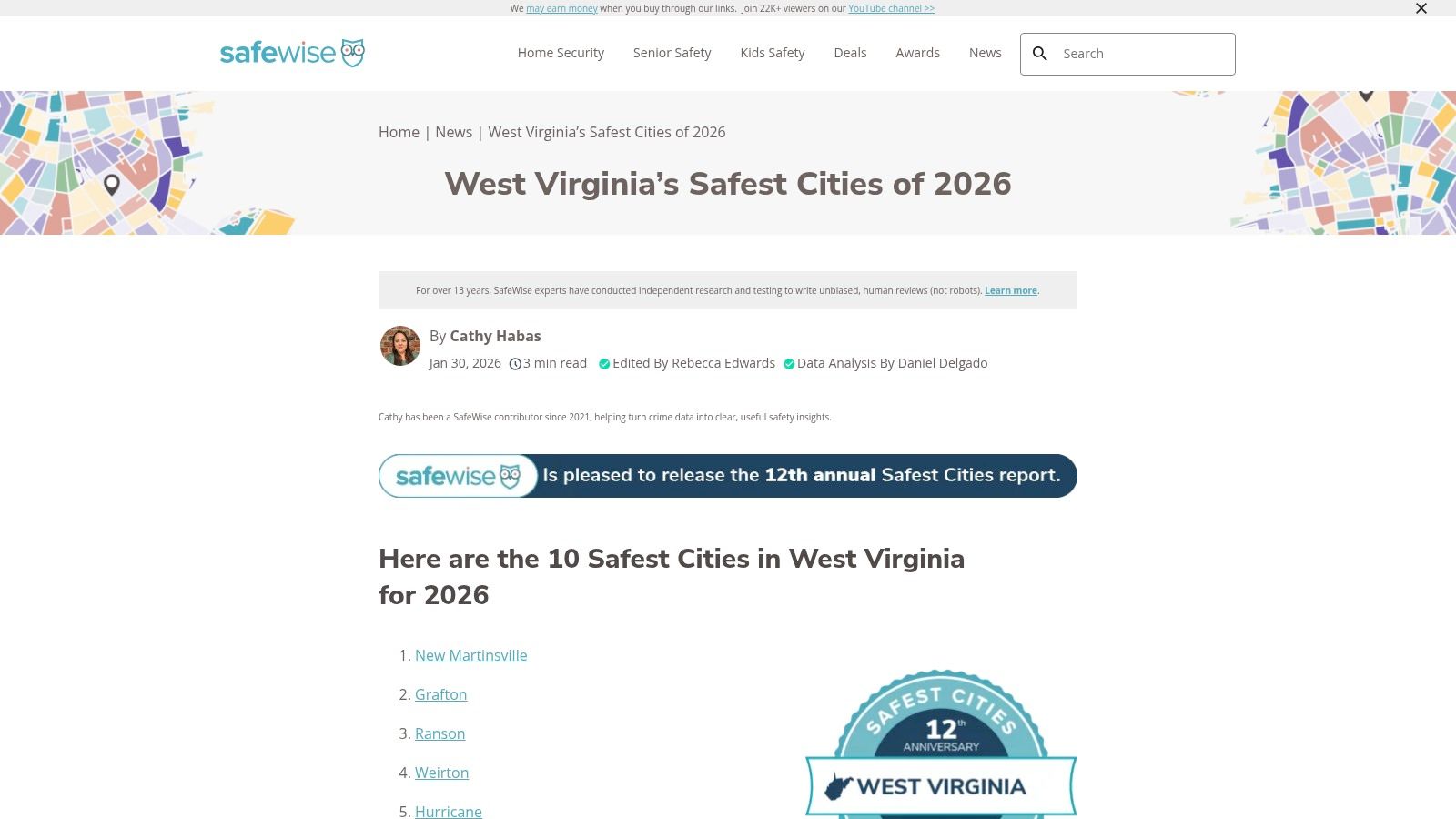
SafeWise's West Virginia safest cities list is the most approachable statewide shortlist for non-analysts. It gives readers a fast top-10 ranking, city snapshots, and a clear reminder that “safest” in its framework refers to crime rates derived from FBI-reported data rather than a full quality-of-life judgment.
For direct shortlist building, SafeWise is useful because it highlights a ranking pattern that many other pages blur. One methodology note worth carrying into your move research is that rankings can swing depending on source and definition. In one 2026 ranking, New Martinsville appears first while another source puts Weirton first, and the broader top 10 reshuffles across publishers such as SafeWise, AreaVibes, HomeSnacks, and OpenCrime (SafeWise methodology context for West Virginia).
Where SafeWise helps most
SafeWise is best when you need a plain-English entry point before moving into deeper validation. It gives families and first-time movers a clean first pass at which cities deserve more research.
It's also a useful contrast tool for larger places that don't always dominate “safest cities in West Virginia” headlines. If you want a bigger-city benchmark while reviewing the list, compare your shortlist with Charleston, West Virginia on ReloMaps to see how safety interacts with scale, amenities, and practical living tradeoffs.
- Easy annual cadence: You can quickly see whether a city is repeatedly near the top or only appears once.
- Per-city crime framing: Violent and property rates are separated, which is more useful than a single overall rank.
- State trend context: It helps you distinguish a safe city from a state that may be moving in a better or worse direction overall.
Limits to keep in mind
SafeWise doesn't solve neighborhood selection. It's also a curated top-10 list, which means places outside that cutoff can be overlooked even if they fit your household better.
That's why I treat SafeWise as a ranking input, not a final answer. It helps identify candidates. It doesn't close the case.
3. Niche
Niche's West Virginia safety rankings are useful for one reason that pure crime tables can't match. They combine reported crime context with resident reviews and broader livability signals.
That makes Niche especially relevant if you're trying to understand why a place with respectable crime numbers may still feel inconvenient, isolating, or mismatched for your household. The supplied background identifies Shepherdstown as near the top of Niche's 2026 list, which is a good reminder that resident sentiment often surfaces smaller places that don't dominate the most-cited crime-only rankings.
What Niche adds that crime rankings miss
Niche is helpful when you want to separate three different concepts that get conflated online:
- Reported crime: What law enforcement data says happened.
- Resident sentiment: How people say the place feels and functions.
- Composite desirability: A platform's blended judgment that may include schools, cost, and general livability.
That distinction matters because a city can perform well on crime while generating mixed reviews on convenience or fit, and the reverse can also happen. Niche's structure makes that tension more visible than a simple “top 10 safest” article does.
Safety rankings based partly on resident reviews answer a different question than official crime reporting. They're often better at surfacing lived friction, but worse at clean apples-to-apples crime comparison.
Best fit for movers
Use Niche after you have a shortlist, not before. It's strongest when you already know which places passed a crime screen and now want to understand social feel, schools, and whether residents describe the place as practical for families or comfortable for retirees.
Its weakness is the same thing that makes it interesting. Once reviews and grade blends enter the picture, rankings become less pure as crime comparisons.
4. FBI Crime Data Explorer CDE
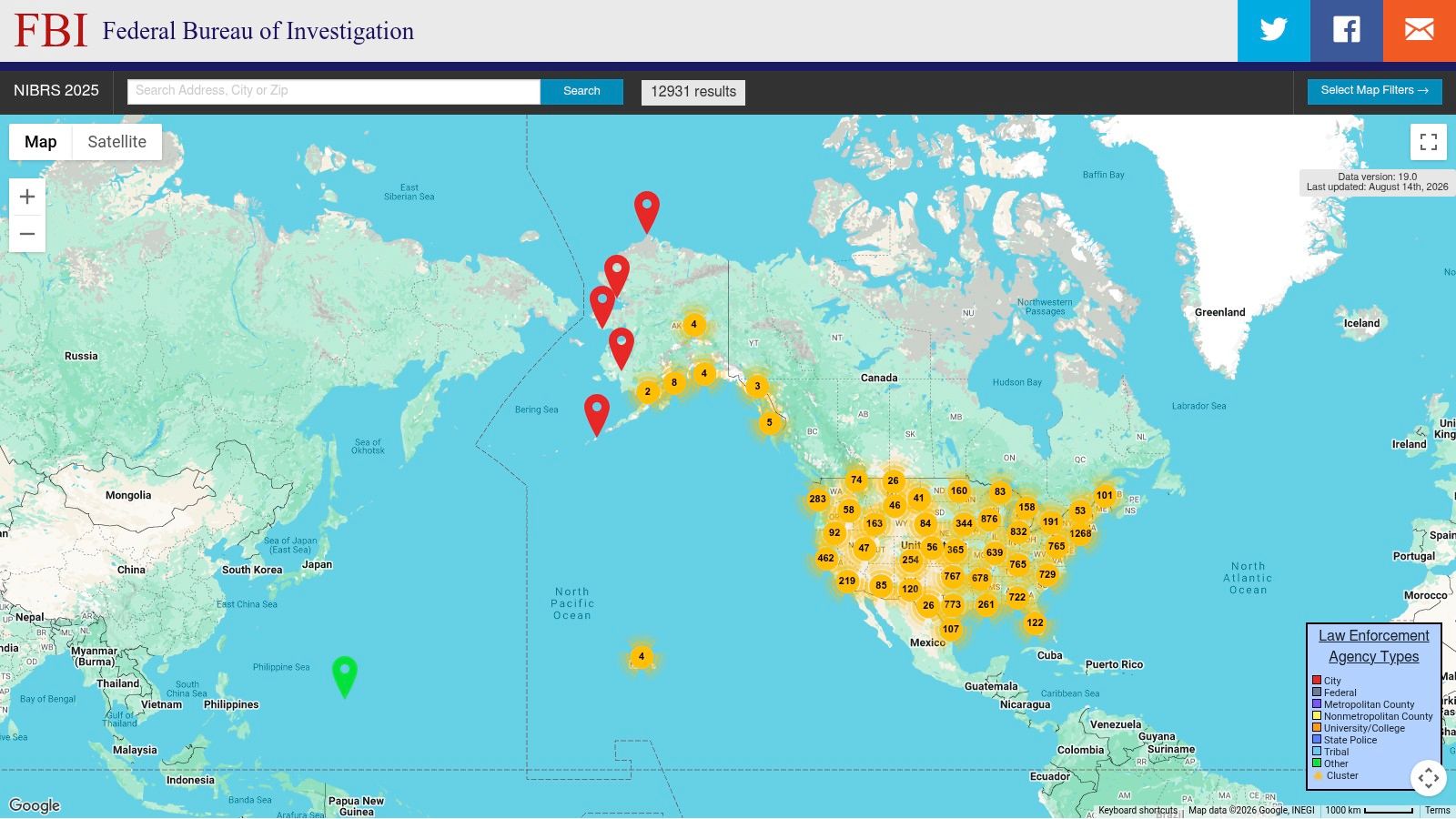
The FBI Crime Data Explorer is the cleanest way to check whether a "safest cities in West Virginia" claim rests on reported incidents rather than opinion, grade blends, or marketing copy. That matters in this article because the final seven are not being treated as a simple crime leaderboard. They are being compared across reported crime, ReloScore safety grades, population scale, affordability, disaster exposure, and day-to-day household fit.
One attribution point needs to stay clear. The specific violent-crime rates often cited in statewide comparisons, including Weirton at 137.7 per 100,000 residents, Vienna at 153.9, and Morgantown at 209.8, come from the OpenCrime West Virginia statewide comparison. Those figures are useful for screening, but they are not quoted directly from the FBI CDE interface. The FBI tool works better here as a verification layer for agency-reported crime patterns and category-level checks.
That distinction improves the analysis.
If a city ranks well on an outside comparison, CDE helps confirm what is being counted and whether the mix skews more toward violent offenses, property offenses, or both. That is especially helpful for places like Morgantown neighborhood and relocation context, where a larger student-driven population can change raw incident totals, household needs, and retirement practicality without automatically making the city a weak relocation option.
What CDE adds to a seven-source ranking
CDE is strongest when you need to test a ranking, not just read one.
- Primary-source checking: Useful for confirming that a city's safety reputation is tied to reported crime data rather than resident sentiment or a composite grade.
- Offense-level review: Helpful if your move depends on the difference between violent crime exposure and property crime exposure.
- Agency comparison: Better for comparing reporting patterns across departments, which matters when datasets do not line up perfectly.
- Scale awareness: More informative for larger places, where a low rank on one list may reflect population and activity levels as much as household-level risk.
Limits that matter for relocation decisions
CDE does not answer whether a city feels convenient, affordable, or age-friendly. It will not tell you if a low-crime place is too small for healthcare access, whether flood exposure changes insurance costs, or whether a family needs stronger school options than a quiet town can offer.
Used correctly, CDE keeps the crime side of the ranking honest. It does not replace the broader relocation test.
5. West Virginia State Police Uniform Crime Reporting WVIBRS Publications

A seven-city safety ranking gets stronger once you test it against the state's own reporting notes.
The West Virginia State Police WVIBRS publications do not function like a consumer ranking site. They are more useful for checking how the ranking was built in practice. If one city posts a surprisingly strong or weak result, these publications can help explain whether the shift reflects actual offense patterns, reporting completeness, or a change in how incidents were categorized.
That distinction matters for relocation decisions because a low reported-crime figure is only one part of the answer. A retiree may care more about whether a small town's calm profile comes with limited healthcare access. A family may accept somewhat higher incident volume in exchange for more housing choice or services. Someone comparing two affordable cities also needs to factor in flood or storm exposure, since disaster risk can change insurance costs and day-to-day practicality even when crime looks favorable.
State publications are useful for that stress test. They add historical and administrative context that helps separate a stable safety pattern from a one-year ranking swing.
How to use WVIBRS without overreading it
Start with the seven-source shortlist, then use WVIBRS to verify whether each city's crime position looks consistent over time. If a place ranks well on composite safety grades but has uneven reporting participation, that should lower your confidence. If reported crime is favorable across multiple years, the case for that city is stronger, even then, it still needs to clear the affordability and household-fit test.
WVIBRS is also one of the better sources for seeing statewide movement in context. That helps when two cities look close on safety and the tie-breakers become population scale, cost, commute patterns, or whether the town works better for families than for retirees.
The main limitation is practical. WVIBRS can tell you more about reported crime structure than about lived convenience. It will not answer whether a low-crime town is too small for your needs, whether resident sentiment is weaker than official numbers suggest, or whether a city with a decent safety grade still has neighborhood-level tradeoffs that matter once you start comparing actual addresses.
6. NeighborhoodScout
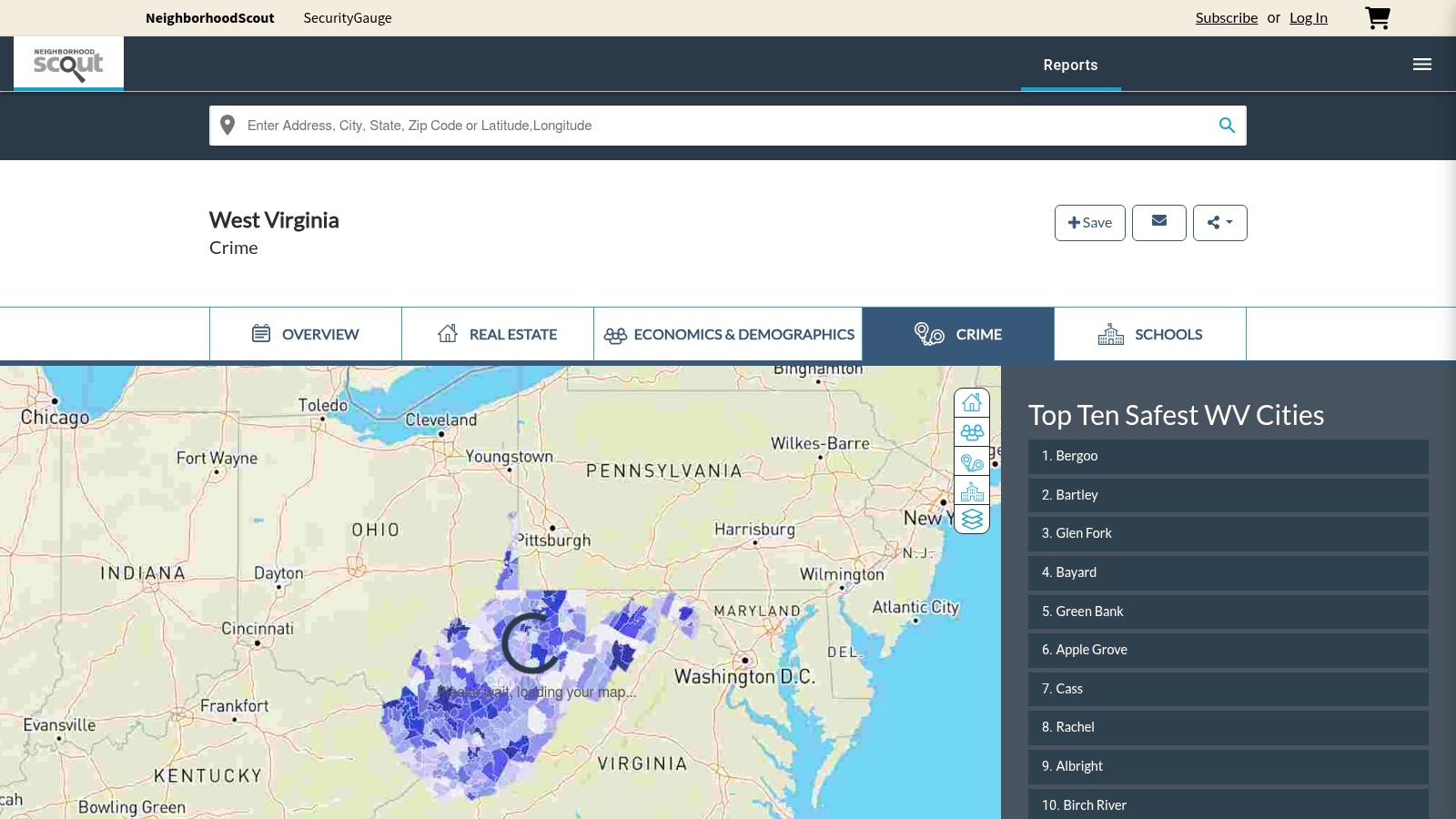
A city can rank well on a seven-source safety comparison and still be a poor fit at the block level. NeighborhoodScout's West Virginia crime pages are useful at that later stage, once the question shifts from statewide ranking to street-level screening.
That distinction matters for this article's method. Reported crime data, resident sentiment, and ReloScore safety grades help narrow West Virginia to seven plausible options. NeighborhoodScout helps test whether a city that looks good in the aggregate still holds up when you compare actual neighborhoods, commute routes, school surroundings, and housing pockets.
Morgantown shows why this matters. A city can stay on the shortlist because of jobs, university access, healthcare, or retirement practicality, while still requiring tighter neighborhood selection than a smaller and more uniform town. In other words, a favorable citywide position does not remove local tradeoffs. It only earns the city a closer look.
Use it late in the process, not first
NeighborhoodScout works best after you have already screened for broader fit. If a place is too expensive, too small, too flood-prone, or poorly matched to your household needs, neighborhood mapping will not fix the core problem. But if two cities look close after the seven-source comparison, this tool can help separate a practical move from a merely good headline rank.
Its value is clearest in three cases:
- You are deciding between neighborhoods inside one city.
- You are comparing addresses in a city with mixed housing stock and uneven development patterns.
- You are trying to judge whether a stronger safety grade also lines up with day-to-day livability for your household.
That last point is easy to miss. Families may care more about consistency near schools and parks. Retirees may care more about quieter residential pockets near healthcare and routine services. A younger renter may accept more variation in exchange for walkability or access to work.
NeighborhoodScout does have limits. It is a commercial product, and its presentation can differ from raw federal or state reporting frameworks because it is built for localized risk interpretation rather than for matching every public table exactly. The practical takeaway is simple. Use it to refine a shortlist, not to replace the reported-crime evidence or the composite grading systems that produced the shortlist in the first place.
7. CrimeGrade.org
CrimeGrade.org's West Virginia violent crime map adds a layer the city rankings cannot. It shows whether a place that looks safe at the city level also appears consistent across nearby ZIP codes and blocks.
That matters because this article is not trying to treat one rank as a complete relocation answer. As noted above, some West Virginia cities score well across reported-crime sources and composite safety systems, but a household still has to ask a different question. Is the safer city also the right size, price, and risk profile for daily life?
CrimeGrade.org helps with that second question. Its A through F grading is best read as a screening tool for micro-location risk, not as a replacement for FBI, state police, or citywide comparisons. If you are evaluating Weirton or New Martinsville, for example, the useful move is not to restate the city rank. It is to zoom in and check whether the address areas you can afford cluster in stronger grades or in more mixed pockets.
A practical way to use the map:
- Start with a city already supported by reported-crime evidence and a decent composite safety grade.
- Check the ZIP-level or neighborhood pattern around likely home searches, schools, shopping, and medical care.
- Compare the safer-looking pockets against flood exposure, commute friction, and housing cost, since the lowest-crime area is not always the most practical one.
- Treat sharp grade changes inside a small area as a cue to verify with local reporting and on-the-ground visits.
The tradeoff is clear. CrimeGrade.org is fast and visually useful, but its grades compress several conditions into a simple label. That makes it good for narrowing options, especially for families and retirees who care about consistency around routine destinations. It is less reliable as a stand-alone answer if you are comparing cities with very different populations, housing markets, or disaster exposure.
Safest West Virginia Cities, 7-Source Comparison
| Source | Implementation complexity | Resource requirements | Expected outcomes | Ideal use cases | Key advantages |
|---|---|---|---|---|---|
| ReloMaps | Low (web app, no setup) | Subscription/quote for full reports, web access | Comparable ReloScore and transparent sub-scores for places | Strategic, lifestyle-driven shortlisting before listing search | Holistic scoring, civic/legal & disaster indicators, Zillow/Redfin deep-link parsing |
| SafeWise | Very low (static report) | Free web report; minimal time | State top‑10 safety list with per‑city crime rates and trend summary | Quick family-friendly shortlist and year‑to‑year tracking | Timely, concise annual ranking easy for non‑analysts |
| Niche | Low (interactive web; optional sign‑in) | Free with optional account; user reviews | Safety grades plus resident feedback and place profiles | Balancing statistical measures with lived experience; finding small towns | Combines official data with qualitative reviews; broad coverage |
| FBI Crime Data Explorer (CDE) | Moderate–high (data queries, analysis) | Free raw data; analysis tools/skills needed | Authoritative offense-level counts, rates and time-series for verification | Validating claims, building custom municipal comparisons | Primary federal source with standardized definitions |
| WV State Police, WVIBRS | Moderate (PDFs, manual extraction) | Free reports; time to read/extract | Statewide reports, methodology notes, and reporting participation details | Understanding state reporting nuances and historical context | Official state context explaining data gaps and transitions |
| NeighborhoodScout | Low–moderate (web tools; subscription for full access) | Paid subscription for detailed reports; web access | Neighborhood- and address-level crime risk indices and maps | Drilling below city level to compare neighborhoods | Granular neighborhood insights with consistent methodology |
| CrimeGrade.org | Very low (consumer maps) | Free/ad-supported web access | A–F grades and quick visual maps plus cost-of-crime estimates | Fast visual scans to spot safer pockets or ZIP-level differences | Fast, visual readout with broad geographic coverage |
Turn the Ranking Into a Safer Move
A statewide shortlist isn't the same thing as a relocation decision. The seven cities here are best understood as candidates that remain credible after comparing multiple safety lenses, not as blanket endorsements.
My ranking order for practical relocation use is New Martinsville, Weirton, Ranson, Hurricane, Charles Town, Vienna, and Morgantown. New Martinsville and Weirton lead because multiple sources keep them near the top on reported crime. Ranson and Hurricane stay competitive because they repeatedly appear in upper-tier lists. Charles Town remains worth watching because it holds a strong position in one ranking set. Vienna makes the cut because official violent-crime comparison keeps it prominent even when consumer lists vary. Morgantown belongs as the largest city in this group that still appears in safety comparisons, but it needs more neighborhood-level scrutiny than the smaller leaders.
A good validation sequence is straightforward. Start with the city's ReloScore safety grade and overall tradeoff picture in ReloMaps. Then verify the reported crime pattern with FBI CDE and WVIBRS context, especially if two publishers rank the city very differently.
After that, drop to the neighborhood level with NeighborhoodScout or CrimeGrade.org. That's the stage where many relocation mistakes happen. Buyers and renters stop too early at the city rank and never test the actual area around the home, commute route, or daily errands.
Families should verify schools, housing fit, commute burden, and street-level conditions before they assume a safe city equals an easy routine. Retirees should pay closer attention to practical services, taxes, healthcare access, emergency logistics, and whether a smaller city's quieter profile also means fewer daily conveniences. Neither group should treat crime rank as a full proxy for livability.
The broader West Virginia picture also deserves context. Historical reporting shows that the state's safest cities change over time, with older low-crime lists including Grafton, Spencer, Barboursville, Mullens, and Ravenswood, while more recent tables highlight places such as Hurricane and New Martinsville with much lower violent-crime rates than statewide levels (OpenCrime safest cities in West Virginia). That turnover is a feature, not a flaw. It's a reminder to check current data, not inherited reputation.
Frequently Asked Questions
How should I interpret a small city's crime rate if only a few incidents can change the ranking?
Treat small-city rankings as directional, not absolute. A place like New Martinsville can look exceptionally strong in one ranking and still move noticeably with a small change in incidents because per-capita rates are sensitive to population size, which is why raw counts and rates should be reviewed together rather than in isolation.
What does it mean when two safest-city lists disagree on West Virginia?
It usually means they're answering different safety questions. One verified comparison notes that one 2026 ranking puts New Martinsville first while another puts Weirton first, which shows why you should separate violent crime, property crime, and per-capita rates from broader composite judgments instead of relying on a single label.
How can I test a neighborhood instead of relying on a city average?
Check the address against at least one neighborhood map and one official city-level source. The most reliable workflow is to shortlist the city through a crime ranking, verify the reporting pattern through FBI or state data, and then inspect the target neighborhood in a mapping tool before evaluating the home itself.
Can a city rank well on crime and still be a risky relocation choice?
Yes, because crime is only one layer of relocation risk. State reporting shows roadway safety trends and broader offense trends can move separately from city rankings, and disaster exposure can still affect insurance costs, emergency planning, and household stress even in a city with a favorable crime profile.
How should hybrid workers compare otherwise safe West Virginia cities?
Set a hard commute threshold before you compare city rankings. If two cities both look acceptable on crime, the better choice is often the one that keeps routine drives, airport access, and backup work options within your acceptable weekly burden rather than the one that edges out the other on a narrow safety metric.
Is West Virginia becoming safer overall, or are city rankings just snapshots?
Both can be true at once. One verified statewide summary reported West Virginia's violent crime rate at 248.8 per 100,000, or 31% below the national average, with Weirton ranked first among the state's safest cities, which suggests the statewide baseline can be favorable while city rankings still shift as local reporting and incident patterns change (Plain Crime safest cities in West Virginia).
Save two or three finalists, compare their city and neighborhood profiles side by side, and verify current local conditions before you sign a lease or make an offer.
ReloMaps gives you a faster way to compare West Virginia cities beyond a one-number safety rank. If you're deciding between places like New Martinsville, Weirton, Vienna, or Morgantown, it helps you weigh safety beside cost, hazards, commute realities, and household fit so you can narrow to better finalists before local due diligence begins.
Enjoying the blog? Subscribe to ReloMaps+ for premium area intelligence — and to keep us independent.
Subscribe today